
Imagine you’ve been taking your heart medication or birth control pills faithfully for years. You feel stable. Then, you decide to try a natural remedy for mild depression-St. John’s Wort, a popular herbal supplement known scientifically as Hypericum perforatum. Within weeks, your blood tests come back alarming. Your immunosuppressant levels have plummeted. Or worse, your contraception has failed, leading to an unintended pregnancy. This isn’t a hypothetical nightmare; it is the documented reality for thousands of patients who underestimate the power of this common herb.
St. John’s Wort is often marketed as a gentle, natural alternative to prescription antidepressants. But in the world of pharmacology, it behaves less like a mild tea and more like a potent enzyme inducer, similar to strong prescription drugs like rifampin. The core issue? It aggressively alters how your liver processes other medications, potentially rendering life-saving drugs ineffective or turning safe doses into toxic ones. Understanding these interactions is not just about avoiding side effects; it is about preventing therapeutic failure that can lead to organ rejection, viral rebound, or severe serotonin syndrome.
The Mechanism: How St. John’s Wort Hijacks Your Liver
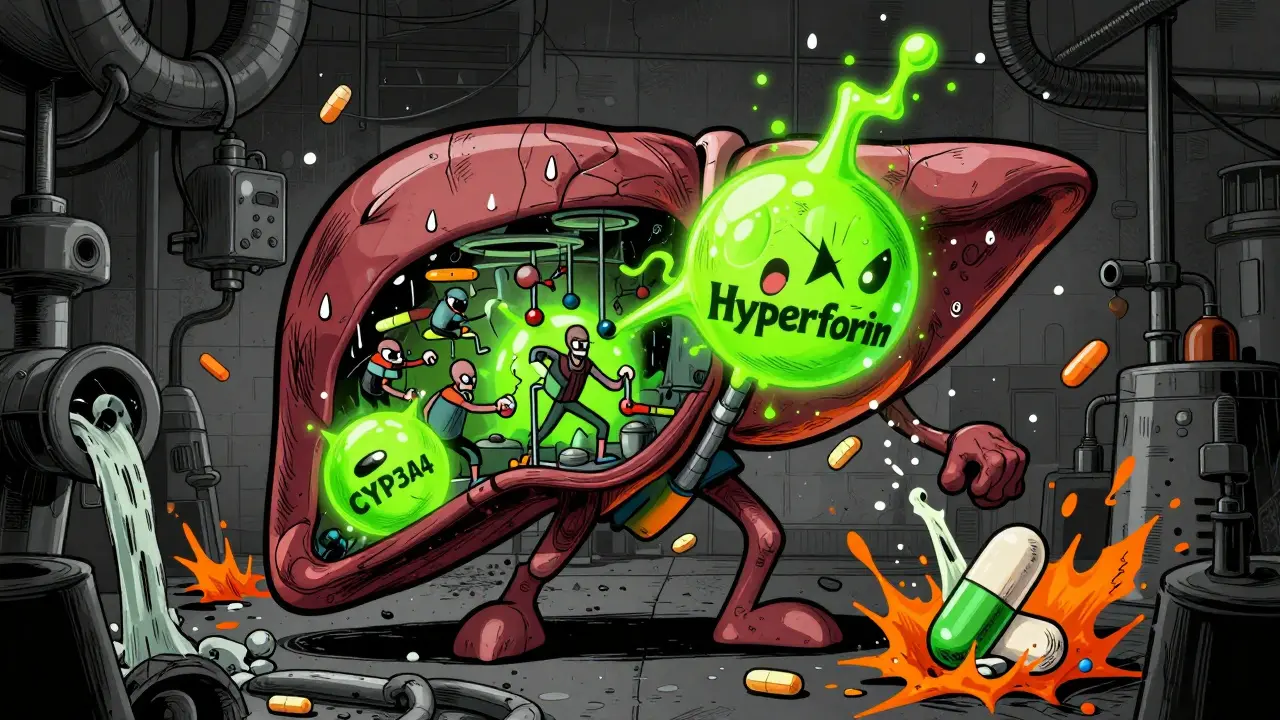
To understand why St. John’s Wort causes such chaos in your system, we need to look at what happens inside your liver. Specifically, we are talking about the cytochrome P450 enzyme system. Think of these enzymes as the body’s recycling plants. They break down drugs so they can be eliminated from your body. One specific enzyme, CYP3A4, handles a massive portion of all prescribed medications, including statins, calcium channel blockers, and many HIV treatments.
St. John’s Wort contains several active compounds, but the main culprit behind drug interactions is hyperforin. When you ingest St. John’s Wort, hyperforin activates a switch in your liver cells called the pregnane-X-receptor (PXR). Once this switch is flipped, your liver goes into overdrive, producing significantly more CYP3A4 enzymes and a transport protein called P-glycoprotein.
The result? Your body starts metabolizing other drugs much faster than intended. Instead of staying in your bloodstream at therapeutic levels, medications are broken down and flushed out before they can do their job. This process, known as enzyme induction, doesn’t happen overnight. It typically takes about 10 days to reach maximum effect, which explains why patients often don’t notice the problem until their condition suddenly worsens. Even after you stop taking St. John’s Wort, the induced enzymes can remain active for up to two weeks, prolonging the risk.
| Compound | Primary Function | Interaction Risk |
|---|---|---|
| Hyperforin | Activates PXR receptor | High (Primary driver of CYP3A4 induction) |
| Hypericin | Antioxidant/Antiviral properties | Low (Standardization marker, not primary interaction cause) |
| Flavonoids | General anti-inflammatory | Moderate (Minor contribution to metabolic changes) |
High-Risk Medication Classes: What You Must Avoid
Not all medications are affected equally, but the list of incompatible drugs is extensive. If you are taking any of the following, combining them with St. John’s Wort is dangerous. Always consult your pharmacist, but here are the major categories where interactions are well-documented and severe.
Immunosuppressants
For transplant patients, this is the most critical warning. Drugs like cyclosporine and tacrolimus keep your body from rejecting a new organ. These drugs have a narrow therapeutic index, meaning the difference between a helpful dose and a useless one is tiny. St. John’s Wort can slash blood levels of these drugs by 50% or more. There are documented cases of heart and kidney transplant recipients suffering acute organ rejection solely because they added St. John’s Wort to their regimen without telling their doctor.
Oral Contraceptives
This is perhaps the most common real-world disaster. Birth control pills rely on precise hormone levels to prevent ovulation. St. John’s Wort accelerates the breakdown of estrogen and progestin. Multiple case reports detail women experiencing breakthrough bleeding and unintended pregnancies while consistently using oral contraceptives alongside the herb. The European Medicines Agency explicitly warns against this combination because the contraceptive efficacy is compromised.
Anticoagulants (Blood Thinners)
If you take warfarin to prevent blood clots, St. John’s Wort can reduce its effectiveness dramatically. A study published in the *Annals of Internal Medicine* documented a patient whose INR (a measure of blood clotting time) dropped from a therapeutic 2.5 to a dangerously low 1.4 within just 10 days of starting the herb. This puts patients at significant risk for strokes or deep vein thrombosis.
HIV Protease Inhibitors
People living with HIV rely on protease inhibitors to suppress the virus. St. John’s Wort induces the enzymes that break these drugs down, leading to sub-therapeutic levels. This can allow the virus to replicate and potentially develop resistance to the medication, making future treatment much harder.
Other Antidepressants
Combining St. John’s Wort with prescription antidepressants like SSRIs (e.g., fluoxetine, sertraline) or SNRIs can lead to serotonin syndrome. This is a potentially life-threatening condition caused by excessive serotonin activity. Symptoms include agitation, confusion, rapid heart rate, high blood pressure, and dilated pupils. Unlike the reduced efficacy seen with other drugs, here the risk is toxicity.
Real-World Evidence: Case Studies and Statistics
Data from clinical settings paints a clear picture of the risks. According to a 2020 review in PubMed Central (PMC7056460), the first clinically relevant reports of these interactions emerged around 2000. Since then, the pattern has remained consistent. In the United States, the FDA issued a Public Health Advisory in February 2000 specifically warning about these interactions, yet usage continues due to the supplement’s over-the-counter availability.
User feedback platforms reflect this duality. On Drugs.com, St. John’s Wort holds a mixed rating. While many users praise its effectiveness for mild depression without the sexual side effects of some prescriptions, a significant portion of negative reviews cite adverse interactions. Common complaints include "caused my birth control to fail" and "my anxiety medication stopped working." Reddit threads in communities like r/Supplements show that while 68% of users report positive mood improvements, 32% mention adverse events when combined with other meds.
A particularly stark example comes from a 2019 Poison Control report. A 34-year-old woman experienced acute organ rejection eight weeks after a kidney transplant. She had been taking standard doses of tacrolimus, which previously maintained therapeutic levels between 5-15 ng/mL. After adding St. John’s Wort, her tacrolimus levels dropped precipitously, leading to rejection. This case highlights the delay in recognition; it took nearly two months for the interaction to manifest as a medical emergency.
Regulatory Landscape: Why Warnings Vary
You might wonder why this information isn’t always front and center. The answer lies in regulatory differences. In the United States, St. John’s Wort is classified as a dietary supplement, not a drug. This means it does not undergo pre-market approval by the FDA for safety or efficacy. Manufacturers are required to list potential interactions on labels, but enforcement varies, and many consumers overlook fine print.
In contrast, the European Union treats St. John’s Wort more strictly. The European Medicines Agency (EMA) requires specific warnings on product packaging regarding interactions with oral contraceptives, immunosuppressants, and anticoagulants. In countries like Germany, where St. John’s Wort accounts for approximately 20% of antidepressant treatments, healthcare providers are trained to screen for these interactions routinely. This stricter approach has led to better awareness among European patients compared to their American counterparts.
Safer Alternatives and Management Strategies
If you are struggling with mild to moderate depression but cannot take St. John’s Wort due to other medications, you are not out of options. Several alternatives exist with lower interaction profiles:
- SAM-e (S-adenosylmethionine): This compound has shown efficacy in depression studies with minimal documented drug interactions, primarily cautioning against use with MAO inhibitors. It is generally safer for those on multiple medications.
- 5-HTP (5-hydroxytryptophan): A precursor to serotonin, 5-HTP can help with mood and sleep. However, it still carries a risk of serotonin syndrome if combined with prescription antidepressants, so it requires careful monitoring.
- Cognitive Behavioral Therapy (CBT): Non-pharmacological interventions like CBT have no physical drug interactions and are highly effective for mild depression.
- Hyperforin-Free Extracts: Emerging research suggests that St. John’s Wort extracts stripped of hyperforin may retain antidepressant effects while reducing CYP3A4 induction by up to 90%. However, these formulations are not yet widely available or standardized in most markets.
If you must use St. John’s Wort despite being on other medications, strict management is essential. Work with your pharmacist to identify potential conflicts. If approved, monitor blood levels of affected drugs every two weeks during the first month of concurrent use. Be vigilant for signs of therapeutic failure, such as return of depressive symptoms, breakthrough bleeding, or increased anxiety.
Frequently Asked Questions
How long does it take for St. John’s Wort to interact with other medications?
It typically takes about 10 days for St. John’s Wort to fully induce liver enzymes and maximize its interaction potential. However, subtle changes can begin within a few days. The effects can persist for up to two weeks after you stop taking the supplement.
Can I take St. John’s Wort with birth control pills?
No, it is strongly advised against. St. John’s Wort accelerates the metabolism of hormones in oral contraceptives, significantly increasing the risk of contraceptive failure and unintended pregnancy. Use a non-hormonal backup method if you must take both, though avoidance is best.
What are the signs that St. John’s Wort is interfering with my medication?
Signs vary by medication but generally include a return of the original condition the drug was treating (e.g., worsening depression, breakthrough bleeding, increased pain, or viral load increase in HIV patients). For blood thinners, you might see unusual bruising or clotting issues. Always monitor for sudden changes in health status.
Is there a safe form of St. John’s Wort for people on medication?
Research is ongoing into hyperforin-free extracts, which may reduce interaction risks by up to 90%. However, these are not yet widely available or standardized. Until then, conventional St. John’s Wort should be avoided by anyone taking prescription medications processed by CYP3A4.
Does St. John’s Wort interact with over-the-counter drugs?
Yes, it can interact with OTC medications like certain antihistamines, pain relievers, and sleep aids that are metabolized by the liver. Always check the label or consult a pharmacist, even for non-prescription products.