
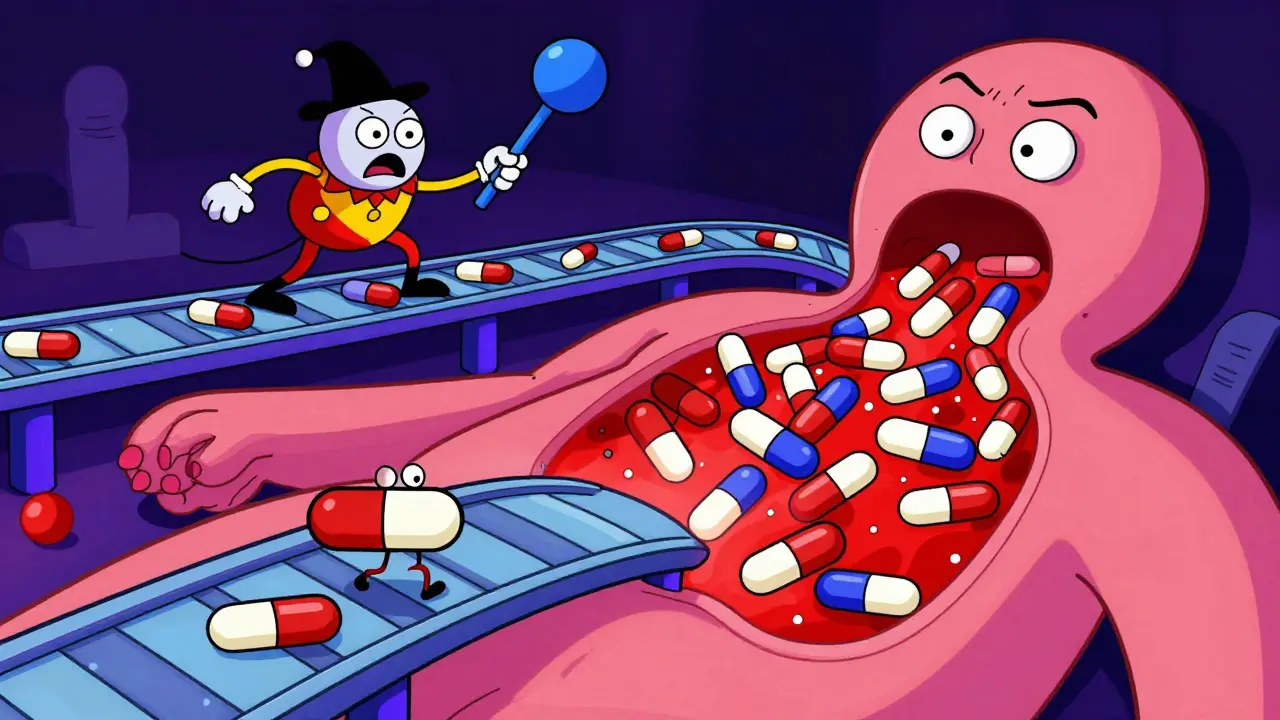
Drug Interaction Mechanism Simulator
How to use: Select a "Perpetrator" drug to see how it changes the activity of the liver enzymes and how that affects the "Victim" drug's concentration in the bloodstream.
Select drugs to simulate the interaction...
The Science Behind This:
Imagine taking a pill for your cholesterol and another for a fungal infection, only to find out that the second drug essentially "turns off" the system your body uses to clear the first one. Suddenly, the cholesterol medication builds up to dangerous levels in your bloodstream. This isn't a rare medical mystery; it's a drug-drug interaction. These happen when one medication changes how another works, and the results can range from a treatment simply not working to life-threatening emergencies.
The Core Difference: Pharmacokinetics vs. Pharmacodynamics
To understand how drugs clash, we first have to look at the two main ways they interact. Think of it as a difference between how much of a drug is in your body and what the drug does once it gets there.
Pharmacokinetic interactions are all about the journey. They happen when one drug alters the absorption, distribution, metabolism, or excretion of another. Essentially, the "perpetrator" drug changes the concentration of the "victim" drug. If a drug is absorbed too slowly or cleared too quickly, it won't reach the level needed to treat the condition. On the flip side, if it isn't cleared at all, it can become toxic.
Pharmacodynamic interactions are different. Here, the concentration of the drugs in the blood might be perfectly normal, but they clash at the site of action. They might fight for the same receptor or work together to amplify an effect. For example, two drugs that both slow down the heart can lead to a dangerously low heart rate, even if neither drug is "interfering" with the other's metabolism.
The Metabolic Engine: Cytochrome P450 Enzymes
Most pharmacokinetic clashes happen in the liver, specifically within the Cytochrome P450 (CYP) enzyme system. These enzymes act like a chemical processing plant, breaking down drugs so your body can get rid of them. The CYP3A4 isoform is the heavy lifter, handling about 50% of all clinically used drugs.
Drugs generally fall into two roles in the liver: inhibitors and inducers.
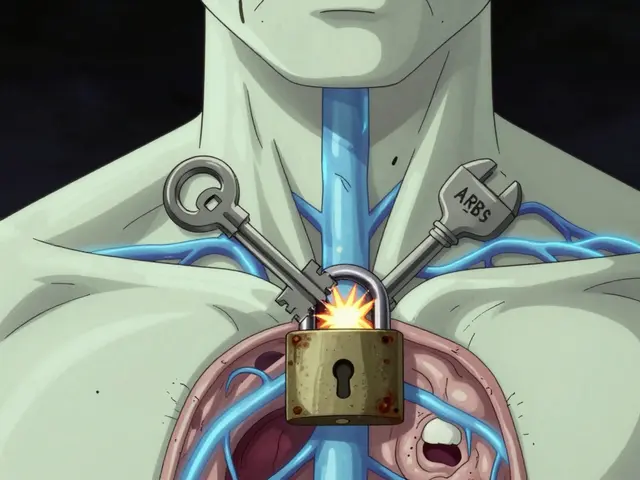
- Inhibitors are like road-blocks. They stop the enzyme from working. When you take an inhibitor, the "victim" drug doesn't get broken down, its levels spike, and you risk toxicity. A classic example is ketoconazole; as a strong inhibitor, it can boost simvastatin levels by 10 to 20 times, which can lead to rhabdomyolysis (severe muscle breakdown).
- Inducers are like accelerators. They tell the body to produce more enzymes. This means the victim drug is chewed up and cleared far faster than intended, often leading to treatment failure. St. John's Wort is a notorious inducer that can slash the levels of cyclosporine (used to prevent organ transplant rejection) by over 50%.
| Role | Effect on Enzyme | Result for Victim Drug | Example Pair |
|---|---|---|---|
| Inhibitor | Decreased Activity | Increased Plasma Levels | Ketoconazole $\rightarrow$ Simvastatin |
| Inducer | Increased Expression | Decreased Plasma Levels | St. John's Wort $\rightarrow$ Cyclosporine |
| Substrate | Processed by Enzyme | Normal Clearance | Simvastatin (as the victim) |
Beyond the Liver: Transport and Absorption
It's not just about enzymes. Your body uses "transporters"-essentially protein pumps-to move drugs across cell membranes. One of the most important is P-glycoprotein (P-gp), which acts like a security guard, pumping drugs out of cells and back into the gut or bloodstream.
If you take a drug like verapamil, which inhibits P-gp, the "guard" stops working. If you're also taking digoxin (a heart medication), digoxin stays in the system longer. This can increase digoxin concentrations by 50-100%, which is dangerous because digoxin has a narrow therapeutic window-meaning the line between a helpful dose and a toxic dose is very thin.
Absorption can also be hit-or-miss based on the environment of your gut. Changes in pH or gut motility can prevent a drug from ever reaching the bloodstream. This is why some medications must be taken on an empty stomach; food or other drugs can physically block absorption or change the acidity of the stomach, rendering the medicine useless.
The Danger of Synergistic and Antagonistic Effects
When we talk about pharmacodynamic effects, we usually see two patterns: synergy and antagonism.
Synergy happens when two drugs amplify each other. This can be helpful (like using two different blood pressure meds to reach a goal) or deadly. For instance, combining fluoroquinolones with macrolide antibiotics like erythromycin can cause a specific type of dangerous heart rhythm called torsades de pointes. The risk increases nearly six-fold when these two are paired compared to using just one.
Antagonism is when drugs work against each other. This is often how overdoses are treated (using a blocker to stop a toxin), but it can also happen accidentally. Using a stimulant and a sedative at the same time can leave your body in a state of "pharmacological tug-of-war," where neither drug works effectively.
Why Some People Are More at Risk
Not everyone reacts to drugs the same way. A huge part of this is down to Pharmacogenomics-the study of how your genes affect your response to drugs.
Some people are "poor metabolizers." For example, if you have a genetic variation in the CYP2D6 enzyme, you might not be able to convert codeine into morphine. In this case, the drug simply won't provide pain relief. Conversely, "ultrarapid metabolizers" might convert the drug too quickly, leading to a morphine overdose even at standard doses.
Age also plays a massive role. People over 65 are far more susceptible to interactions because their liver and kidney function naturally decline. According to the Beers Criteria, a specialized list of potentially inappropriate medications for older adults, certain combinations are particularly risky. Mixing NSAIDs (like ibuprofen) with anticoagulants can increase the risk of internal bleeding by 3 to 5 times.
Managing the Risks in a Modern World
With the rise of polypharmacy-where patients take five or more medications-the chance of an interaction skyrockets. Doctors and pharmacists now use several layers of protection to keep patients safe.
- Therapeutic Drug Monitoring (TDM): For high-risk drugs like warfarin, doctors regularly check blood levels (like the INR test) to ensure the dose is still safe and effective.
- Electronic Alerts: Most clinics use software that flags potential interactions. While these can sometimes cause "alert fatigue" for doctors due to high false-positive rates, they still catch thousands of dangerous pairings every year.
- Professional Review: A pharmacist's review can reduce clinically significant interactions by over 30% simply by catching a mistake before the patient leaves the store.
Can herbal supplements cause drug interactions?
Yes, absolutely. Many people assume "natural" means "safe," but herbal products are potent chemicals. St. John's Wort is a prime example; it is a powerful inducer of the CYP3A4 enzyme, which can significantly lower the blood concentration of many prescription drugs, including birth control and transplant medications, potentially leading to treatment failure.
What is a "narrow therapeutic index"?
A narrow therapeutic index means the difference between a dose that works and a dose that is toxic is very small. For these drugs, even a slight interaction that increases the concentration by 20% could be the difference between health and a medical emergency. Digoxin and Warfarin are classic examples.
How do I know if my medications are interacting?
The best way is to maintain a complete list of all medications, vitamins, and supplements you take and share it with every doctor and pharmacist you visit. Be alert for new or unusual side effects that appear after starting a new medication, and never stop a prescribed drug without consulting your healthcare provider first.
Does food affect drug interactions?
Yes. Food can either act as a facilitator or a blocker. For example, vitamin K-rich foods (like spinach) can reduce the effectiveness of warfarin, a blood thinner. Similarly, tyramine-containing foods can cause a dangerous spike in blood pressure if taken with monoamine oxidase inhibitors (MAOIs).
Why do some people experience side effects while others don't?
This is usually due to genetic polymorphisms. Your DNA determines how many and what kind of enzymes your liver produces. A "poor metabolizer" will have higher drug levels in their system and more side effects, while an "ultrarapid metabolizer" might find the drug doesn't work at all.


Comments
Aaron McGrath
April 20, 2026 AT 21:07 PMAbsolute game changer on the CYP3A4 breakdown! Most people just skim the surface, but understanding the inhibitor vs inducer dynamic is the real key to optimizing pharmacokinetics. If you aren't tracking your metabolic pathways, you're basically flying blind with your chemistry! Get your head in the game and double-check those P-gp transporters before you crash your system!
julya tassi
April 22, 2026 AT 12:19 PMWow, this is so helpful! 😊 I never realized that simple things like spinach could actually interfere with a prescription. It's kind of scary how everything is connected! 🌸
Quinton Bangerter
April 22, 2026 AT 15:50 PMFunny how they mention "electronic alerts" as a safety feature. Ever wonder why the software is designed to have "alert fatigue"? It's the perfect cover for big pharma to push polypharmacy without doctors actually paying attention to the contradictions. They keep us in a loop of substrate and inhibitor interactions just to keep the prescriptions flowing. The P450 system is well-known, but they don't tell you how some "supplements" are actually designed to counteract the meds they sell you. It's all a giant shell game where the patient is the only one losing. Just follow the money and you'll see why the "narrow therapeutic index" is conveniently ignored until it's too late for the average person to realize they're being used as a lab rat in a giant social experiment. Total control through chemical imbalance.
Lesley Wimbush
April 23, 2026 AT 09:40 AMHonestly, it's just so quaint that some people still don't understand the basic interplay of ligands and receptors. It's almost endearing, really, how the general public views these things as "mysteries." 💅
William Young
April 25, 2026 AT 04:49 AMIt is important to remember that everyone's journey with medication is different, and the genetic aspect mentioned here really highlights why we should be patient and supportive of those who struggle with side effects.
Wendy Ajurín
April 25, 2026 AT 21:43 PMThe mention of the Beers Criteria is particularly pertinent. For those managing geriatric care, adherence to these guidelines is essential to mitigate the risks of adverse drug events, especially regarding the synergy between NSAIDs and anticoagulants.
Tanya Rogers
April 27, 2026 AT 18:55 PMThe insistence on reducing complex biochemical processes to "road-blocks" and "accelerators" is a pedestrian approach to science. While it may satisfy the masses, it ignores the nuanced elegance of molecular orbital theory and the stochastic nature of enzyme binding. One must wonder if we have completely abandoned intellectual rigor in favor of accessibility.
Lynn Smith
April 29, 2026 AT 13:45 PMI totally agree with the part about keeping a list of all supplements! It's such a simple step but it makes a huge difference for the doctors.
Charlotte Boychuk
April 30, 2026 AT 13:34 PMWild stuff! It's like a little chemical dance party in the liver and sometimes the guests just don't get along. 💃✨ Totally makes sense why some folks feel the meds hit different.
Cynthia Didion
April 30, 2026 AT 20:12 PMAmerican medicine is the gold standard here. Best systems in the world.
Valorie Darling
May 2, 2026 AT 16:58 PMidk why ppl even care about the science part just tell me what not to take lol
Akshata Kembhavi
May 3, 2026 AT 11:11 AMThis is very useful info for anyone taking multiple meds, quite a common thing in my community too.
caesar simpkins
May 4, 2026 AT 12:00 PMThe thought of a "pharmacological tug-of-war" is honestly such a hauntingly beautiful way to describe the chaos of our internal chemistry. Truly dramatic.