
When you fill a prescription for a generic drug like lisinopril or metformin, you might think the insurance company pays a small, straightforward amount. But the truth is far more complicated. The money that flows from your insurer to the pharmacy doesn’t tell the whole story. In fact, what insurance actually pays for generics is often hidden behind layers of deals, fees, and secret pricing arrangements that most patients - and even many employers - never see.
Generics Don’t Work Like Brand-Name Drugs
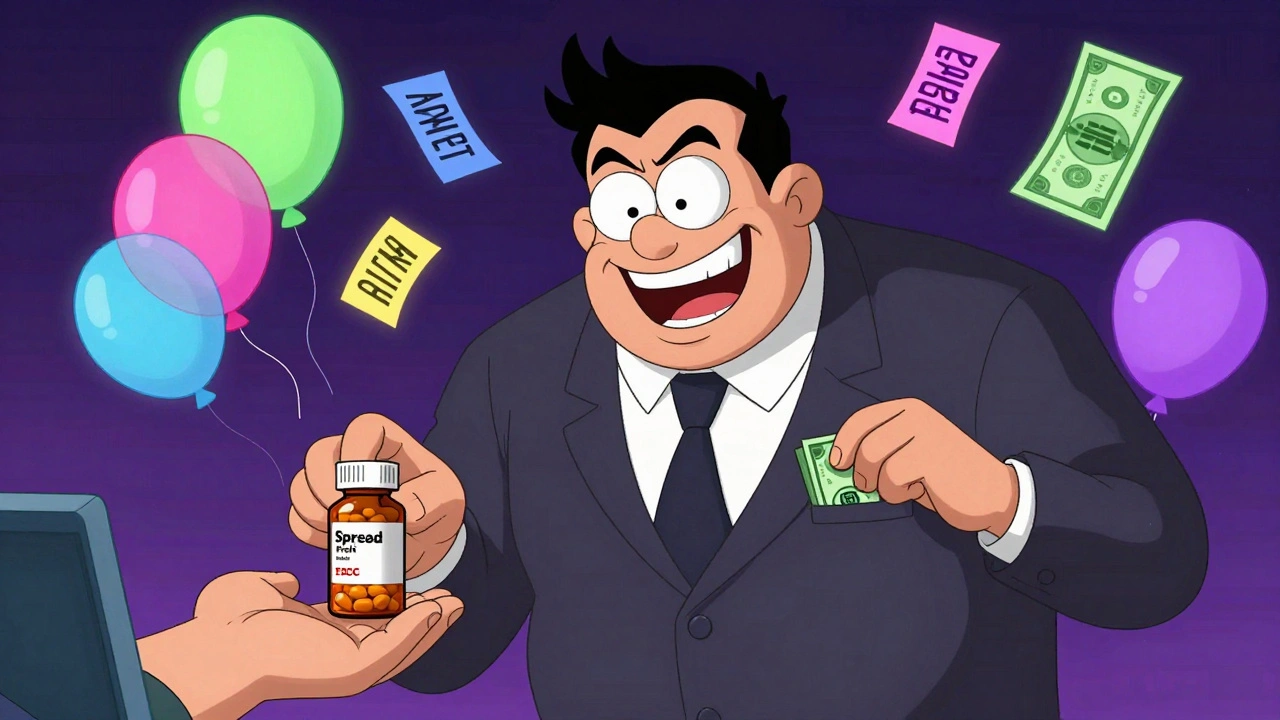
Brand-name drugs come with big rebates. Manufacturers pay pharmacy benefit managers (PBMs) hundreds of millions in rebates to get their drugs placed on insurance formularies. These rebates can be 30% to 70% of the list price. But generics? They’re different. Because multiple companies make the same generic drug, prices are already low. There’s no need for big rebates - and in most cases, there aren’t any at all.Instead of rebates, PBMs make money on generics through something called spread pricing. Here’s how it works: Your insurer agrees to pay the pharmacy, say, $8.50 for a 30-day supply of generic metformin. But the PBM only pays the pharmacy $4.25. The $4.25 difference? That’s pocketed by the PBM. No rebate. No disclosure. Just profit hidden in plain sight.
This isn’t a glitch - it’s the business model. A 2022 U.S. Department of Health and Human Services report found the average spread on generic prescriptions was $4.73 per fill. Multiply that by millions of prescriptions, and you’re talking about billions in hidden fees every year.
Why Don’t Generics Get Rebates?
It’s simple economics. When only one company makes a brand-name drug, they can charge high prices and then offer big rebates to get on insurance lists. But with generics, there are 10, 20, even 50 manufacturers making the same pill. Competition drives the price down - often to pennies per dose. There’s no room for rebate negotiations because there’s no monopoly to negotiate with.According to the U.S. Government Accountability Office, when rebates do happen on generics, they’re usually under 5% of list price - compared to 30-70% for brand-name drugs. And even those small rebates rarely make it to your insurer. PBMs often keep them.
Here’s the kicker: PBMs sometimes exclude cheaper generics from formularies just to favor more expensive brand-name drugs that pay bigger rebates. A 2023 report from Rightway Healthcare found that PBMs would block a $0.15 generic version of a drug to push a $5 brand-name version with a 60% rebate. The insurer ends up paying more. The patient pays more. And the PBM still gets paid.
What Does Insurance Actually Pay?
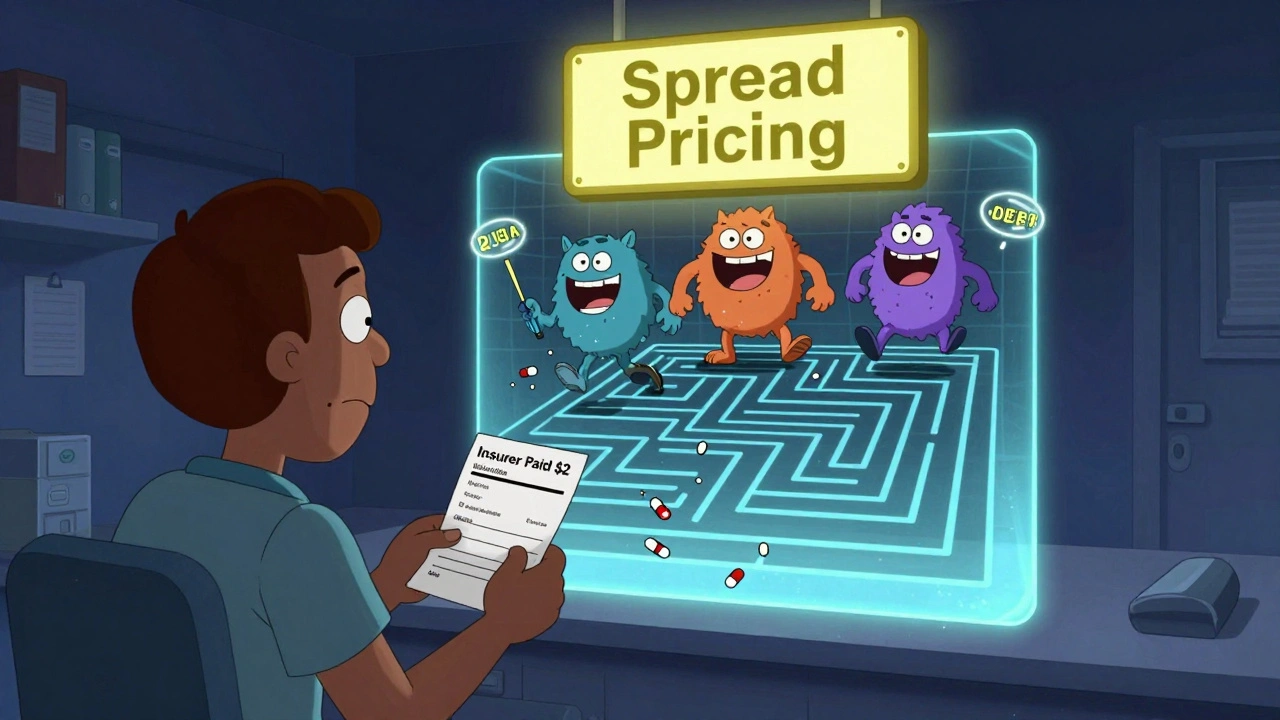
Let’s say your plan covers a generic blood pressure pill. The pharmacy charges $12. You pay your $10 copay. Your insurer is billed $12. At first glance, it looks like they paid $2. But that’s not the full story.The PBM, acting on behalf of your insurer, has already negotiated a lower price with the pharmacy - say, $5. So the $12 billed amount? That’s inflated. The PBM only pays the pharmacy $5. The $7 difference? That’s spread pricing. Your insurer’s “payment” of $2 is just your copay. The real cost to the insurer? $5 - minus whatever administrative fee the PBM charges.
And here’s where it gets worse: Many employers and insurers don’t even know this is happening. A 2023 survey by the National Business Group on Health found that 68% of large employers couldn’t determine the actual net cost of generic drugs because PBMs refused to disclose their acquisition prices.
The Real Cost Isn’t What You See on the Receipt
Your receipt shows your $10 copay. Your explanation of benefits says the insurer paid $2. But the real cost? The pharmacy was paid $5. The PBM kept $7. And your insurer didn’t pay $2 - they paid a fee to the PBM to manage the whole mess.This system isn’t just confusing - it’s harmful. It removes any incentive for PBMs to push the cheapest, most effective drugs. Why would they? If a $0.15 generic saves you money but pays no rebate, and a $5 brand-name drug pays a $3 rebate, the PBM will choose the $5 drug. Even if it costs more overall.
That’s why some patients end up paying more out-of-pocket for generics than they should. Or worse - they’re denied coverage for a generic because it’s not on the formulary, even though it’s the exact same drug.
Who’s Making Money - and Who’s Losing
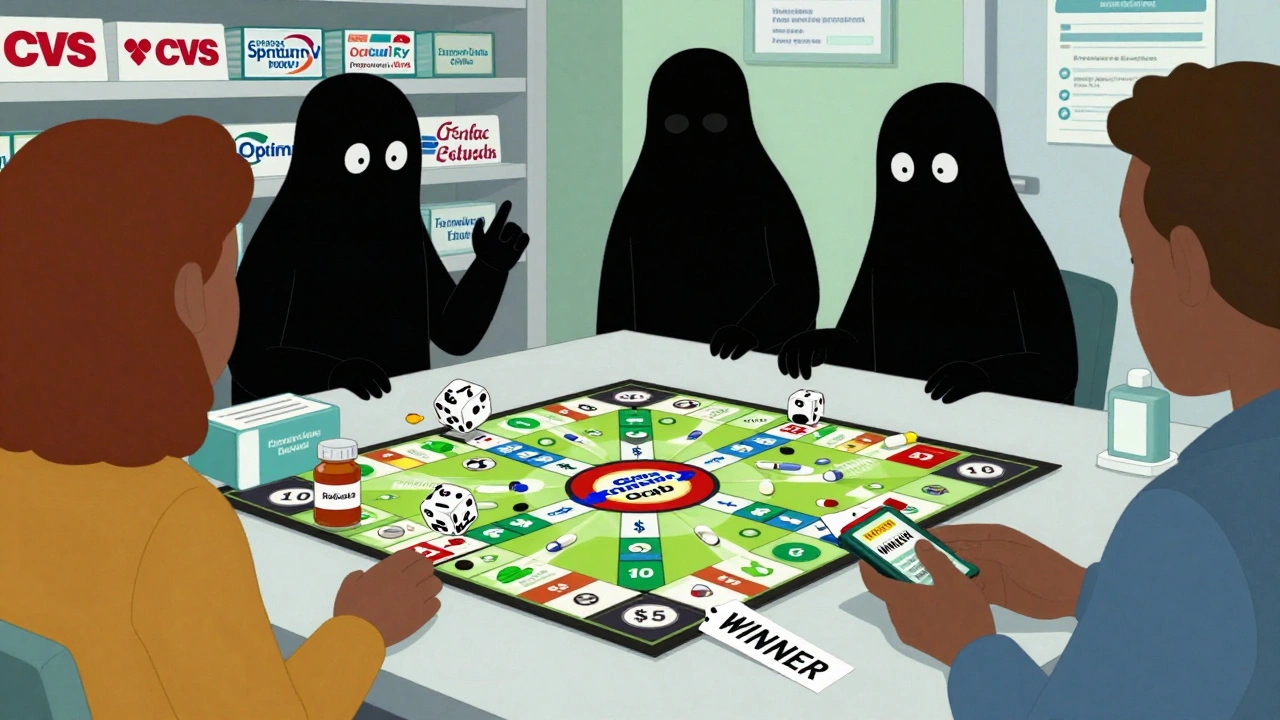
Three companies - CVS Caremark, Express Scripts, and OptumRx - control about 80% of the PBM market. They’re the ones setting the spreads, hiding the prices, and designing formularies to maximize their own profits.Patients lose because they pay higher copays and face coverage denials. Employers lose because their health plan costs are inflated by hidden fees. Taxpayers lose because Medicare and Medicaid overpay for drugs due to lack of transparency.
And the drug manufacturers? They’re not the villains here. Generic makers are competing on price. They’re the ones offering pills for a few cents. The problem isn’t the drug - it’s the middlemen.
What’s Changing? And What You Can Do
There’s pressure building. The Biden administration’s 2024 Executive Order directed the Department of Health and Human Services to investigate practices that limit generic drug use. The No Surprises Act of 2020 started pushing for more transparency. And in 2025, CMS announced new rules requiring PBMs to disclose their pricing structures to employers.More employers are switching to pass-through pricing. Instead of letting PBMs keep the spread, the employer pays the pharmacy directly - minus a flat administrative fee. No hidden profits. No spread pricing. Just fair pricing.
According to the National Business Group on Health, 42% of large employers now use pass-through models - up from just 18% in 2020. That’s progress.
If you’re an individual with insurance, you can’t control your PBM. But you can ask questions. When you’re handed a generic prescription, ask your pharmacist: “What’s the actual cost to my plan?” If they don’t know, ask your insurer. Demand transparency.
If you’re an employer or plan sponsor, review your PBM contract. Look for language about spread pricing. Demand full disclosure of acquisition costs. Push for pass-through models. Your employees’ wallets - and your bottom line - will thank you.
The Bigger Picture
Generics make up 90% of all prescriptions in the U.S. But they account for only 23% of total drug spending. That’s because they’re cheap - if the system lets them be.The rebate system was built for brand-name drugs. It doesn’t work for generics. And forcing it to do so - by hiding fees, manipulating formularies, and profiting from spreads - is driving up costs instead of lowering them.
True savings come from competition, not rebates. And the only way to make sure generics deliver on that promise is to cut out the middlemen who profit from opacity.
The system is rigged - but it’s not broken beyond repair. Transparency is the first step. Accountability is the next. And until we demand both, what insurance “pays” for your generic drugs will remain a mystery - and a money pit.

Comments
Akash Sharma
December 3, 2025 AT 16:58 PMMan, this is wild. I never realized how much of the generic drug pricing was just smoke and mirrors. I thought PBMs were there to save us money, not quietly pocket $4-7 per prescription. The fact that they exclude cheaper generics to push brand-name drugs with rebates? That’s not just unethical-it’s predatory. And the worst part? Most people have no idea. I’ve been on metformin for years and always assumed my $10 copay was the full cost. Turns out my insurer paid way less than I thought, and the pharmacy got even less. This system is designed to confuse, not help. We need full transparency-like, real-time public dashboards showing every transaction from manufacturer to pharmacy. No more black boxes. If PBMs can’t prove they’re saving money, they shouldn’t be in the middle at all.
Justin Hampton
December 3, 2025 AT 22:22 PMSo what? You’re mad because middlemen make money? Welcome to capitalism. If generics were so cheap, why don’t you just buy them cash? No insurance needed. The whole system works because someone has to negotiate, manage networks, and absorb risk. You want lower prices? Stop blaming the middleman and start blaming the FDA for making it impossible to produce generics faster. And don’t even get me started on how the government screws up drug pricing with all its regulations.
Pooja Surnar
December 4, 2025 AT 09:07 AMlol so pbms are evil?? what a shocker. these guys are literally the reason your insulin costs 300 bucks. they’re crooks. they’re liars. they’re rich because you’re poor. and you know what? they dont even pay taxes right. and your doctor? they get kickbacks too. dont trust anyone in this system. its all rigged. #pbmsarethieves
Sandridge Nelia
December 4, 2025 AT 10:14 AMThis is such an important breakdown-thank you for laying it out so clearly! 🙌 I work in healthcare admin and this is exactly what we fight against daily. The spread pricing model is insane. We just switched to pass-through pricing last year and our generic drug costs dropped 40%. Patients are happier, our premiums stabilized, and we finally know what we’re paying. If you’re an employer reading this-DO IT. It’s not hard. Talk to your broker. Ask for the acquisition price. If they hesitate? Run. 🚩
Mark Gallagher
December 4, 2025 AT 19:45 PMIndia and Nigeria don’t get it. In America we have the best healthcare system in the world. You think other countries have transparency? They don’t even have generics that work. This system keeps us safe. The PBM model is efficient. Stop complaining about profits. If you want cheap drugs, move to Bangladesh. We pay for quality and innovation. The fact that you think $0.15 pills should be the standard is naive. You don’t know what you’re talking about.
Joanne Rencher
December 6, 2025 AT 07:09 AMtbh i just pay my copay and move on. why does this even matter? i get my meds. the rest is noise.
Erik van Hees
December 6, 2025 AT 23:54 PMOkay, so here’s the thing nobody talks about-PBMs didn’t invent spread pricing. Pharmacies did. Back in the 90s, when cash-paying customers started asking for discounts, pharmacies started marking up the list price and then offering "discounts" to insurers. PBMs just took over the game. And guess what? The pharmacies still make bank on cash sales. So if you’re mad at PBMs, be mad at Walgreens and CVS too. They’re the ones who turned drug pricing into a casino. Also, did you know that 70% of generic prescriptions are filled at just three chains? That’s not PBM control-that’s retail consolidation. Fix that first.
May .
December 8, 2025 AT 12:05 PMThey’re stealing. End of story.
Sara Larson
December 8, 2025 AT 14:52 PMTHIS IS SO IMPORTANT 💪✨ I’ve been screaming about this for years! I’m so glad someone finally broke it down in plain English. If you’re reading this and you’re on insurance-ask your pharmacist right now: "What’s the actual cost to my plan?" Don’t wait for someone else to fix it. Be the person who asks. Share this. Tag your employer. Let’s make transparency the new normal. We got this! 🌟💊 #DemandTransparency
Josh Bilskemper
December 9, 2025 AT 02:02 AMLet’s be clear: this isn’t a systemic flaw-it’s a moral failure of the American middle class. People don’t want to pay for complexity. They want magic. But magic doesn’t exist in pharmaceuticals. The PBM system is the only thing preventing complete chaos. If you want real savings, stop demanding generic drugs and start demanding personal responsibility. Buy your own pills. Pay cash. Don’t rely on the system. That’s what adults do.
dan koz
December 10, 2025 AT 18:32 PMMan this is real. I work in Lagos pharmacy and we see this same thing but worse. In Nigeria we dont even have PBMs but the local distributors do the same thing. Mark up the price then say its a discount. People think they saving but they paying double. This system is global. Its not just USA. Its everywhere. The rich get richer. The poor get pills with hidden cost.
Katey Korzenietz
December 12, 2025 AT 18:06 PMso pbms are just… middlemen who rip us off? wow. shocker. next youll tell me the guy at the gas station is making money off the fuel too. 🤦♀️
Chris Jahmil Ignacio
December 14, 2025 AT 01:49 AMThey’re not just hiding spreads-they’re colluding with Congress. Did you know that the 2003 Medicare Modernization Act banned Medicare from negotiating drug prices? That was pushed by PBMs and pharma lobbyists. And now? They’re using that same lobbying power to block state transparency laws. This isn’t about profit-it’s about control. They want you dependent. They want you confused. They want you to think your copay is the cost. It’s not. It’s a distraction. The real cost is in the backroom deals. And if you think this is going to change without a full-scale rebellion? You’re dreaming. This is a $300 billion industry with zero accountability. They’ll bury the truth under 1000 pages of legalese. And you? You’ll keep paying your $10 copay like a good little consumer.
Paul Corcoran
December 15, 2025 AT 14:48 PMThanks for this. I’ve been trying to explain this to my team at work for months. We’re a small nonprofit and our health plan costs keep rising even though we’re using more generics. I showed them this breakdown and they finally got it. We’re switching to pass-through pricing next quarter. It’s not perfect, but it’s honest. If you’re an employer reading this-don’t wait for someone else to fix it. Look at your PBM contract. Ask for the acquisition price. If they won’t give it to you, fire them. Your employees deserve better. And honestly? So do you.
dylan dowsett
December 15, 2025 AT 15:53 PMWait-so PBMs are making money off the difference between what they bill and what they pay? That’s illegal, right? No, wait-it’s legal because they lobbied to make it legal? Of course it is. And now they’re telling us it’s ‘market efficiency’? That’s not efficiency-that’s theft with a PowerPoint. And the worst part? You can’t even sue them. They’re protected by ERISA. So your only option is to… do nothing? And hope they feel bad? This isn’t capitalism. This is feudalism with a pharmacy counter.