
Anti-Xa Test Validator
This tool checks if an anti-Xa test is valid and whether the measured level is therapeutic based on timing and dosing type.
Enter your test details to see if this anti-Xa test is valid and if the level is therapeutic.
Most people on low molecular weight heparin (LMWH) like enoxaparin or dalteparin never need their blood tested. That’s because these drugs are designed to work reliably with fixed doses-no routine checks required. But when something goes wrong-unexpected bleeding, a new clot despite being on treatment, or kidney failure-that’s when anti-Xa monitoring becomes critical. It’s not about checking numbers for the sake of it. It’s about answering one urgent question: Is the blood thinner working the way it should?
Why Anti-Xa Testing Exists
Anti-Xa testing measures how much LMWH is actively blocking factor Xa, a key protein in blood clotting. Unlike unfractionated heparin, which is tracked with aPTT tests, LMWH acts more selectively. That’s why aPTT is useless here. Anti-Xa is the only lab test that directly tells you how strong the anticoagulant effect is.It sounds simple, but this test isn’t for everyone. In fact, the American College of Chest Physicians says routine monitoring is unnecessary for most patients. The problem? Too many hospitals still order it out of habit-after surgery, during hospital stays, or just because “we’ve always done it.” That’s not just wasteful. It’s risky.
When You Actually Need It
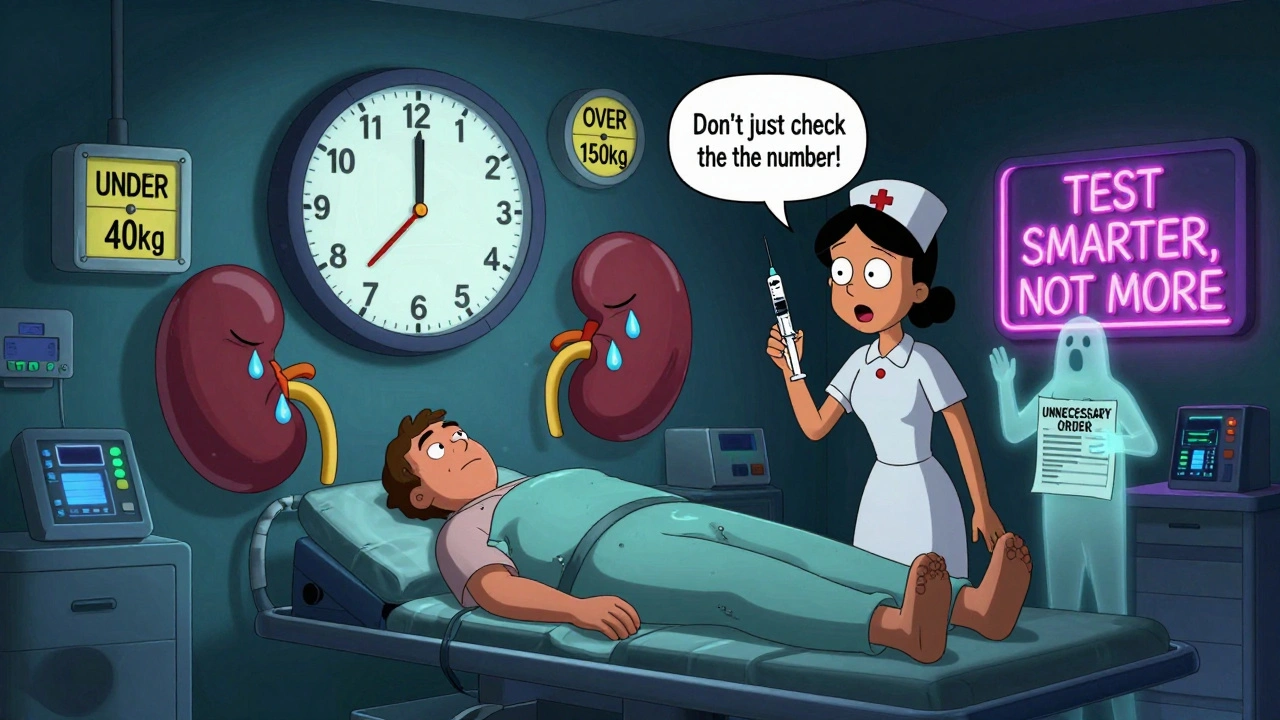
There are five real-world situations where anti-Xa testing changes outcomes:- Severe kidney impairment (creatinine clearance under 30 mL/min): LMWH is cleared by the kidneys. When they’re failing, the drug builds up. A standard dose can turn dangerous. Anti-Xa levels above 1.0 IU/mL in these patients mean bleeding risk skyrockets.
- Extreme body weight (over 150 kg or under 40 kg): Standard dosing formulas break down. A 320 kg trauma patient might need more than double the usual dose. Without testing, you’re guessing.
- Pregnancy: Especially in the third trimester, blood volume and kidney function change. Target levels shift to 0.2-0.6 IU/mL. Monitoring helps avoid both clots and hemorrhage.
- Unexplained bleeding: A patient on LMWH starts oozing from IV sites, has a GI bleed, or develops a large bruise with no trauma. Anti-Xa can tell you if the drug level is too high.
- Thrombosis on therapy: A deep vein thrombosis or pulmonary embolism occurs even though the patient is taking their prescribed dose. This suggests under-dosing-anti-Xa levels below 0.6 IU/mL confirm it.
These aren’t theoretical. A 2018 audit at Ventura County Medical Center found only 28% of anti-Xa orders had valid reasons. The rest were routine checks-useless, expensive, and sometimes harmful.
How the Test Works
The test isn’t complicated, but timing matters. You can’t just draw blood anytime.For accurate results, the sample must be taken 4 to 6 hours after the last LMWH injection. That’s when the drug hits its peak level in the blood. Drawing it too early or too late gives misleading numbers. Trough levels (right before the next dose) are rarely used for LMWH-they’re more relevant for unfractionated heparin.
Therapeutic ranges depend on the goal:
- Prophylactic dosing (preventing clots): 0.2-0.5 IU/mL
- Therapeutic dosing (treating clots): 0.6-1.0 IU/mL
- Pregnancy: 0.2-0.6 IU/mL
These aren’t rigid targets. They’re guides. A level of 1.1 IU/mL doesn’t automatically mean you need to stop the drug. If the patient feels fine and has no bleeding, you might just watch. But if they’re oozing blood and their level is 1.4 IU/mL? That’s a red flag.

What the Test Can’t Do
Anti-Xa testing has serious limits. It doesn’t tell you:- Why the patient is bleeding (could be a stomach ulcer, not the LMWH)
- If the patient is compliant (they might not be taking the shots)
- Whether they have heparin-induced thrombocytopenia (HIT)-that needs a separate test
- How well they’ll respond to reversal agents
It also can’t distinguish between different types of LMWH. Enoxaparin and dalteparin both show up the same way. And results vary between labs-up to 15% difference-because no universal standard exists yet. That’s why you should always interpret results with the clinical picture, not in isolation.
One study found that 41% of patients had anti-Xa levels above target, but none had bleeding. That’s a classic trap: a number looks wrong, but the patient is fine. Overreacting to those numbers can lead to unnecessary dose reductions-and higher risk of clots.
Cost and Accessibility
The test costs between $45 and $75 per draw, depending on the region. Medicare pays around $58. It’s not cheap, and most insurance won’t cover it unless there’s a clear clinical reason.It’s also not available everywhere. Smaller hospitals often send samples out, which means a 24-48 hour wait. In emergencies, that’s too long. But in planned cases-like a patient with end-stage kidney disease starting LMWH-having the test ready is worth it.
Some newer platforms, like Diagnostica Stago’s STA-R Max 3, are bringing point-of-care testing closer to reality. Early studies show 92% accuracy compared to central labs. If this takes off, we might see faster decisions in ICUs and ERs.
What Happens When You Get It Wrong
The biggest danger isn’t missing a case-it’s ordering the test when you shouldn’t.A 2016 review of 4,328 patients found that 72% of anti-Xa orders led to inappropriate dose changes. In one hospital, 8% of those changes caused bleeding. That’s not helping. That’s harming.
Doctors sometimes order the test because they’re nervous. “What if something goes wrong?” But in most cases, the answer is: it won’t. LMWH is safe in 95% of patients without monitoring.
Here’s what works better: clinical judgment. If a patient has kidney failure and starts bleeding, check the anti-Xa. If they’re obese and had a knee replacement, don’t. If they’re pregnant and had a clot last time, monitor. If they’re fine and just got a shot, don’t.
Real Stories From the Front Lines
One hematologist in Oregon ordered anti-Xa twice in five years. Once for a 320 kg trauma patient on enoxaparin-levels were barely detectable. They doubled the dose. He didn’t clot. The second time was for a post-op patient with a creatinine clearance of 18 mL/min who started bleeding from the surgical site. The level was 1.5 IU/mL. They held the next dose. The bleeding stopped.At Vanderbilt, a pharmacist-led team redesigned the order system. They built automated alerts that only allow anti-Xa testing if one of the five clinical triggers is selected. Result? Inappropriate orders dropped by 63%.
On Reddit, a nurse in Texas wrote: “I used to think we checked anti-Xa for everyone on enoxaparin. Then I saw a patient die from a brain bleed after we lowered the dose because his level was 0.95-normal for a 70kg person, but way too high for a 110kg woman with stage 3 kidney disease. We didn’t know her weight or kidney function. We just saw a number.”
What You Should Do
If you’re a clinician:- Only order anti-Xa when one of the five clinical triggers is present.
- Always correlate the result with symptoms-not just the number.
- Draw the sample 4-6 hours after the last dose.
- Know your lab’s reference range. Don’t assume it’s the same as others.
- If in doubt, consult a pharmacist or anticoagulation specialist.
If you’re a patient:
- Ask: “Do I need this test?” If the answer is “just because,” push back.
- Report any unusual bruising, bleeding, or new pain/swelling in your legs.
- Know your kidney function. If your creatinine clearance is low, make sure your doctor knows.
Anti-Xa monitoring isn’t a routine check. It’s a rescue tool. Used right, it saves lives. Used wrong, it creates problems. The goal isn’t to test more-it’s to test smarter.
When should anti-Xa levels be checked for LMWH?
Anti-Xa levels should only be checked when there’s a clinical reason-such as unexpected bleeding, a new clot despite proper dosing, severe kidney impairment (CrCl <30 mL/min), extreme body weight (over 150 kg or under 40 kg), or pregnancy. Routine monitoring is not recommended.
What is a normal anti-Xa level for LMWH?
For prophylactic dosing, the target is 0.2-0.5 IU/mL. For therapeutic dosing (treating clots), it’s 0.6-1.0 IU/mL. In pregnancy, the range is narrower: 0.2-0.6 IU/mL. Always confirm the lab’s reference range, as values can vary.
Can you monitor LMWH with aPTT instead?
No. aPTT is unreliable for LMWH because it doesn’t reflect the drug’s actual effect. LMWH works mainly by inhibiting factor Xa, not thrombin, so aPTT often stays normal even when the drug is active. Anti-Xa is the only accurate test.
How long after an LMWH shot should anti-Xa be drawn?
The blood sample should be drawn 4 to 6 hours after the injection. This captures the peak concentration of the drug in the bloodstream. Drawing it sooner or later gives inaccurate results.
Is anti-Xa testing covered by insurance?
Insurance typically covers anti-Xa testing only when there’s a documented clinical indication, such as kidney failure, bleeding, or thrombosis on therapy. Routine or unexplained orders are often denied. The cost per test ranges from $45 to $75.
What happens if my anti-Xa level is too high?
A high level doesn’t always mean you need to stop the drug. If you have no bleeding or symptoms, your doctor may just delay the next dose and recheck. If you’re actively bleeding, the next dose may be held, and reversal strategies (like protamine sulfate, though less effective for LMWH than UFH) may be considered. Clinical context matters more than the number alone.




Comments
Mark Curry
December 6, 2025 AT 03:39 AMBeen using LMWH for years after my DVT. Never had a test. Docs just said 'keep taking it, you're fine.' Turns out they were right. I've seen too many people over-test and then panic over numbers that don't mean anything. Sometimes the body just knows what to do.
Also, 0.95 isn't automatically dangerous. Context matters. Like, if you're 110kg with kidney issues? Yeah, that's a problem. But if you're 70kg and feel great? Leave it be.
Also lol at hospitals ordering it 'just because.' 😅
aditya dixit
December 7, 2025 AT 01:23 AMThis is one of the clearest summaries I've read on LMWH monitoring. The five clinical triggers are spot-on. Too many clinicians treat labs like gospel instead of tools.
Especially the point about drawing blood 4–6 hours post-injection. I've seen so many reports ruined because someone grabbed a sample right after the shot. The lab gets confused, the doctor panics, and the patient gets underdosed. It's a domino effect.
Also, the Vanderbilt pharmacist-led alert system? That's the future. Automation that supports, not replaces, clinical judgment. Brilliant.
Annie Grajewski
December 8, 2025 AT 10:44 AMOhhh so THAT'S why my last blood draw was so weird? I thought they were just being extra. Turns out I'm the 41% of people with a 'wrong' number who didn't bleed. Classic.
Also, I'm pretty sure my nurse just clicked 'anti-Xa' because it was the 3rd box down. No clue what it meant. Neither did I. We just both nodded and pretended we were doctors.
Also also: why does this test cost $75? I paid $12 for a burrito last week. The burrito didn't try to kill me. 😒
Mark Ziegenbein
December 10, 2025 AT 01:17 AMLet me be blunt - the entire medical-industrial complex is built on the illusion of control. We don't need anti-Xa tests. We need humility. We need doctors who stop treating labs like crystal balls and start treating patients like humans.
And yet here we are - hospitals billing for unnecessary tests because they're reimbursed for it, not because it's good medicine. The 72% of inappropriate dose changes? That's not error. That's systemic greed wrapped in a white coat.
And don't get me started on how labs don't even have standardized reference ranges. One lab's 'dangerous' is another lab's 'perfectly normal.' How is this acceptable in 2025? We're flying blind with ink on paper and spreadsheets.
Meanwhile, the real solution? Clinical judgment. A concept so ancient, so basic, that modern medicine has forgotten it exists. We've outsourced thinking to machines and algorithms. And now we're surprised when people die because someone trusted a number over a pulse.
It's not medicine anymore. It's performance art.
Rupa DasGupta
December 11, 2025 AT 20:33 PMOkay but what if the test is wrong? What if the lab messed up? What if the machine glitched? What if the phlebotomist used the wrong tube? What if the patient drank coffee before the draw? What if they were stressed? What if their cat sat on them right before the blood draw and it changed their coagulation? 🤯
I'm just saying - we can't trust ANYTHING anymore. Not labs, not doctors, not even the air we breathe. I heard a nurse say once that anti-Xa levels can be influenced by moon phases. I don't know if that's true but I'm not taking any chances.
Also, I think they're hiding the real reason. It's not about bleeding. It's about insurance companies wanting to see something on the chart so they can deny coverage later. I'm telling you - it's all a scheme. 😔
Marvin Gordon
December 12, 2025 AT 14:29 PMJust wanted to say thank you for writing this. As a nurse who’s seen too many patients get their doses lowered because of a 'high' anti-Xa that didn’t match their symptoms - this is the kind of clarity we need.
And yes - the Vanderbilt system? We implemented something similar last year. Orders dropped by 70%. Bleeding events dropped too. Because we stopped treating numbers like commands.
Doctors: if you’re ordering this test because you’re scared of being sued, you’re doing it wrong. If you’re ordering it because your patient is bleeding and has kidney failure? That’s medicine.
Stop over-testing. Start thinking.
ashlie perry
December 14, 2025 AT 02:50 AMThey're watching you. The labs, the hospitals, the drug companies - they all want you to believe you need this test. But what if the real danger isn't the blood thinner? What if it's the system that profits from your fear? I read a whistleblower report once - anti-Xa testing was pushed hard after the 2010 patent cliff on LMWH. Coincidence? I think not.
Also, I'm pretty sure the 15% lab variation is intentional. Keeps us dependent. And don't get me started on the point-of-care machines - they're just beta tests for the real agenda. The algorithm knows your clotting status before you do. We're not patients. We're data points.
Juliet Morgan
December 14, 2025 AT 11:04 AMI’m a nurse in a rural ER and I just wanted to say this post saved me last week. We had a pregnant patient with a DVT, creatinine clearance of 25, and a level of 0.85. Everyone wanted to hold the dose. I pulled up this exact guide and said: ‘She’s pregnant, she’s got kidney issues, and she’s within target.’ We kept the dose. She’s doing great now.
Also - thank you for mentioning the 4–6 hour window. So many of us were drawing at random times and getting confused results. This made a real difference.
You’re not just writing facts. You’re helping people not mess up.
Norene Fulwiler
December 15, 2025 AT 17:04 PMI’m from a country where LMWH is mostly used for post-op patients and we don’t have anti-Xa testing at all. We rely on clinical signs - bleeding, swelling, pain. If it looks wrong, we stop. If it looks fine, we don’t touch it.
This post made me realize how much we’ve lost in the West - the art of observation. We replaced intuition with numbers. But sometimes, the patient’s face, their pulse, the color of their urine - that’s the real lab.
Maybe we don’t need more tests. Maybe we just need to remember how to look.
William Chin
December 17, 2025 AT 08:02 AMIt is with the utmost gravity that I must formally submit, for consideration by the institutional review board and the hospital pharmacy and therapeutics committee, a formal critique of the current protocol regarding the utilization of anti-Xa assays in the administration of low molecular weight heparin. The data presented herein, while statistically significant in certain cohorts, fails to account for the confounding variables of diurnal variation, inter-assay coefficient of variation, and the absence of standardized calibrators across manufacturers. Furthermore, the implicit assumption that clinical judgment is a reliable substitute for quantitative biomarker analysis is, in my professional estimation, both epistemologically unsound and ethically precarious. I urge immediate revision of all order sets to include mandatory documentation of clinical indication prior to test initiation, with audit trails maintained in compliance with Joint Commission Standard IC.10.01.01. Failure to do so may result in increased liability exposure, suboptimal patient outcomes, and potential noncompliance with CMS reimbursement guidelines.