
When you pick up a prescription for a generic drug, you might assume it’s just a cheaper version of the brand-name medicine. But behind that simple swap is a complex, highly structured decision-making system used by insurance companies to decide exactly which generics they’ll pay for-and which ones they won’t. This isn’t random. It’s not based on who has the best marketing team. It’s a cold, calculated process driven by science, cost, and regulation-and it affects millions of people every day.
Why Insurers Even Care About Generics
Generics aren’t just cheaper. They’re massively cheaper. On average, a generic drug costs 80 to 85% less than its brand-name equivalent. That’s not a small difference. For insurers, that means billions in savings. From 2007 to 2019, Medicare Part D plans alone saved $1.67 trillion by using generics and biosimilars. In 2019, that annual savings hit $141 billion. That’s money that doesn’t go to drug companies-it stays in the system, keeping premiums lower and coverage wider. But it’s not just about saving money. It’s about making sure patients get the right treatment without breaking the bank. If a generic works just as well as a brand-name drug-and it’s far less expensive-why wouldn’t an insurer cover it? The answer is: they almost always do.The Formulary: The Rulebook for Coverage
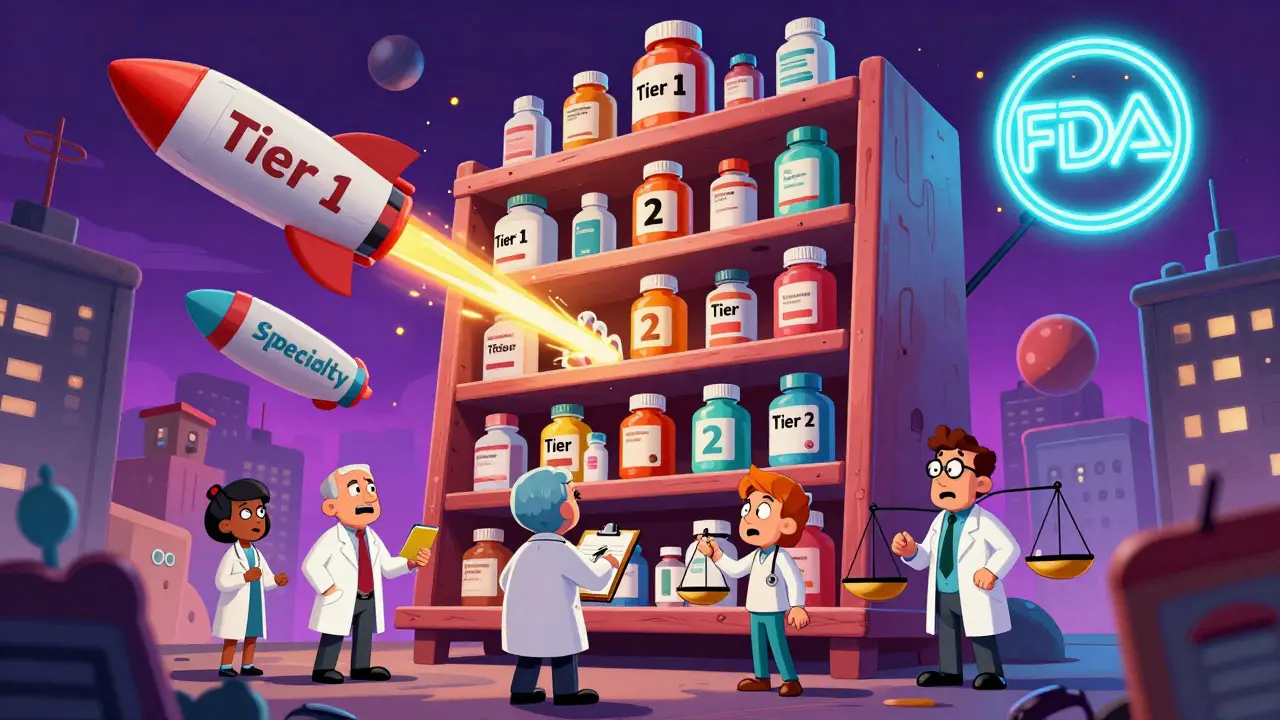
Every insurance plan has a formulary-a list of drugs they agree to cover. It’s not a secret document. It’s published online, updated regularly, and often broken into tiers. Think of it like a pricing ladder. Tier 1: Lowest cost. Almost always generic drugs. Copays? Usually $0 to $15 for a 30-day supply. Tier 2: Sometimes brand-name drugs, sometimes higher-cost generics. Copays range from $20 to $50. Tier 3 and 4: Specialty drugs, brand-name medications with no generic yet. Copays can hit $100 or more. Medicare Part D plans follow this structure too. In fact, 92% of them use a 3-tier system where Tier 1 is reserved for generics only. Blue Shield of California, Humana, Cigna, UnitedHealthcare-all of them use this same model. It’s not coincidence. It’s industry standard.Who Decides What Gets Covered?
The real decision-makers aren’t CEOs or claims adjusters. They’re the Pharmacy & Therapeutics (P&T) committees. These are groups of doctors, pharmacists, and health economists hired by insurers to review drugs and make coverage recommendations. They don’t just look at price. They look at three things:- Clinical effectiveness-Does the drug actually work? Is there solid evidence from studies?
- Safety-What are the side effects? How common are they? Has it been used safely in real patients for years?
- Cost-effectiveness-If Drug A and Drug B do the same thing, but Drug B is half the price? Drug B wins.
Why Some Generics Get Rejected
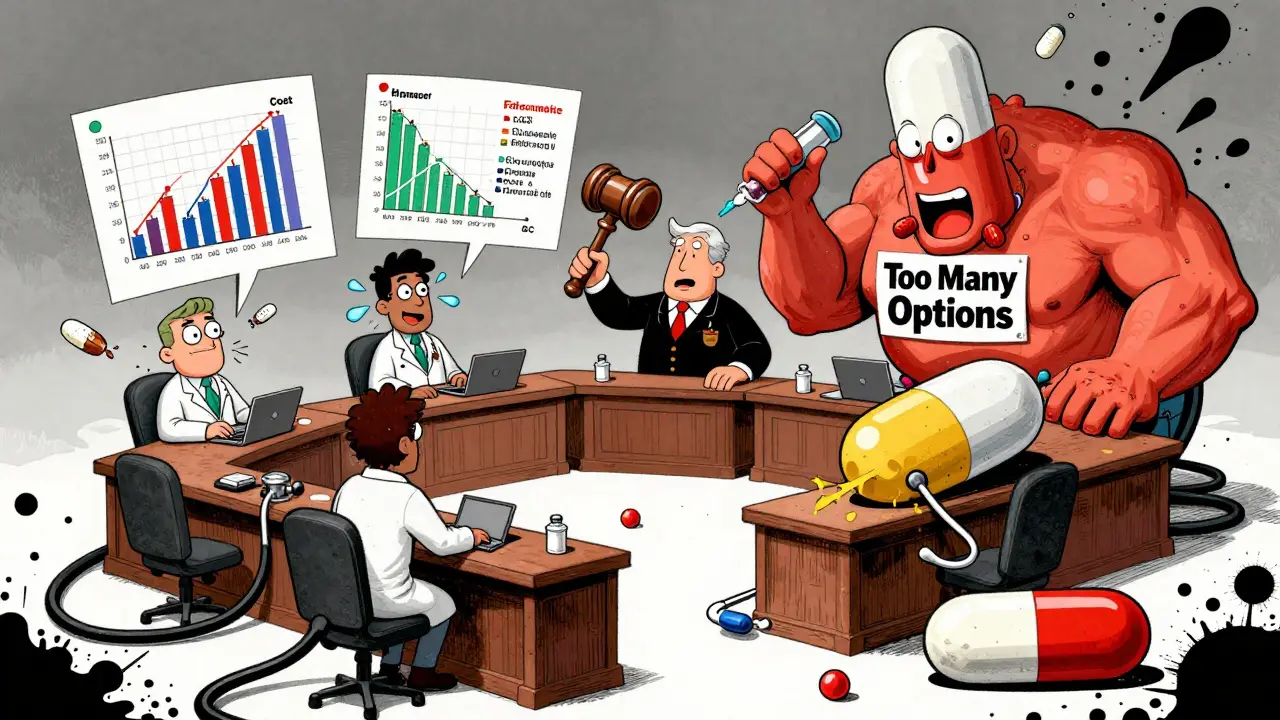
You might think: if it’s FDA-approved, it should be covered. But that’s not always true. Here’s why some generics still get left out:- Too many similar options-If five different generic versions of a drug are already on the formulary, adding a sixth might not make sense unless it’s significantly cheaper or better.
- Supply chain issues-If a generic manufacturer has frequent shortages (and 78% of current drug shortages are generics), insurers may avoid them until stability improves.
- Therapeutic substitution rules-Some insurers require you to try the cheapest generic first, even if your doctor prescribed something else. If that generic causes side effects, you can appeal-but the process isn’t always smooth.
What Happens When a Drug Isn’t Covered?
If your doctor prescribes a generic that’s not on your plan’s formulary, you’re not stuck. You can file an exception request. Here’s what you need to show:- The drug you were prescribed caused harmful side effects.
- You tried a similar drug on the formulary and it didn’t work.
- The formulary drug requires a dosage higher than what’s allowed under your plan’s rules.
Where the System Falls Short
The system works well for most people. But it’s not perfect. One big problem? Lack of transparency. Only 37% of insurers publicly share the full criteria their P&T committees use to make decisions. That means patients and doctors often don’t know why a drug was excluded until they’re already in the middle of a coverage battle. Doctors are also stretched thin. A 2022 American Medical Association survey found physicians spend an average of 13.3 hours per week just dealing with prior authorizations and formulary exceptions. That’s over three full workdays a month spent on paperwork-not patient care. And then there’s the rise of complex generics. Drugs like inhalers, insulins, and injectables are harder to copy. The FDA is trying to speed up approval for these, but it’s slow. That means fewer generic options in critical areas-and more pressure on insurers to make tough calls.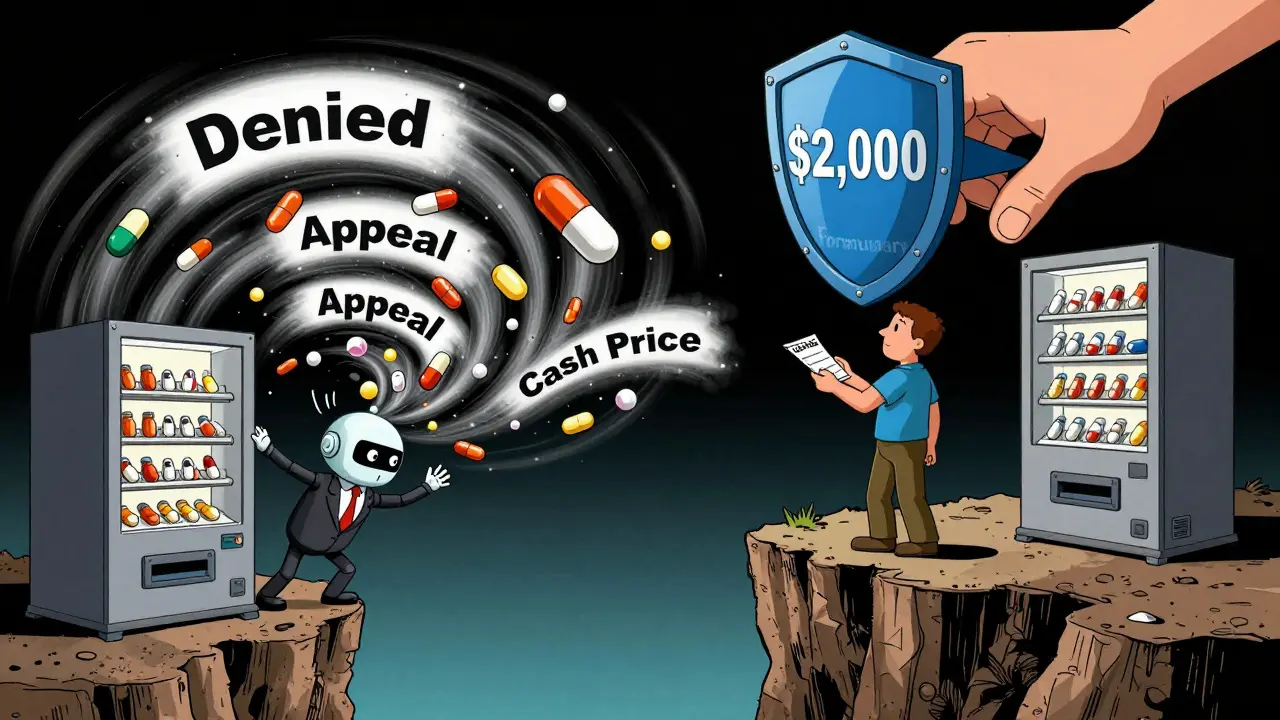
What’s Changing in 2025?
The Inflation Reduction Act of 2022 capped Medicare Part D out-of-pocket costs at $2,000 per year starting in 2025. That’s huge. It means patients won’t be forced to skip doses because they can’t afford their meds. But here’s the twist: insurers are now shifting their focus. With patients paying less out of pocket, insurers are doubling down on managing total drug spend. That means even more pressure to push high-volume generics-especially the cheapest ones. Also, preferred pharmacy networks are becoming standard. Medicare Part D plans are now required to offer discounts on generics through specific pharmacies. That could save beneficiaries over $1,000 a year on prescriptions.What You Can Do
If you’re on a plan that doesn’t cover a generic you need:- Ask your doctor if there’s an alternative on the formulary.
- Request a formulary exception-you have the right to appeal.
- Check if your pharmacy offers a cash price lower than your copay. Sometimes, paying out of pocket is cheaper.
- Use your insurer’s online formulary tool. Most let you search by drug name and see exactly which tier it’s on.
The Bigger Picture
The U.S. generic drug market is worth over $80 billion-and growing. By 2027, 95% of prescriptions will have a generic alternative. That’s up from 91% today. Insurers aren’t trying to deny care. They’re trying to make care affordable. Generics are the backbone of that effort. But the system only works if it’s fair, transparent, and flexible enough to handle real-world patient needs. Right now, it mostly does. But as drugs get more complex and patient expectations rise, the pressure on P&T committees will only grow. The goal remains the same: get the right medicine to the right person at the right price. The challenge is making sure no one gets left behind in the process.Why do insurance companies only cover certain generic drugs?
Insurers use Pharmacy & Therapeutics (P&T) committees to evaluate generics based on clinical effectiveness, safety, and cost. Even if a drug is FDA-approved, it may not be covered if there are already cheaper or more proven options on the formulary. The goal is to offer effective treatment at the lowest possible cost.
Can I get a generic drug that’s not on my plan’s formulary?
Yes. You can file an exception request with your insurer. You’ll need to show that the covered generic caused side effects, didn’t work for you, or requires a dosage higher than allowed. Insurers must respond within three business days-or the request is automatically approved.
Are all generic drugs the same?
By FDA standards, yes-they must contain the same active ingredient and work the same way. But inactive ingredients (fillers, dyes) can differ, and some patients report side effects when switching between generics made by different manufacturers. That’s why doctors sometimes specify "dispense as written" on prescriptions.
Why do some insurers force me to try a generic first?
This is called therapeutic substitution. It’s a cost-control tactic. Since generics are cheaper, insurers require you to try them before covering more expensive brand-name drugs. About 78% of commercial plans require this. You can appeal if the generic doesn’t work or causes problems.
How do I find out what generics my plan covers?
Check your insurer’s website. Most have a searchable formulary tool where you can enter your drug name and see its tier, copay, and any restrictions. Medicare beneficiaries can also use the Medicare Plan Finder tool. If you’re unsure, call customer service-they’re required to provide this information.
Will the new $2,000 out-of-pocket cap in 2025 change how insurers cover generics?
Yes. With patients paying less out of pocket, insurers are shifting focus to managing total drug spending. That means they’ll push even harder for high-volume, low-cost generics to keep overall costs down. You might see fewer exceptions for brand-name drugs and more pressure to use the cheapest generic available.

Comments
Virginia Seitz
December 17, 2025 AT 11:10 AMGenerics saved my life 💊❤️ I used to skip doses because of cost-now I take my meds like clockwork. Thank you for explaining this so clearly!
Peter Ronai
December 17, 2025 AT 21:16 PMLet’s be real-this whole system is a corporate scam dressed up as ‘cost-efficiency.’ P&T committees are just pharma lapdogs with MDs after their names. They pick generics based on kickbacks, not science. And don’t get me started on how they bury the real data behind paywalls. This isn’t healthcare-it’s a profit-driven puppet show.
Brooks Beveridge
December 19, 2025 AT 15:49 PMIt’s easy to get angry at the system, but let’s not forget: without generics, millions wouldn’t have access to life-saving meds at all. The flaws are real-transparency, delays, side effects-but the framework is still the best thing we’ve got. The goal isn’t perfection, it’s access. We fix the gaps, not tear it down. Keep advocating, keep appealing, keep asking for better. You’re not alone in this.
Chris Van Horn
December 20, 2025 AT 20:51 PMOne must acknowledge the epistemological underpinnings of pharmaceutical formulary governance, which are rooted in evidence-based pharmacoeconomics and regulatory compliance frameworks established by the FDA and CMS. The notion that insurers ‘choose’ generics capriciously is a gross misapprehension of the systematic, peer-reviewed, and clinically validated protocols governing therapeutic substitution. To imply otherwise is to indulge in anti-intellectual populism.
Marie Mee
December 22, 2025 AT 18:19 PMthey're hiding something... i know it. why do they always switch me to the blue pill? i swear the white one worked better. they're putting tracking chips in the generics. i saw it on a video. they want to control our minds. and the pharmacies? they're all connected to the same shadow network. i stopped taking my meds after they switched me. i'm fine now. they don't want you to know this.
Steven Lavoie
December 24, 2025 AT 03:13 AMThere’s a quiet dignity in the way this system functions-imperfect, yes, but grounded in clinical rigor. The P&T committees are staffed by professionals who weigh data, not profit margins. The real issue isn’t the structure-it’s the lack of public access to their decision logs. If insurers published their scoring rubrics (even anonymized), we’d see how rational this really is. Patients deserve transparency, not suspicion.
amanda s
December 26, 2025 AT 01:35 AMWhy are we letting foreign drug makers dictate our health? 78% of shortages are from generics made overseas-China, India, you name it. We used to make our own meds here. Now we’re dependent on countries that don’t even have our interests at heart. This isn’t healthcare-it’s national security failure. We need to bring generic manufacturing back to America. Period.
Sachin Bhorde
December 27, 2025 AT 01:25 AMbro the whole generic game is wild. i got switched from one lisinopril to another and my legs swelled up like balloons. docs just say ‘it’s the same chem’ but nope-my body knew. now i pay cash for the one that works. $12 at Walmart beats $45 copay with side effects. also-check the pill imprint code. different makers = different fillers. if you react, document it. i kept a journal. saved my appeal.
Jigar shah
December 28, 2025 AT 18:03 PMInteresting read. In India, generics are the default-almost no one uses brand names unless absolutely necessary. The cost difference is 10x, not 5x. But we also have quality control issues. Some generics are substandard. How do U.S. insurers ensure consistency across manufacturers? Is there third-party testing?
Anu radha
December 29, 2025 AT 17:41 PMi have a friend who got sick because they switched her generic. she cried for days. i didn't know this was so complicated. thank you for explaining. i will tell my family to check their formulary before they pick up meds.
Michael Whitaker
December 29, 2025 AT 22:13 PMIt is worth noting that the P&T committee’s methodology, while ostensibly grounded in clinical and economic criteria, remains largely opaque to the very stakeholders it affects most: patients and prescribers. One might argue that this lack of transparency is not merely an oversight, but a deliberate feature-allowing insurers to maintain plausible deniability while maximizing margin. The rhetoric of ‘efficiency’ masks the institutional inertia that resists patient-centered reform. A system that demands appeals to correct its errors is not efficient-it is extractive.
Joe Bartlett
December 30, 2025 AT 21:41 PMMy mate in the NHS says the UK does this way better-same meds, same price, no drama. We over here are just making it up as we go. Why are we so complicated? Just cover the cheap stuff and move on. Simple.