
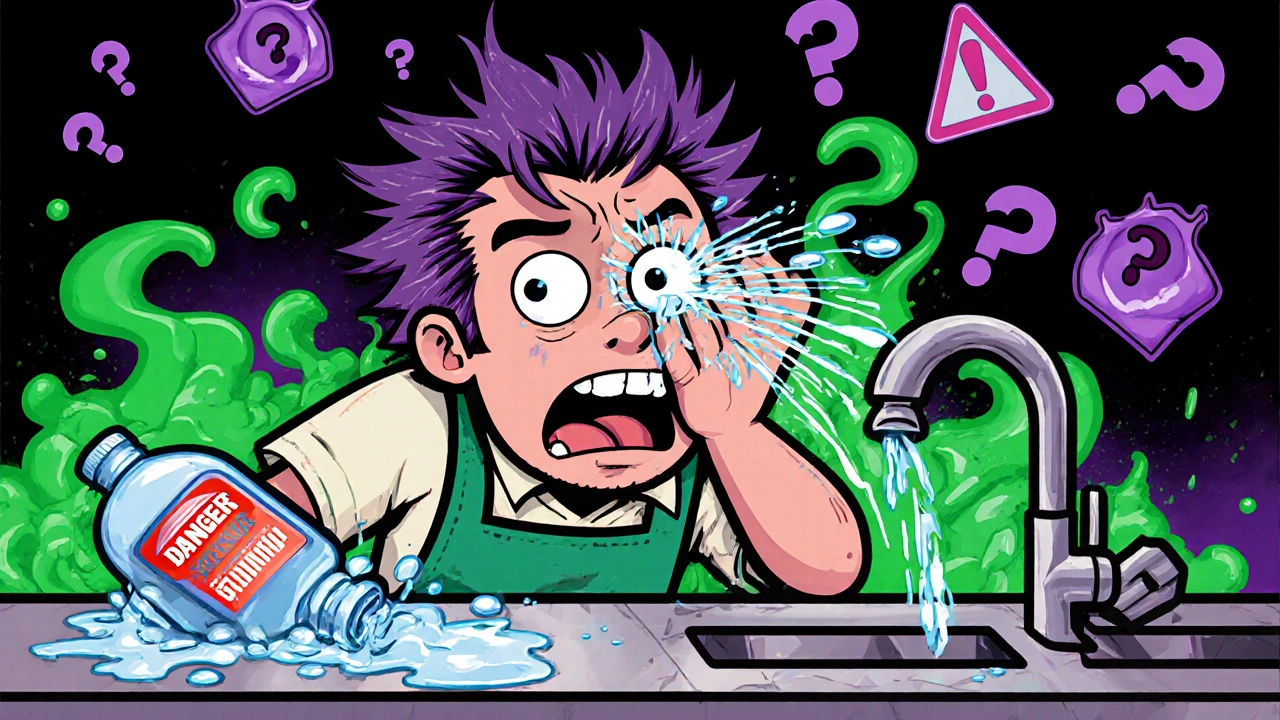
When a chemical splash hits your eye, you don’t have seconds to waste. It’s not like a cut or a burn on your skin-your eye is one of the most sensitive and vital organs in your body, and a few seconds of delay can mean the difference between seeing clearly and losing vision forever. Every year, tens of thousands of people suffer chemical eye injuries, from factory workers handling cleaning agents to parents accidentally spraying bleach near their kids. The good news? Most of these injuries can be prevented or minimized with the right immediate action. The bad news? Most people don’t know what to do when it happens.
Why Speed Matters More Than Anything
Chemical splashes don’t wait. Alkalis like ammonia, drain cleaners, or lime can burn through the cornea in under a minute. Acids like battery fluid or vinegar might seem less dangerous, but they still cause serious damage. Research from the British Journal of Ophthalmology shows that starting irrigation within 10 seconds of exposure cuts the risk of permanent vision loss by 76%. That’s not a suggestion-it’s a medical fact backed by decades of clinical data.
Delay is the enemy. A 2022 study of workplace injuries found that the average person waited over two minutes before doing anything. By then, the chemical had already started eating into the eye’s surface. The key isn’t just flushing-it’s flushing immediately and continuously.
What You Must Do Right Now
If you or someone else gets a chemical splash in the eye, follow these steps exactly:
- Get to water-fast. Don’t waste time looking for saline or bottled water. Tap water works just as well, according to research from Bascom Palmer Eye Institute. The goal is volume and speed, not purity.
- Hold the eye open. Use your fingers to gently pull the upper and lower eyelids apart. This is critical. Most people instinctively blink or squeeze shut, which traps the chemical inside. You need the water to reach every part of the eye.
- Start flushing. Tilt the head back and turn it toward the injured side. This stops the chemical from flowing into the other eye. Let water run over the eye from the inner corner (near the nose), letting it flow outward. Don’t aim the stream directly at the eyeball-let it gently wash across the surface.
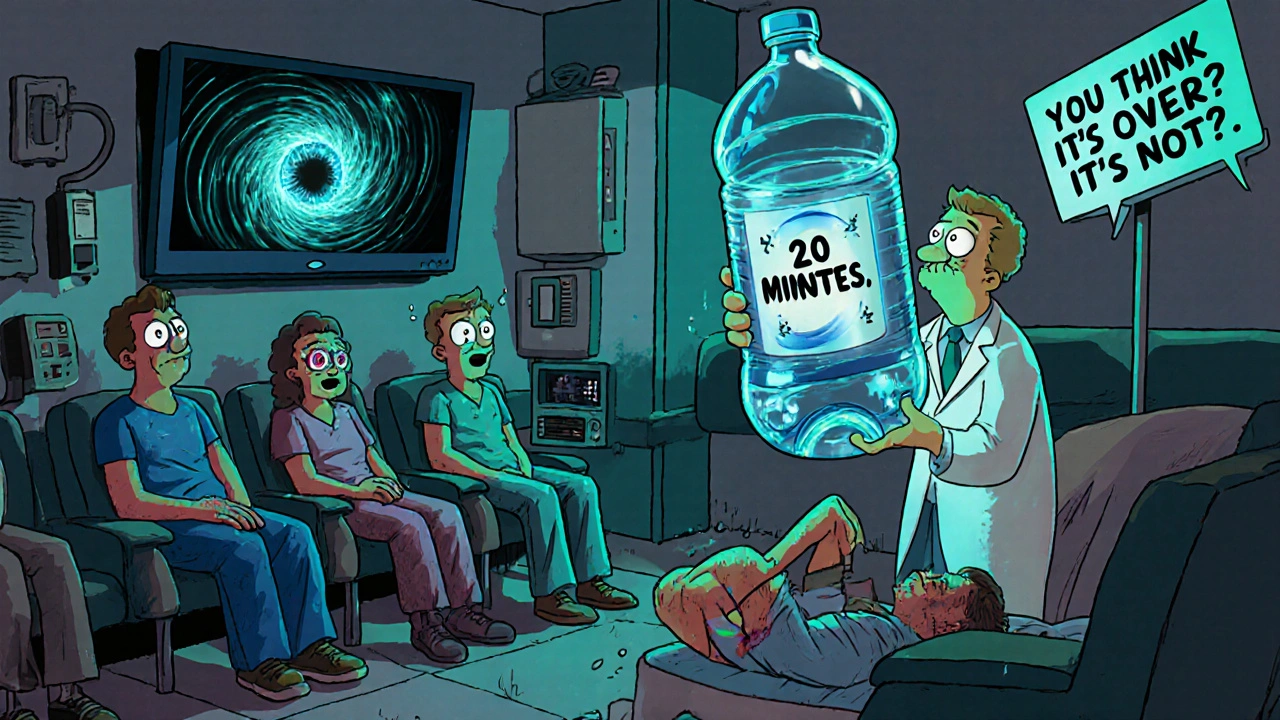
- Keep going for at least 20 minutes. Yes, 20 minutes. Healthdirect Australia and the Better Health Channel both recommend this duration. Some sources say 10 minutes is enough, but if you’re unsure, go longer. Alkali burns can keep damaging tissue for hours if not fully rinsed out. The American Red Cross says to keep flushing until emergency help arrives-and that’s the safest rule to follow.
- Don’t rub. Don’t press. Don’t try to remove a contact lens unless it’s loose and easy to take out. Forcing it can scratch the cornea. If it’s stuck, leave it and let the water flush it out naturally.
There’s no magic solution here. You don’t need baking soda, vinegar, or any home remedy. Water is the only thing you need. And you need a lot of it.
What Doesn’t Work (And Why People Get It Wrong)
People make the same mistakes over and over. Here’s what not to do:
- Using a small cup of water. You can’t flush an eye with a few ounces. You need a steady stream. A sink, shower, or hose works better than a bottle.
- Stopping when it feels better. Pain may ease after a few minutes, but the chemical is still active underneath. Stopping too soon is the #1 reason people end up with permanent damage.
- Rubbing the eye. 68% of injury cases involve rubbing. That’s like scrubbing a wound with sandpaper.
- Waiting for someone else to help. If you’re injured, you’re the best person to start flushing. Don’t wait for a coworker, parent, or friend to find the first aid kit.
A CDC survey found that 78% of households don’t even have a plan for eye emergencies. That’s terrifying. You wouldn’t wait to call 911 if someone was having a heart attack-why wait to flush your eye?
Workplace vs. Home: What’s Different?
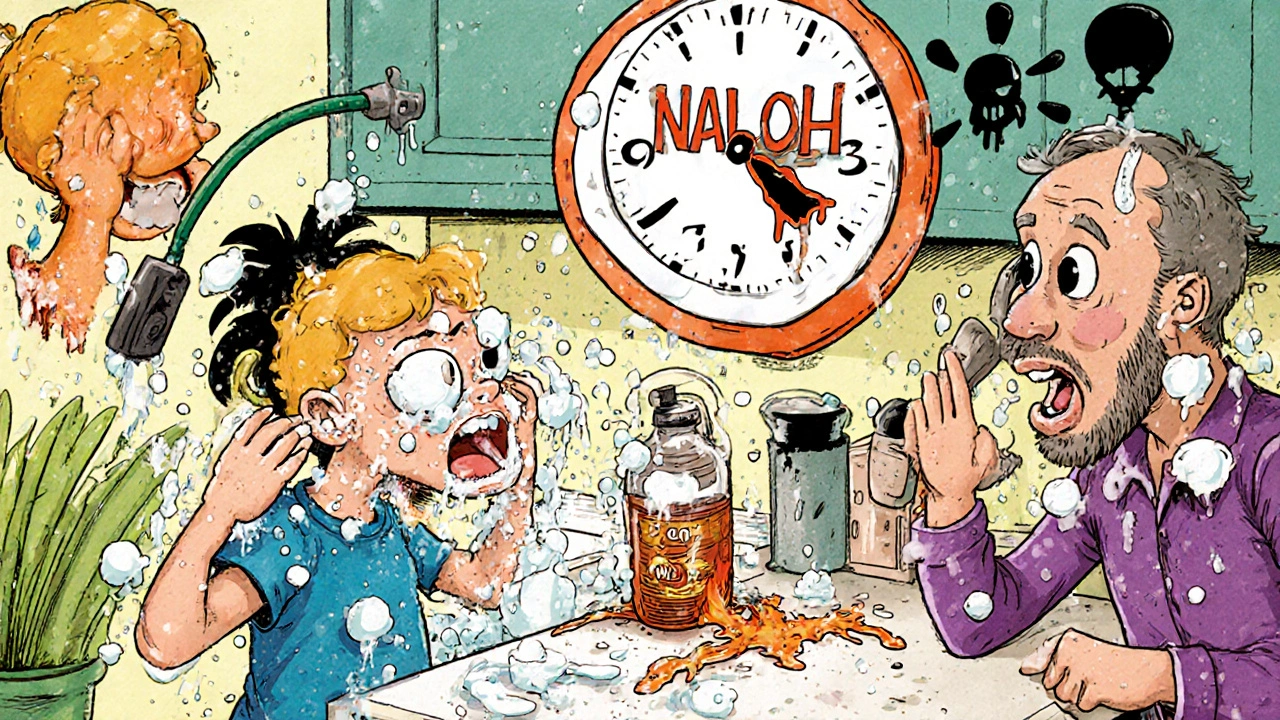
In a factory or lab, ANSI Z358.1-2021 requires eyewash stations to deliver tepid water (60-100°F) at 0.4 gallons per minute for at least 15 minutes. These stations are designed to activate in under a second and be reachable within 10 seconds of travel. But here’s the catch: OSHA found that nearly 23% of workplaces with hazardous chemicals still don’t have compliant stations nearby.
At home, you don’t have those stations. But you do have a sink, a shower, or even a garden hose. The goal is the same: flood the eye. Don’t wait for the perfect setup. Use what’s available. Cold water is fine-even if it’s uncomfortable. The discomfort is a signal to keep going, not to stop.
One key difference: workplace injuries are often from industrial chemicals like sodium hydroxide or sulfuric acid. At home, it’s more likely to be cleaning products-oven cleaner, bleach, or hair dye. But the treatment is identical: flush, flush, flush.
What Happens After You Flush?
Even if you feel fine after 20 minutes, you still need to see a doctor. Chemical damage isn’t always obvious right away. The cornea can swell, the iris can become inflamed, or pressure can build inside the eye. These issues might not show up for hours or even days.
Emergency rooms have tools to check eye pH, measure pressure, and look for hidden damage. If the chemical was strong enough, you might need a corneal transplant later. About 18.7% of severe chemical eye injury patients require one within five years, according to Medicare data.
Don’t assume you’re okay just because the pain is gone. Vision loss can be slow and silent. Get checked.
Prevention Is the Real Win
The best first aid is avoiding the injury in the first place. Wear safety goggles whenever you’re using chemicals-even at home. If you’re working with drain cleaner, paint stripper, or battery acid, goggles aren’t optional. They’re your last line of defense.
Store chemicals out of reach of children. Never transfer them to unmarked bottles. Label everything. Keep a bottle of saline or an eyewash station in your garage, workshop, or kitchen if you use harsh cleaners regularly.
Employers must train staff on emergency procedures. A 2022 study found that workers who had hands-on training were 3.2 times more likely to respond correctly than those who only read a manual. If your workplace doesn’t offer regular eye safety drills, ask why.
What’s New in Eye Injury Care?
There’s new tech on the horizon. In 2022, the FDA approved a special solution called Diphoterine that actively binds to chemicals instead of just washing them away. It can cut irrigation time by 40%. But it’s still mostly used in industrial settings and isn’t available for home use.
Researchers are also testing citrate buffers in irrigation fluids to better neutralize alkali burns. And smart goggles with built-in pH sensors are in beta testing-they’ll alert you the moment a chemical hits your eye.
But for now, the best tool you have is still water, your hands, and the will to act fast.
Final Reality Check
Chemical eye injuries are expensive-$327 million a year in the U.S. alone. They’re also preventable. Every single case starts with a moment of inaction. Someone didn’t flush fast enough. Someone thought it would be okay to wait. Someone didn’t know how.
You’re not alone if you didn’t know what to do. But now you do. And if you share this information with someone else, you could save their sight.
Can I use saline solution instead of tap water for chemical eye injuries?
Tap water works just as well as saline for initial irrigation. Research from the Bascom Palmer Eye Institute found no advantage to using sterile saline in the first minutes after exposure. The priority is speed and volume-not sterility. Only use saline if it’s already in your hand and you’re already flushing. Don’t waste time searching for it.
How long should I flush my eye after a chemical splash?
Flush for at least 20 minutes. Some guidelines say 10-15 minutes, but if you’re unsure, go longer. Alkali burns (like from oven cleaners) can keep damaging tissue for hours. The American Red Cross advises continuing until emergency help arrives. Better to over-flush than under-flush.
Should I remove my contact lenses during a chemical splash?
Only if you can do it easily without causing more damage. If the eye is already swollen or painful, leave the lens in. Water will flush it out naturally. Forcing removal can scratch the cornea. Healthdirect Australia recommends removal only if it’s loose and doesn’t cause pain.
Is it safe to use a shower to flush my eye?
Yes. A shower is often better than a sink because it delivers more water volume. Stand under the stream, tilt your head, and let the water flow over your eye. Keep the eye open. Don’t aim the water directly at the eyeball-let it gently wash across the surface. Make sure the water isn’t too hot.
Can chemical eye injuries cause permanent blindness?
Yes. Without immediate and thorough irrigation, chemical burns can destroy the cornea, cause glaucoma, or lead to scarring that blocks vision. About 1 in 5 severe cases require a corneal transplant. Speed is the biggest factor in whether you keep your sight.
What should I do if the chemical gets in both eyes?
Flush both eyes at the same time. Use a shower, sink, or hose and let water run over both eyes together. Tilt your head back and keep your eyes open. Don’t try to flush one eye at a time-it will take too long. The goal is to get the chemical out as fast as possible, no matter how many eyes are affected.
Do I need to go to the ER even if I feel fine after flushing?
Yes. Even if your eye stops hurting and looks normal, internal damage can develop hours later. Doctors can check eye pressure, pH levels, and corneal health with special tools. Delayed complications like infection, scarring, or glaucoma can be treated if caught early.


Comments
Brianna Groleau
November 20, 2025 AT 12:02 PMMy mom worked in a lab back in the 80s and she always said if your eye starts burning, don’t think-just move. She once had drain cleaner splash her while cleaning the kitchen sink, and she ran straight to the faucet, held her eye open with one hand, and screamed for my dad to turn on the shower. She didn’t stop for ten minutes. No fancy solutions, no waiting. Just water. And she still sees fine today. I tell everyone I know this story. It’s not dramatic-it’s just survival.
Rebecca Cosenza
November 21, 2025 AT 03:18 AMDon’t rub. Ever.
rob lafata
November 22, 2025 AT 15:36 PMOh wow, another ‘water is magic’ post. Let me guess-next you’ll tell us we should drink bleach to cure cancer? You’re acting like flushing with tap water is some kind of divine intervention. Newsflash: alkali burns don’t care how loud you scream while you’re rinsing. And if you think a sink spray is better than a proper eyewash station, you’re one bad workplace accident away from becoming a cautionary tale. I’ve seen people try this ‘flush for 20 minutes’ nonsense and end up with corneal ulcers because they didn’t realize the chemical was still active under their eyelid. You don’t get bonus points for being loud-you get bonus points for knowing when to stop flushing and when to call a professional. Stop glorifying DIY first aid. This isn’t a YouTube challenge.
Sarah Swiatek
November 24, 2025 AT 01:22 AMOh honey, you really think the average person has the presence of mind to hold their eye open while screaming into a faucet? I’ve seen grown men cry because they stubbed their toe. Now imagine a chemical burning your eyeball while you’re trying to pry your lids apart with shaking fingers. You’re not just asking for first aid-you’re asking for superhuman reflexes. And then you want them to keep flushing for 20 minutes? That’s longer than most people spend in the shower. Most people panic, blink, and then freeze. The real problem isn’t ignorance-it’s human biology. We’re wired to shut down under trauma. So yeah, water’s great, but what about training? What about drills? What about making people practice this before they need it? Because telling someone ‘just flush’ is like telling someone ‘just don’t panic’ during a fire. It’s not helpful. It’s cruel.
Matthew McCraney
November 24, 2025 AT 10:09 AMThey’re hiding the truth. The real reason they say ‘flush with water’ is because the pharmaceutical companies don’t want you to know about the patented neutralizing agents that work 10x faster. You think they’d let the public know about Diphoterine? Nah. That stuff costs $200 a vial. So they push tap water because it’s free. And don’t get me started on the CDC-they’re funded by the same folks who make bleach. You think they really want you to know how fast alkalis eat through your optic nerve? They want you to wait. They want you to suffer. That’s why they don’t put eyewash stations in every home. It’s all corporate control. I saw a guy on TikTok who used apple cider vinegar after a splash-still has both eyes. But no one’s talking about that. Why? Because truth is too dangerous.
serge jane
November 25, 2025 AT 11:57 AMI think we’ve lost sight of something deeper here. We treat the eye like a machine that needs fixing, but it’s not. It’s part of us. It’s the window to our soul, as they say. And when we reduce an injury like this to a checklist of steps-flush, hold open, tilt head-we’re not just teaching first aid, we’re teaching detachment. We’re teaching people to respond mechanically to trauma instead of emotionally. But trauma doesn’t care about steps. Trauma screams. Trauma shakes. Trauma makes you forget how to breathe. Maybe the real solution isn’t more water or better stations. Maybe it’s teaching people how to stay present when everything is falling apart. How to hold their own eye open not because they read a manual, but because they’re still connected to themselves. That’s the real first aid. Not the water. The courage.
Nick Naylor
November 25, 2025 AT 17:10 PMAccording to ANSI Z358.1-2021, Section 4.2.3, subsection C, eyewash stations must deliver a minimum of 0.4 gallons per minute, sustained for a minimum of 15 minutes, with water temperature regulated between 60°F and 100°F, inclusive, to prevent thermal shock. Tap water, especially in colder climates, often falls below 60°F, which constitutes a violation of OSHA 29 CFR 1910.151(c), and may induce hypothermic shock in prolonged exposure scenarios. Furthermore, the American Red Cross guidelines, while well-intentioned, are not codified standards-they are recommendations, not mandates. Employers are legally required to provide compliant stations. Individuals who rely on sinks are not just misinformed-they are negligently exposing themselves to additional physiological risk. This post is dangerously misleading. Water is not always sufficient. Temperature, flow rate, and duration must be calibrated. Not all water is created equal. Not all eyes survive improvisation.
Rusty Thomas
November 26, 2025 AT 10:43 AMOkay but like… imagine this: you’re at home, you’re cleaning the oven, you’re wearing your cute little floral apron, and suddenly-BAM-chemical spray to the face. You’re screaming, your kid is crying, your dog is barking, your husband is yelling ‘WHERE’S THE SALINE?!’ and you’re just standing there with your eye on fire, thinking ‘I thought this was supposed to be easy.’ I mean, really? We’re supposed to just… hold our eyes open? Like a zombie? And flush for 20 minutes? That’s longer than my Netflix binge. I don’t care if it’s science-I’m not doing it. I’m calling 911 and hoping they get here before I go blind. And if they don’t? Well… at least I tried. But honestly? I’m buying those smart goggles. The ones with the sensors. I don’t care if they cost a mortgage. I’d rather be rich and blind than poor and blind.
Lemmy Coco
November 26, 2025 AT 12:03 PMi just read this and i think i might have done it wrong last year when i got cleaner in my eye. i used a water bottle and blinked a lot and it felt better after 5 mins so i stopped. i didnt go to the er because i thought it was fine. now im scared. i hope i didnt mess up my vision. i just wanna know if its too late now?
Dave Wooldridge
November 26, 2025 AT 22:08 PMThey’re lying about the 76% statistic. That’s from a study funded by the National Eye Institute-which is tied to the NIH, which is tied to the FDA, which is tied to the pharmaceutical lobby. The real data? It’s buried. I found a 2019 paper from a Ukrainian lab that showed saline with sodium bicarbonate buffer reduced corneal damage by 89% in alkali burns. But you won’t see that on the CDC website. Why? Because sodium bicarbonate is cheap. It’s baking soda. And if people knew they could neutralize a chemical burn with $0.25 worth of baking soda and water, who would buy $200 vials of Diphoterine? The system doesn’t want you to know. They want you to keep flushing… and keep coming back for surgery.