
You take your inhaler. You avoid known allergens like pollen or pet dander. Yet, on some days, your chest still feels tight, and your breathing gets short. The culprit might not be what you’re touching inside your home, but the very air you are breathing. Air pollution is a silent trigger for millions of people with asthma, a chronic condition affecting over 300 million people globally that causes inflammation in the airways. When polluted air enters your lungs, it doesn’t just sit there; it triggers an inflammatory response that narrows those airways further, leading to increased medication use, emergency room visits, and hospitalizations.
The connection between dirty air and respiratory health is no longer theoretical. A 2024 systematic review confirmed that air pollution is a major driver of adverse health effects in people with chronic lung disease. But here is the good news: you don’t have to accept poor air quality as fate. By understanding specific pollutants and implementing targeted exposure reduction strategies, you can significantly lower your risk and improve your daily comfort. This isn't about moving to a different continent; it’s about making smart, evidence-based adjustments to your environment and habits.
Understanding the Invisible Triggers
To fight air pollution, you first need to know what you are fighting. Not all pollution is created equal, and different particles affect your lungs in different ways. The most dangerous offenders are fine particulate matter, specifically PM2.5 (particles smaller than 2.5 microns) and PM10. Because PM2.5 is so small, it bypasses your body’s natural defenses and penetrates deep into your lung tissue, causing immediate irritation and long-term damage. Other key pollutants include nitrogen dioxide (NO2), often from vehicle exhaust, ozone (O3), which forms when sunlight reacts with pollutants, and sulfur dioxide (SO2).
Why does this matter for your strategy? Because knowing the source helps you choose the right defense. If you live near a busy highway, NO2 and PM10 are your primary concerns. If you live in an area prone to summer smog, ozone becomes the bigger threat. Understanding these distinctions allows you to tailor your protection rather than using a one-size-fits-all approach that might miss the mark.
Mastering the Air Quality Index (AQI)
Your first line of defense is information. You wouldn’t step outside without checking the weather forecast for rain; you should do the same for air quality. The Air Quality Index (AQI) is a standardized scale used by agencies like the EPA to communicate how clean or polluted the air is and what health effects might result. It ranges from 0 to 500, with higher numbers indicating greater pollution levels and health risks.
Here is how to interpret the AQI specifically if you have asthma:
- AQI 51-100 (Moderate): Air quality is acceptable. However, sensitive groups, including those with asthma, should consider reducing prolonged outdoor exertion. If you feel wheezy after a jog, cut it short.
- AQI 101-150 (Unhealthy for Sensitive Groups): This is where things get serious for asthmatics. You should reduce prolonged outdoor exertion. Keep your rescue inhaler close and monitor symptoms closely.
- AQI 151-200 (Unhealthy): Everyone may begin to experience health effects. People with asthma should avoid prolonged outdoor exertion entirely. Shift workouts indoors.
- AQI 201-300 (Very Unhealthy): Health warnings of emergency conditions. Avoid all outdoor exertion. Stay inside with windows closed and air filtration running.
Technology makes this easier than ever. Mobile apps that provide real-time AQI alerts have been shown to improve Asthma Control Test (ACT) scores by nearly 16% in randomized controlled trials. Simply knowing when to stay inside changes the outcome. Check platforms like AirNow.gov before planning your day. It takes seconds and could save you an evening of coughing fits.
Cleaning Your Indoor Sanctuary
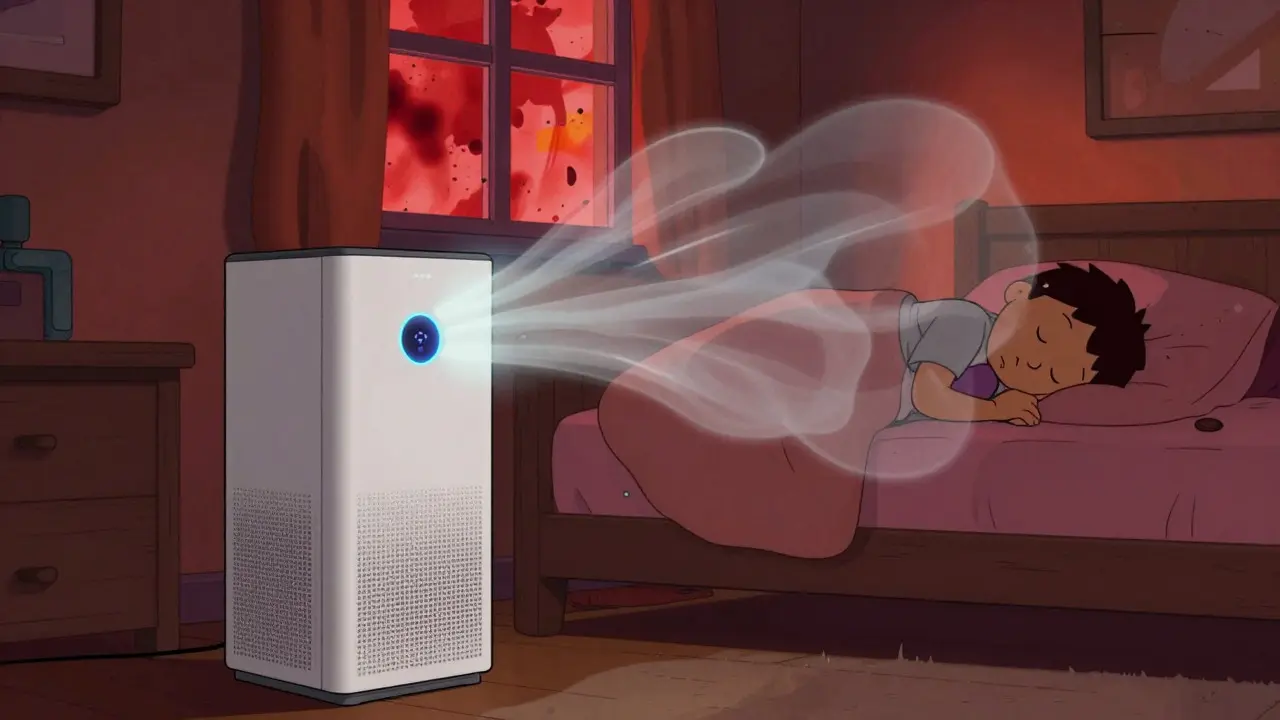
When outdoor air is toxic, your home must become a sanctuary. However, a common misconception is that closing windows is enough. Research indicates that even with windows shut, indoor PM2.5 levels can reach 60-80% of outdoor levels within an hour during high-pollution events like wildfires. To truly protect yourself, you need active filtration.
The gold standard for indoor air cleaning is the HEPA filter (High-Efficiency Particulate Air). These filters are designed to capture at least 99.97% of particles that are 0.3 microns in size-effectively trapping PM2.5, pollen, and mold spores. When choosing a portable air cleaner, look for the Clean Air Delivery Rate (CADR). The Association of Home Appliance Manufacturers recommends a CADR that is at least two-thirds of your room’s square footage. For example, in a 300-square-foot bedroom, you need a purifier with a CADR of at least 200.
If you are upgrading your whole-house HVAC system, check the MERV rating. A Minimum Efficiency Reporting Value (MERV) of 13 to 16 is recommended for capturing finer particles. Be cautious with ratings above 16, as they can restrict airflow in older systems unless professionally installed. Proper placement matters too: keep purifiers away from walls to allow proper air circulation, and replace filters every 3 to 6 months. Many users fail here, letting clogged filters turn their expensive machines into mere fans.
Navigating Personal Protective Equipment
Sometimes, you have to go outside. Maybe you work in construction, walk your dog, or commute via public transit. In these cases, personal protective equipment (PPE) becomes necessary. The CDC recommends N95 respirators for protection against wildfire smoke and high pollution events. Unlike surgical masks or cloth face coverings, N95s are designed to filter out 95% of airborne particles when properly fitted.
However, experts caution against relying solely on masks. Dr. John Balmes from UCSF notes that face masks provide incomplete protection and can create a false sense of security, especially for children who often wear them improperly. An N95 only works if it seals tightly around your nose and mouth. If you have facial hair, the seal is broken, and the effectiveness drops dramatically. Use masks as a last resort when avoidance isn’t possible, not as a license to ignore high pollution days.

Policy and Community Action
Individual actions are powerful, but they have limits. You cannot filter the air in your entire neighborhood. This is why policy-level interventions are critical. Regulatory standards like the EPA’s National Ambient Air Quality Standards (NAAQS) set the baseline for public safety. As of 2023, the annual PM2.5 standard was 12 μg/m³, though health organizations argue for stricter limits of 8 μg/m³ to better protect vulnerable populations.
Community efforts also yield significant results. School-based interventions, such as relocating bus parking zones away from playgrounds and implementing anti-idling policies, have reduced indoor PM2.5 levels in schools by 22-35%. Urban planning initiatives, like requiring new schools to be located at least 500 feet from major roadways, are gaining traction in dozens of U.S. cities. Supporting local policies that promote electric school buses and low-emission zones contributes to a broader reduction in traffic-related pollutants, benefiting everyone, not just those with asthma.
| Strategy | Effectiveness | Cost Range | Best For |
|---|---|---|---|
| HEPA Air Purifier | Reduces indoor PM2.5 by 55-67% | $50 - $800 (plus filter costs) | Home/Office environments |
| AQI Monitoring Apps | 15.8% improvement in control scores | Free - Low cost | Daily activity planning |
| N95 Respirators | 95% filtration (if fitted correctly) | $1 - $3 per unit | Short-term outdoor exposure |
| School Anti-Idling Policies | 22-35% reduction in school PM2.5 | Varies by district | Children/School communities |
Overcoming Implementation Barriers
Knowing what to do is different from doing it. A survey of 2,500 asthma patients found that while 68% check air quality regularly, only 32% consistently modify their activities based on those readings. Why? Life gets in the way. Work obligations, childcare responsibilities, and financial constraints are real barriers. If you work outdoors, telling you to "stay inside" isn’t helpful.
In these cases, focus on what you can control. Ensure your workplace has proper ventilation. Advocate for electric vehicles in your fleet if you manage a team. At home, prioritize the rooms where you spend the most time, like the bedroom, for air purification. Small, consistent steps are more sustainable than perfect, occasional efforts. Remember, the goal is not zero exposure-it’s manageable exposure that keeps your symptoms under control and your life uninterrupted.
What is the best air purifier for asthma?
The best air purifier for asthma is one with a True HEPA filter and a Clean Air Delivery Rate (CADR) appropriate for your room size. Look for a CADR number that is at least two-thirds of your room's square footage. For a 300-square-foot room, aim for a CADR of 200 or higher. Brands like Coway and Levoit are frequently cited by users for effectiveness, but the technical specs matter more than the brand name.
Can air pollution cause asthma attacks?
Yes, absolutely. Pollutants like PM2.5, nitrogen dioxide, and ozone trigger inflammatory responses in the airways. This inflammation narrows the passages, making it harder to breathe and leading to asthma attacks, increased medication use, and hospitalizations.
How do I know if the air quality is bad for me?
Check the Air Quality Index (AQI) using apps like AirNow or AirVisual. If the AQI is above 100 (Unhealthy for Sensitive Groups), you should reduce prolonged outdoor exertion. Above 150 (Unhealthy), avoid prolonged outdoor activity entirely. Real-time alerts can help you plan your day safely.
Do N95 masks help with air pollution?
Yes, N95 respirators can filter out 95% of airborne particles, including fine particulate matter. However, they must fit snugly to be effective. They are recommended for short-term exposure during high pollution events like wildfires, but they are not a substitute for avoiding polluted air when possible.
Is indoor air always safer than outdoor air?
Not necessarily. Without proper filtration, indoor air can contain up to 80% of outdoor pollution levels within an hour. Additionally, indoor sources like cooking, smoking, or mold can add to the problem. Using HEPA filters and maintaining good ventilation is key to keeping indoor air safe.