
Metformin Dose Calculator
Check Your Safe Metformin Dose
Enter your current eGFR to see the recommended maximum daily dose and monitoring schedule.
Results
Important: This calculator provides general guidance based on FDA and ADA guidelines. Always consult with your healthcare provider before adjusting your medication.
Dialysis Patients
For patients on dialysis:
Monitoring Recommendations
- eGFR 60 or higher: Check every 6-12 months
- eGFR 45-59: Check every 3-6 months
- eGFR 30-44: Check every 3 months
Important: If your eGFR drops suddenly (e.g., from 50 to 40 in a month), pause metformin and consult your doctor.
Metformin is the most common pill prescribed for type 2 diabetes - and for good reason. It lowers blood sugar, helps with weight, and may even protect your heart. But if your kidneys aren’t working well, taking metformin can be risky. The good news? You don’t have to stop it. With the right monitoring and dose changes, most people with mild to moderate kidney issues can keep using metformin safely. The key is understanding how your kidneys affect the drug - and what to do about it.
Why Kidneys Matter for Metformin
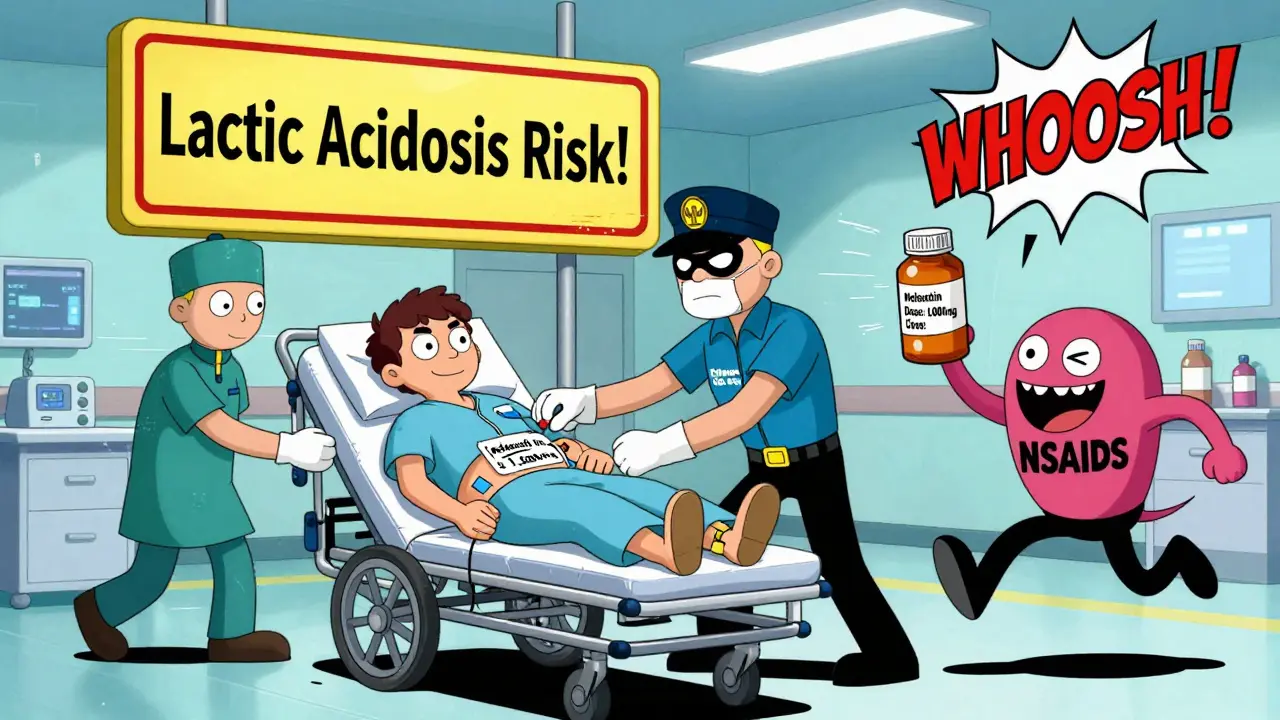
Metformin doesn’t get broken down by your liver. Instead, it leaves your body through your kidneys. If your kidneys slow down, metformin builds up in your blood. That’s not a problem if your kidneys are healthy. But if they’re damaged, too much metformin can lead to a rare but serious condition called lactic acidosis - where your blood becomes too acidic. The risk is tiny: only about 3.3 cases per 100,000 people per year. And in most of those cases, other factors like infection, dehydration, or heart failure played a bigger role than metformin itself.
Still, doctors used to cut people off metformin as soon as their creatinine levels rose. That changed in 2016. The FDA updated its guidelines to use eGFR - estimated glomerular filtration rate - instead. eGFR is a more accurate measure of how well your kidneys filter waste. It’s calculated using your age, sex, race, and blood creatinine level. Now, we don’t judge kidney health by a single number. We look at the full picture.
What Your eGFR Means for Your Metformin Dose
Your eGFR tells you exactly how much metformin is safe to take. Here’s how it breaks down:
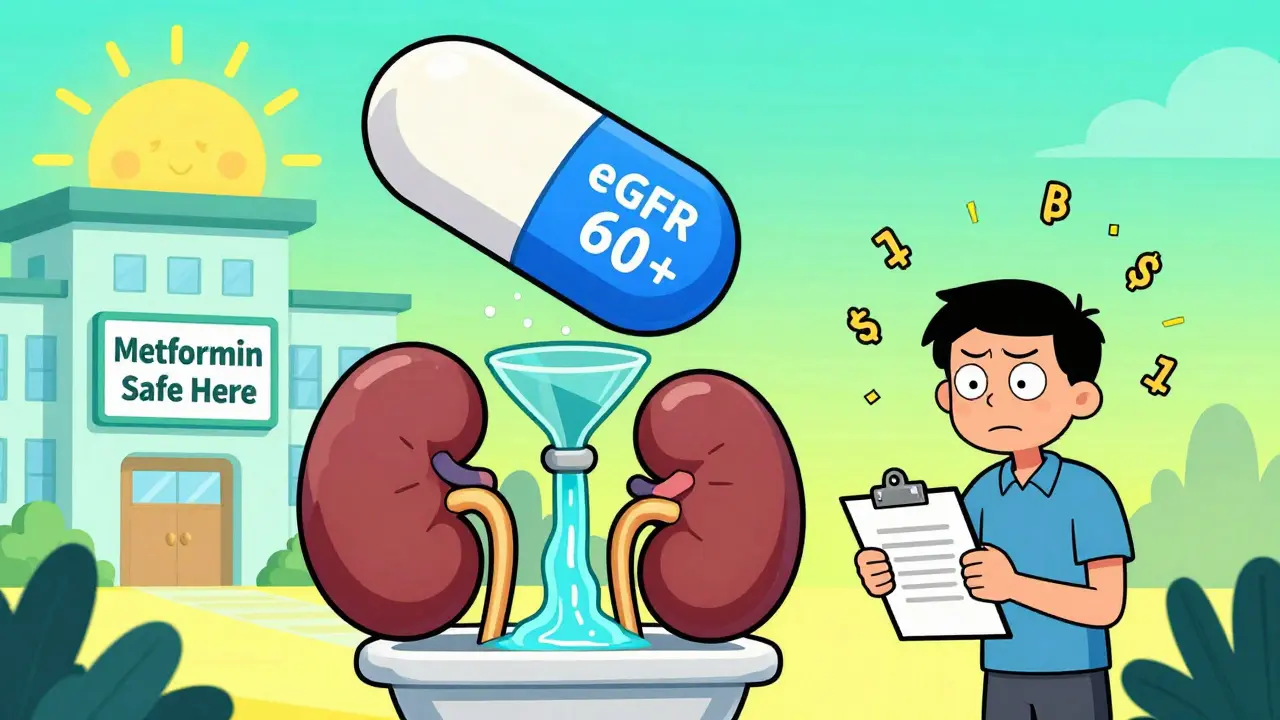
- eGFR 60 or higher: You can take the full dose - up to 2,550 mg per day. Get your kidney function checked every 6 to 12 months.
- eGFR 45-59: Max dose drops to 2,000 mg per day. Monitor every 3 to 6 months.
- eGFR 30-44: Max dose is 1,000 mg per day. Check your kidneys every 3 months.
- eGFR below 30: Metformin is generally not recommended. Some experts may allow 500 mg daily in very stable patients, but only under close supervision.
These aren’t arbitrary numbers. They’re based on years of research showing when metformin starts to accumulate dangerously. For example, a 2022 case report in the Renal Fellow Network described a 76-year-old man who kept taking 2,000 mg daily despite an eGFR of 27. He ended up with a blood pH of 6.98 - life-threateningly acidic. His lactate level hit 12.4 mmol/L. He survived, but barely. That’s why dose limits exist.
What About Dialysis?
If you’re on dialysis, your kidney function is very low - but that doesn’t mean you can’t take metformin. The rules change slightly:
- Peritoneal dialysis: 250 mg per day is safe.
- Hemodialysis: Take 500 mg after each dialysis session. Metformin is removed during dialysis, so you need to replace it afterward.
Never take your normal dose right before dialysis. You’ll end up with too much in your system. Always talk to your nephrologist about timing.
Contrast Dyes and Imaging Tests
If you’re scheduled for a CT scan or other imaging test that uses iodinated contrast dye, you need to pause metformin - especially if your eGFR is below 60. The dye can cause sudden kidney stress. If your kidneys get worse temporarily, metformin can build up and trigger lactic acidosis.
Here’s the standard protocol:
- Stop metformin the day of the scan.
- Wait 48 hours after the scan.
- Get your eGFR checked again.
- If your kidney function is stable, restart metformin.
Skipping this step is a common mistake. A 2023 study in JAMA Internal Medicine found that 41% of patients with diabetes and kidney disease didn’t get their eGFR checked after contrast imaging - putting them at unnecessary risk.
The Big Myth: Metformin Damages Kidneys
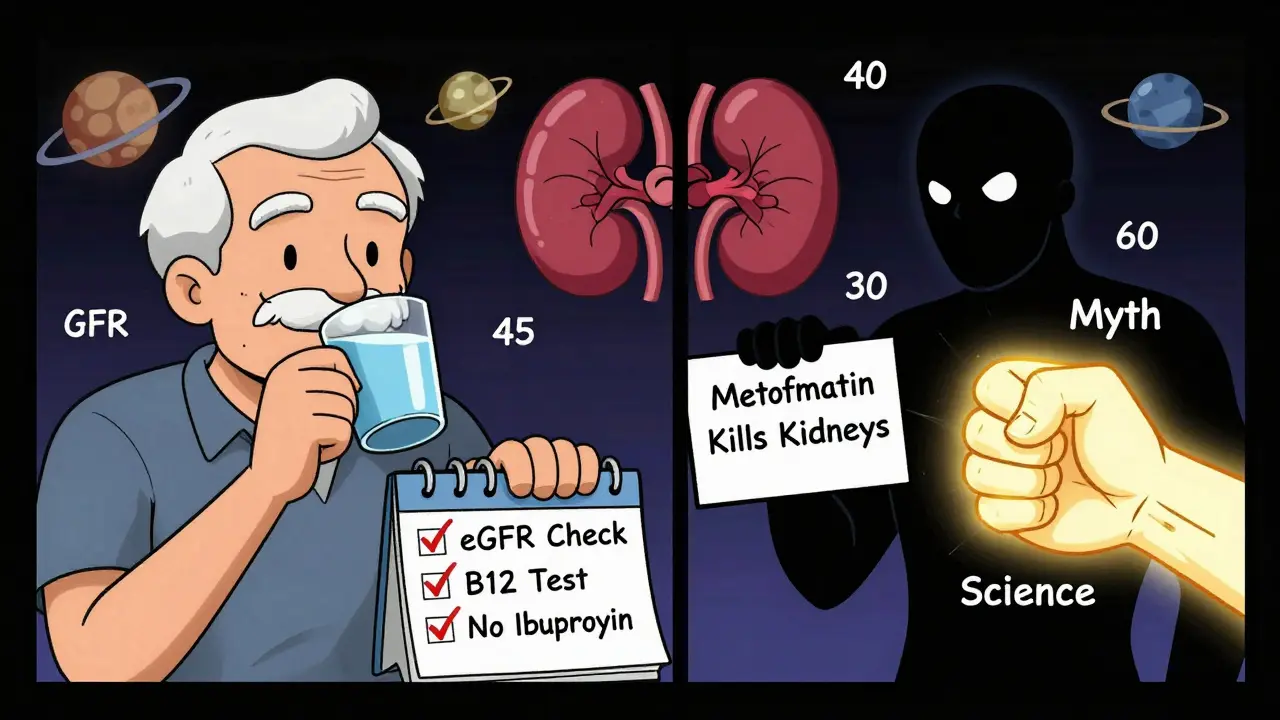
This is wrong. Metformin does not cause kidney damage. It just leaves your body through your kidneys. If your kidneys are already weak, the drug can build up. But the drug isn’t the problem - the kidney disease is.
Yet many patients stop metformin because they’re scared. A 2022 chart review from the Cleveland Clinic found that 22% of patients with eGFR above 30 had their metformin stopped unnecessarily. One 82-year-old patient saw their HbA1c jump from 6.8% to 8.9% after stopping metformin - not because their diabetes got worse, but because they lost the drug’s blood sugar control. That’s a preventable problem.
Doctors need to explain this clearly: “Metformin doesn’t hurt your kidneys. But your kidneys help clear it. So we check them to make sure you’re not carrying too much.” That simple message improved monitoring adherence by 35% in one clinic’s quality project.
Other Things to Watch For
Metformin isn’t just about kidney numbers. Other factors matter too:
- Dehydration: From illness, heat, or not drinking enough. This can drop your eGFR fast. Hold metformin if you’re sick with vomiting or diarrhea.
- NSAIDs: Painkillers like ibuprofen or naproxen can hurt kidney function. Avoid them if your eGFR is below 60.
- Vitamin B12: Long-term metformin use lowers B12 levels in 7-10% of people. Get tested every 2-3 years. Low B12 can cause fatigue, nerve pain, or even anemia.
- Unstable kidney function: If your eGFR drops suddenly - say, from 50 to 40 in a month - pause metformin. That’s not just a number change. It’s a red flag.
What the Guidelines Say - And Where They Differ
Not all medical groups agree on every detail. The FDA, ADA, and NICE all say: don’t start metformin if your eGFR is below 30. But they split on what to do between 30 and 45:
- ADA and FDA: Don’t start metformin in this range, but if you’re already on it and stable, you can keep going.
- NICE (UK): Review your dose as soon as eGFR falls below 45. Don’t wait.
- AACE/ACE: Reduce the dose in this range - no exceptions.
- KDIGO: Say it’s safe if your eGFR is above 45 - unless you’re at high risk for sudden kidney injury.
The Canadian RxFiles guidelines give the clearest dosing rules: exact milligram limits for every eGFR range. Many U.S. doctors use them as a practical reference.
How to Stay on Track
Keeping metformin safe with kidney disease isn’t hard - but it does require habits:
- Get your eGFR checked regularly - every 3 to 6 months if your kidney function is borderline.
- Keep a log of your numbers. Note any drops or spikes.
- Never skip doses because you’re scared. Talk to your doctor first.
- Stay hydrated. Drink water, especially when you’re sick or in hot weather.
- Ask for a B12 test every few years.
- Always tell any new doctor you’re on metformin - especially before surgery or imaging.
One clinic in Bristol cut metformin side effects in half by starting patients at 500 mg and increasing by 500 mg each week. That slow ramp-up reduced stomach upset - the main reason people quit - from 28% to just 9%.
What’s Coming Next?
Research is moving beyond eGFR. New studies are looking at cystatin C - another blood marker that might be more accurate for older adults. The 2024 ADA guidelines are expected to include this. There’s also the MET-FORMIN-CKD trial, which is testing whether 500 mg of metformin daily is safe for people with eGFR 25-35. Early results could change guidelines again.
For now, the message is clear: metformin is still the best first-choice drug for type 2 diabetes - even if your kidneys aren’t perfect. The cardiovascular benefits - like a 32% lower risk of heart attack over 10 years - far outweigh the tiny risk of lactic acidosis when you’re monitored properly.
And with generic metformin costing just $4 to $12 a month, it’s also the most affordable option. That’s why 76% of people starting diabetes meds in the U.S. still get metformin - even with newer, pricier drugs on the market.
Frequently Asked Questions
Can I take metformin if my eGFR is 40?
Yes, but your dose should be limited to 1,000 mg per day. You’ll need to check your kidney function every 3 months. If your eGFR stays stable and you feel fine, you can continue long-term. Many people with eGFR in the 30-44 range stay on metformin safely for years.
Does metformin cause kidney damage?
No. Metformin doesn’t harm your kidneys. It’s cleared by them, so if your kidneys are weak, the drug can build up. But the drug itself isn’t toxic to kidney tissue. This myth causes many people to stop metformin unnecessarily - which can lead to worse blood sugar control and higher heart disease risk.
Should I stop metformin before a CT scan?
Yes - if your eGFR is below 60. Stop metformin the day of the scan, wait 48 hours, then get your kidney function checked again. If it’s stable, restart the medication. This prevents contrast-induced kidney injury from turning into lactic acidosis.
What if my eGFR drops suddenly?
Pause metformin immediately. A sudden drop - like from 50 to 35 in a few weeks - could mean infection, dehydration, or another illness is stressing your kidneys. Don’t restart until your doctor confirms your kidney function has recovered. Never ignore a sudden change.
Can I take metformin with high blood pressure meds?
Most blood pressure medications are safe with metformin. But avoid NSAIDs like ibuprofen or naproxen if your eGFR is below 60. They can reduce kidney blood flow and make metformin buildup more likely. Stick to acetaminophen for pain if you need it.
Is metformin safe for elderly patients with kidney disease?
Yes - as long as doses are adjusted and monitored. Older adults often have lower muscle mass, which can make eGFR appear worse than it is. That’s why some experts now use cystatin C, a more accurate marker for seniors. But even with standard eGFR, many elderly patients benefit from low-dose metformin. The key is regular checks and avoiding dehydration.




Comments
John Rose
January 28, 2026 AT 17:34 PMGreat breakdown. I’ve been on metformin for 8 years and my eGFR dipped to 48 last year. My doc dropped my dose to 2000 mg and we’re monitoring every 4 months. No issues since. It’s crazy how many people panic and quit without understanding the numbers.
Mark Alan
January 29, 2026 AT 04:17 AMTHIS IS WHY AMERICA’S HEALTHCARE IS BROKE 😭
Doctors still don’t explain this stuff right. I had to Google this myself after my endo told me to ‘just stop it.’ I’m 52, eGFR 42, and I’m still on 1000mg. They act like it’s poison. It’s not. It’s a LIFE-SAVER.
Also, why is this even a debate? The science is clear. 🤦♂️
Amber Daugs
January 30, 2026 AT 00:12 AMPeople really think they can just ‘manage’ kidney disease with a pill? 🙄
Metformin isn’t the problem, sure-but your lifestyle is. You’re eating junk, not moving, and then blaming the drug when your kidneys fail. This is just enabling bad habits. If you had real discipline, you wouldn’t need this at all.
And don’t get me started on people skipping their eGFR tests. You’re not special. You’re not immune. You’re just lazy.
Ambrose Curtis
January 30, 2026 AT 09:52 AMYo I’ve been on metformin since 2019 and my eGFR went from 63 to 51 in 2 years. Doc kept me on 2000mg and said ‘if you’re not puking or dizzy, you’re fine.’
Also, B12? Yeah I was low as hell-tired all the time, tingling fingers. Took a supplement and boom, energy back. No one told me that.
And contrast dye? I had a CT last year, forgot to stop metformin, got a weird stomach cramp, panicked, went to ER. They checked my lactate, it was fine. But I learned my lesson. Now I write it on my calendar like a religious ritual.
Also, NSAIDs? I used to take ibuprofen for back pain. Now I use Tylenol. Simple. Free. Works.
And yeah, metformin doesn’t kill kidneys. But people act like it’s a death sentence. It’s not. It’s a tool. Use it right.
One more thing: my grandma’s 84, eGFR 38, on 500mg. Still walks 3 miles a day. No lactic acidosis. No drama. Just smart dosing.
Stop the fear. Start the facts.
Robert Cardoso
January 30, 2026 AT 23:19 PMThe entire premise is flawed. You’re treating a symptom, not a cause. Metformin doesn’t cure diabetes-it just masks hyperglycemia while allowing insulin resistance to worsen. The real issue is systemic inflammation, gut dysbiosis, and mitochondrial dysfunction. eGFR thresholds are arbitrary constructs of pharmaceutical-influenced guidelines.
Furthermore, the 3.3 cases per 100,000 statistic is misleading. It ignores underreporting, confounding variables, and the fact that lactic acidosis often presents as ‘sudden death’ without autopsy. You’re statistically safe, yes-but ethically, are you?
And why is no one talking about the 2021 meta-analysis linking metformin to increased homocysteine levels? Or the epigenetic alterations observed in long-term users?
It’s not about dosing. It’s about the entire paradigm of pharmacological management being fundamentally broken.
Katie Mccreary
February 1, 2026 AT 17:17 PMYou’re all missing the point. Why is this even allowed? Metformin is a cheap, old drug that’s been weaponized by Big Pharma to keep people dependent. The real solution is diet. Period.
And if you’re on dialysis and still taking it? That’s just dangerous. You’re playing Russian roulette with your organs.
SRI GUNTORO
February 2, 2026 AT 15:46 PMWhy do Americans think a pill can fix everything? In India, we treat diabetes with diet, yoga, and turmeric. No metformin needed. Your kidneys will thank you.
Kevin Kennett
February 2, 2026 AT 20:44 PMJust want to say-this post saved my life. I was about to quit metformin because my eGFR dropped to 41. My doc was ready to pull the plug. I read this, printed it out, and walked into his office. He changed his mind. Now I’m on 1000mg, get checked every 3 months, and my HbA1c is 6.2.
You’re not broken. Your kidneys just need a little respect. And you? You’re doing better than you think.
Howard Esakov
February 4, 2026 AT 17:23 PMHow quaint. You’re all treating this like a simple dosing chart. But have you considered the geopolitical implications? Metformin is manufactured in China and India. The supply chain is fragile. What happens when sanctions hit? Or when a monsoon floods a factory?
And let’s not forget the ethical dilemma: if we optimize metformin use for kidney patients, are we indirectly incentivizing poor lifestyle choices? Are we creating a generation of medicated zombies who think a pill replaces discipline?
And why is no one talking about the 2023 WHO report on metformin and gut microbiome depletion?
This isn’t medicine. It’s algorithmic compliance.
Rhiannon Bosse
February 6, 2026 AT 04:23 AMOkay but what if the eGFR numbers are wrong? 😈
What if the lab made a mistake? What if your creatinine spiked because you ate a steak the night before? What if your doctor’s software auto-calculates eGFR wrong for people over 70? What if this whole system is just a scam to sell more tests?
I stopped metformin because I read a Reddit post that said ‘eGFR is a lie.’ Now I’m on cinnamon and fasting. My HbA1c is 7.5. Worth it? 🤔
Bryan Fracchia
February 7, 2026 AT 19:15 PMIt’s funny how we treat medicine like a math problem. eGFR 45? 1000mg. eGFR 60? 2500mg. But the body isn’t a spreadsheet. It’s a living, breathing, fluctuating system.
What if someone’s eGFR is 47 but they’re a marathon runner with low muscle mass? Their creatinine is artificially low. Their eGFR looks worse than it is.
What if someone’s 78, eats kale, walks daily, and drinks water like it’s oxygen? Should they be denied metformin because a formula says ‘no’?
Maybe the real answer isn’t more numbers. Maybe it’s more listening. More trust. More humanity.
And yeah-metformin isn’t the villain. Fear is.
Lance Long
February 8, 2026 AT 23:30 PMI’ve been helping people with diabetes for 15 years. I’ve seen so many quit metformin because they were scared. Then their sugars go nuts. Then they get hospitalized. Then they blame the drug.
But here’s the truth: the drug isn’t the enemy. Ignorance is.
So if you’re reading this and you’re on metformin with eGFR above 30? Don’t quit. Don’t panic. Talk to your doc. Get your labs. Stay hydrated. Take your B12.
You’ve got this. I believe in you.
fiona vaz
February 9, 2026 AT 14:21 PMJust wanted to add-my mom’s 81, eGFR 34, on 500mg daily. She’s been on it for 6 years. No issues. She checks her numbers every 3 months. She drinks water. She doesn’t take ibuprofen. She’s fine.
It’s not about the number. It’s about the habits.
Sue Latham
February 10, 2026 AT 21:30 PMWow. So you’re saying it’s okay to keep taking a drug that can kill you if your kidneys slip a little? That’s not medicine. That’s gambling.
And you’re telling people to ‘trust the guidelines’? The same guidelines that said trans fats were fine? That said hormone replacement therapy was safe?
Don’t be naive. Medicine changes. Always has. Always will.