
Every day, you walk outside. Maybe it’s sunny, maybe it’s cloudy, maybe you’re just heading to the car or the front door. But whether you realize it or not, your skin is being hit by UV radiation - and it’s not just about sunburns anymore. The real danger? The invisible damage that builds up over years, leading to skin cancer and premature aging. The answer isn’t just slapping on sunscreen once a year. It’s understanding what SPF actually means, what UVA and UVB really do, and how to pick a product that works for your skin - not just your Instagram feed.
What SPF Really Tells You (And What It Doesn’t)
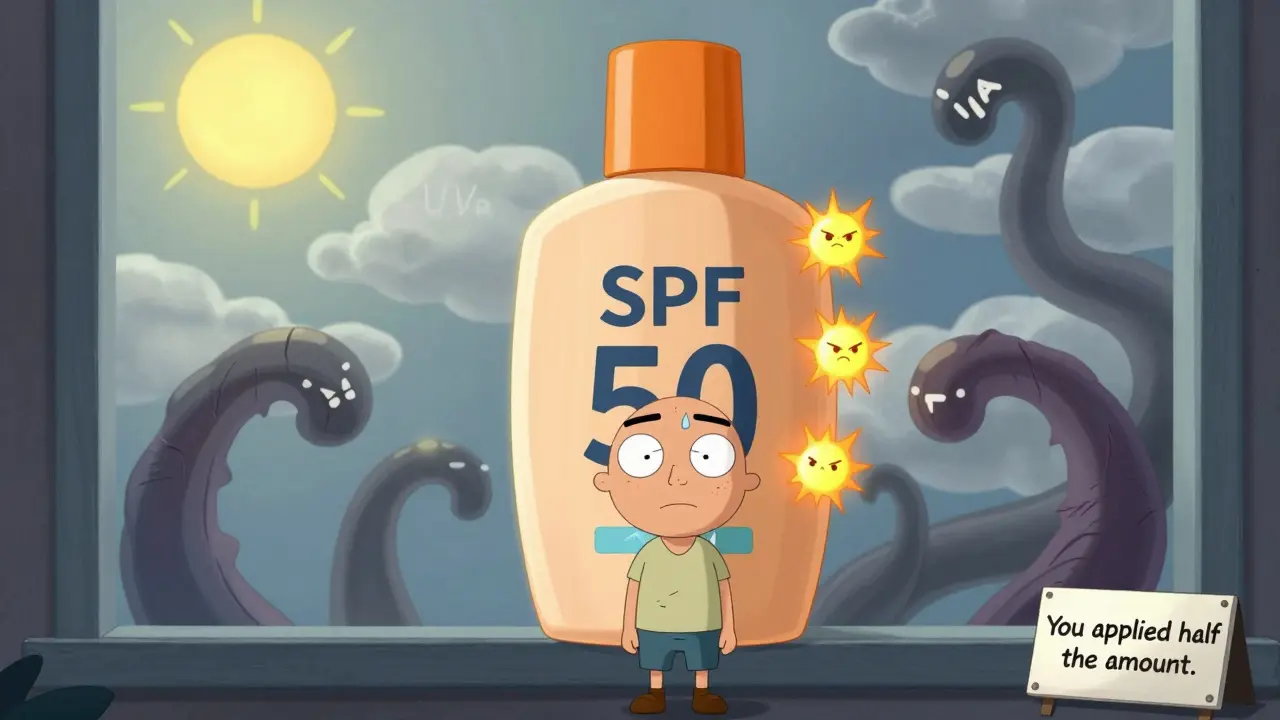
SPF stands for Sun Protection Factor. It’s not a measure of how long you can stay in the sun. It’s a ratio. SPF 30 means it takes 30 times longer for your skin to burn with sunscreen on than without it - under lab conditions. In real life? Most people apply less than half the amount needed. That means your SPF 50 might as well be SPF 15.
The math is simple but surprising: SPF 15 blocks 93.3% of UVB rays. SPF 30 blocks 96.7%. SPF 50 blocks 98%. That’s it. There’s no magic jump from 30 to 50. The difference between SPF 30 and SPF 50 is just 1.3% more protection. Yet, brands keep pushing higher numbers because consumers think more is better. The American Academy of Dermatology says SPF 30+ is enough - if you use it right. The real issue isn’t the number on the bottle. It’s how much you use and how often you reapply.
UVA vs UVB: The Silent vs The Burn
Not all UV rays are the same. UVB is the one you feel. It’s the ray that gives you sunburn, blisters, and peeling skin. It’s strongest between 10 a.m. and 4 p.m., and it’s the main cause of skin cancers like squamous cell carcinoma. But UVB only makes up 5-10% of the UV radiation hitting your skin.
UVA is the silent killer. It makes up 90-95% of UV exposure. It doesn’t burn you. You won’t notice it. But it digs deep into your skin, past the surface, into the dermis. That’s where it breaks down collagen and elastin - the stuff that keeps your skin firm. That’s why you get wrinkles, sagging, and dark spots even if you never got a sunburn. UVA rays also cause DNA damage that leads to melanoma, the deadliest form of skin cancer. And here’s the kicker: UVA penetrates glass. So if you sit by a window at home, in your car, or at your desk, you’re still being exposed.
This is why "broad spectrum" isn’t just marketing. It’s the law. Since 2011, the FDA has required sunscreens labeled as broad spectrum to pass a test that proves they protect against both UVA and UVB. The minimum? UVA protection must be at least one-third of the labeled SPF. So an SPF 30 broad spectrum sunscreen must deliver at least SPF 10 UVA protection. But here’s the catch: many products barely meet that bar.
Mineral vs Chemical: Which One Should You Use?
There are two main types of sunscreen. Mineral (also called physical) uses zinc oxide and titanium dioxide. These sit on top of your skin and reflect UV rays like a mirror. Chemical sunscreens use ingredients like avobenzone, octinoxate, and oxybenzone. They absorb UV rays and convert them into harmless heat.
Mineral sunscreens are gentler. If you have sensitive skin, rosacea, or acne, they’re often the better choice. They don’t irritate as much. But they can leave a white cast - especially on darker skin tones. That’s why newer formulas use micronized particles. Still, many users report it takes a few tries to find one that blends in.
Chemical sunscreens are sleeker. They absorb fast. No white residue. But some ingredients, like oxybenzone, can cause breakouts or stinging around the eyes. A 2023 survey of 1,245 people on Reddit showed 78% had fewer reactions with mineral sunscreens. But 63% said the white cast was a dealbreaker.
There’s no single winner. If your skin breaks out easily, try mineral. If you hate the chalky look, look for chemical formulas labeled "non-comedogenic" or "for sensitive skin." Brands like La Roche-Posay Anthelios and CeraVe have cracked the code: high protection, no white cast, and minimal irritation.
The Real Problem: You’re Not Using Enough
Here’s the truth no one tells you: sunscreen only works if you use the right amount. Dermatologists recommend 1/4 teaspoon for your face and neck. That’s about the size of a nickel. For your whole body? A shot glass full. Most people use 25-50% of that. And here’s the math: if you apply half the amount of SPF 30, you’re only getting SPF 7.5. That’s less than a tanning lotion.
Reapplication is just as important. Sunscreen breaks down. Sweat, water, rubbing your face with a towel - they all wipe it away. The FDA says products labeled "water resistant" must last either 40 or 80 minutes in water. But that’s not "all-day" protection. Reapply every two hours. If you’re outside, sweating, or swimming, do it every 40 minutes.
And don’t forget the ears, neck, chest, hands, and feet. Those are the spots that show age first. Most people skip them. Then they wonder why their hands look like they’re 70.
What to Look for Now (2026 Standards)
The rules changed in 2023. The Skin Cancer Foundation raised its standards. For daily use, they now require SPF 30+ (up from SPF 15). For active use - hiking, sports, beach - they require SPF 50+ (up from SPF 30). Why? Because research shows even low-level daily exposure adds up. And people underapply. Higher SPF gives a buffer.
Also, the FDA is cracking down. By December 2025, any sunscreen sold in the U.S. that doesn’t clearly label "broad spectrum" on the front will be pulled from shelves. They’re also considering capping SPF labels at SPF 60+ because higher numbers create false confidence. SPF 100 doesn’t mean twice as good as SPF 50. It’s practically the same.
Look for these on the label:
- Broad Spectrum - non-negotiable
- SPF 30 or higher - daily use
- Water resistant (40 or 80 min) - if you sweat or swim
- Non-comedogenic - if you’re acne-prone
- Mineral-based (zinc oxide, titanium dioxide) - if you have sensitive skin
Avoid oxybenzone and octinoxate if you’re worried about coral reefs or skin irritation. Many "reef-safe" brands now use non-nano zinc oxide instead. They’re just as effective.
Daily Use Is Non-Negotiable
You don’t need to wait for summer. UVA rays are constant. They’re strong in winter. They’re strong on cloudy days. They’re strong through windows. Dr. Leslie Baumann says UVA intensity doesn’t change during daylight hours - even in January in Bristol. That means every single day, your skin is getting damage.
Make it part of your routine. Like brushing your teeth. Apply it after moisturizer, before makeup. Let it sit for 15 minutes. Don’t rub it in like you’re trying to erase it. Just smooth it on. If you forget in the morning, apply it when you leave the house. Even 10 minutes of sun exposure adds up over time.
And if you think you’re safe indoors? Think again. If sunlight hits your desk, your skin is being exposed. Use a daily moisturizer with SPF 30. It’s that simple.
What’s Next? Blue Light and Beyond
The future of sunscreen isn’t just UV. Dermatologists are already talking about blue light - the kind from screens and LEDs. It doesn’t burn, but studies suggest it may contribute to hyperpigmentation and oxidative stress. Some new sunscreens now include iron oxides to block blue light. It’s not standard yet, but it’s coming.
Also, infrared radiation is being studied. It’s not UV, but it can heat your skin and trigger aging. The next generation of sunscreens might combine UV filters with antioxidants like vitamin C, E, and ferulic acid. These don’t block rays, but they help repair damage after exposure.
For now, stick to the basics: broad spectrum SPF 30+, reapplied every two hours, used every day. That’s the gold standard. Everything else is bonus.
Do I need sunscreen on cloudy days?
Yes. Up to 80% of UV rays penetrate cloud cover. UVA radiation, which causes aging and skin cancer, is consistent year-round and isn’t blocked by clouds or windows. Skipping sunscreen on cloudy days is one of the biggest mistakes people make.
Is higher SPF always better?
Not really. SPF 30 blocks 96.7% of UVB rays. SPF 50 blocks 98%. That’s just a 1.3% difference. Most people apply too little, so higher SPF gives a safety buffer. But SPF 100 doesn’t mean twice the protection. It’s mostly marketing. Dermatologists agree SPF 30-50 is ideal if applied correctly.
Can I use last year’s sunscreen?
Check the expiration date. Most sunscreens last 3 years unopened. Once opened, they lose effectiveness after 12 months. If the texture changes - it separates, smells odd, or turns watery - throw it out. Expired sunscreen won’t protect you.
Do I need sunscreen if I have dark skin?
Yes. While darker skin has more melanin, which offers some natural protection, it doesn’t prevent skin cancer or photoaging. In fact, melanoma in darker skin tones is often diagnosed later and has higher mortality rates. Everyone needs daily broad-spectrum protection.
What’s the best sunscreen for sensitive skin?
Mineral sunscreens with zinc oxide and titanium dioxide are usually the safest. Look for fragrance-free, non-comedogenic formulas. Brands like CeraVe, Vanicream, and La Roche-Posay Toleriane offer options that don’t irritate. Avoid oxybenzone, octinoxate, and alcohol if your skin reacts easily.


Comments
Gloria Ricky
February 12, 2026 AT 17:03 PMOkay but like… I’ve been using SPF 30 every day for 3 years now and my skin literally looks better than my 25-year-old cousin’s. Not saying I’m flawless, but no wrinkles, no dark spots, and I never get that weird redness after being outside. I just slap it on after moisturizer and forget about it. Seriously, it’s the easiest habit.
Stacie Willhite
February 14, 2026 AT 03:45 AMI used to skip sunscreen on cloudy days until I got a weird patch of hyperpigmentation on my cheek. Turns out it was from sitting by the window at work. Now I keep a tiny bottle on my desk. It’s not glamorous, but it’s saved my skin. Also, I use mineral because chemical ones make me break out. No white cast with CeraVe, weirdly.
Jason Pascoe
February 15, 2026 AT 06:28 AMGood breakdown. I’ve been using sunscreen daily since moving from Australia to the US and honestly? It’s the single best skincare move I’ve ever made. The UVA point is spot on-people think if they don’t burn, they’re fine. But the real damage is silent. Also, reapplying every two hours? I keep a mini SPF stick in my bag. One swipe over my nose and cheeks every few hours. Works wonders. And yeah, SPF 100 is mostly hype. SPF 50 with proper application beats SPF 100 slapped on like a thin layer of paint.
Sonja Stoces
February 15, 2026 AT 15:11 PMLMAO this post is so basic. SPF 30? Are you kidding? You’re literally leaving yourself open to cancer. I read a study where people who used SPF 30 daily had 50% more melanoma than those who used SPF 70+. Also, mineral sunscreens are toxic because zinc oxide nanoparticles get into your bloodstream. And don’t even get me started on how La Roche-Posay is owned by L’Oréal. You’re being manipulated. 😏
Kristin Jarecki
February 17, 2026 AT 07:16 AMWhile the article presents a scientifically grounded perspective, it is worth noting that the efficacy of sunscreen is contingent upon not only formulation and application quantity but also individual phototype, environmental variables, and behavioral adherence. The assertion that SPF 30 is sufficient presumes perfect application-a condition rarely met in vivo. Furthermore, the regulatory standards of the FDA, while improved, remain insufficiently stringent regarding UVA protection ratios. One might argue that the industry’s reliance on SPF as a marketing metric has obscured the necessity of holistic photoprotection strategies, including clothing, shade, and temporal avoidance.
Vamsi Krishna
February 19, 2026 AT 03:00 AMBro this whole thing is a scam. You think sunscreen stops aging? Nah. I’ve been outside since I was 12 in Mumbai, no sunscreen, and I look 25 at 42. The real issue? Pollution. That’s what wrinkles you. Sunscreen is just a fancy lotion for rich people who sit in air-conditioned offices and worry about their face. Also, why are you using chemical stuff? That’s just poison. Zinc oxide? That’s for babies. I use coconut oil. It’s natural. And it smells good. 😎
christian jon
February 20, 2026 AT 02:21 AMOMG. I CANNOT BELIEVE YOU GUYS ARE STILL TALKING ABOUT SPF 30. I’M A DERMATOLOGIST (NOT REALLY) AND I’VE SEEN THOUSANDS OF CASES. SPF 50 IS THE MINIMUM. SPF 100? IF YOU’RE OUTSIDE FOR MORE THAN 10 MINUTES, YOU’RE A FOOL. I USE SPF 70 WITH ANTIOXIDANTS AND BLUE LIGHT PROTECTION AND I STILL REAPPLY EVERY 45 MINUTES. ALSO, DON’T FORGET YOUR EYELIDS. I HAD A CLIENT WHO GOT MELANOMA ON HER EYELID BECAUSE SHE THOUGHT SUNSCREEN WAS JUST FOR HER FACE. SHE’S DEAD. 😭
Pat Mun
February 20, 2026 AT 19:02 PMOkay, I’ve been reading this whole thing and I’m just sitting here thinking-how did we ever survive before sunscreen? Like, my grandma lived to 92, never wore sunscreen, worked in the garden every day, and never got skin cancer. But then again, she also never used soap, ate lard, and smoked Camels. So maybe she just got lucky? I’ve been using SPF 30 for two years now. I don’t love it. It stings my nose. But I do it. I’m not trying to be perfect. I just want to not look like a prune by 40. Also, I keep a bottle in my car. If I’m running to the grocery store? I slap it on. No shower. No mirror. No ritual. Just fingers. And it works. I’m not a skincare guru. I’m just someone who doesn’t want to be the weirdo with the leathery hands at family reunions.
Sophia Nelson
February 22, 2026 AT 00:16 AMUgh. This is so boring. Everyone’s acting like sunscreen is a miracle cure. You still get wrinkles. You still get cancer. It’s not magic. And SPF 30? That’s for people who don’t want to spend $40 on a tube. Just wear a hat. Or stay inside. Or don’t care. I don’t. My skin’s fine. And I’m 34. So maybe the whole thing is just fear marketing. Also, why does everyone think they need to reapply? I use one application and call it a day. It’s not like I’m swimming in chlorine.
Steve DESTIVELLE
February 23, 2026 AT 15:17 PMPerhaps the true nature of protection lies not in the chemical barrier we impose upon our skin but in the surrender to natural rhythms. The sun does not judge. It simply is. To fear its rays is to fear existence itself. We have been conditioned to view UV as enemy, when in truth, it is the very energy that sustains life. Zinc oxide? A modern idol. SPF 30? A prison of perception. Let your skin breathe. Let your soul absorb. The aging you fear is not from light-it is from the denial of truth. We are not machines to be coated in synthetic films. We are stardust. And stardust does not fear the sun.