
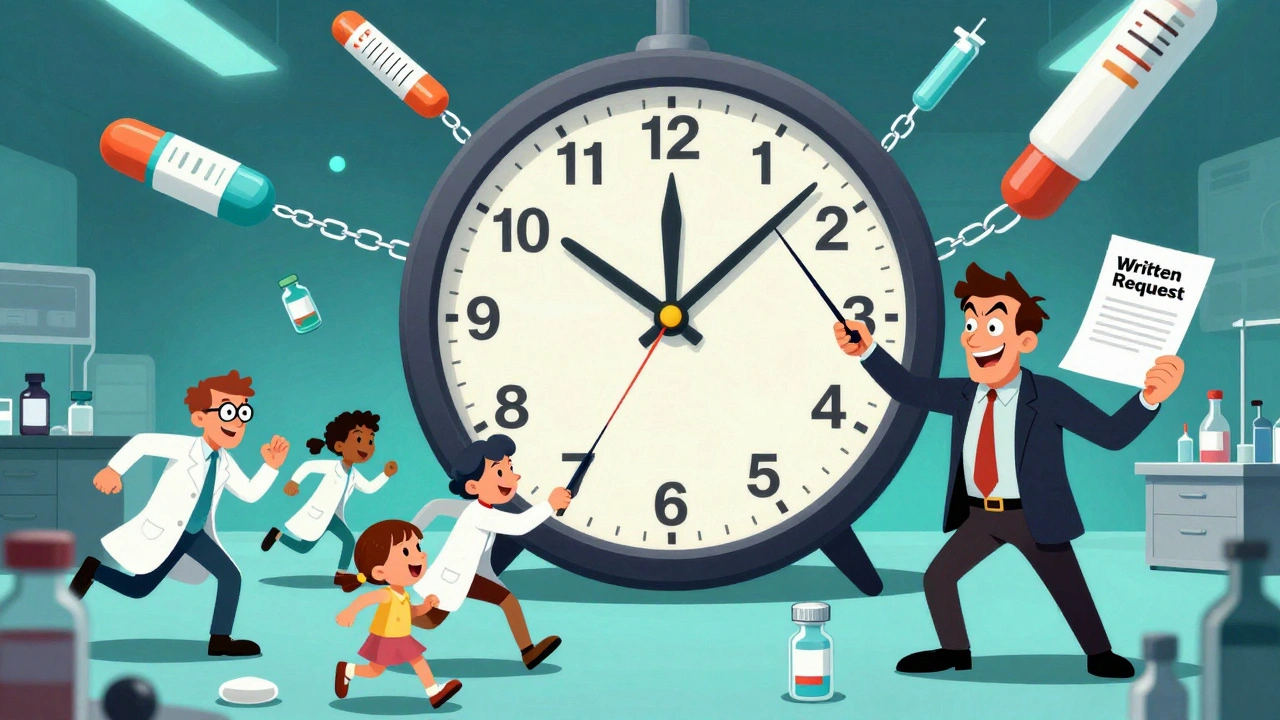
When a drug company gets approval for a new medicine, it doesn’t just get a patent-it gets a clock. But that clock doesn’t always run on its own. The FDA has a hidden tool that can add six full months to a drug’s market protection, even after the patent expires. This isn’t a patent extension. It’s something else entirely: pediatric exclusivity.
What pediatric exclusivity really does
Pediatric exclusivity doesn’t change the patent date on a drug. It doesn’t make the patent last longer. Instead, it blocks the FDA from approving generic versions-even if the patent is already gone. This is the key difference most people miss.
Here’s how it works: if a drug maker studies how a medicine affects children and submits the results to the FDA, the agency can grant six extra months of market protection. That means no generic competitor can get final approval during that time, no matter what the patent says. The FDA doesn’t need to approve new labeling or change anything about the drug. Just submitting the right pediatric studies is enough.
This rule comes from Section 505A of the Federal Food, Drug, and Cosmetic Act, made permanent in 2002 under the Best Pharmaceuticals for Children Act. The goal was simple: get more data on how drugs work in kids. For decades, most medicines were tested only in adults. Doctors had to guess dosages for children. Pediatric exclusivity gave companies a financial reason to do the right thing.
How the FDA triggers the six-month extension
The FDA doesn’t just hand out pediatric exclusivity. It issues a Written Request-a formal letter telling a drug company exactly what pediatric studies it needs. These aren’t random. They’re based on scientific gaps in the data. If a company ignores the request, they get nothing. But if they do the work and submit it on time, the FDA has 180 days to review whether the studies meet the rules.
Once approved, the six-month clock starts. And here’s the catch: it doesn’t just apply to the specific drug studied. It applies to every formulation of that same active ingredient. So if a company studies an oral version of a drug in children, the six-month protection extends to the injectable, the cream, the eye drops-all of them-as long as they contain the same active moiety.
That’s why pediatric exclusivity is so powerful. One study can lock out competition across multiple products. A blockbuster drug like Adderall or Zoloft could see hundreds of millions in extra revenue from a single pediatric study.
When pediatric exclusivity stacks with other protections
Pediatric exclusivity doesn’t work alone. It attaches to whatever exclusivity is already in place. If a drug has five years of new chemical entity exclusivity, the six-month pediatric extension adds to it. Same with three-year exclusivity for new clinical data, or orphan drug exclusivity.
But there’s a rule: the original exclusivity must have at least nine months left when pediatric exclusivity is granted. If the five-year clock is about to run out, the FDA won’t add the extra six months. That’s why timing matters. Companies often delay filing pediatric studies until just before their original exclusivity expires-maximizing the overlap.
In the FDA’s Orange Book, you’ll see patents listed twice: once with the original expiration date, and again with the pediatric extension. Generic manufacturers have to check both dates. Missing the second one means risking a lawsuit.
What happens when the patent expires?
This is where pediatric exclusivity gets tricky. Many assume that once a patent expires, generics can jump in. Not true. If pediatric exclusivity is still active, the FDA can’t approve any generic-no matter what.
That’s because pediatric exclusivity creates a regulatory barrier, not a legal one. Even if a generic company files a Paragraph II certification (meaning they say the patent is expired), the FDA still can’t approve the drug during the six-month window. The only way around it is if the brand company waives the exclusivity, or if a court rules the patent is invalid or not infringed.
In one well-known case, Apotex tried to launch a generic after patent expiration, but the FDA blocked it because pediatric exclusivity was still in effect. The courts backed the FDA. The message was clear: pediatric exclusivity overrides patent status.
Who can’t use pediatric exclusivity?
Pediatric exclusivity only applies to small-molecule drugs regulated under the Hatch-Waxman Act. It doesn’t work for biologics-like insulin, monoclonal antibodies, or vaccines. Those are governed by the Biologics Price Competition and Innovation Act (BPCIA), which doesn’t have a pediatric exclusivity provision.
That’s a big gap. Biologics are now the fastest-growing segment of the pharmaceutical market. But because they’re not eligible, companies have no regulatory incentive to study them in children. Many pediatric biologic treatments still lack proper dosing guidelines.
Also, if a drug has no patent or exclusivity left-and the company is only seeking to add a new pediatric indication-pediatric exclusivity can still be granted. But only if the supplemental application requires new clinical data. The FDA won’t reward a company for just reusing old data.
Why generic companies hate it
For generic manufacturers, pediatric exclusivity is a major roadblock. It can delay market entry by half a year, costing millions in lost sales. And unlike patent litigation, there’s no easy way to challenge it. You can’t sue the FDA over a Written Request. You can’t argue the studies were flawed in court before approval.
The only legal paths are: get a waiver from the brand company, win a patent lawsuit, or wait. Many generics wait. Others try to time their filings so they’re ready the day after exclusivity ends. Some even negotiate deals with brand companies to get early access.
Lachman Consultants reported in 2025 that a difference of one calendar day can make or break a generic launch. If the FDA approves a generic even one day before pediatric exclusivity ends, it’s illegal. The agency doesn’t make exceptions.
The hidden value: billions on the line
For a drug that brings in $1 billion a year, six months of exclusivity equals $500 million in extra revenue. That’s why companies invest millions in pediatric studies-even for drugs that aren’t popular in children.
Take the asthma drug albuterol. It’s been around for decades. But when the manufacturer studied it in kids, they got six months of exclusivity on every formulation-nebulizers, inhalers, tablets. That’s pure profit. No R&D cost, no new patent. Just a few well-placed studies.
It’s also why some companies delay pediatric studies until the last possible moment. Waiting means the six-month extension hits right when generic competition is about to begin. It’s not unethical-it’s just smart business.
What’s next?
Pediatric exclusivity has been around since 1997. It’s worked. More drugs now have pediatric labeling. More kids get safe, effective treatments. But the system is still imperfect. Biologics are left out. Some companies game the system. And the FDA’s review process can be slow.
Still, it’s one of the most effective tools in pharmaceutical policy. It doesn’t just protect profits. It saves lives. And that’s why, despite its complexity, pediatric exclusivity remains a cornerstone of how the FDA balances innovation, safety, and access.
Does pediatric exclusivity extend the actual patent term?
No. Pediatric exclusivity does not extend the legal patent term. Instead, it blocks the FDA from approving generic versions for six months, even if the patent has expired. It’s a regulatory delay, not a patent extension.
Can a generic drug be approved during pediatric exclusivity?
Only under three conditions: if the brand company waives the exclusivity, if a court rules the patent is invalid or not infringed, or if the generic applicant successfully challenges the exclusivity in court. Otherwise, the FDA is legally barred from approving any ANDA during the six-month window.
Does pediatric exclusivity apply to biologics?
No. Pediatric exclusivity only applies to small-molecule drugs regulated under the Hatch-Waxman Act. Biologics, such as insulin or monoclonal antibodies, are governed by a different law (BPCIA) that does not include pediatric exclusivity.
Does pediatric exclusivity apply to all forms of a drug?
Yes. If a company studies one formulation-like an oral tablet-and qualifies for pediatric exclusivity, the six-month protection extends to all other dosage forms (injections, creams, inhalers) that contain the same active ingredient, regardless of indication.
What happens if a company ignores the FDA’s Written Request?
Nothing. Pediatric exclusivity is voluntary. The FDA issues Written Requests to encourage studies, but companies are not legally required to respond. If they don’t submit the required pediatric data, they won’t get the six-month extension.
How long does the FDA take to review pediatric studies?
The FDA has 180 days to review the submitted pediatric study reports and determine if they meet the requirements of the Written Request. If approved, the six-month exclusivity period begins on the date of the decision.
Can pediatric exclusivity be granted to a drug with no existing patent?
Yes, but only if the company submits a supplemental application to add a new pediatric indication and the FDA requires new clinical data for approval. If the drug has no exclusivity left and no new data is needed, pediatric exclusivity won’t be granted.
Is pediatric exclusivity the same as orphan drug exclusivity?
No. Orphan drug exclusivity grants seven years of market protection for drugs treating rare diseases. Pediatric exclusivity adds six months to any existing exclusivity, including orphan status. They’re separate but can stack together.
Comments
Bruno Janssen
December 13, 2025 AT 13:21 PMThis system is a joke. Companies get half a billion extra dollars just for doing the bare minimum. Kids don’t need more studies-they need cheaper meds.
Willie Onst
December 15, 2025 AT 10:07 AMHonestly? I’m kinda glad this exists. I remember my sister getting dosed with adult meds as a kid-scary stuff. This isn’t perfect, but at least it pushes pharma to stop guessing what works for children. 🌱
Ronan Lansbury
December 16, 2025 AT 09:05 AMOf course the FDA enables corporate rent-seeking under the guise of child safety. Classic regulatory capture. The Written Requests? Pre-approved by Big Pharma lobbyists. The data? Often statistically meaningless. And yet, we pretend this is science. 🤡
Jennifer Taylor
December 16, 2025 AT 22:02 PMWAIT-so they get 6 MONTHS of monopoly just for studying kids?!?!?!?! I’m literally screaming right now. My cousin needed a drug that was ONLY tested on adults and they almost died because the dose was wrong. And now you’re telling me companies make HALF A BILLION DOLLARS just to NOT KILL KIDS?!?!?!?!
Shelby Ume
December 17, 2025 AT 05:11 AMIt’s fascinating how policy can be both brilliant and deeply flawed. Pediatric exclusivity incentivizes research that would otherwise be ignored-no doubt. But the fact that it applies to every formulation of the active ingredient? That’s a loophole that could fill a stadium. Still, if it saves even one child from being overdosed, it’s worth the trade-off.
Jade Hovet
December 17, 2025 AT 10:46 AMOMG I just learned this and now I’m obsessed 😍 Like… imagine you’re a drug company and you’re like ‘hey what if we just… study it in kids??’ and suddenly you get 6 months of no competition?? 🤯 Like… that’s literally free money!! But also… kinda genius?? 🤔❤️
nithin Kuntumadugu
December 18, 2025 AT 09:28 AMlmao big pharma again. they dont even care about kids. they just want to delay generics. the FDA is just their puppet. i bet the written requests are written by pharma lawyers. 6 months = 500 mil. math is easy. #corruptsystem
Harriet Wollaston
December 19, 2025 AT 12:59 PMThis made me cry a little. I work in pediatrics. We’ve seen so many kids suffer because doctors had to wing it with adult doses. This isn’t about profit-it’s about making sure no child has to be a guinea pig anymore. Even if the system’s imperfect, the outcome matters.
Lauren Scrima
December 20, 2025 AT 23:21 PMSo… you’re telling me the FDA lets companies get a free six-month monopoly… by doing the bare minimum? And we call this ‘public health policy’? 😏
sharon soila
December 21, 2025 AT 16:01 PMThe intent behind pediatric exclusivity is noble. It addresses a critical gap in medical knowledge. Children are not small adults. Their metabolism, organ development, and drug response differ significantly. Without this incentive, the pharmaceutical industry would have little reason to invest in pediatric research. The system, while imperfect, has led to measurable improvements in pediatric safety and efficacy. We must continue to refine it-not abandon it.
nina nakamura
December 21, 2025 AT 17:22 PMIt’s not a policy. It’s a corporate welfare program disguised as child protection. Every single one of these studies could be funded by public money. Instead, we give billion-dollar companies a free pass to extend monopolies. The FDA is complicit. The public is being played.
Constantine Vigderman
December 23, 2025 AT 02:56 AMWait wait wait-so if a company studies albuterol for kids, they get 6 months on EVERY FORM? Like the inhaler, the nebulizer, the syrup?? That’s wild. I thought patents were the only thing blocking generics. This is like a cheat code 🤯
Tom Zerkoff
December 23, 2025 AT 22:50 PMThe framework established under Section 505A represents a rare alignment of regulatory incentive and public health need. While the financial implications for manufacturers are substantial, the resultant increase in evidence-based pediatric dosing protocols has demonstrably reduced adverse events in children. The challenge lies in extending similar mechanisms to biologics, where therapeutic gaps remain profound. A policy that saves lives should not be dismissed merely because it benefits industry.