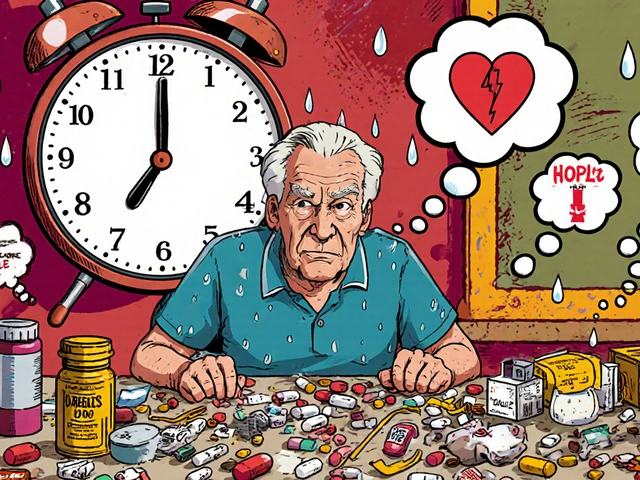

When you fly across multiple time zones, your body doesn’t just get tired - it gets confused. Your internal clock, the one that tells you when to sleep, wake up, eat, and feel alert, is still stuck in London while your body is sitting in Tokyo. This mismatch is jet lag, and it’s not just about feeling groggy. It’s a real disruption in your circadian rhythm, the 24-hour biological cycle that controls everything from your body temperature to hormone release. And if you’re using time-released melatonin to fix it, you might be making it worse.
Why Jet Lag Isn’t Just a Bad Night’s Sleep
Jet lag happens because your body’s master clock, located in the brain’s hypothalamus, doesn’t adjust instantly. It takes days to sync with the new light-dark cycle. For every time zone you cross, it usually takes about one day to recover. But eastward travel? That’s harder. Crossing eight time zones going east? You’re looking at 12 days of adjustment - not because you’re weak, but because your body has to advance its rhythm, which is biologically tougher than delaying it. Westward travel lets you stay up later, which feels more natural. Eastward means forcing yourself to sleep when your body says no.
Symptoms? Insomnia, daytime fatigue, brain fog, stomach upset, even mood swings. A 2023 Sleep Cycle survey of over 5,000 frequent flyers found that people who didn’t use any intervention took an average of 6.1 days to fully adapt after an 8-time-zone flight. That’s more than a week of being off your game - and for business travelers, that’s lost productivity.
The Melatonin Myth: Time-Released Doesn’t Work for Jet Lag
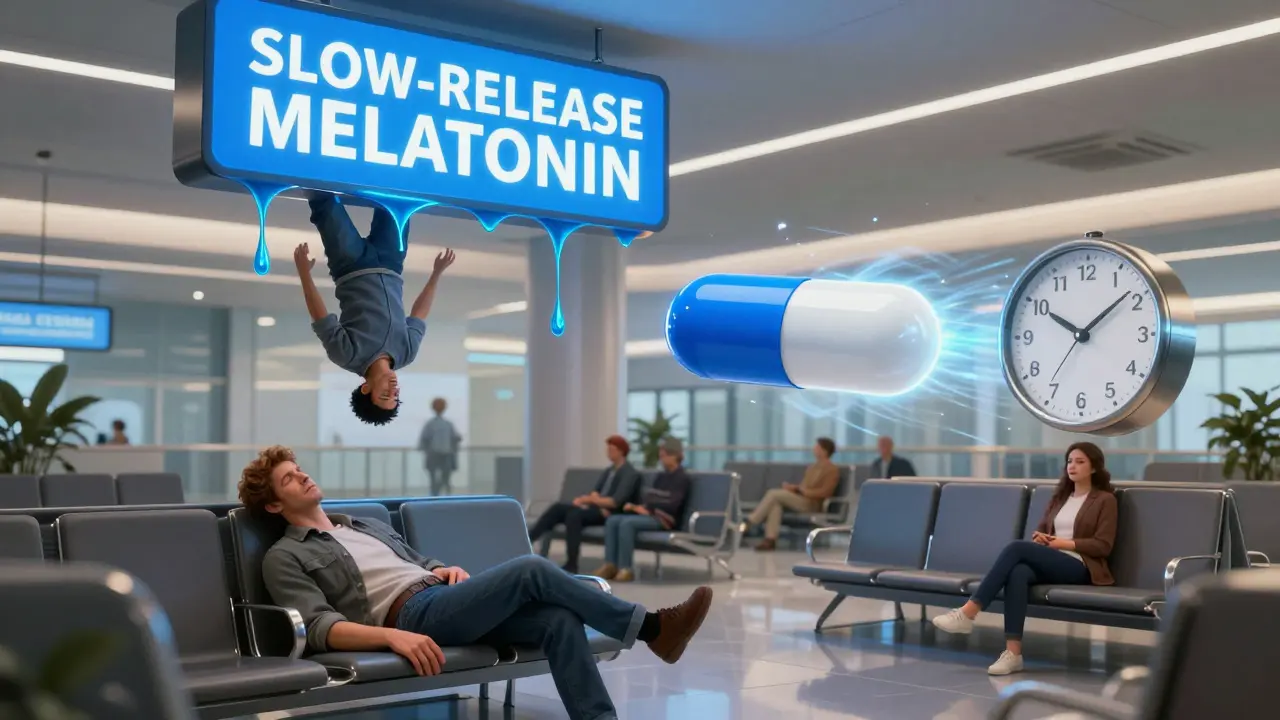
You’ve seen the bottles: "Slow-release melatonin for all-night support." It sounds smart. But here’s the truth: time-released melatonin is the wrong tool for jet lag.
Melatonin isn’t a sleeping pill. It’s a signal. Your body naturally makes it at night to tell your brain: "It’s time to sleep." When you take it as a supplement, you’re not trying to knock yourself out - you’re trying to shift your internal clock. And that requires precision.
Research from the CDC Yellow Book 2024 and multiple peer-reviewed studies shows that time-released melatonin stays in your system for 6 to 8 hours. That’s too long. The circadian system responds to a sharp, short signal - like a flashlight flicked on and off. A slow drip of melatonin? That’s like leaving the light on all night. It confuses your clock. Instead of helping you adjust, it can cause you to feel wired at 3 a.m. or groggy all morning.
A 2019 study in Sleep Medicine compared 3 mg of immediate-release versus time-released melatonin. The immediate-release group advanced their sleep cycle by 1.8 hours. The time-released group? Just 0.6 hours. That’s a 70% drop in effectiveness. And for eastbound travelers - the ones who need the biggest shift - 68% reported worse symptoms with time-released versions, according to a 2021 study.
Even the European Medicines Agency, which approved a time-released melatonin product (Circadin) for insomnia in older adults, explicitly says it’s not for jet lag. Why? Because the science doesn’t support it.
What Actually Works: Immediate-Release Melatonin
Immediate-release melatonin dissolves fast. It peaks in your blood within 30 minutes and clears out in 1-2 hours. That’s perfect. It gives your body a clear, timed signal - like a text message saying, "It’s bedtime now."
Here’s how to use it right:
- For eastward travel (e.g., London to Tokyo): Take 0.5 to 3 mg of immediate-release melatonin 30 minutes before your target bedtime at your destination. Do this for 3 to 5 nights. If you’re crossing 7+ time zones, go with 3 mg. If you’re sensitive, start with 0.5 mg - studies show it’s just as effective for shifting your rhythm.
- For westward travel (e.g., Tokyo to London): The science is less clear, but some experts recommend taking melatonin in the morning at your destination to help delay your clock. This is less common, so most travelers focus on light exposure instead.
Timing is everything. Take it too early? You might delay your clock when you need to advance it. Take it too late? You might not shift it at all. That’s why apps like Timeshifter - used by over 1.2 million travelers - are gaining traction. They ask for your flight details, chronotype, and sleep habits, then give you a personalized schedule. One Business Insider travel writer used it to cross nine time zones and adapted in just 3.5 days.
Why Time-Released Melatonin Is Still Sold (And Why You Should Avoid It)
So why do stores still sell time-released melatonin for jet lag? Because it sounds better. "All-night support" sounds more comforting than "take this at 10 p.m. sharp." Manufacturers know consumers want something easy. But the science doesn’t care how it sounds.
Amazon reviews tell the real story. Time-released melatonin products average 2.8 out of 5 stars. Immediate-release? 4.1. Users write things like: "Woke up at 3 a.m. feeling wired after taking it for my Tokyo trip." Or: "Felt groggy all morning. The time-release version made jet lag worse."
And here’s the kicker: the FDA doesn’t regulate melatonin as a drug. It’s sold as a supplement. That means the amount of melatonin in each pill can vary by up to 478% from what’s on the label. A 3 mg pill might actually have 1.2 mg or 5.7 mg. No wonder people get confused. Immediate-release is still better - but even then, you’re gambling on quality unless you buy from trusted brands with third-party testing.

What Else Helps? Light, Not Just Pills
Melatonin is only half the story. Light is the other half - maybe even more important.
Your circadian clock responds to light like a switch. Bright light in the morning tells your body: "Wake up." Darkness at night says: "Sleep." So if you’re flying east, get bright light (ideally 2,000-10,000 lux) as soon as you wake up at your destination. Sit by a window. Go for a walk. Avoid blue light (phones, screens) after dusk.
Combine that with the right melatonin timing, and you’re not just managing jet lag - you’re resetting your body. The University of Surrey found that travelers who used both light and melatonin adapted 40% faster than those who used melatonin alone.
The Bottom Line
Time-released melatonin doesn’t work for jet lag. It’s a well-intentioned mistake. Your body doesn’t need a slow drip of melatonin - it needs a precise, timed signal. Immediate-release melatonin, taken at the right moment, is backed by decades of research, endorsed by sleep experts, and used by airlines and Fortune 100 companies to keep their travelers sharp.
Don’t waste your money on slow-release formulas. Don’t guess the timing. Use a tool like Timeshifter. Stick to 0.5-3 mg of immediate-release melatonin. Get sunlight. Avoid screens at night. And give your body the clear signal it needs to reset.
Jet lag doesn’t have to be a week-long slog. With the right approach, you can be back to normal in under 48 hours - no matter how far you’ve flown.
Is time-released melatonin ever okay for jet lag?
No. Time-released melatonin is not recommended for jet lag by any major sleep organization, including the American Academy of Sleep Medicine and the CDC. Its prolonged release confuses the circadian clock by flooding your system with melatonin during times when it should be low. This can delay adjustment, worsen morning grogginess, and even cause phase shifts in the wrong direction. Stick with immediate-release for precise, timed signaling.
How much melatonin should I take for jet lag?
For most people, 0.5 to 3 mg of immediate-release melatonin is enough. Research shows 0.5 mg is just as effective as higher doses for shifting your circadian rhythm. Higher doses (3-5 mg) may help with sleep onset but don’t improve phase-shifting. Start low - especially if you’re sensitive to supplements. Avoid doses above 5 mg; they increase side effects without adding benefit.
When should I take melatonin for eastward travel?
For eastward travel, take melatonin 30 minutes before your target bedtime at your destination. If you’re flying from London to Tokyo (8 time zones ahead), your body still thinks it’s 8 p.m. in London. You want to sleep at 10 p.m. Tokyo time - so take melatonin at 9:30 p.m. Tokyo time. Do this for 3 to 5 nights. Use a tool like Timeshifter to calculate the exact time based on your flight and chronotype.
Can I use melatonin for westward travel?
Yes, but it’s trickier. For westward travel, your body needs to delay its clock - meaning you want to stay awake later and sleep later. Some experts recommend taking melatonin in the morning (upon waking) at your destination to help push your rhythm backward. But light exposure is more critical here: get bright sunlight in the late afternoon and evening. Many travelers skip melatonin for westward trips and rely on light alone.
Are there alternatives to melatonin for jet lag?
Yes, but they don’t fix the root problem. Prescription options like zolpidem (for sleep) or modafinil (for alertness) treat symptoms, not circadian misalignment. Light therapy, strategic napping, and hydration are non-pharmacological tools that work well alongside melatonin. The most effective approach combines timing-based melatonin with light exposure and sleep hygiene - not drugs.