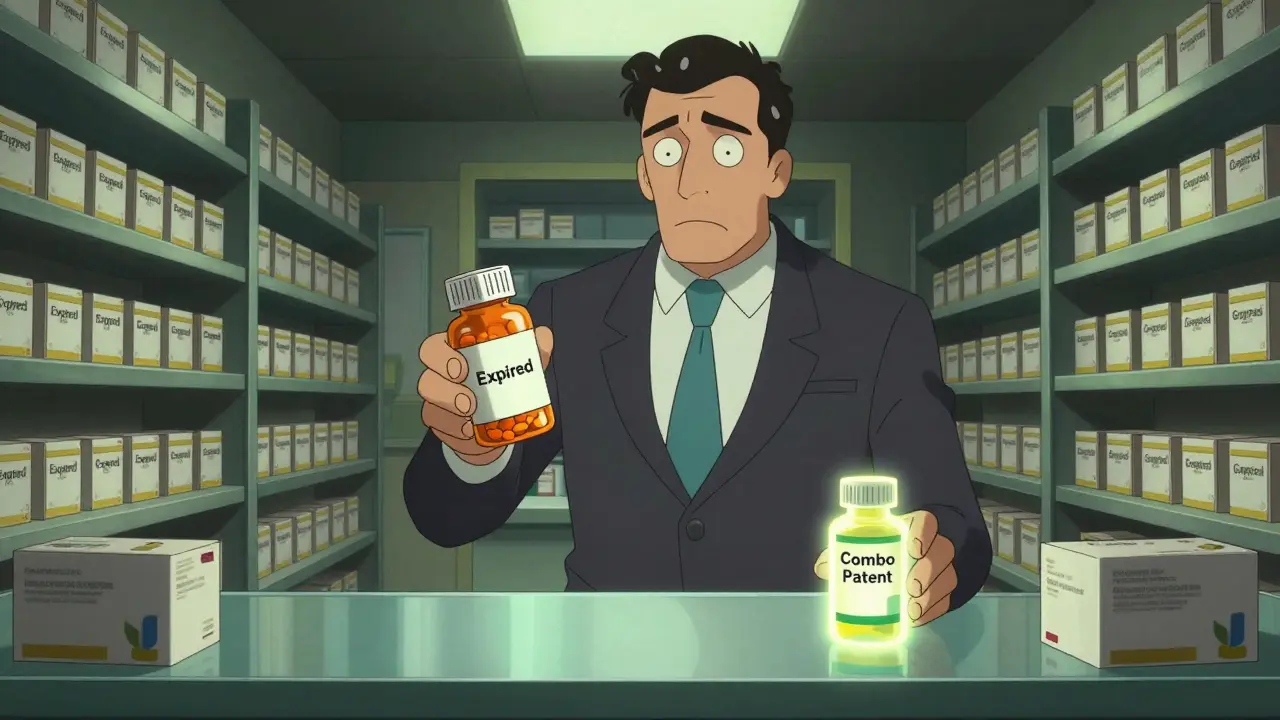
Imagine you just bought a brand-name medication that costs hundreds of dollars a month. The original patent is expiring, so you expect the price to drop when cheaper generics hit the shelves. But then, the manufacturer releases a slightly tweaked version-maybe a different pill shape, a new combination with another drug, or a special delivery system-and suddenly, the cheap option isn't available anymore. This isn't a glitch in the system; it's a calculated strategy known as evergreening, driven largely by formulation and combination patents.
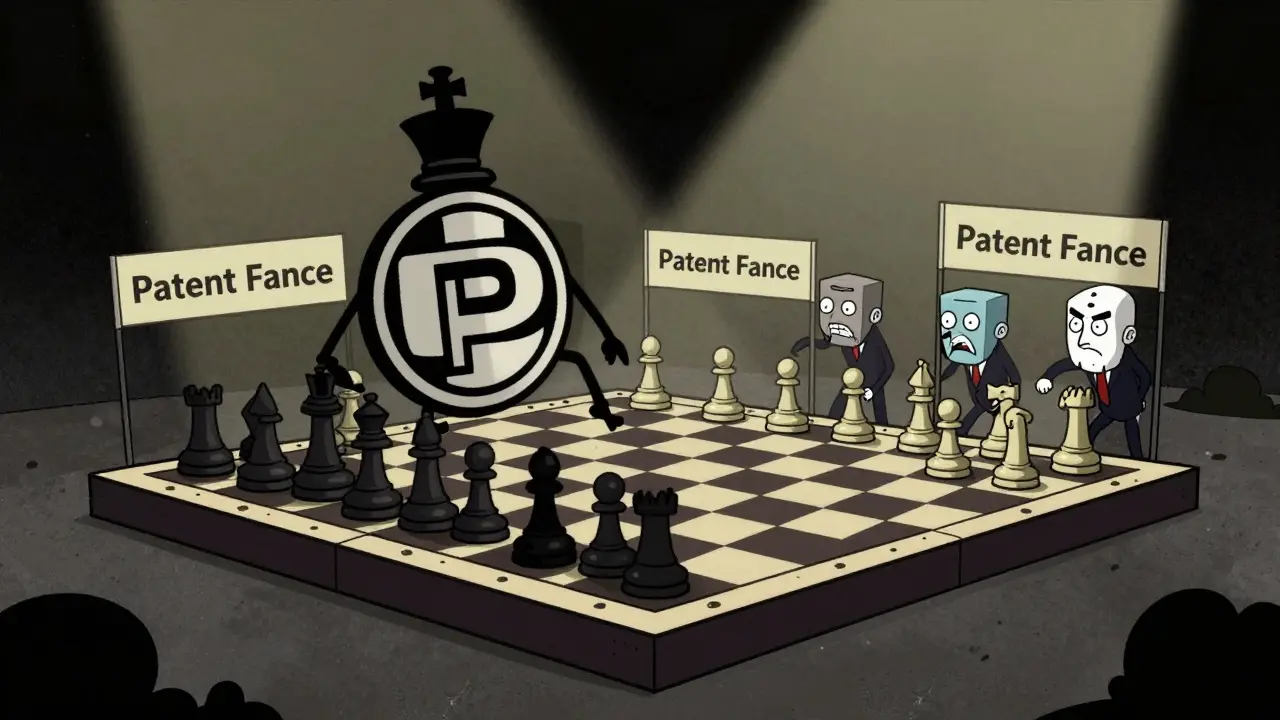
Pharmaceutical companies don't just rely on one big patent for their blockbuster drugs. They build what experts call a "picket fence" of intellectual property. When the core patent protecting the main ingredient expires, these secondary patents kick in to keep competitors at bay. It’s a sophisticated game of legal chess that extends market exclusivity by years, often keeping prices high long after the initial innovation period has passed.
The Anatomy of a Combination Patent
To understand how this works, we need to look at what exactly is being patented. A primary patent covers the chemical structure of the active pharmaceutical ingredient (API). That’s the big one. But once that starts ticking down toward expiration, companies pivot to secondary patents. These include formulation patents, which protect how the drug is made (like a time-release coating), and combination patents, which protect mixing two or more active ingredients into a single product.
Combination patents are particularly powerful because they create a new barrier to entry. Even if the individual drugs inside the combo are generic, the specific way they are combined-the exact ratio, the dosage form, or the administration method-is protected. For example, a patent might claim a composition comprising exactly 10mg of Drug A and 50mg of Drug B. If a generic company wants to compete, they can’t just copy that mix. They have to develop a non-infringing alternative, which often means running expensive new clinical trials to prove safety and efficacy for a different ratio or formulation.
This strategy relies heavily on the FDA’s Orange Book, which lists all approved drugs and their associated patents. The book tracks three main types of protection: combination patents, method-of-use patents, and formulation patents. Between 2018 and 2022, the latter two categories made up 63% of all secondary patents filed. By listing these patents, manufacturers legally block generic makers from launching equivalent products until those secondary patents expire or are invalidated.
The Legal Hurdle: Proving "Unexpected Results"
You might wonder why the USPTO grants patents for simple combinations. After all, if Drug A treats headaches and Drug B reduces inflammation, isn’t it obvious to combine them for an inflammatory headache? Not necessarily, according to patent law. However, it’s not easy to get approved.
The legal standard comes from a landmark 2007 Supreme Court case, KSR International Co. v. Teleflex Inc. The court established that combining known elements is presumed to be "obvious" unless the inventor can show something unexpected. To win a combination patent, pharma companies must provide compelling data showing that the combo works better than the sum of its parts. Maybe it reduces side effects, improves absorption, or allows for less frequent dosing.
This is where the money goes. Companies invest millions in additional research to generate statistically significant data. According to industry insights shared at the 2023 BIO International Convention, successful portfolios require $28-42 million in extra R&D just to prove these unexpected benefits. If the data shows only a marginal improvement, examiners will likely reject the application under 35 U.S.C. § 103, which governs obviousness. The precision matters immensely-one attorney noted seeing claims for a 10mg/50mg ratio rejected while a 9.8mg/51.2mg ratio was granted simply because the latter had distinct clinical data backing it.
Real-World Examples of Exclusivity Extension
Let’s look at how this plays out in the real world. Take Roche’s Phesgo®. It combines two existing cancer drugs, trastuzumab and pertuzumab, into a single subcutaneous injection. The original IV versions of these drugs faced biosimilar competition. But Phesgo offered a new delivery method-under the skin instead of through a vein-which is faster and more convenient for patients. Because this formulation was patented, Roche could maintain control over this segment of the market even as older versions lost exclusivity.
Another classic example involves AstraZeneca’s Nexium. While famous for salt-formulation tricks, the principle applies to combinations too. By creating multiple layers of protection, AstraZeneca extended revenue streams for decades. In contrast, not every attempt succeeds. Amgen tried to extend exclusivity for Enbrel using a subcutaneous injector patent, but courts invalidated it, ruling it was just "obvious automation." That failure cost Amgen $147 million in legal fees alone.
| Feature | Primary (Composition) Patent | Secondary (Combination/Formulation) Patent |
|---|---|---|
| What it protects | The chemical molecule itself | Mixtures, ratios, delivery methods, or uses |
| Average exclusivity added | 12-14 years post-approval | 3-8 additional years |
| Invalidation rate | Lower (approx. 22%) | Higher (approx. 38%) |
| Generic workaround | None (must wait) | Design around (different ratio/form) |
The Cost to Patients and Payers
Why does this matter to you? It affects your wallet and healthcare costs. The Federal Trade Commission (FTC) has raised alarms about this practice. FTC Chair Lina Khan testified in 2023 that trivial formulation changes can increase drug prices by 17-23% beyond what true innovation justifies. When a brand name company holds onto exclusivity via combination patents, insurers and patients pay premium prices for longer.
Data supports this concern. A study in the *Journal of Managed Care & Pharmacy* found that 78% of new drug applications between 2015 and 2020 included at least one formulation or combination patent designed specifically to extend exclusivity. Furthermore, 31% of combination patents filed during that period covered minor modifications like salt forms or excipient changes with no proven clinical benefit. Critics, including Dr. Aaron Kesselheim from Harvard Medical School, have labeled this "patent privateering," arguing it exploits the system without advancing patient care.
However, the industry argues that these extensions are necessary to recoup massive R&D costs. Developing a new drug takes 10-15 years and costs roughly $2.6 billion on average. Without the ability to layer patents, companies argue they wouldn’t have the incentive to innovate further on existing therapies. They point out that combination patents contributed significantly to the $1.4 trillion in global prescription drug sales in 2022.
How Generics Fight Back
Generic manufacturers aren’t sitting idle. They use a tool called a Paragraph IV challenge under the Hatch-Waxman Act. This allows them to file for approval immediately upon noticing a listed patent, asserting that the patent is invalid or won’t be infringed. It’s a high-stakes gamble. If they win, they get 180 days of exclusive generic marketing rights. If they lose, they face costly litigation.
The tide is shifting slightly in favor of challengers. In 2023, generic and biosimilar companies filed 842 Paragraph IV challenges against formulation patents, up from 517 in 2020. Their success rate has climbed to 45%, partly because courts are applying stricter standards for obviousness following the KSR decision. As a result, the average exclusivity extension from these strategies is expected to shrink from 5.3 years (in the early 2020s) to 3.8 years by 2030.
The Future of Drug Exclusivity
Regulators are watching closely. The FDA proposed rules in May 2024 requiring "clinical superiority evidence" for new formulations seeking exclusivity. Congress is also considering legislation like the Preserve Access to Affordable Generics Act, which would limit secondary patents to those showing "meaningful clinical benefit." If passed, such laws could invalidate nearly 30% of current formulation patents.
Despite the pressure, the strategy isn’t going away. IQVIA projects that strategic formulation patenting will still protect 65-70% of top-selling drugs’ revenue through 2030. But the bar is getting higher. Companies are moving away from trivial tweaks and toward more substantial innovations, like pH-sensitive release technologies or fixed-dose combos with novel mechanisms. The era of easy evergreening is ending, replaced by a demand for genuine therapeutic advancement.
What is a combination drug patent?
A combination drug patent protects a specific mixture of two or more active pharmaceutical ingredients (APIs). It covers the exact ratio, dosage form, or administration method of the combined drugs, preventing competitors from selling an identical mix even if the individual ingredients are off-patent.
How do combination patents extend market exclusivity?
When the primary patent on a drug expires, generic makers can enter the market. However, if the brand owner holds a secondary combination patent, generics cannot launch a competing product with the same formula. This forces competitors to wait for the secondary patent to expire or develop a non-infringing alternative, extending the brand's monopoly by several years.
Is evergreening illegal?
Evergreening itself is not illegal; it is a common business strategy within the bounds of patent law. However, certain tactics, like "product hopping" (discontinuing an old formulation to force patients to switch to a new patented one), face intense scrutiny from the FTC and can lead to antitrust lawsuits if deemed anti-competitive.
What is a Paragraph IV challenge?
A Paragraph IV challenge is a legal mechanism under the Hatch-Waxman Act that allows generic drug manufacturers to seek FDA approval before a brand-name patent expires. They assert that the patent is invalid or will not be infringed. If successful, they can launch the generic version early, breaking the exclusivity barrier.
Why are combination patents harder to enforce than primary patents?
Combination patents have higher invalidation rates (around 38% vs. 22% for primary patents) because they must overcome the "obviousness" hurdle. Courts and examiners presume that combining known drugs is obvious unless the applicant proves unexpected clinical benefits. Generic companies can also "design around" these patents by changing the ratio or formulation slightly.