

Drug-Induced Arrhythmia Risk Calculator
This tool helps you understand your risk of developing heart rhythm problems from medications. Based on your inputs, it provides a risk assessment and personalized recommendations. Always consult with your doctor about any concerns regarding your medications.
More than 400 common medications can trigger dangerous heart rhythm problems - and many people have no idea they’re at risk. It’s not just about heart drugs. Even your allergy pill, antibiotic, or antidepressant could be quietly messing with your heartbeat. This isn’t rare. Every year in the U.S., drug-induced arrhythmias lead to 100,000 to 150,000 hospital visits. Some of these cases turn fatal. But the good news? Most are preventable if you know what to watch for and what to do.
What Exactly Is a Drug-Induced Arrhythmia?
An arrhythmia is when your heart beats too fast, too slow, or irregularly. When it’s caused by a medication, it’s called a drug-induced arrhythmia. These aren’t always obvious. You might feel a flutter in your chest, get dizzy out of nowhere, or just feel unusually tired. But behind those symptoms, something serious could be happening: your heart’s electrical system is being disrupted.
Medications interfere with the tiny channels in heart cells that control the flow of potassium, sodium, and magnesium. When those channels don’t work right, the timing of your heartbeat gets thrown off. The most dangerous type is QT prolongation - a delay in the heart’s recovery phase that can spiral into a life-threatening rhythm called torsades de pointes. It doesn’t happen often, but when it does, it can cause sudden cardiac arrest.
Which Medications Are Most Likely to Cause Problems?
You might be surprised by the list. It’s not just the heart drugs. Here are the top offenders:
- Antibiotics: Azithromycin and levofloxacin can prolong the QT interval. Risk spikes in the first week of use.
- Antidepressants and antipsychotics: Citalopram, escitalopram, and haloperidol are common culprits. Even low doses can be risky in older adults.
- Anti-nausea drugs: Ondansetron and promethazine are frequently prescribed - and frequently linked to arrhythmias.
- Diuretics: Furosemide and hydrochlorothiazide drain potassium and magnesium, which are critical for stable heart rhythms.
- Cholesterol drugs: Statins rarely cause arrhythmias directly, but they can worsen them if you’re already low on electrolytes.
- Even heart rhythm drugs: Flecainide, propafenone, and amiodarone can make arrhythmias worse instead of better. This is called proarrhythmia.
Here’s the kicker: some people are genetically wired to be more sensitive. About 15% of people of African ancestry carry the S1103Y gene variant. About 12% of East Asians carry R1193Q. These variants make QT prolongation much more likely - even with normal doses of a drug. Most doctors don’t test for this. But if you’ve had unexplained fainting or a family history of sudden cardiac death, it’s worth asking.
Warning Signs You Can’t Ignore
Most people don’t realize their symptoms are heart-related. They blame stress, aging, or lack of sleep. But these signs could mean your heart is in trouble:
- Palpitations: Feeling like your heart is skipping, fluttering, or pounding. Happens in 70-80% of cases.
- Dizziness or lightheadedness: Especially if it happens suddenly, without standing up too fast.
- Fatigue: Not just being tired - feeling drained even after a full night’s sleep.
- Chest discomfort: Not always sharp pain. Could be pressure, tightness, or just an odd sensation.
- Fainting or near-fainting: This is a red flag. If you’ve passed out after starting a new medication, get checked immediately.
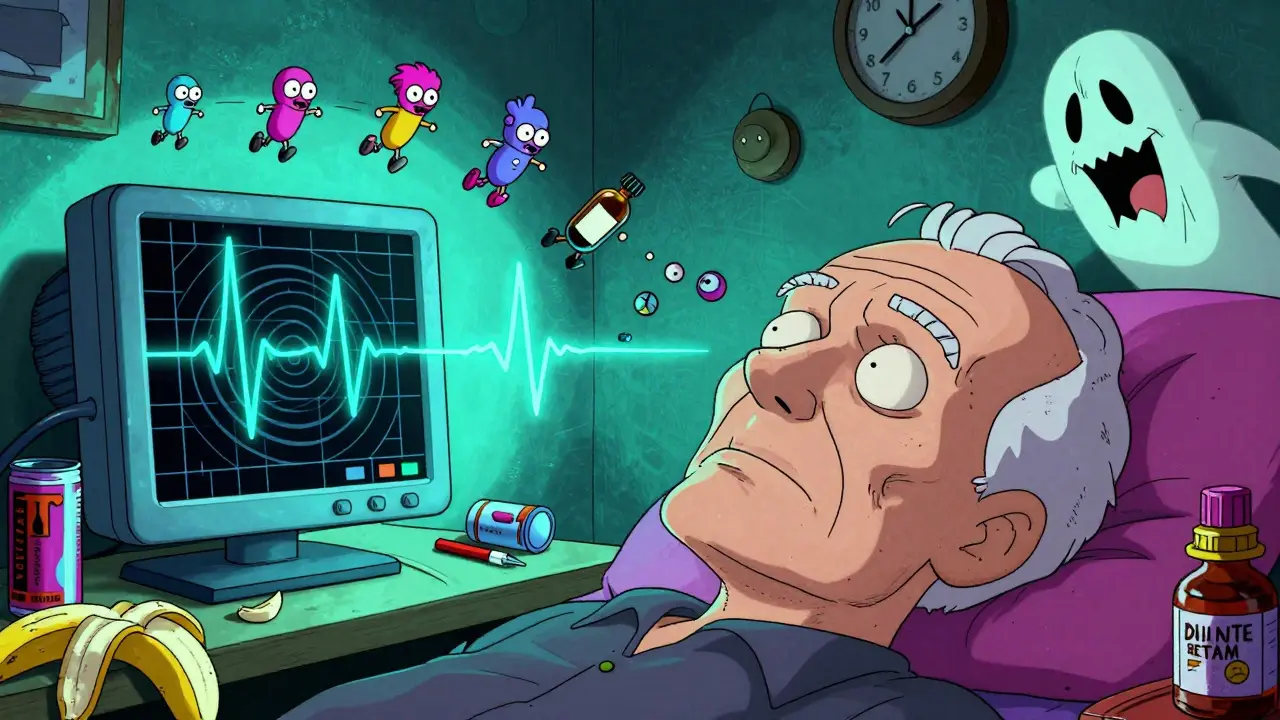
And yes - caffeine can make things worse. While it rarely causes arrhythmias on its own, it can push someone already at risk over the edge. About 25-30% of patients report palpitations after coffee or energy drinks. Cut back if you’re on a high-risk drug.
Who’s Most at Risk?
It’s not just about the drug. Your body’s condition matters just as much. Three big risk factors:
- Age 65 and older: 60-70% of severe cases happen in this group. Kidneys slow down with age, so drugs stick around longer.
- Low potassium or magnesium: One in five hospitalized patients has low potassium. One in ten has low magnesium. Both are essential for heart rhythm stability.
- Heavy alcohol use: More than three drinks a day triples your risk. Alcohol messes with electrolytes and directly irritates heart tissue.
Women are also more likely to develop QT prolongation than men - even on the same dose. And if you’re taking more than one QT-prolonging drug? Risk jumps 300-500%. That’s not a small increase. It’s a danger zone.
What Should You Do If You Suspect a Problem?
Don’t panic. But don’t wait either. Here’s what to do:
- Stop the drug only if advised. Never quit a medication cold turkey without talking to your doctor. Some drugs need to be tapered.
- Get an ECG. A simple 10-second test can show if your QT interval is prolonged. Ask for one if you’ve started a new medication and have symptoms.
- Check your electrolytes. A blood test for potassium and magnesium is quick and cheap. If levels are low, your doctor can prescribe supplements or adjust your diuretic.
- Review all your meds. Bring your full list - including OTC drugs and supplements - to your doctor. Many interactions happen with things you think are harmless.
For many people, simply switching to a safer alternative works. For example, if you’re on citalopram and getting palpitations, switching to sertraline often fixes it. If you’re on azithromycin and have a history of heart issues, amoxicillin might be just as effective without the risk.
How Are These Arrhythmias Treated?
Most cases respond well to simple steps:
- Stop or change the drug: This fixes the problem in 75-85% of cases.
- Correct electrolytes: Giving IV magnesium can stop torsades de pointes within minutes. Oral supplements help prevent it.
- Slow the heart rate: If you’re on a beta-blocker like metoprolol and your heart’s too slow, lowering the dose helps 60-70% of the time.
- Pacemaker: Needed in 10-15% of cases where the heart rate stays dangerously low despite medication adjustments.
- Catheter ablation: Used in 5-10% of persistent cases to destroy the small area of heart tissue causing the rhythm problem.
- Surgery: Required in less than 2% of cases - only when nothing else works.
For digoxin toxicity - which causes a fast atrial rhythm with a slow ventricular response - the antidote is digoxin-specific antibody fragments. It’s expensive, but it works fast. If you’re on digoxin and your kidney function is poor, your doctor should be checking your levels regularly.
How to Prevent This From Happening
Prevention is easier than treatment. Here’s what works:
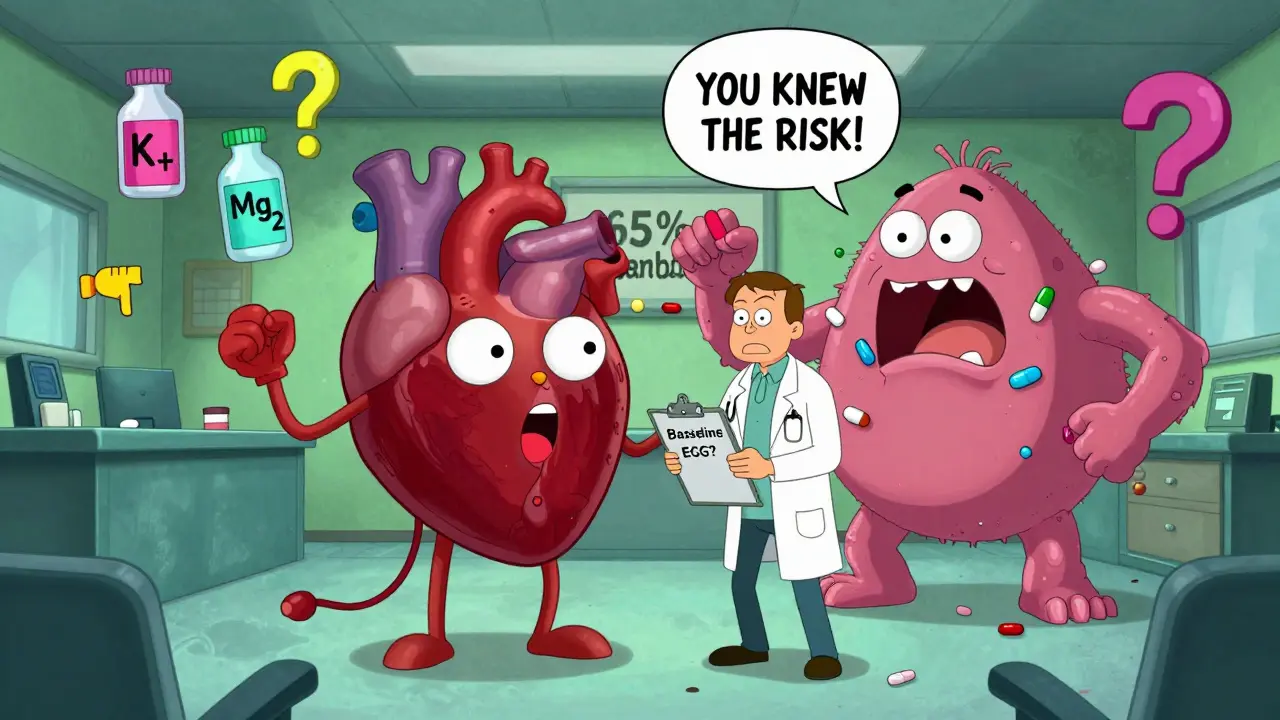
- Baseline ECG before starting high-risk drugs: Especially if you’re over 65 or on multiple meds.
- Repeat ECG within 72 hours: That’s when QT prolongation often shows up.
- Keep potassium above 4.0 mEq/L and magnesium above 2.0 mg/dL: These aren’t just numbers - they’re your heart’s safety net.
- Avoid alcohol and caffeine: Especially during the first week of a new drug.
- Stay hydrated and eat potassium-rich foods: Bananas, spinach, sweet potatoes, and beans help naturally.
- Ask about genetic testing: If you’ve had unexplained fainting or a family history of sudden cardiac death, it could save your life.
The American Heart Association now recommends that doctors use risk calculators before prescribing QT-prolonging drugs. These tools consider age, sex, kidney function, electrolytes, and other meds. A new clinical tool from the American College of Cardiology launches in 2024 - and it could become standard practice soon.
Why This Matters More Than You Think
Drug-induced arrhythmias aren’t just a medical footnote. They cost the U.S. healthcare system over $1.2 billion a year. Each hospital stay adds $8,000 to $12,000. And many of these cases are preventable. Studies show 65-75% of severe outcomes happen because symptoms were ignored or misdiagnosed.
It’s not about scaring you. It’s about empowering you. If you’re on any medication - especially if you’re older, have kidney issues, or take more than five pills a day - know the signs. Speak up. Ask for an ECG. Get your electrolytes checked. Your heart might not be able to tell you what’s wrong. But you can.
Can over-the-counter drugs cause heart arrhythmias?
Yes. Common OTC drugs like antihistamines (diphenhydramine in Benadryl), decongestants (pseudoephedrine), and anti-nausea meds (dimenhydrinate) can prolong the QT interval. Even some herbal supplements - like licorice root - can lower potassium. Always check with your pharmacist before mixing OTC drugs with prescriptions.
Is it safe to take antibiotics if I have a history of heart rhythm problems?
It depends. Macrolides like azithromycin and fluoroquinolones like levofloxacin carry higher risk. If you’ve had a previous arrhythmia, ask your doctor for alternatives like amoxicillin or doxycycline. Never assume an antibiotic is safe just because it’s common. Your heart history matters more than its popularity.
How long does it take for a drug to cause an arrhythmia?
It can happen anytime - from hours to weeks after starting the drug. For QT-prolonging drugs, the highest risk is within the first 3 to 7 days. But some, like amiodarone, build up over months. That’s why ongoing monitoring matters, even if you felt fine at first.
Can stress or anxiety mimic drug-induced arrhythmias?
Yes, anxiety can cause palpitations and dizziness that feel identical. But if you’ve recently started a new medication, don’t assume it’s just stress. The two can coexist. An ECG is the only way to tell if your heart’s rhythm is truly abnormal. If symptoms started after a drug change, assume it’s related until proven otherwise.
Should I get genetic testing before taking a new medication?
Not routinely - but if you’ve had unexplained fainting, a family history of sudden cardiac death, or you’re of African or East Asian descent, it’s worth discussing. Genetic variants like S1103Y and R1193Q increase risk significantly. While testing isn’t standard yet, some hospitals offer it for high-risk patients. Ask your cardiologist or pharmacist.


Comments
Uzoamaka Nwankpa
January 4, 2026 AT 04:16 AMMy grandma started on azithromycin for a sinus infection and passed out in the kitchen. They said it was 'just old age.' Turns out her QT interval was through the roof. No one ever asked if she was on anything else. Now I check every single med my family takes.
Chris Cantey
January 5, 2026 AT 11:12 AMIt’s fascinating how medicine has become a statistical gamble rather than a science of individual biology. We treat the body like a black box with input-output ratios, ignoring the intricate symphony of genetics, epigenetics, and environmental triggers that govern cardiac electrophysiology. The system doesn’t want you to know this-it wants compliance, not consciousness.
Abhishek Mondal
January 5, 2026 AT 14:36 PMActually, the data on S1103Y and R1193Q variants is wildly overstated in this article-most studies show effect sizes under 1.5x, and population-level risk remains negligible without polypharmacy. Also, 'QT prolongation' is not inherently pathological; it's a lab finding, not a diagnosis. You're conflating correlation with causation. And please, stop implying that all OTC meds are dangerous-diphenhydramine has been used safely for 70 years by millions. This is fearmongering dressed as education.
Oluwapelumi Yakubu
January 6, 2026 AT 22:36 PMMan, this post hit different. I'm from Lagos, and we don't even have ECG machines in half the clinics here-but folks still pop antibiotics like candy. My cousin took levofloxacin for a fever and ended up in ICU with torsades. They didn't even know what QT meant. We need this info in pidgin, on WhatsApp, on radio jingles. Knowledge ain't power if it's locked in a PDF. Spread this like yam flour in hot water.
Terri Gladden
January 7, 2026 AT 01:26 AMSo wait-so I'm supposed to believe that my Benadryl for allergies is gonna give me a heart attack? I'm 32, I run 5Ks, I eat kale. This is just Big Pharma gaslighting us again. I'm not getting an ECG because my doctor 'might' think I'm at risk. I'm not a lab rat. Also, my dog has more sense than this article.
Jennifer Glass
January 8, 2026 AT 11:11 AMI appreciate how thorough this is. I’m on escitalopram and noticed fatigue and occasional palpitations after 3 weeks. I brought it up to my PCP, and they agreed to check my electrolytes and do an ECG. My potassium was 3.7-low-normal-and they switched me to sertraline. No more symptoms. It’s scary how easily this gets missed. Thank you for the clarity.
Joseph Snow
January 10, 2026 AT 10:53 AMThis entire narrative is a manufactured crisis. The FDA has issued 12 warnings on QT-prolonging drugs since 2000. Over 100 million prescriptions are filled annually. That’s 0.001% adverse events. Meanwhile, the CDC reports 500,000 deaths from antibiotic resistance each year. We’re panicking over a statistical ghost while ignoring real epidemics. Who benefits from this fear? Pharma? Hospitals? The medical-industrial complex is monetizing anxiety.
John Ross
January 12, 2026 AT 10:33 AMFrom a clinical pharmacology standpoint, the real issue isn’t the drugs-it’s the lack of therapeutic drug monitoring. We monitor INR for warfarin, creatinine for nephrotoxins, HbA1c for diabetes-but we don’t routinely track QTc or serum Mg/K+ when prescribing high-risk agents. That’s not negligence-it’s systemic underinvestment in preventive cardiology. We treat arrhythmias like emergencies, not iatrogenic outcomes waiting to happen.
Clint Moser
January 12, 2026 AT 18:16 PMThey’re lying about the statins. They don’t cause arrhythmias… but they DO deplete CoQ10. And CoQ10 deficiency = mitochondrial dysfunction = arrhythmia substrate. They won’t tell you because statins make billions. And the ECG? It’s a trap. They’ll say 'normal' even if your QTc is 480. They don’t want you to know. Google 'QTc calculator'-you’ll see the truth.
Ashley Viñas
January 14, 2026 AT 12:41 PMIt’s not just about the meds-it’s about the people taking them. If you’re 70, on 8 medications, and still drinking 2 glasses of wine a night while eating nothing but white bread and processed cheese… well, honey, you’re not a victim of medicine. You’re a victim of your own choices. Stop blaming the pill and start blaming the plate.
Brendan F. Cochran
January 16, 2026 AT 12:22 PMThey’re trying to scare us into thinking every pill is poison. In America, we’re the most medicated nation on Earth-and we’re also the healthiest? No. We’re the most sick. This is just another way for doctors to make more money. Get off the meds. Eat real food. Walk. Sleep. Stop letting corporations run your body.
jigisha Patel
January 16, 2026 AT 16:59 PMThere is a critical omission here: the role of CYP450 polymorphisms. The article mentions S1103Y and R1193Q but ignores CYP2D6 ultra-rapid metabolizers who convert prodrugs into toxic concentrations. That’s a larger population than the genetic variants cited. Also, the reference to '100,000–150,000 hospital visits' is misleading-it includes transient, asymptomatic QT prolongation without clinical sequelae. This is cherry-picked data.
Mandy Kowitz
January 18, 2026 AT 16:15 PMOh wow, so now I can't even take a cold pill without risking cardiac arrest? I'm gonna go lie down in a dark room and pray to the gods of electrolytes. This article is the reason people don't trust doctors anymore. Also, who wrote this? A pharmaceutical sales rep with a thesaurus?
melissa cucic
January 19, 2026 AT 07:50 AMThank you for the nuanced, evidence-based approach. I work in a rural clinic where patients often come in on 10+ medications, many prescribed by different providers. The ECG and electrolyte checks you recommend are not just prudent-they’re life-saving. I’ve started a protocol: for any patient over 60 on more than 5 meds, we do a baseline ECG and a basic metabolic panel before adding anything new. Simple. Cheap. Effective. This isn’t fear-it’s responsibility.