

When you fill a prescription, do you know if you’re getting the brand-name drug or a generic? And if it’s a generic, do you know whether it’s an authorized generic-or just a regular one?
Most people don’t think about it. They pick up their pill bottle, see a lower price, and assume it’s the same as the brand. But there’s a big difference between a traditional generic and an authorized generic-and patients notice it more than you’d expect.
What Exactly Is an Authorized Generic?
An authorized generic isn’t made by a different company trying to copy the brand. It’s made by the same company that makes the brand-name drug. Same factory. Same ingredients. Same pill shape, color, and coating. The only difference? No brand name on the label.
For example, if you take Lipitor (atorvastatin), the brand-name version, your doctor might prescribe it. But when the patent expires, Pfizer-yes, the same Pfizer-can launch an authorized generic of atorvastatin. It’s chemically identical. It’s not just "similar enough." It’s the exact same product, just sold under a different label.
This is different from traditional generics, which must prove they work the same way through FDA testing. Authorized generics skip that step because they’re already approved under the original brand’s application. They don’t have to prove bioequivalence-they already are the brand.
Why Do Patients Prefer Authorized Generics?
Patients aren’t just saving money-they’re avoiding anxiety.
A 2018 study tracking over 210,000 patients found that when people switched from a brand-name drug to an authorized generic, only 22.3% went back to the brand. That’s compared to 28.7% who switched to a traditional generic and then switched back. That’s a 22% drop in switchbacks.
Why? Because traditional generics sometimes have different fillers, dyes, or coatings. These inactive ingredients don’t affect how the drug works, but they can change how the pill feels in your mouth, how quickly it dissolves, or even cause minor side effects like stomach upset or headaches. People notice these differences. They don’t always know why, but they feel something’s off.
Authorized generics don’t have that problem. They’re the same pill, just cheaper. In a Consumer Reports survey, 78% of people couldn’t tell the difference between an authorized generic and the brand when given unlabeled samples. Only 52% could tell the difference with traditional generics.
On Reddit’s r/pharmacy community, a 2022 thread asked: "Authorized generics vs regular generics-any difference?" Of 87 comments, 63% said they noticed no difference between the authorized version and the brand. Only 28% said the same about traditional generics.
But Price Still Matters-A Lot
Here’s the catch: authorized generics aren’t the cheapest option.
When a brand-new generic hits the market, the first company to file gets 180 days of exclusivity. During that time, if the brand company launches an authorized generic, it cuts prices by 4-8% at the retail level and 7-14% at the wholesale level. That’s helpful-but it’s not the full story.
After those 180 days, other generic manufacturers enter. Their versions are often 15-25% cheaper than the authorized generic. That’s when most patients switch again-this time to the lowest-priced option.
According to AmerisourceBergen’s 2022 analysis, after the exclusivity window closes, traditional generics grab 65-75% of the market share. Authorized generics drop to 10-15%. Why? Because most people don’t care if it’s the same pill if they’re saving $15 a month.
So patients don’t choose authorized generics because they’re the best. They choose them because they’re the best at first. Once cheaper options arrive, price wins.
Who Decides What You Get?
Here’s the uncomfortable truth: you probably don’t get to choose.
Most insurance plans and pharmacy benefit managers (PBMs) automatically substitute generics for brand-name drugs. A 2022 KFF analysis found that 82% of commercial insurance plans do this without asking. Only 12% let you or your doctor request the brand without extra paperwork.
Pharmacists are trained to dispense the lowest-cost option. If your plan covers both an authorized generic and a traditional generic, they’ll pick the cheaper one. If both cost the same, they might pick the authorized version-but only because it’s listed as the default.
Most patients never even see the difference on their receipt. The label says "atorvastatin." They don’t know if it’s made by Pfizer, Teva, or Mylan. And unless they’re paying attention, they won’t care.
The Hidden Strategy Behind Authorized Generics
Why do brand companies bother making authorized generics at all?
It’s not about helping patients. It’s about protecting profits.
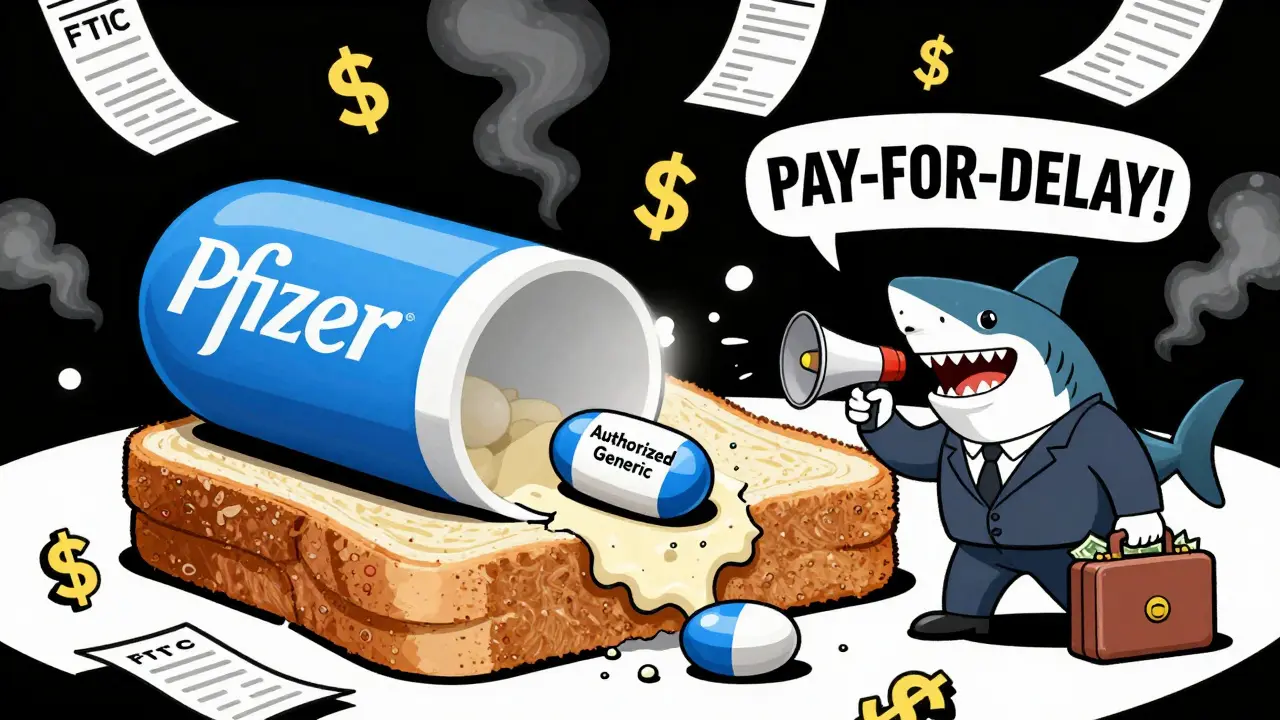
The Federal Trade Commission found that some brand companies use the threat of launching an authorized generic to pressure generic manufacturers into delaying their entry. If a generic company knows the brand will undercut them the moment they launch, they might agree to wait months-or even years-to enter the market. That’s called a "pay-for-delay" deal.
Between 2021 and 2022, the FTC identified 23 such settlements involving authorized generics. These deals cost consumers billions. The Congressional Budget Office estimates that if this trend continues, Medicare Part D could lose $1.2 billion a year by 2027.
At the same time, authorized generics let brand companies keep making money after their patent expires. Instead of losing 90% of sales overnight, they keep 10-15% by selling the same drug under a cheaper label. It’s a soft landing.
But it’s not a win for competition. It’s a win for the brand.

What Should You Do?
Here’s what you can actually do:
- Ask your pharmacist: "Is this an authorized generic?" They can check the FDA’s "Products with No Applicant" list. It’s updated monthly.
- If you notice side effects after switching to a generic, ask if you can go back to the brand-or to an authorized version.
- Check your insurance formulary. Some plans list authorized generics separately. If they’re priced the same as traditional generics, ask your doctor to write "Dispense as Written" on the prescription.
- Don’t assume all generics are equal. If you’ve had bad experiences with traditional generics before, an authorized one might be safer.
Most people won’t dig this deep. But if you’ve ever had a drug stop working-or made you feel weird-after switching to a generic, you’re not imagining it. And you’re not alone.
The Bigger Picture
Authorized generics sit in a weird space. They’re not the cheapest. They’re not the most common. But they’re the most trusted.
They prove that patients care about more than price. They care about consistency. About trust. About not having to guess whether their medicine will work the same way tomorrow.
And while the system is designed to push people toward the lowest price, the data shows that when patients have a choice, they often pick the version that feels most like the brand.
That’s not irrational. It’s human.
As the market evolves, more authorized generics will appear. More patients will ask for them. And more insurers will have to decide: do they want to save a few dollars now-or keep people on their meds long-term?
Right now, the answer leans toward cost. But if patient outcomes matter, maybe it’s time to rethink that.


Comments
Fabian Riewe
December 28, 2025 AT 20:36 PMHad a weird experience with my blood pressure med last year. Switched to a generic and started getting these weird headaches. Didn't think much of it until I switched back to the brand and boom - gone. Then I asked my pharmacist if there was an authorized version - turns out there was. Same pill, half the price. No more headaches. Seriously, if you've ever felt "off" after a switch, don't just brush it off. It's not all in your head.
Russell Thomas
December 29, 2025 AT 15:12 PMOh wow, so the pharma giants are just playing pretend to save us money? How noble. Next they'll tell us the moon landing was real and that "generic" just means "same stuff, different box." I'm sure the shareholders are just sobbing into their yachts over this humanitarian crisis.
Joe Kwon
December 31, 2025 AT 02:43 AMFrom a formulary management standpoint, the authorized generic (AG) model represents a fascinating博弈 between market entry deterrence and therapeutic continuity. The FTC data on pay-for-delay is particularly telling - it's essentially a regulatory arbitrage where brand manufacturers leverage their NDA to suppress ANDA competition. The 180-day exclusivity window creates a temporal chokepoint that's exploited via AG launch strategies, which, while clinically benign, function as anti-competitive mechanisms. That said, from a patient adherence perspective, the psychological equivalence of AGs is a clinically significant factor that's often overlooked in cost-driven formulary decisions.
Lisa Dore
December 31, 2025 AT 09:16 AMThis is such an important topic and I'm so glad someone broke it down like this! I work with seniors on meds and so many of them are terrified to switch because "it just doesn't feel right." They can't explain why, but they know something changed. It's not just placebo - it's real. If we can help people get the same pill at a lower cost without the anxiety? That's a win. Let's push for more transparency so pharmacists can flag AGs when they're available. Small changes, big impact.
Sharleen Luciano
December 31, 2025 AT 22:07 PMOf course patients prefer authorized generics - because they're too uneducated to understand bioequivalence. The fact that people base their medication choices on "how the pill feels" is a testament to the failure of public health literacy. If you can't distinguish between inactive ingredients and active pharmacology, you shouldn't be making therapeutic decisions. Just take what the pharmacy gives you and stop being so dramatic.
Jim Rice
January 2, 2026 AT 08:29 AMYou're all wrong. I switched to an authorized generic and got worse. The brand was better. So your whole "data says patients prefer AGs" thing is garbage. Also, why are you even talking about this? It's just a pill. Stop overthinking it.
Henriette Barrows
January 3, 2026 AT 12:19 PMI had the exact same thing happen with my thyroid med. Switched to a regular generic and felt like I was dragging through mud. My doctor didn't even ask if I noticed a change - just assumed it was "all in my head." When I asked about authorized versions, my pharmacist looked surprised and said, "Oh, yeah, we have those, but we don't usually tell people." I didn't even know they existed. This post made me feel less crazy. Thank you.
Alex Ronald
January 4, 2026 AT 04:57 AMJust a quick note: if you're on a chronic med and notice changes after switching, ask for the NDC code on your receipt. Look it up on the FDA’s NDC directory - it’ll tell you exactly who made it and whether it’s an authorized generic. Most people don’t know this, but it’s public info. Takes 2 minutes. Could save you weeks of weird side effects.