

Colesevelam Drug Interaction Checker
Check Medication Timing with Colesevelam
Bile acid sequestrants like colesevelam (WelChol) can interfere with other medications. Enter the medications you're taking to see if they interact and how to space them properly.
Your Selected Medications
Interaction Results
When you're managing type 2 diabetes, you don't just need to control your blood sugar-you often need to manage cholesterol, too. That’s where bile acid sequestrants come in. These aren’t your typical diabetes pills. They were originally made to lower cholesterol, but doctors found they also gently bring down blood sugar. For some people, that dual benefit is a lifesaver. But they come with a catch: GI trouble and tricky drug interactions. If you’ve been prescribed one-likely colesevelam (WelChol)-you’re probably wondering if it’s worth the side effects. Let’s break down what really happens when you take these drugs, what goes wrong, and how to stay safe.
How Bile Acid Sequestrants Actually Work
Bile acid sequestrants don’t get absorbed into your bloodstream. Instead, they act like sponges in your gut. They bind to bile acids-the substances your liver makes to help digest fat-and flush them out in your stool. Your liver notices the loss and scrambles to make more. To do that, it pulls cholesterol from your blood. That’s how LDL (bad) cholesterol drops by 15-18%.
But here’s the surprise: this process also improves blood sugar. When bile acids are pulled from circulation, they trigger receptors in your gut and liver-FXR and TGR5-that help your body use insulin better and reduce glucose production. It’s not as powerful as metformin or GLP-1 drugs, but it’s real. Studies show colesevelam lowers HbA1c by about 0.5%, which might not sound like much, but for someone with mild diabetes and high cholesterol, it’s a two-for-one win.
The only FDA-approved bile acid sequestrant for diabetes in the U.S. is colesevelam. Sevelamer, used for kidney patients, has shown similar glucose-lowering in trials but isn’t approved for diabetes. So if your doctor says you’re on a bile acid sequestrant for diabetes, they mean colesevelam.
The Side Effects: Why So Many People Quit
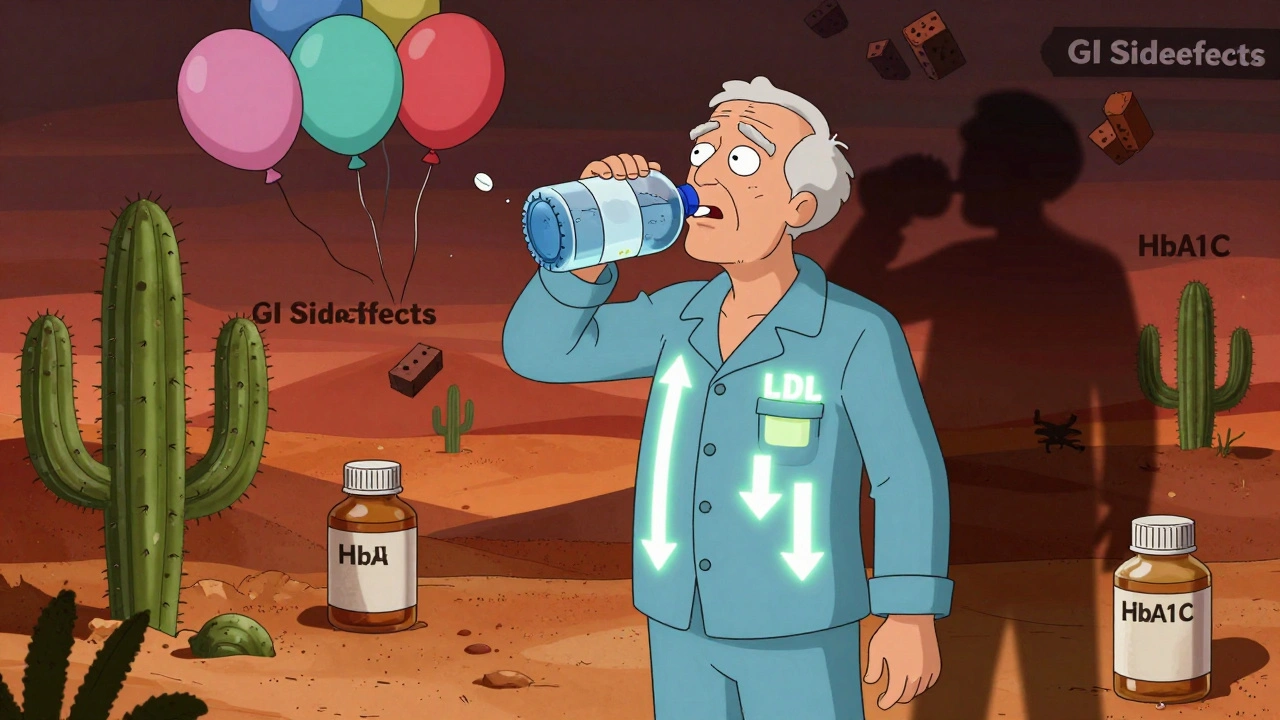
If you’ve ever tried cholestyramine (the old-school version), you know the taste-chalky, gritty, like swallowing powdered concrete. Colesevelam is better, but not by much. The most common complaints? Constipation, bloating, gas, and nausea.
Up to 30% of people experience GI issues severe enough to consider stopping. In clinical trials, about 19% of users quit because of them. On Drugs.com, colesevelam has a 5.2 out of 10 rating. One user wrote: “I needed Miralax every day just to go.” Another said: “After three months, I ended up in the hospital with a bowel obstruction.”
These aren’t rare anecdotes. The GLOWS trial found that 34% of users reported constipation, 28% had nausea, and 22% dealt with bloating. The problem isn’t just discomfort-it’s adherence. Only about 65% of people are still taking it after six months. That’s a huge dropout rate.
What helps? Start low. Doctors usually begin with 1,875 mg daily (three 625 mg tablets) and slowly increase to the full 3,750 mg over a few weeks. Drink plenty of water. Add fiber-oats, beans, apples-but not too fast. Too much fiber with a sequestrant can make constipation worse. And never take it dry-it’s meant to be mixed with water or soft food.
Drug Interactions: The Hidden Danger
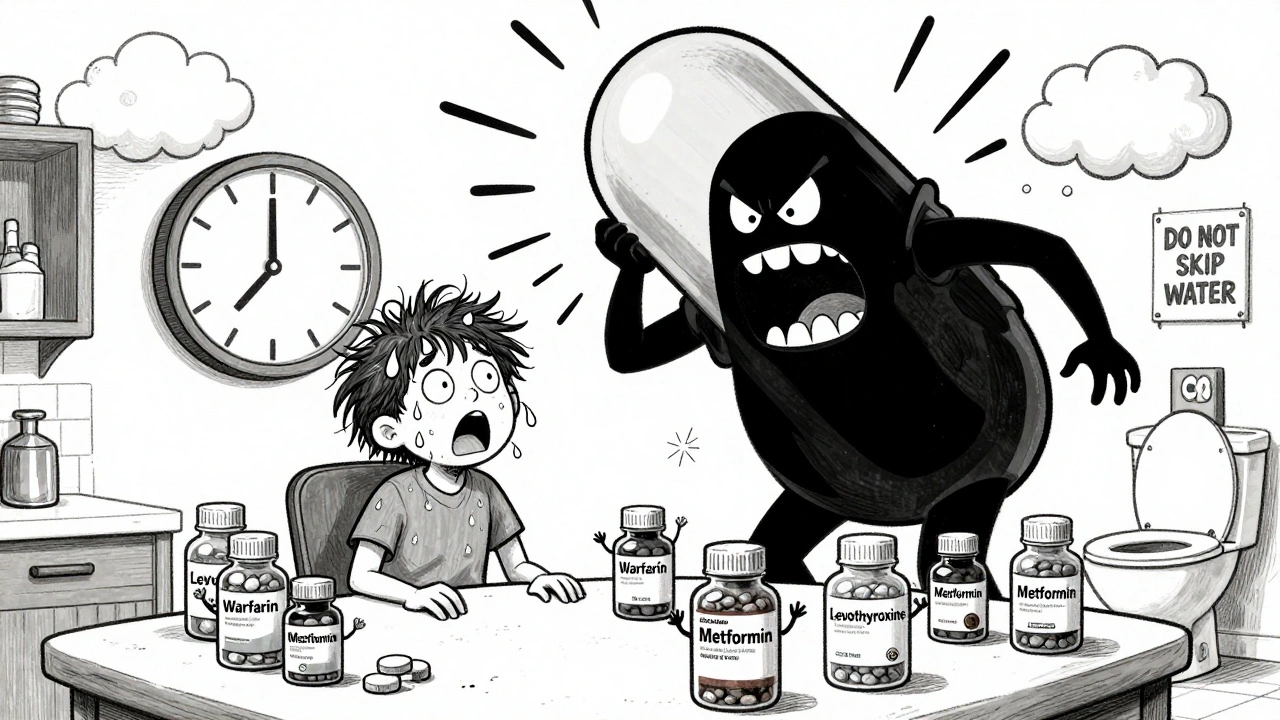
This is where things get serious. Bile acid sequestrants don’t just bind bile-they bind anything else in your gut. That includes your other medications.
The FDA requires you to take colesevelam at least 4 hours before or 1 hour after any other drug. Why? Because it can reduce absorption of:
- Thyroid hormones (like levothyroxine): If taken too close, your TSH can spike, making hypothyroidism worse.
- Warfarin: Lower absorption means your INR drops, raising your risk of clots. You’ll need more frequent blood tests.
- Sulfonylureas (glipizide, glyburide): Reduced absorption could mean less blood sugar control.
- Metformin: Some studies show a small drop in metformin levels, but it’s usually not clinically significant.
- Statins: Colesevelam cuts simvastatin levels by 40% and atorvastatin by 20%. Your doctor may need to increase your statin dose.
People on 5+ medications are at highest risk. If you’re taking pills for diabetes, cholesterol, blood pressure, and thyroid-timing becomes a daily puzzle. Many patients just forget, and that’s when things go wrong. Always check with your pharmacist before adding or changing any drug. Use a pill organizer with clear labels. Set phone alarms for dosing windows.
Who Benefits Most-and Who Should Avoid It
Bile acid sequestrants aren’t for everyone. They’re best for a very specific group:
- People with type 2 diabetes and high LDL cholesterol who can’t take statins (due to muscle pain or other side effects).
- Those with mild hyperglycemia (HbA1c under 9%)-they respond better than those with advanced diabetes.
- Patients who need a non-injectable, weight-neutral option that doesn’t cause hypoglycemia.
But avoid them if you have:
- Bowel obstruction or severe constipation
- Triglycerides over 500 mg/dL (they can make this worse)
- Complete biliary obstruction
- History of GI surgery or motility disorders
And here’s the reality check: They’re fading fast. In 2012, over 1.7 million prescriptions were written for colesevelam. By 2023, that dropped to under 900,000. Why? Because newer drugs like semaglutide and empagliflozin do more-lower HbA1c by 1-2%, protect the heart and kidneys, and help with weight loss. They’re also injectables or pills that don’t require strict timing.
Today, colesevelam is used by less than 0.5% of all diabetes patients in the U.S. It’s a niche drug for a niche group.
Real-Life Experience: The Good, the Bad, and the Ugly
One 68-year-old man from Ohio, who asked to remain anonymous, started colesevelam after statins gave him muscle pain. His LDL dropped from 142 to 98 in three months. His HbA1c fell from 7.1 to 6.8. “I didn’t lose weight, didn’t feel weird-just got better cholesterol and slightly better sugar,” he said. “I take it with applesauce and drink a gallon of water a day. It’s a grind, but worth it.”
But then there’s the woman from Texas who posted on Reddit: “I took it for four months. Constipation got so bad I couldn’t eat. My doctor said ‘just push through.’ I ended up in the ER with a blockage. I’ve been off it for six months and still have digestive issues.”
Positive stories usually come from people who were already managing their diet and hydration. Negative ones? Almost always involve skipping the water, ignoring the timing, or taking it with other meds without spacing them out.
What’s Next for These Drugs?
Pharma companies aren’t betting big on bile acid sequestrants anymore. Genzyme shut down its diabetes trials for sevelamer in 2021. No new BAS is close to FDA approval.
But there’s one glimmer: combination therapy. Researchers are testing colesevelam with semaglutide. The idea? Use the bile acid sequestrant to help with cholesterol and mild glucose control, while the GLP-1 drug handles the heavy lifting on blood sugar and weight. Early results show fewer GI side effects than colesevelam alone-possibly because lower doses can be used. If this works, it might revive the class.
For now, though, they’re a backup plan. Not a first choice. Not even a second. But if you’ve got high cholesterol, can’t take statins, and your HbA1c is still above target, they’re one of the few options that won’t make you gain weight or crash your blood sugar.
Practical Tips for Taking Colesevelam
If your doctor says yes, here’s how to make it work:
- Start low: Take three 625 mg tablets (1,875 mg) daily with your largest meal. Wait 4 weeks before increasing to six tablets (3,750 mg).
- Take with food and water: Mix tablets with water, juice, or soft food like applesauce. Never swallow dry.
- Space other meds: Take all other pills at least 4 hours before or 1 hour after colesevelam. Write this on your calendar.
- Hydrate and fiber: Drink 8-10 glasses of water daily. Add 25-30g of fiber from whole foods-not supplements.
- Track your stool: If you haven’t had a bowel movement in 3 days, call your doctor. Don’t wait for a blockage.
- Check your INR: If you’re on warfarin, get blood tests every 2 weeks for the first month, then monthly.
And if you’re not seeing results after 12 weeks? Talk to your doctor. HbA1c should drop by at least 0.3%. If not, it’s time to reconsider.
Can bile acid sequestrants cause low blood sugar?
No. Unlike sulfonylureas or insulin, bile acid sequestrants don’t stimulate insulin release or block glucose production in a way that causes hypoglycemia. That’s one of their main advantages. You can take them safely with other diabetes meds without worrying about your blood sugar dropping too low.
Is there a generic version of colesevelam?
No. As of 2025, colesevelam (WelChol) has no generic equivalent in the U.S. It’s still under patent protection. A 30-day supply costs around $547 without insurance. Some pharmacies offer discount programs, but savings are limited. If cost is a barrier, ask your doctor about alternatives like metformin or SGLT2 inhibitors, which are cheaper and more effective.
Do bile acid sequestrants help with weight loss?
No. Unlike GLP-1 drugs or SGLT2 inhibitors, bile acid sequestrants don’t cause weight loss. In fact, some people gain a little weight due to bloating and reduced appetite from GI side effects. They’re weight-neutral, which can be good or bad depending on your goals. If weight loss is a priority, this isn’t the right drug.
Can I take colesevelam if I have kidney disease?
Yes. Unlike many diabetes drugs, colesevelam is not processed by the kidneys. It’s eliminated through the gut. That makes it safe for people with chronic kidney disease-even those on dialysis. This is one reason it’s still used in older patients with multiple health conditions.
How long does it take to see results?
Cholesterol levels usually drop within 2-4 weeks. Blood sugar improvements take longer-typically 8-12 weeks before you see a change in HbA1c. Don’t give up before 3 months. Your doctor will likely check your HbA1c at the 12-week mark to see if it’s working.
If you’re considering bile acid sequestrants, weigh the pros and cons honestly. The cholesterol benefit is real. The blood sugar help is modest. The side effects are common and sometimes severe. But for the right person-someone with high LDL, statin intolerance, and mild diabetes-it can still be a valuable tool. Just don’t take it without a plan for managing the GI issues and timing your other meds. This isn’t a drug you can just start and forget.

Comments
David Palmer
December 10, 2025 AT 22:47 PMThis drug sounds like a nightmare. I’d rather just eat less bread and walk more.
Paul Dixon
December 11, 2025 AT 10:01 AMI’ve been on WelChol for 8 months now and honestly? It’s a grind but it works. I started with 1 tablet at dinner, worked up to 6, drink a liter of water before bed, and take all my other meds at 7am. No more statin muscle pain and my LDL’s at 89. Worth the hassle if you’re disciplined.
Vivian Amadi
December 12, 2025 AT 16:01 PMOf course the FDA approved this. Big Pharma loves drugs that make you suffer so you keep coming back for more laxatives and blood tests. They don’t care if you’re constipated-they care about the profit margin. This is medical abuse disguised as science.
Jimmy Kärnfeldt
December 13, 2025 AT 01:42 AMI get why people hate this stuff, but I also see why it’s still around. For folks who can’t tolerate statins or GLP-1s, it’s one of the few options that doesn’t wreck your gut or make you lose weight you didn’t want to lose. It’s not glamorous, but sometimes medicine isn’t about flashy results-it’s about staying alive and steady. I’ve seen patients thrive on it when everything else failed them.
Ariel Nichole
December 14, 2025 AT 05:42 AMMy dad’s on this and he swears by it. He’s 72, has CKD, and can’t take metformin. He takes it with his oatmeal, drinks tons of water, and uses a pill organizer with color-coded labels. His HbA1c dropped from 7.6 to 6.9 in four months. He says it’s the only thing that didn’t make him feel like a zombie.
john damon
December 15, 2025 AT 17:41 PMJust took WelChol yesterday 😫💩 I’m already regretting it. Why does it taste like chalk dust and regret? 🤢
matthew dendle
December 16, 2025 AT 10:23 AMWho even still uses this? Its 2025 and you’re taking a drug that needs a schedule like rocket launch? Metformin’s cheaper and works better. If your doc prescribes this you need a new doc
Sylvia Frenzel
December 17, 2025 AT 21:51 PMWhy are we even talking about this? America’s healthcare system is broken. You’re supposed to get a GLP-1, not a chalky sponge. This is what happens when you let insurance companies decide treatment. Shameful.
Michaux Hyatt
December 18, 2025 AT 04:26 AMIf you’re on this, here’s the real tip: take it with a banana and a glass of prune juice. The fiber helps the sponge do its job without turning your gut to concrete. Also, set a phone reminder for your meds-4 hours apart is non-negotiable. I’ve helped dozens of patients get past the first month. It gets easier.
Raj Rsvpraj
December 18, 2025 AT 13:19 PMOf course this works-it’s science! In India, we use sevelamer for diabetes and kidney patients, and it’s far superior to these Western pharmaceutical gimmicks. You Americans rely too much on pills. We have Ayurveda, fasting, and discipline. This drug? It’s just a band-aid for a lifestyle that’s already dead.
Jack Appleby
December 19, 2025 AT 15:34 PMThe pharmacokinetics of bile acid sequestrants are fascinating. Their non-absorbable polymeric structure creates a chelation cascade that modulates FXR-TGR5 signaling pathways, indirectly enhancing insulin sensitivity via enterohepatic feedback loops. It’s elegant, really-except for the constipation, which is a brutal side effect of non-selective anion binding. Still, the mechanism is far more sophisticated than most modern diabetes drugs.
Rebecca Dong
December 20, 2025 AT 04:20 AMThey’re hiding something. Why does this drug only work for ‘mild’ diabetes? Because it doesn’t actually fix anything-it just masks it while the system profits. I bet they’re testing this with AI-generated patient testimonials. And why no generic? Because they’re hoarding it like gold. Wake up people!
Regan Mears
December 20, 2025 AT 22:28 PMI’ve been a nurse for 20 years, and I’ve seen people quit this drug because they didn’t know how to take it. The key isn’t the drug-it’s the education. If you give someone a pill and say ‘take it with food,’ they’ll just swallow it dry. But if you sit with them, show them how to mix it in applesauce, set alarms, and track bowel movements? They stick with it. It’s not magic-it’s care.
Stephanie Maillet
December 22, 2025 AT 07:24 AMI read this entire post with tears in my eyes-not because I’m emotional, but because it’s so rare to see a medical article that doesn’t just list facts, but actually understands the human experience of chronic illness. The way you described the 68-year-old man from Ohio? That’s my grandfather. And the woman from Texas? That’s my sister. You didn’t just explain a drug-you gave voice to the quiet, exhausting, invisible labor of managing health. Thank you. I’m sharing this with my entire family.