
CYP2D6 Metabolizer Risk Calculator
Why This Matters
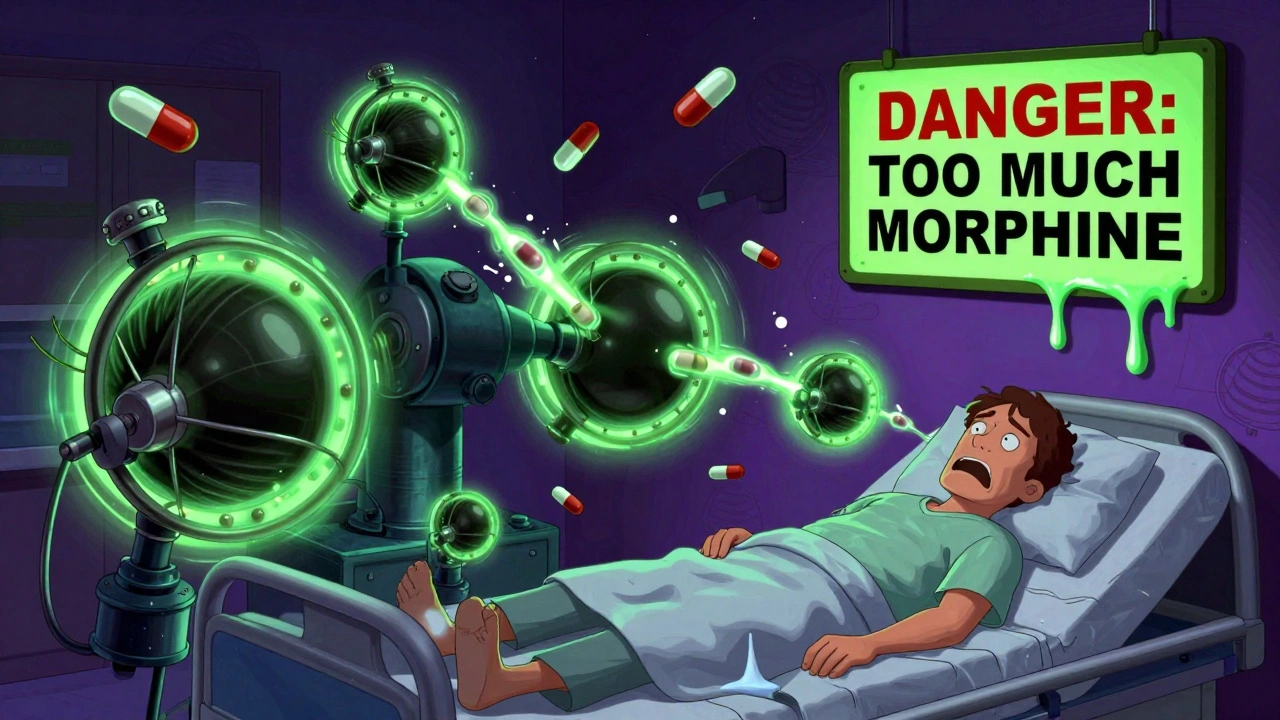
Codeine converts to morphine via the CYP2D6 enzyme. For ultrarapid metabolizers (1-29% of different populations), this conversion happens 3.5-4.5x faster than normal, potentially leading to fatal respiratory depression. This calculator helps you understand your genetic risk based on ancestry.
Codeine is one of the most commonly prescribed painkillers in the world - but for a small group of people, even a single pill can be fatal. It’s not because they took too much. It’s because their body turns codeine into morphine too fast. This isn’t rare. It’s genetic. And if you or someone you care about has been prescribed codeine, you need to know this.
How Codeine Turns Into a Deadly Substance
Codeine itself doesn’t relieve pain. It’s a prodrug - meaning it’s inactive until your body changes it. That change happens in the liver, thanks to an enzyme called CYP2D6. This enzyme converts codeine into morphine, the powerful opioid that actually blocks pain signals in your brain.
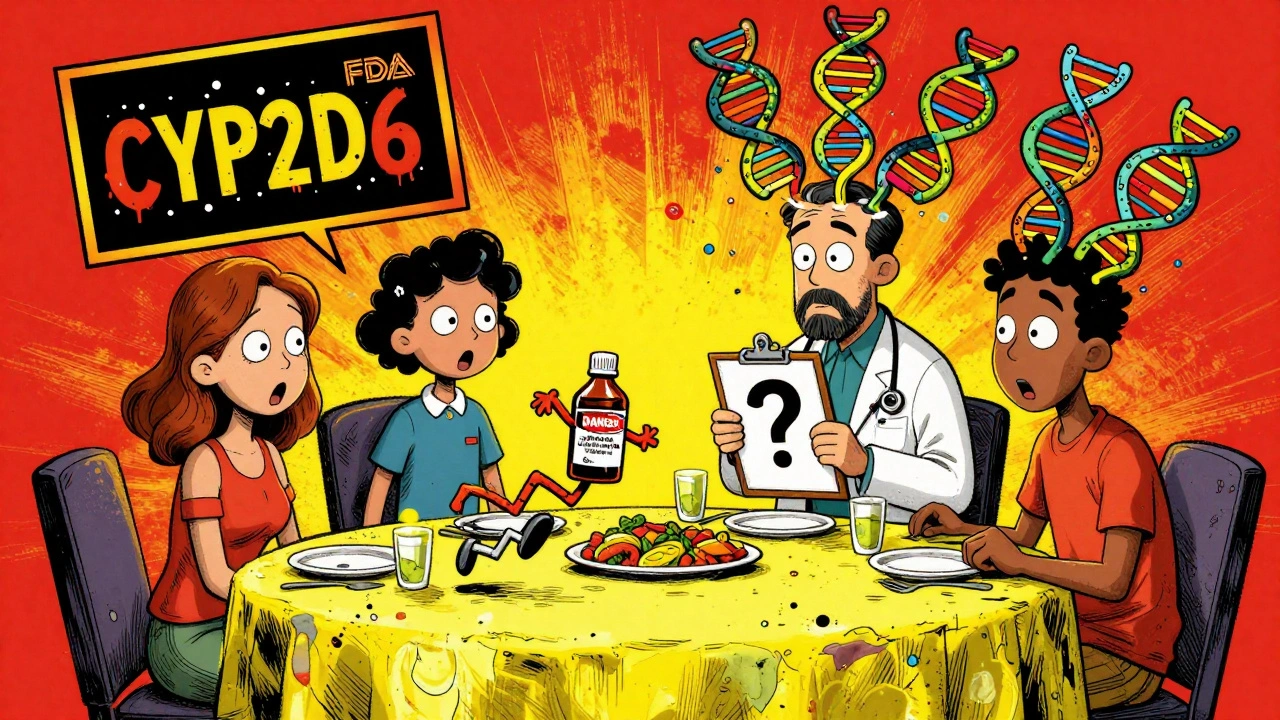
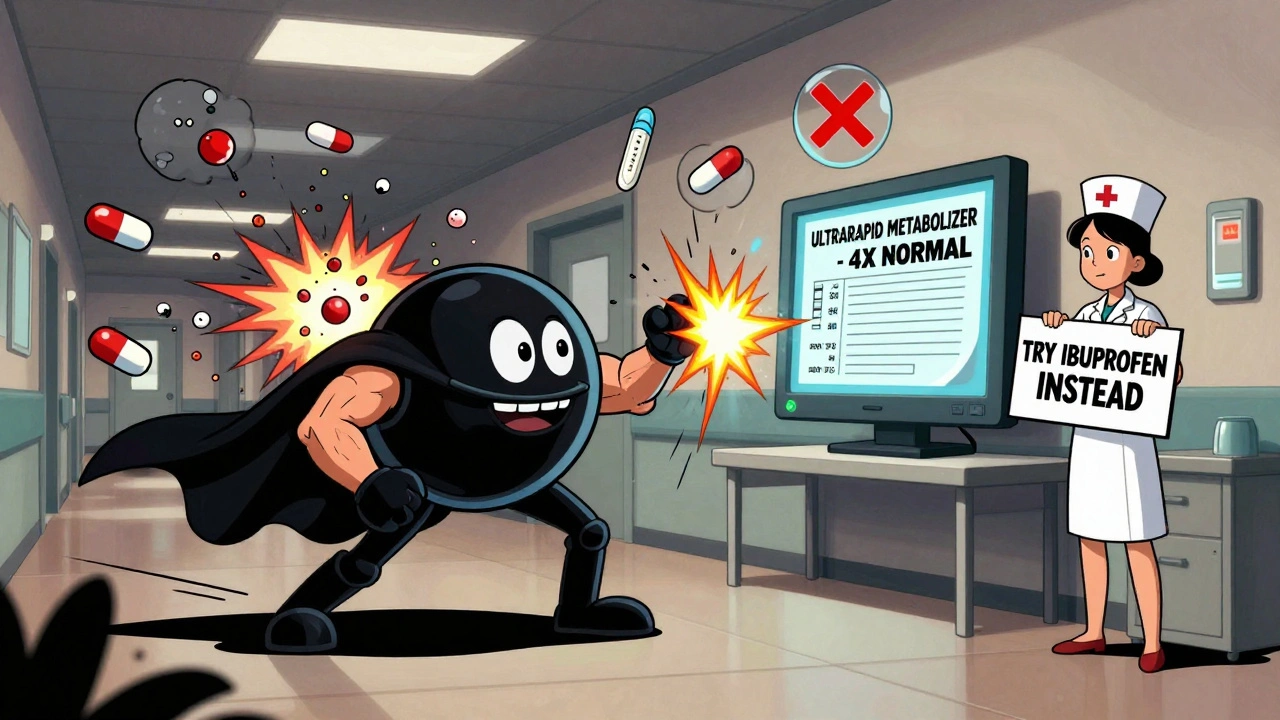
For most people, this process works like a slow drip: just enough morphine is made to help with pain, without causing harm. But for about 1 to 7% of people - depending on their ancestry - CYP2D6 works like a firehose. These are called ultrarapid metabolizers. They have extra copies of the CYP2D6 gene. Instead of one or two functional copies, they might have three, four, or even more. That means they turn codeine into morphine at 3.5 to 4.5 times the normal rate.
What happens next is terrifying. Blood morphine levels spike within hours. The body can’t keep up. Breathing slows. Then stops. In children, this has led to dozens of deaths after routine surgeries like tonsillectomies. In adults, it’s caused respiratory arrest during routine pain management. The FDA reviewed 64 cases of serious harm from codeine - 24 of them fatal. In 21 of those deaths, the victims were under 12 years old.
Who’s at Risk?
Not everyone is equally at risk. The chance of being an ultrarapid metabolizer depends on your ancestry:
- Up to 29% in North African and Ethiopian populations
- 3-7% in Europeans
- 3% in Australians
- 1-2% in East Asians
This isn’t random. It’s evolution. In some populations, faster drug metabolism may have helped ancestors detoxify plant toxins. But today, it puts people at risk from common medications.
Children are especially vulnerable. Their bodies are smaller. Their breathing is more easily suppressed. In one well-documented case, a 15-month-old child died after receiving a standard dose of codeine after surgery. Post-mortem testing confirmed they were an ultrarapid metabolizer - and their blood morphine level was far beyond the lethal range.
The FDA’s Warning - And Why It Was Ignored
In September 2013, the U.S. Food and Drug Administration issued a black box warning - the strongest possible - on all codeine products. It said: "Respiratory depression and death have occurred in children who received codeine following tonsillectomy or adenoidectomy, and had evidence of being CYP2D6 ultrarapid metabolizers."
The warning didn’t just apply to kids. It applied to anyone. But the real impact was on pediatric care. In the U.S., pediatric codeine prescriptions dropped by 50% between 2012 and 2015. Other countries followed: New Zealand, the European Union, Canada - all restricted codeine use in children under 12.
But here’s the problem: many doctors still prescribe it. Why? Because they don’t know. Or because testing isn’t routine. Or because they think, "It’s never happened to me before." But the science is clear. The data is undeniable. And the consequences are irreversible.
What to Do Instead
If you’re prescribed codeine, ask: "Is there a safer option?" There are plenty.
For pain relief, opioids that don’t rely on CYP2D6 metabolism are much safer:
- Morphine (direct-acting, no conversion needed)
- Hydromorphone
- Fentanyl
- Oxycodone (though it’s partially metabolized by CYP2D6, its risk is far lower than codeine’s)
For mild pain, non-opioid options work just as well:
- Acetaminophen (Tylenol)
- Ibuprofen (Advil, Motrin)
- Naproxen (Aleve)
For coughs? Codeine has no proven benefit over non-opioid alternatives like dextromethorphan - and carries a deadly risk. The FDA specifically recommends avoiding codeine cough syrups in children under 12.
Can You Get Tested?
Yes. Genetic testing for CYP2D6 is available. Labs can analyze your DNA to see if you’re an ultrarapid, normal, intermediate, or poor metabolizer. Results typically take 3 to 14 days. The cost? $200 to $500. Insurance often requires pre-authorization.
But here’s the catch: most doctors don’t order it. Not because it’s unreliable - but because it’s not yet standard practice. Only 15-20% of major U.S. hospitals have integrated pharmacogenetic testing into their prescribing workflows.
That’s changing. Research is underway at Vanderbilt University to develop point-of-care tests that can give results in under two hours. If that works, testing could become as routine as a blood pressure check.
What About Tramadol?
Tramadol is often suggested as a "safer" alternative to codeine. But it’s not. Tramadol also depends on CYP2D6 to become active. In ultrarapid metabolizers, it can cause the same deadly morphine-like toxicity. In fact, the Clinical Pharmacogenetics Implementation Consortium (CPIC) explicitly warns against both codeine and tramadol for people with CYP2D6 activity scores above 2.25 - the threshold for ultrarapid metabolism.
So if you’ve been told tramadol is safe because it’s "not codeine," you’re being misled. The mechanism is the same. The risk is the same.
Why This Matters Beyond Codeine
This isn’t just about one drug. It’s about a broken system. For decades, doctors treated all patients the same. One size fits all. But your genes aren’t one size. They’re unique. Codeine’s danger to ultrarapid metabolizers is one of the clearest examples of why personalized medicine isn’t futuristic - it’s necessary.
And it’s not just codeine. Other drugs - like antidepressants, beta-blockers, and chemotherapy agents - are also affected by CYP2D6 variations. Learning how your genes affect your response to medication could save your life - or your child’s life - the next time you need pain relief.
What You Can Do Right Now
If you’ve been prescribed codeine:
- Ask your doctor: "Is this the safest option for me?"
- Ask: "Could I be an ultrarapid metabolizer?"
- Ask: "Is there an alternative that doesn’t rely on CYP2D6?"
- If you’re giving codeine to a child - especially after surgery - refuse it. Insist on acetaminophen or ibuprofen instead.
If you’ve had a bad reaction to codeine - extreme drowsiness, trouble breathing, nausea, vomiting - tell your doctor. That could be your body’s warning sign.
If you’re planning surgery, especially for your child, ask your surgeon: "Will you be using codeine for pain?" If yes, say no. Demand alternatives.
You don’t need to wait for genetic testing to act. When in doubt, choose non-opioid pain relief. It’s safer for everyone - regardless of your genes.
Can codeine kill someone who takes it as prescribed?
Yes. For people who are CYP2D6 ultrarapid metabolizers, even a standard, doctor-prescribed dose of codeine can convert into a lethal amount of morphine too quickly. This has caused multiple deaths in children after routine surgeries and in adults taking codeine for pain or cough. The FDA confirmed this risk in 2013 after reviewing dozens of fatal cases.
How do I know if I’m an ultrarapid metabolizer?
You can find out through a genetic test that analyzes your CYP2D6 gene. The test looks for extra copies of the gene that cause faster metabolism. Results usually take 3-14 days. While most doctors don’t order this routinely, you can ask for it - especially if you’ve had a bad reaction to codeine or tramadol, or if you have ancestry from North Africa or Ethiopia, where ultrarapid metabolism is more common.
Is codeine still prescribed at all?
Yes, but much less often - especially in children. After the FDA’s 2013 warning, pediatric codeine prescriptions dropped by half in the U.S. Many doctors now avoid it entirely, even for adults, because safer alternatives exist. It’s still available in some cough syrups and combination painkillers, but its use is declining rapidly as awareness grows.
What are the signs of codeine toxicity?
Symptoms include extreme drowsiness, difficulty waking up, slow or shallow breathing, nausea, vomiting, confusion, cold or clammy skin, and blue lips or fingernails. In children, these symptoms can appear within hours of taking a dose. If you see any of these, seek emergency help immediately - this is a medical emergency.
Why don’t doctors test everyone for CYP2D6 before prescribing codeine?
Because it’s not yet standard practice. Testing costs money, takes time, and most electronic health records don’t automatically flag genetic risks. Many doctors weren’t trained in pharmacogenetics. But guidelines from the FDA and the Clinical Pharmacogenetics Implementation Consortium (CPIC) clearly say codeine should be avoided in ultrarapid metabolizers. The gap between science and practice is narrowing - but slowly.
Are there any safe opioids for ultrarapid metabolizers?
Yes. Opioids that don’t rely on CYP2D6 metabolism are safe options. These include morphine, hydromorphone, and fentanyl. They work directly without needing conversion, so your genes don’t affect how they’re processed. Oxycodone is sometimes used, but it’s partially activated by CYP2D6 - so it’s less ideal than morphine or fentanyl for known ultrarapid metabolizers.



Comments
pallavi khushwani
December 5, 2025 AT 18:05 PMWow. This is one of those posts that makes you realize how little we actually know about our own bodies. I never thought about genetics playing this big a role in pain meds. My mom took codeine after her knee surgery and was fine, but now I wonder… was she just lucky? Or did her ancestry shield her? Either way, this needs to be common knowledge. Not just for kids, but for everyone.
Dan Cole
December 6, 2025 AT 16:52 PMLet’s be clear: this isn’t a ‘rare genetic quirk’-it’s a systemic failure of medical education. The FDA issued a black box warning in 2013. That’s over a decade ago. And yet, doctors still prescribe codeine like it’s aspirin. This isn’t negligence-it’s willful ignorance masquerading as tradition. If your physician doesn’t know about CYP2D6, they shouldn’t be prescribing opioids. Period. The science is settled. The data is peer-reviewed. The deaths are documented. Stop pretending this is controversial.
Billy Schimmel
December 7, 2025 AT 06:09 AMSo… we’re telling people to avoid codeine because some people turn it into morphine too fast? Cool. So what’s the alternative? Just take more ibuprofen? That’s it? No wonder people are still getting prescribed this stuff-because the alternatives are either expensive, hard to get, or just… not as nice. I get the science. But real life is messy.
Kay Jolie
December 8, 2025 AT 21:23 PMAs a pharmacogenomics enthusiast, I’m thrilled to see this topic finally surface in mainstream discourse. The CYP2D6 polymorphism isn’t merely a pharmacokinetic footnote-it’s a paradigm-shifting exemplar of precision medicine’s imperative. Ultrarapid metabolizers exhibit a gene dosage effect: multi-copy alleles (e.g., *1/*1xN, *2/*2xN) result in supranormal enzyme expression, leading to supra-therapeutic morphine concentrations. The 2013 FDA advisory was not merely a recommendation-it was a bioethical obligation. Yet, clinical inertia persists due to fragmented EHR integration and a lamentable absence of mandatory genomics training in medical curricula. Until point-of-care genotyping becomes as routine as CBCs, we are complicit in preventable mortality.
Shayne Smith
December 8, 2025 AT 22:29 PMMy cousin’s 3-year-old died after a tonsillectomy. They gave her codeine. The doctor said it was ‘standard.’ I still don’t know if I’m angry or just numb. This post? It’s the first time I’ve seen someone explain it in a way that doesn’t feel like a textbook. Thank you. I’m sharing this with every parent I know.
Katie O'Connell
December 9, 2025 AT 17:04 PMIt is, regrettably, a matter of profound concern that the medical establishment continues to rely upon empirical, population-based prescribing paradigms, despite the availability of validated, individualized genomic diagnostics. The persistence of codeine prescriptions in pediatric populations constitutes, in my estimation, a failure of professional duty. One may reasonably infer that the absence of mandatory pharmacogenetic screening reflects not a lack of technological capacity, but rather a structural devaluation of patient autonomy and biological individuality within contemporary healthcare economics.
Clare Fox
December 11, 2025 AT 02:36 AMi had no idea tramadol was the same deal. i took it for years after my back surgery. never had a problem. but now i’m wondering… was i just lucky? or was i a slow metabolizer? either way, i’m gonna ask my doc about testing. no thanks to the ‘safe’ opioids i’ve been handed like candy.
Akash Takyar
December 12, 2025 AT 10:03 AMThank you for sharing this vital information. It is imperative that we, as a global community, recognize the role of genetic diversity in pharmacological response. I urge all healthcare providers to consider pharmacogenetic testing as a standard of care, especially in populations with higher prevalence of ultrarapid metabolism. Let us not wait for tragedy to prompt change. Proactive, science-based interventions can save lives. Please, spread this awareness.
Arjun Deva
December 13, 2025 AT 04:02 AMSo… let me get this straight. The government knows this, but they still let pharma sell codeine? And doctors? They’re just ignoring it? Hmm. Sounds like a classic case of corporate greed hiding behind ‘medical tradition.’ And now they want us to pay $500 to test for something they should’ve warned us about 20 years ago? Yeah. I’m not surprised. This is why I don’t trust the system. They let people die so they can keep selling pills. And now they want a medal for ‘warning’ us after the fact. Pathetic.
Inna Borovik
December 13, 2025 AT 13:02 PMLet’s not pretend this is about ‘personalized medicine.’ This is about liability avoidance. If you test someone and they’re an ultrarapid metabolizer, you’re now legally obligated to avoid codeine. But if you don’t test? You’re just ‘following standard protocol.’ That’s why no one orders the test. It’s not ignorance-it’s insurance. And don’t get me started on how they push tramadol as a ‘safer’ alternative while ignoring the same CYP2D6 risk. This isn’t science. It’s a legal loophole dressed up as medicine.
Jackie Petersen
December 14, 2025 AT 07:32 AMSo now we’re blaming genetics for bad decisions? Next they’ll say it’s my DNA that made me take too much Tylenol. This is just another way for the elites to make us paranoid about our own bodies. Codeine’s been used for a century. Millions of people take it. Why are we suddenly acting like it’s poison? Maybe the real problem is people don’t know how to take medicine properly-not their genes.
Annie Gardiner
December 15, 2025 AT 14:46 PMWait, so if I’m an ultrarapid metabolizer, does that mean I’m basically a superhero who turns painkillers into morphine faster than anyone else? That’s kind of cool. I mean, if I could just control the dose, I’d be the ultimate pain-free ninja. Why are we treating this like a tragedy? It’s just biology with extra steps. Maybe we should be celebrating, not panicking.