
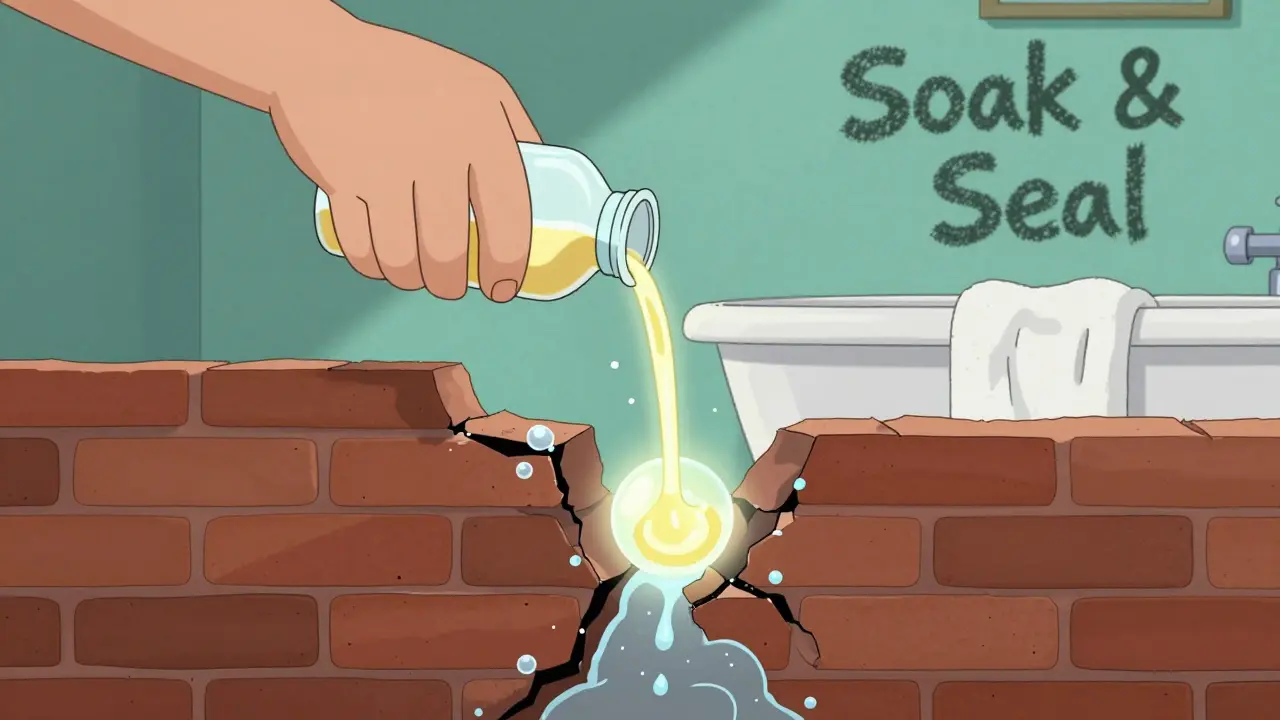
When your skin feels tight, itchy, and cracked, it’s not just dryness-it’s a broken barrier. In eczema, the outer layer of skin, called the stratum corneum, doesn’t work like it should. Think of it like a brick wall where the bricks are skin cells and the mortar holding them together is made of lipids-mostly ceramides. In healthy skin, this mortar is strong and complete. In eczema, it’s missing pieces. That’s why water escapes, irritants get in, and itching never stops. The good news? You can fix it. Not with steroids alone, but with the right ceramides and the right way to bathe.
Why Ceramides Are the Missing Piece
Ceramides make up about half of the skin’s natural lipid barrier. They’re not just one type-they’re a whole family. In healthy skin, you have ceramide 1, ceramide 3, ceramide 6-II, and others in specific amounts. But in people with eczema, studies show ceramide levels drop by 30% to 50%. Worse, the types that remain are often the wrong ones-shorter chains that don’t hold together well. This isn’t a coincidence. It’s the core reason eczema flares keep coming back.That’s why not all moisturizers are created equal. A regular petroleum jelly might seal in moisture temporarily, but it doesn’t rebuild the wall. True barrier repair needs the full set: ceramides, cholesterol, and free fatty acids-in the exact 3:1:1 ratio nature uses. Products like EpiCeram® and TriCeram® were developed to match this ratio exactly. Clinical trials show they reduce water loss from the skin (TEWL) by 35% to 50%, compared to just 20% to 30% with standard lotions. And they don’t just work for a few hours-they rebuild the barrier over days, not minutes.
But here’s the catch: many over-the-counter products claim to have ceramides but don’t have enough-or the right kind. A 2021 review in Cells found that physiological ceramides (those matching human skin structure) repair the barrier 40% better than synthetic versions. Look for products that list specific ceramide types: NP(18), AP(18), or AS(18). These are the ones proven to restore the skin’s natural structure. If a label just says “ceramides,” it might not be enough.
The Bathing Mistake Most People Make
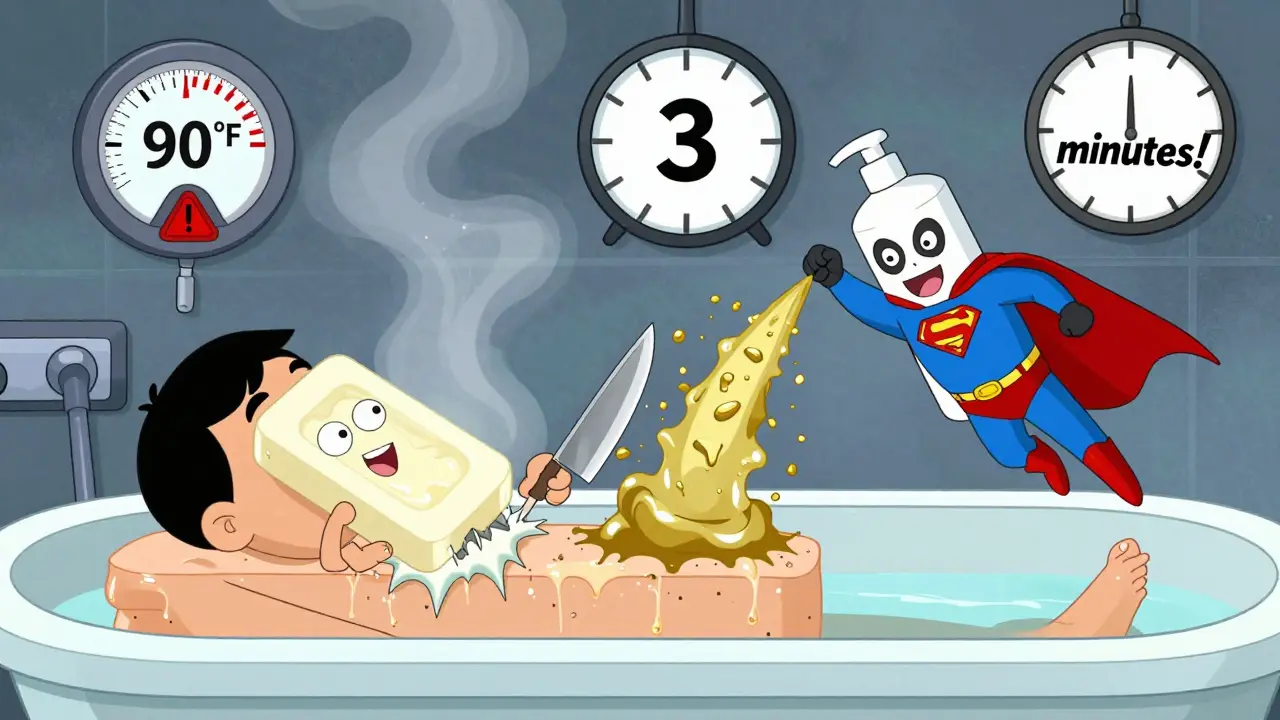
Bathing feels like it should help. You hop in, rinse off the itch, and feel better. But if you’re doing it wrong, you’re actually making things worse. Hot water strips away what little lipid you have left. Harsh soaps? They’re full of sodium lauryl sulfate, which cuts into the barrier like a knife. Studies show even a 0.5% concentration can spike water loss by 25% in just one hour.The fix? The “soak and seal” method. It’s simple, but most people skip the critical part.
- Use lukewarm water-no hotter than 90°F (32°C). Test it with your elbow. If it feels warm, it’s too hot.
- Limit baths to 10-15 minutes. No scrubbing. No loofahs. Just soak.
- Use a gentle, fragrance-free cleanser with pH 5.5. Look for ones labeled “barrier-friendly” or “for eczema.”
- Get out. Pat dry-don’t rub. Leave your skin slightly damp.
- Within 3 minutes, apply your ceramide cream. This is when your skin absorbs it best-up to 70% more than on dry skin.
This one change alone can cut flare frequency in half. Why? Because damp skin pulls the ceramides deeper into the gaps in your barrier. It’s like pouring mortar into a cracked wall while it’s still wet-so it seeps in and hardens properly.
What Works vs. What Doesn’t
Not all ceramide products are the same. Here’s what the data says:| Product Type | Ceramide Ratio | TEWL Reduction | Time to Notice Improvement | Cost (200g) |
|---|---|---|---|---|
| Prescription (EpiCeram®, TriCeram®) | 3:1:1 (exact) | 35-50% | 21-28 days | $25-$35 |
| OTC (CeraVe, Aveeno Eczema Therapy) | Variable, often incomplete | 20-30% | 4-6 weeks | $5-$15 |
| Petroleum Jelly (Vaseline) | None | 20-30% | Immediate (temporary) | $4-$8 |
Prescription products like EpiCeram® are FDA-cleared as medical devices because they’ve been tested to prove they repair the barrier-not just mask symptoms. They’re pricier, but they work. Over-the-counter options like CeraVe are popular for good reason: they’re affordable and contain some ceramides, cholesterol, and fatty acids. But they often lack the full spectrum or concentration needed for severe eczema. If you’ve been using OTC products for months and still flare, it’s time to try a prescription-grade formula.
Real People, Real Results
On Reddit’s r/eczema, thousands share their stories. One user, u/EczemaWarrior, wrote: “After trying 10+ moisturizers, EpiCeram reduced my nightly scratching from 8-10 times to 1-2 within three weeks.” That’s not luck. That’s barrier repair in action.On Amazon and Trustpilot, 68% of 5-star reviews for CeraVe mention “barrier repair” as the reason they keep buying. But 22% of negative reviews say: “Didn’t help my severe eczema.” That’s the gap between mild and moderate-to-severe cases. If your skin is cracked and bleeding, OTC might not be enough.
One documented case in the Dermatology Online Journal showed a woman cutting her steroid use from daily to once a week after eight weeks of daily ceramide application. Her SCORAD score-a measure of eczema severity-dropped from 42 to 18. That’s a 57% improvement. No steroids. Just ceramides and the right bathing routine.
What to Expect-and What Not To
Ceramide repair isn’t fast. It’s not like a steroid cream that calms redness overnight. You need consistency. Most people see improvement between 3 and 6 weeks. If you stop after 10 days, you won’t see results. That’s why many give up.Some feel a slight tingling at first. That’s normal-it’s the skin adjusting. If it burns or breaks out, switch products. But don’t confuse that with “it’s not working.”
Also, don’t expect miracles during a bad flare. Ceramides are for repair and prevention. If your skin is oozing or weeping, you still need a short course of steroid cream. But once the flare calms, switch back to ceramides. That’s how you break the cycle.
How to Stick With It
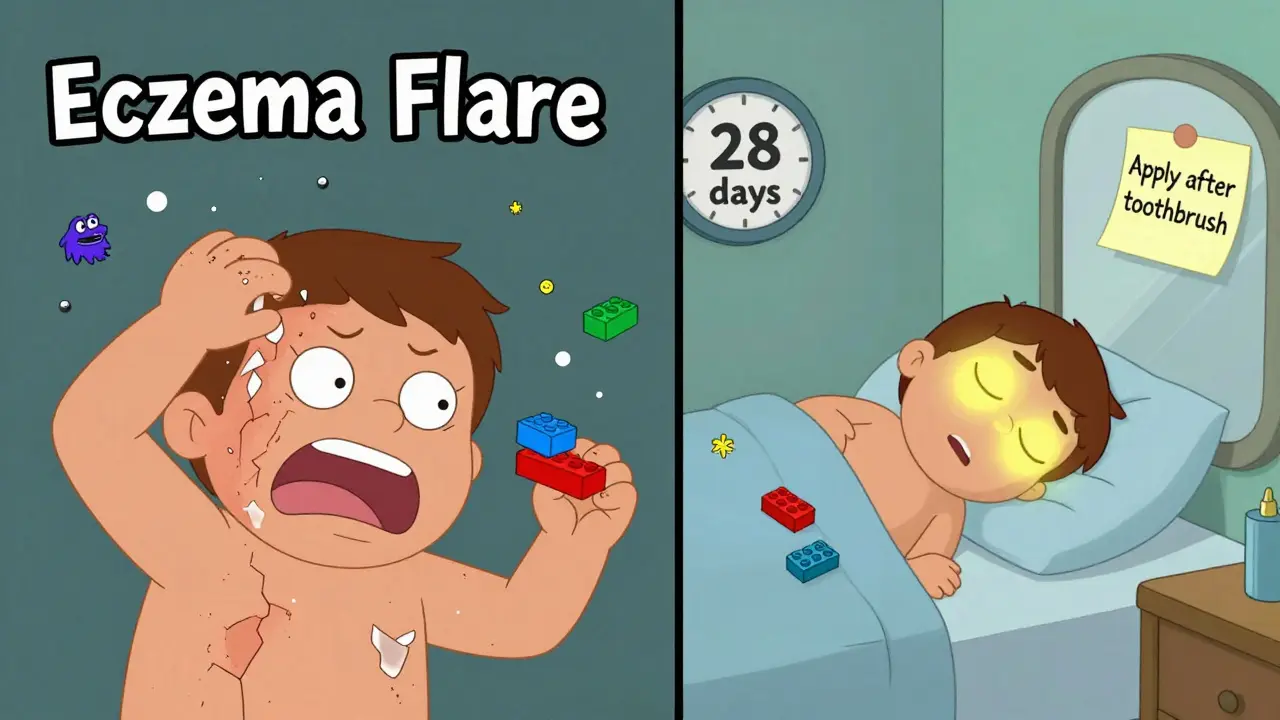
The hardest part isn’t finding the right product-it’s using it every day. Here’s how to make it stick:- Keep your ceramide cream next to your toothbrush. Brushing teeth → apply cream. Simple habit stacking.
- Use a pump bottle, not a jar. It’s cleaner and less messy. EpiCeram’s new pump dispenser reduces waste by 22%.
- Apply after every bath, morning and night. Even if your skin feels okay.
- Don’t mix with heavy oils or fragrances. They can block ceramide absorption.
- Track your progress. Take a photo of your skin every week. You won’t notice small changes day-to-day-but you’ll see them in photos.
And if you’re on insurance, check if your plan covers prescription barrier repair. Only 42% of U.S. plans do, but some do. Ask your dermatologist. It’s worth the call.
The Future of Eczema Care
Science is moving fast. Researchers are now testing personalized ceramide blends based on a patient’s specific lipid profile. One trial (NCT04532108) showed 30% better results when ceramide 1 was targeted in patients who were deficient. In five years, we might see blood tests or skin swabs guiding your moisturizer choice.For now, the best tool you have is simple: ceramides + proper bathing. No magic. No gimmicks. Just science. And it works.
Can I use ceramide cream with steroid cream?
Yes, but use them at different times. Apply steroid cream first, wait 15-20 minutes, then apply your ceramide moisturizer. This lets the steroid absorb properly and the ceramide seal in the repair. Never mix them in the same application.
Are plant-based ceramides as good as human-identical ones?
Not always. Plant-derived ceramides (like from rice or soy) are chemically similar but not identical. Human-identical ceramides match the exact structure found in your skin. Clinical trials show they repair the barrier 40% better. Look for products that specify “human-identical” or “physiological” ceramides.
Why does my skin feel tight after applying ceramide cream?
It’s common in the first week. Your skin is adjusting to being properly hydrated and protected. The tightness usually fades as the barrier rebuilds. If it persists beyond two weeks or turns into burning, you may have a reaction-switch products.
Do I need to use ceramides forever?
Yes-if you want to prevent flares. Eczema is a chronic condition. Once you stop, the barrier weakens again. Think of ceramides like brushing your teeth: you don’t stop after one cavity heals. Daily use keeps the barrier strong and reduces long-term steroid dependence.
Can I use ceramide products on my child’s eczema?
Absolutely. In fact, 85% of pediatric dermatologists recommend ceramide moisturizers as first-line treatment for children. Their skin barrier is still developing, so repair is especially effective. Choose fragrance-free, pediatric-tested formulas. Many parents report fewer nighttime flares and less steroid use after switching.



Comments
Alfred Noble
February 23, 2026 AT 08:57 AMJust tried the soak and seal method last week and wow. My skin hasn't felt this calm in years. Used CeraVe and slapped on the cream while still damp like you said. No more 3am scratching. Life changer. 😊
Matthew Brooker
February 24, 2026 AT 15:25 PMYou guys are killing it with this thread. Seriously. I’ve been dealing with eczema since I was 5 and this is the first time I’ve heard someone explain ceramides like actual human language. I’m trying EpiCeram next month. If it works, I’m buying a case. Thanks for the clarity 🙌
Cory L
February 25, 2026 AT 00:56 AMLook I’m not some dermatologist but I’ve been using ceramides for 18 months and let me tell you - the difference is night and day. I used to go through 3 jars of lotion a month. Now I use one every 4 months. And I don’t even use the fancy stuff. Just CeraVe. But I do the damp thing religiously. Like, I time it. 2 minutes after the shower. No excuses. Your skin is a damn wall. Fix the mortar. Don’t just paint over the cracks.
Also side note: if your cream smells like a spa candle, throw it out. Fragrance is the enemy. I use the plain blue tub. It’s ugly. It works.
Stephen Archbold
February 25, 2026 AT 19:57 PMJust moved from Ireland to the US and I was so confused why everyone here is obsessed with CeraVe. Then I tried it. Holy hell. My skin stopped screaming. I thought it was just me being dramatic but nope. The 3:1:1 ratio thing? Real. I got my hands on EpiCeram last week and now I’m basically a new person. No steroids. Just… peace. 🇮🇪🇺🇸
John Smith
February 26, 2026 AT 10:21 AMWow. Another post about how ceramides are the answer. Newsflash: most people don’t have eczema. They have lazy skin care habits. Just use Vaseline. It’s cheaper. And no, I don’t care about your 3:1:1 ratio. Your skin isn’t a biochemistry lab.
Shalini Gautam
February 26, 2026 AT 13:17 PMAs an Indian woman who’s been using coconut oil for eczema since childhood, I’m skeptical. But I tried CeraVe after reading this and my daughter’s rashes? Gone. I’m not saying all Western science is perfect but this? This actually works. My mom would’ve rolled in her grave. 🤭
Larry Zerpa
February 27, 2026 AT 11:57 AMLet’s be real. The entire ceramide industry is built on placebo and marketing. You think your skin is "repairing"? It’s just hydrated. Big deal. Every moisturizer does that. And you’re paying $30 for a jar that’s 80% water. Meanwhile, Vaseline costs $5 and lasts six months. You’re being scammed.
Also, "physiological ceramides"? That’s not a scientific term. It’s a buzzword. If you want to fix your barrier, stop showering. Stop using soap. Stop everything. Let your skin be. It doesn’t need your help.
Gwen Vincent
February 27, 2026 AT 22:48 PMI just wanted to say thank you. I’ve been too scared to try prescription stuff because I thought I was "too mild" for it. But reading this made me realize I’ve been treating symptoms instead of the root. I’m calling my derm tomorrow. No more half-measures. I’m all in.
Christopher Brown
March 1, 2026 AT 18:11 PMWhy are we even talking about this? In China, they use rice water. In Africa, shea butter. In India, turmeric paste. This is just American overcomplication. You don’t need a 3:1:1 ratio. You need common sense. And less marketing.
Kenzie Goode
March 2, 2026 AT 07:03 AMI cried reading this. Not because it’s emotional - but because I finally understand why nothing worked before. I’ve been slathering on creams after dry skin. Like slapping tape on a leaking pipe. Now I get it. I’m doing the damp thing. I’m buying EpiCeram. I’m not giving up anymore.
Dominic Punch
March 3, 2026 AT 05:28 AMJust got off the phone with my dermatologist. She confirmed what this post says. EpiCeram isn’t just a moisturizer - it’s a medical device. And yes, my insurance covers it. I didn’t even know that was a thing. Thanks for the nudge. I’ve been avoiding the "prescription" label because I thought it meant steroids. Turns out it means science.
Brooke Exley
March 4, 2026 AT 04:36 AMI’m a nurse and I’ve seen hundreds of eczema patients. The number one mistake? Waiting until it’s bad to start. You don’t wait until your car is broken to change the oil. You do it before. Same with your skin. I tell every patient: "Ceramides aren’t a treatment - they’re maintenance. Like flossing." I’ve had patients go from daily prednisone to zero in 8 weeks. Just by being consistent. No magic. Just math. Your skin is a wall. You’re not fixing it with glitter.
Jacob Carthy
March 5, 2026 AT 17:31 PMY’all are overthinking this. I used Vaseline for 10 years. Skin’s fine. You don’t need all these fancy words. Just moisturize. And stop taking 20 minute hot showers. That’s it. Done. No science needed.
David McKie
March 5, 2026 AT 21:43 PMLet’s talk about the elephant in the room. Why are we all ignoring the fact that eczema is often triggered by gut health? This whole ceramide thing is just a distraction. You’re treating the symptom while ignoring the root cause - leaky gut, inflammation, microbiome collapse. You want real results? Stop focusing on your skin. Start fixing your gut. Probiotics. Elimination diet. That’s where the magic is.
Haley Gumm
March 7, 2026 AT 03:26 AMMy daughter has eczema. We tried everything. Then we switched to CeraVe and started the damp thing. Within two weeks, the redness faded. No more steroid creams. She sleeps through the night. I didn’t believe it either. But it works. I’m just glad I didn’t give up.