
More than 40 million Americans take statins to lower cholesterol and protect their hearts. But for a lot of people, the side effects make it hard to keep taking them. The most common problem? Muscle pain. It’s not just a minor annoyance-it’s one of the main reasons people stop statins, even when they need them. The good news? Most cases of muscle pain aren’t actually caused by the statin. And even if they are, there are effective alternatives that work.
What Is Statin Intolerance, Really?
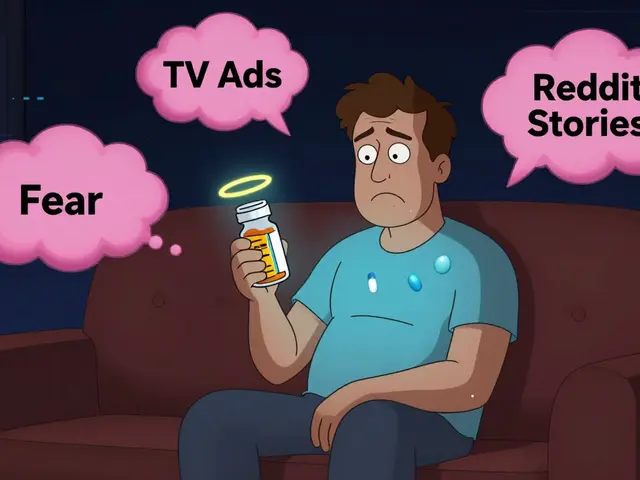
Statin intolerance isn’t just when you feel sore after starting a pill. According to the National Lipid Association (2022), it’s a specific diagnosis: you have to be unable to tolerate two different statins. One at the lowest dose, and another at any dose. And the symptoms must go away when you stop the drug. That’s it. No guesswork. No one-off reactions. Most people who think they’re intolerant aren’t. Studies show that up to 85% of patients who say they have statin-related muscle pain actually have the same symptoms when they take a placebo. That’s the nocebo effect-your brain expects side effects, so you feel them. This isn’t all in your head. It’s a real psychological response to fear, misinformation, or even a bad experience with a previous medication. True statin intolerance is rare. The actual risk of serious muscle damage from statins? About 5 in every 1,000 people per year. Compare that to the placebo group: 4.9 in 1,000. That’s almost the same. Most muscle symptoms are mild, temporary, and not dangerous. They don’t mean you’re at risk of rhabdomyolysis-a condition so rare, it affects fewer than 2 in a million statin users.What Do Statin Muscle Symptoms Actually Feel Like?
If you’re experiencing muscle issues, pay attention to where and how they show up. Statin-associated muscle symptoms (SAMS) usually hit the large muscles: thighs (78% of cases), buttocks (65%), back (52%), and shoulders (47%). It’s not sharp pain. It’s more like:- Heaviness-like your legs are filled with sand
- Stiffness-especially in the morning or after sitting
- Cranking or cramping-not constant, but annoying
- Weakness-struggling to get up from a chair or lift your arms
Why Do So Many People Stop Statins-And Why They Shouldn’t
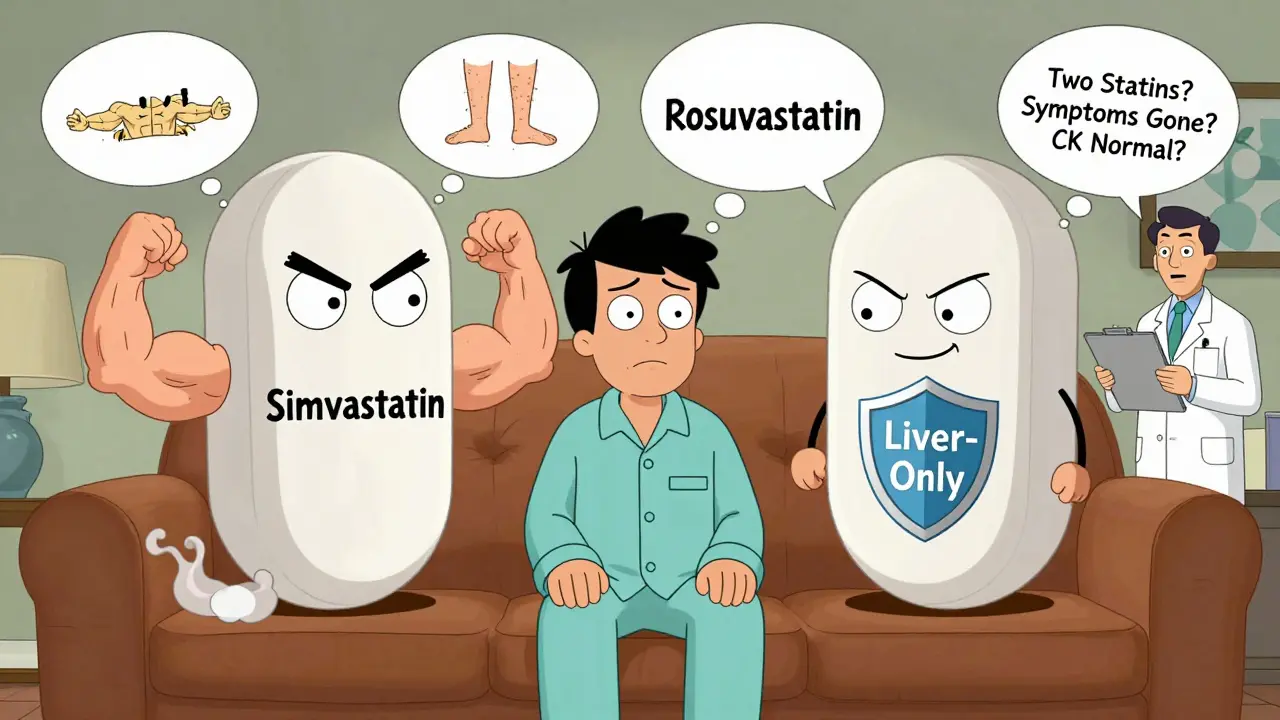
About half of all statin prescriptions get stopped within the first year. Muscle pain is the top reason. But here’s the catch: people who stop statins without proper evaluation are at higher risk of heart attack, stroke, and death. One study found that inappropriate discontinuation increases cardiovascular events by 25%. That’s huge. The problem? Many doctors don’t follow the official guidelines. They hear “I feel sore,” and they stop the statin. But the right approach? First, confirm it’s really the statin. Then, try another statin. Then, consider alternatives. Studies show that 65% of people who can’t tolerate one statin can handle another. Why? Because not all statins are the same. Lipophilic statins like simvastatin and atorvastatin cross into muscle tissue more easily. That’s why they’re linked to more symptoms. Hydrophilic statins like pravastatin and rosuvastatin stay mostly in the liver. They’re gentler on muscles. Try this: if you stopped simvastatin because of leg pain, switch to rosuvastatin at 5mg. It’s just as effective at lowering LDL, but with 28% fewer muscle complaints. And if 10mg of atorvastatin caused trouble, try 5mg. You still get 32% LDL reduction-with 89% tolerability.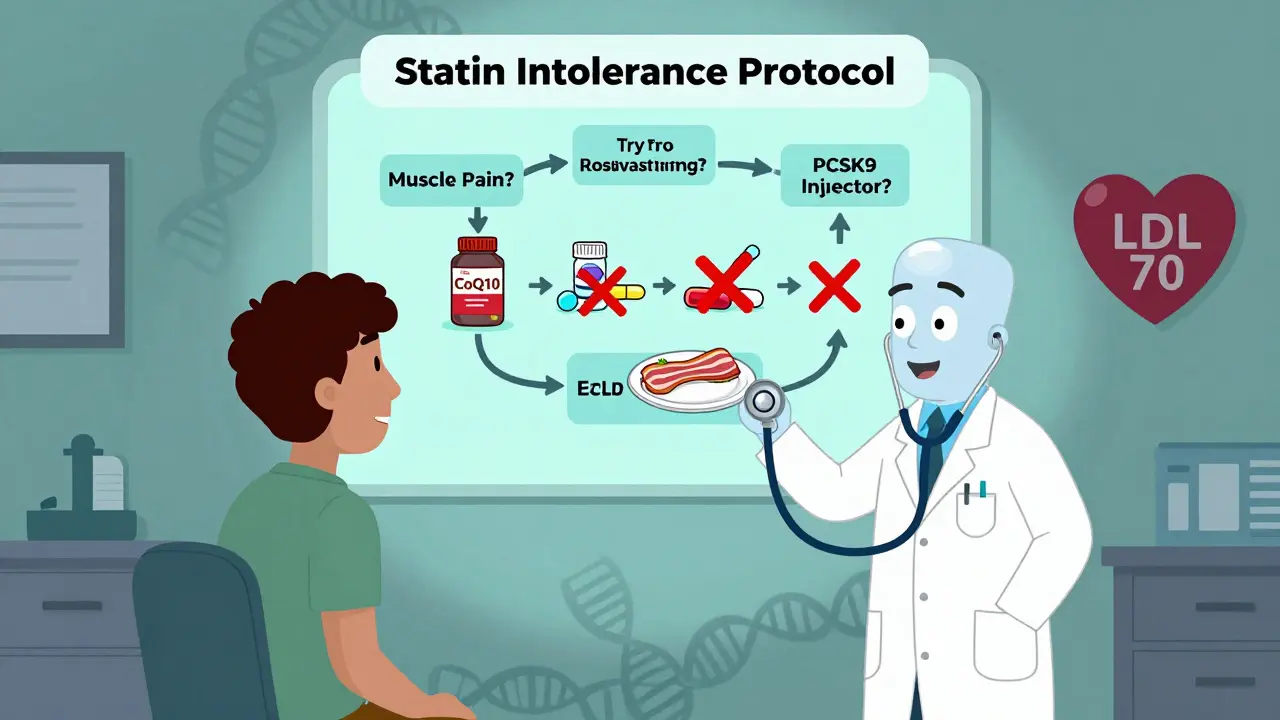
What If You Really Can’t Tolerate Any Statin?
If you’ve tried two statins and still can’t handle them, you’re not out of options. There are proven, effective non-statin therapies. Here’s what works:- Ezetimibe (10mg daily): Reduces LDL by 18%. Takes effect in days. Side effects? Less than 5%-mostly mild bloating. It’s well tolerated in 94% of patients after 12 months. Often used with low-dose statins, but works alone too.
- Bempedoic acid (180mg daily): Lowers LDL by 17%. Designed for people who can’t take statins. Works in the liver, not the muscles. In trials, 88% stuck with it for a year. One study showed it reduced heart attacks by 23% in statin-intolerant patients.
- PCSK9 inhibitors (evolocumab, alirocumab): Injected every 2 or 4 weeks. Drops LDL by 59%. Used in high-risk patients with very high cholesterol. Adherence is 91%. Cost is high-around $5,800 a year-but insurance often covers it if you’ve tried other options.
- Bile acid sequestrants (colesevelam): Powder or tablet. Lowers LDL by 15-18%. Can cause constipation or gas in 22% of users. Good for those who can’t take pills with meals.
- Inclisiran: A twice-yearly injection that silences a liver gene to lower LDL. In trials, it cut LDL by 50% with 93% adherence. Approved in Europe and coming to the U.S. soon.
What About CoQ10, Diet, or Exercise?
You’ve probably heard that CoQ10 supplements help with statin muscle pain. The science? Weak. In double-blind trials, only 34% of people reported improvement. That’s no better than placebo. It’s not a reliable fix. Diet and exercise? They help-but not enough on their own. If your LDL is over 190 mg/dL, lifestyle changes alone won’t get you to goal. Statins (or alternatives) are still needed for people with heart disease, diabetes, or very high cholesterol. But combining them? That’s powerful. One study showed that patients who switched from statins to ezetimibe + bempedoic acid + a Mediterranean diet saw LDL drop 45% and reported fewer muscle symptoms than when they were on statins.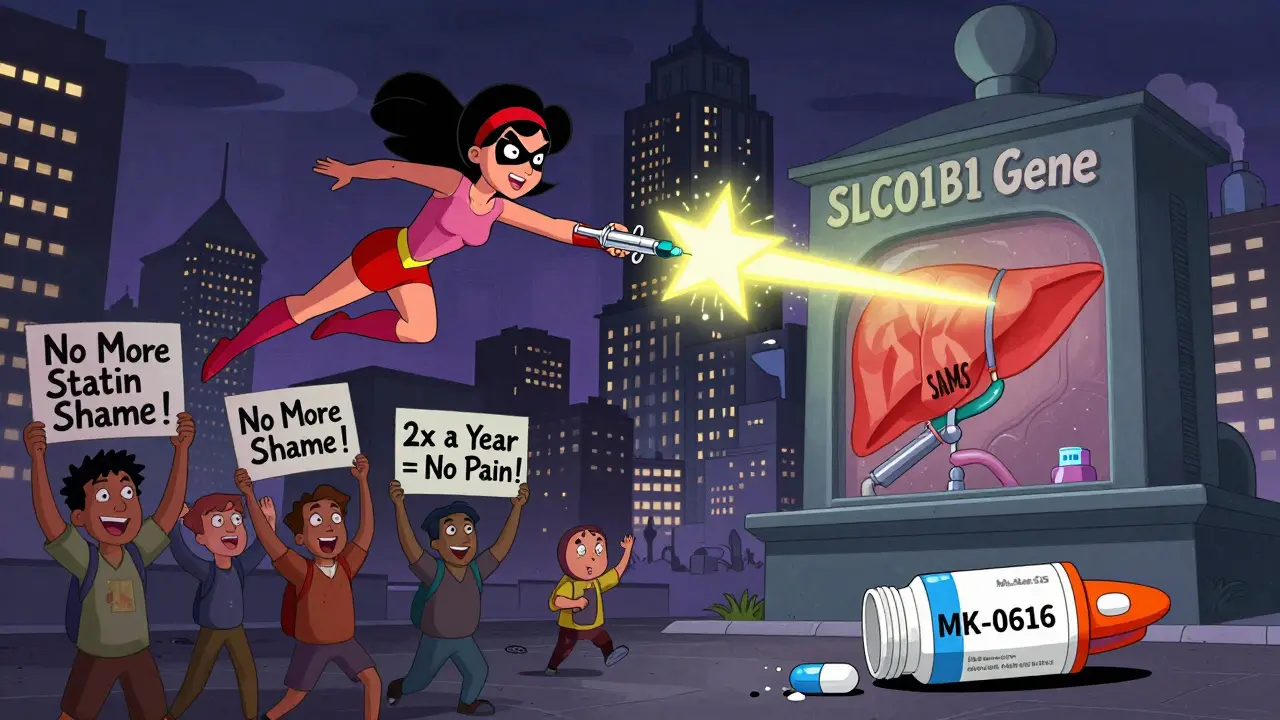
How to Get a Proper Diagnosis
If you think you’re statin intolerant, here’s what to ask your doctor:- Have I tried at least two different statins? One at the lowest dose?
- Did my symptoms go away after stopping the statin?
- Have we checked for other causes? (Vitamin D, thyroid, arthritis, fibromyalgia)
- Have we tried re-challenging? (Reintroducing the statin after a break to see if symptoms return?)
- Am I on a lipophilic statin? Could I switch to a hydrophilic one?
What’s Next for Statin Intolerance?
The field is changing fast. By 2025, genetic testing for the SLCO1B1 gene variant may be routine. People with the *5 or *15 allele have a 4.5 times higher risk of muscle side effects. Knowing this before starting a statin could prevent problems entirely. New drugs are coming too. Oral PCSK9 inhibitors (like MK-0616) are in Phase 3 trials. They work like the injectables but are pills. Inclisiran is already approved in Europe. And a new muscle-protecting drug called IMOD3001 is showing promise in early trials. The bottom line? Most people labeled as “statin intolerant” can be helped. Studies show over 90% of them can reach their cholesterol goals with the right combination of drugs and strategies. You don’t have to live with high cholesterol just because you had a bad experience with one pill.What to Do Today
Don’t stop your statin without talking to your doctor. If you’re having muscle symptoms:- Write down when they started, where they hurt, and how bad they are.
- Check your vitamin D level. If it’s under 30 ng/mL, supplementing may help.
- Ask if you can switch to rosuvastatin 5mg or pravastatin 10mg.
- Request ezetimibe if you’re still having issues.
- Don’t accept “just live with it” as an answer. There are better options.

Comments
Mike Hammer
February 14, 2026 AT 21:36 PMSo many people think statins are poison, but honestly? It's usually just their brain playing tricks on them. I had a buddy who swore he couldn't take them after one week of leg cramps-turned out he was on simvastatin. Switched him to rosuvastatin 5mg and he's been fine for two years. No magic, just biology.
Also, CoQ10? Please. I’ve seen more placebo effects than actual relief. If you’re gonna take supplements, fix your vitamin D first. That’s the real game-changer.
Josiah Demara
February 16, 2026 AT 00:38 AMLet’s cut through the noise. The entire statin intolerance narrative is a marketing scam built on placebo-driven panic. 85% of people who think they’re intolerant react the same to placebo? That’s not a side effect-it’s a failure of critical thinking. Doctors who just stop statins are abdicating their duty. You don’t get to opt out of cardiovascular prevention because your thighs feel ‘heavy.’
And don’t even get me started on ezetimibe as a first-line solution. It’s a Band-Aid on a hemorrhage. If your LDL is over 190 and you’re not on a potent statin, you’re gambling with your life.
Sarah Barrett
February 17, 2026 AT 10:02 AMI’ve been on statins for eight years, and honestly? I thought I was intolerant too. Heavy legs, morning stiffness-I blamed the pill. But then I read the studies about the nocebo effect and decided to rechallenge. Switched from atorvastatin to pravastatin. Within two weeks, the ‘pain’ was gone. Not because I was cured-I was just convinced I was broken.
It’s wild how much our expectations shape our bodies. I’ve since become a quiet advocate for trying again. Not everyone can tolerate statins, but most of us who think we can’t… just need a different one. And maybe a little more science, less fear.
Charlotte Dacre
February 19, 2026 AT 01:10 AMOh wow. So we’re now diagnosing ‘statin intolerance’ based on whether your hamstrings feel like they’re filled with sand? Next up: ‘aspirin intolerance’ because your left pinky tingles after taking a baby pill.
Meanwhile, the real problem is that 70% of doctors haven’t read the 2022 guidelines. They hear ‘I feel weird’ and hit stop. No rechallenge. No switching. No data. Just fear. And now we have a generation of Americans with LDLs over 200 because someone didn’t want to feel ‘cranky’ after yoga.
Betty Kirby
February 20, 2026 AT 22:07 PMLet’s be real: if you’re too fragile to handle a statin, maybe you’re not ready to handle adulthood. This isn’t about muscle pain-it’s about a culture that treats medicine like a menu. ‘I don’t like the taste, can I get a vegan version?’
And CoQ10? Please. That’s the supplement industry’s answer to ‘I don’t want to take responsibility for my health.’ You want to lower your LDL? Take the pill. Or don’t. But don’t pretend a $20 jar of capsules is going to save you from a heart attack.
Erica Banatao Darilag
February 20, 2026 AT 23:42 PMi just wanted to say thank you for this post. i’ve been scared to take statins for years because i thought the muscle pain meant something worse. i didn’t know about the nocebo effect or that ck levels are usually normal. i switched to rosuvastatin 5mg last month and my legs feel better than they have in years. i didn’t realize i was blaming the medicine for my arthritis. thank you for helping me understand. i’m so glad i didn’t give up.
p.s. sorry for typos. typing on phone with tired hands.
Mandeep Singh
February 22, 2026 AT 20:46 PMLet me tell you something about statin intolerance-it’s not about biology, it’s about privilege. In America, people have the luxury to say ‘I feel icky’ and walk away from life-saving medicine. In India, we don’t have that luxury. We take what we can get. We don’t have the time or money to test five different statins or wait for PCSK9 inhibitors to come down in price.
And now you’re telling us to switch to ezetimibe? That’s a joke. It’s a 18% reduction. My uncle had a stroke at 54 because his doctor said ‘try diet first.’ He didn’t have access to rosuvastatin. He didn’t have a lipid specialist. He had a 15-minute appointment and a prescription for turmeric.
This isn’t science. It’s a rich person’s problem dressed up as medicine.
Daniel Dover
February 24, 2026 AT 09:53 AMSwitching statins works. Simple. Proven. Underused.
Pravastatin or rosuvastatin for muscle-sensitive patients. Done.
Chiruvella Pardha Krishna
February 26, 2026 AT 08:53 AMThere is a deeper truth here, one that science does not yet dare to name: the body does not rebel against molecules-it rebels against the metaphysical rupture between self and system. We are not merely chemical vessels. We are narratives shaped by fear, by the ghost of illness, by the silent scream of a society that equates health with obedience.
When a man says his legs feel heavy, is it the statin? Or is it the weight of a thousand unspoken anxieties-of mortality, of control, of the modern condition that tells him he must be perfect to survive?
Perhaps the true intolerance is not to the drug-but to the demand that we submit without question.
Joe Grushkin
February 27, 2026 AT 22:29 PMOh please. Another feel-good article that treats patients like toddlers who can’t handle the truth. You’re telling people to ‘try another statin’ like it’s a flavor of yogurt. Meanwhile, real-world data shows that 50% of patients who stop statins never restart. And now you’re giving them a list of expensive biologics like it’s a spa menu?
Here’s the truth no one wants to say: if you can’t tolerate a statin, you probably have high cardiovascular risk. And if you’re too weak to take a pill that saves your life, maybe you’re not ready to be alive.
Virginia Kimball
February 28, 2026 AT 10:52 AMTHIS. This is the kind of post that gives me hope. I’ve been so scared to talk about my muscle pain because I thought I was weak for it. But learning that 85% of people feel the same with placebo? That’s a game changer.
I switched to rosuvastatin 5mg last week and honestly? I feel better than I have in years. Not because the drug is magic-but because I finally stopped blaming myself. Thank you for writing this. You made me feel seen.
Kapil Verma
March 1, 2026 AT 17:36 PMWestern medicine is broken. You people think you can solve heart disease with pills and lab tests while your children eat junk food and sit on couches all day. Statins? They’re just a bandage on a dying system. In India, we used to cure high cholesterol with turmeric, neem, and daily walks. Now you want to inject $6,000 drugs into people’s arms? You’ve forgotten what health really means.
Stop treating symptoms. Start treating lifestyles. That’s real medicine.
Kaye Alcaraz
March 1, 2026 AT 23:47 PMIf you’re having muscle pain on statins, don’t quit. Talk to your doctor. Try another one. You’ve got options.