
Statin Risk Assessment Tool
This tool estimates your risk of developing rhabdomyolysis from statins based on key risk factors. Rhabdomyolysis is a rare but serious condition where muscle tissue breaks down rapidly. While most people taking statins experience no issues, certain factors can increase risk. This assessment is for educational purposes only and should not replace medical advice.
Enter your information to see your risk level
What Your Risk Level Means
Low Risk: Your risk of rhabdomyolysis is very low. Continue taking your statin as prescribed and follow your doctor's advice. Report any muscle pain to your healthcare provider.
Moderate Risk: Your risk is higher than average. Monitor for symptoms closely and discuss with your doctor about possible dose adjustments or alternative medications.
High Risk: You have multiple significant risk factors. Discuss this with your doctor immediately. Do not stop your statin without medical guidance, but your doctor may recommend alternatives.
Most people taking statins never experience serious muscle problems. But for a tiny fraction, a rare and dangerous condition called rhabdomyolysis can develop - and it can happen fast. This isn’t just sore muscles or mild fatigue. It’s when your skeletal muscle breaks down so quickly that it floods your bloodstream with toxic proteins, risking kidney failure, heart rhythm issues, and even death. The good news? It’s extremely rare. The bad news? If you’re one of the few it happens to, you need to recognize the signs immediately.
What Exactly Is Rhabdomyolysis?
Rhabdomyolysis means muscle tissue is literally dissolving. Your muscle cells rupture, spilling their contents - especially a protein called myoglobin - into your blood. Myoglobin is toxic to your kidneys. When too much of it builds up, your kidneys can’t filter it out fast enough. That’s when acute kidney injury kicks in. In severe cases, you may need dialysis. Some patients don’t survive.Statins are the most common drug linked to this reaction. These cholesterol-lowering pills - like simvastatin, atorvastatin, and rosuvastatin - are taken by over 30 million Americans. They’ve saved countless lives by preventing heart attacks and strokes. But for about 1.5 to 5 people out of every 100,000 taking them each year, the cost is muscle breakdown.
Why Do Statins Cause This?
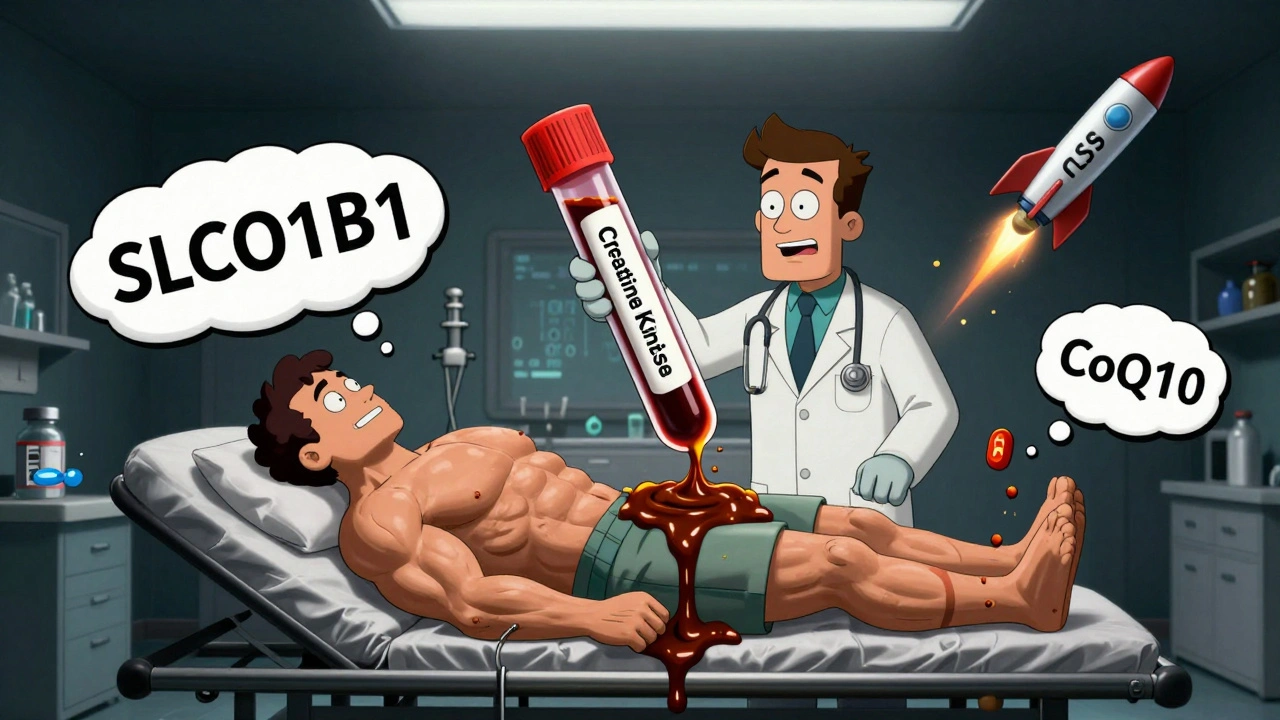
No one single explanation fits every case. Scientists have found several overlapping pathways that can lead to muscle damage.First, statins block an enzyme called HMG-CoA reductase. That’s how they lower cholesterol. But that same enzyme is also needed to make other important molecules - like coenzyme Q10 (CoQ10), which your muscles use to produce energy. When CoQ10 drops, muscle cells struggle to function, especially under stress.
Second, statins can trigger your body’s own muscle-wasting system. Research shows they turn up genes like atrogin-1, which tells your cells to break down their own proteins. This isn’t normal muscle repair - it’s uncontrolled destruction.
Third, some statins - especially the more lipophilic ones like simvastatin and lovastatin - can slip into muscle cell membranes. This makes the membrane unstable. If you’re doing something that stretches your muscles - like hiking downhill, lifting weights, or even just walking up stairs - those weakened membranes can tear, starting the breakdown process.
And then there’s genetics. If you carry a specific variation in your SLCO1B1 gene - about 1 in 10 people do - your liver can’t clear statins properly. That means more of the drug stays in your bloodstream, hitting your muscles harder. People with this variant have up to a 4.5 times higher risk of muscle damage, especially with high-dose simvastatin.
Which Statins Are Riskiest?
Not all statins are created equal when it comes to muscle risk.- Simvastatin 80 mg - This dose was pulled from new prescriptions in 2011 after studies showed it increased myopathy risk by over 10 times compared to 20 mg. It’s still used in some long-term patients, but only with extreme caution.
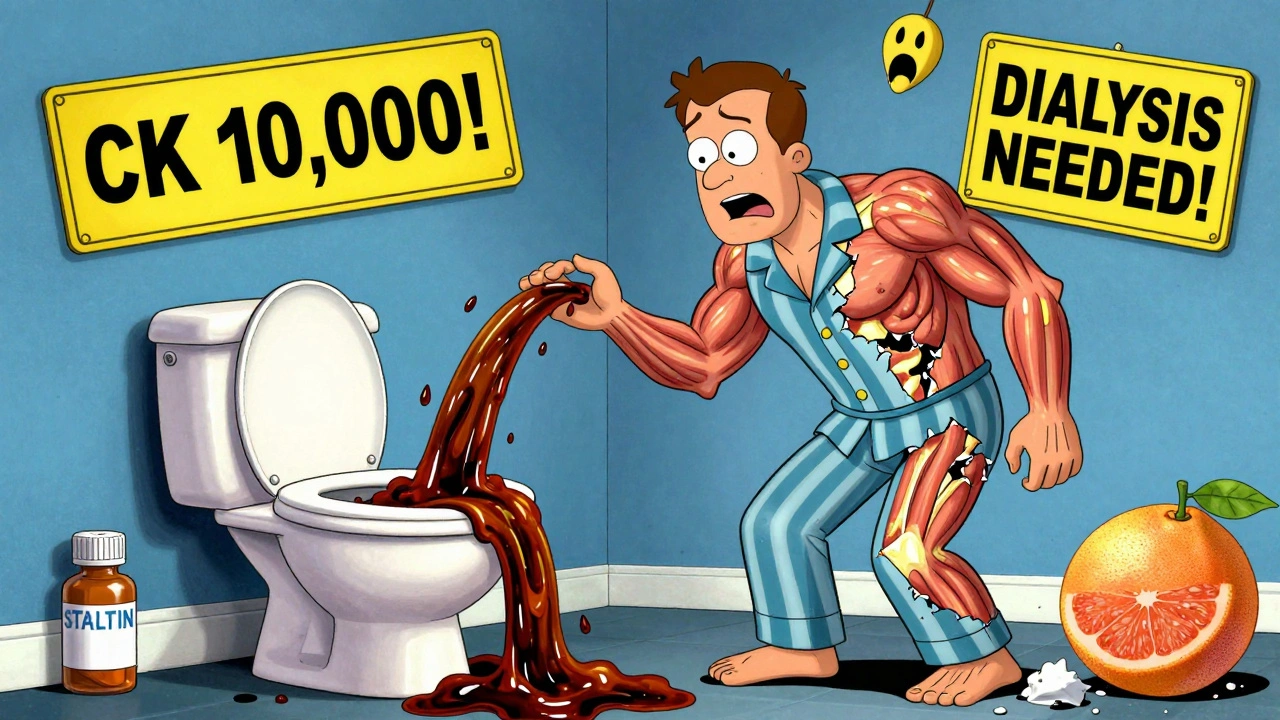
- Atorvastatin and lovastatin - These are metabolized by the CYP3A4 liver enzyme. If you’re also taking a drug that blocks this enzyme - like clarithromycin (an antibiotic), itraconazole (an antifungal), or even grapefruit juice in large amounts - your statin levels can spike dangerously.
- Pravastatin and fluvastatin - These are much safer for muscle health. They don’t rely on CYP3A4 and are less likely to build up in muscle tissue.
- Rosuvastatin - Moderate risk. It’s not metabolized by CYP3A4, but high doses (40 mg) still carry a higher chance of muscle issues than lower ones.
One study found that people taking simvastatin with clarithromycin had their simvastatin blood levels rise 10-fold. That’s not a coincidence - it’s a recipe for disaster.
Who’s Most at Risk?
Some people are far more likely to develop rhabdomyolysis than others.- Age 65+ - Over 78% of reported cases are in older adults. Your liver and kidneys don’t clear drugs as efficiently as you age.
- Women - Nearly two-thirds of cases occur in women, though the reasons aren’t fully clear. Hormonal differences and body composition may play roles.
- People with kidney or liver disease - If your organs can’t process or remove statins, levels build up.
- Those taking other interacting drugs - Fibrates (like gemfibrozil), cyclosporine, and even high-dose colchicine can dramatically increase risk when combined with statins.
- People with SLCO1B1 gene variants - As mentioned, this genetic quirk can turn a safe dose into a dangerous one.
And don’t underestimate exercise. Many patients report symptoms starting after a hike, a new workout routine, or even just walking more than usual. The 2005 research on membrane instability suggests that eccentric movements - like lowering yourself down stairs or running downhill - are especially risky because they stretch muscle fibers while they’re under tension.
What Are the Warning Signs?
Most people with statin-related muscle issues have mild symptoms - soreness, fatigue, or cramps. That’s called statin-associated muscle symptoms (SAMS), and it affects up to 29% of users. But rhabdomyolysis has clear red flags:- Severe muscle pain - often described as a deep, crushing ache, not just soreness
- Extreme weakness - struggling to stand up from a chair or climb stairs
- Dark urine - tea-colored, cola-colored, or brown. This is myoglobin being flushed out
- Fever, nausea, vomiting - signs your body is in crisis
If you’re on a statin and suddenly feel like you’ve been hit by a truck after light activity, don’t wait. Don’t assume it’s just aging or overdoing it. These symptoms can progress to kidney failure within hours.
What Should You Do If You Suspect Rhabdomyolysis?
Time is critical.Stop taking your statin immediately. Then call your doctor or go to the ER. Do not wait until morning. A simple blood test for creatine kinase (CK) can confirm muscle breakdown. If your CK level is more than 10 times the normal upper limit, you likely have rhabdomyolysis. If it’s over 10,000 IU/L - especially with dark urine - you need urgent care.
Treatment focuses on protecting your kidneys. You’ll get large volumes of IV fluids to flush out myoglobin. Your doctors will monitor your kidney function, electrolytes, and heart rhythm. In severe cases, dialysis may be needed.
Genetic testing for SLCO1B1 is now available (like the OneOme RightMed test, costing around $249). While insurance rarely covers it unless you’ve had prior muscle issues, it can be a game-changer for people who’ve had to stop statins and need to find a safer alternative.
Can You Still Take Statins After This?
Yes - but carefully.Many patients who had rhabdomyolysis can eventually restart a statin, but not the same one. Switching to a low-dose pravastatin or fluvastatin often works. Some people tolerate rosuvastatin at 5 mg or 10 mg after a long break. Your doctor may also suggest taking the statin every other day to reduce muscle exposure.
There’s also new hope. A 2023 study in Nature Communications identified 17 blood proteins that predict statin myopathy with over 85% accuracy. In the future, a simple blood test before starting a statin could tell you your personal risk level - no genetic test needed.
And if statins truly aren’t an option? PCSK9 inhibitors like evolocumab and alirocumab are alternatives. They’re injectables, not pills, and cost over $5,800 a year. But for people with familial hypercholesterolemia or very high heart risk, they can be life-saving.
The Bigger Picture: Risk vs. Reward
It’s easy to focus on the rare danger. But here’s what you need to remember: statins prevent about 500,000 heart attacks and strokes every year in the U.S. alone. For someone with a history of heart disease, diabetes, or high cholesterol, the benefit of taking a statin is massive.Studies show that 75% of people who quit statins because of muscle symptoms do so unnecessarily. Many of them didn’t have true statin intolerance - they had the nocebo effect. That’s when you expect side effects, so your brain starts sensing them, even if the drug isn’t the cause.
The American College of Cardiology now recommends that patients who believe they’re statin-intolerant should be carefully re-challenged under medical supervision. In 78% of cases, they can tolerate a different statin or lower dose.
Don’t let fear of a rare side effect keep you from a treatment that could save your life. But don’t ignore real warning signs either. Know the difference between ordinary muscle soreness and the kind of pain that means something’s seriously wrong.
Practical Tips for Safe Statin Use
- Start low, go slow. Always begin with the lowest effective dose.
- Avoid grapefruit juice if you’re on simvastatin, lovastatin, or atorvastatin.
- Let your doctor know every medication and supplement you take - including over-the-counter ones.
- Don’t suddenly start intense exercise. Ease into it, especially if you’re new to working out.
- Report any new muscle pain, weakness, or dark urine immediately.
- If you’ve had muscle issues before, ask about SLCO1B1 testing or a genetic panel.
- Don’t stop your statin on your own - talk to your doctor first.
Statins are one of the most studied drugs in history. Their benefits are proven. Their risks are rare. But when they happen, they’re serious. Stay informed. Stay alert. And never ignore your body when it’s screaming for help.
Can statins cause muscle pain without rhabdomyolysis?
Yes. Up to 29% of people on statins report mild muscle aches, fatigue, or cramps - this is called statin-associated muscle symptoms (SAMS). It’s not rhabdomyolysis. These symptoms are often manageable with a lower dose, switching statins, or taking the pill every other day. True rhabdomyolysis involves severe pain, weakness, and dark urine - signs of muscle breakdown and kidney risk.
Is rhabdomyolysis reversible?
Yes, if caught early. Stopping the statin and getting IV fluids can reverse muscle damage and prevent kidney failure in most cases. But if treatment is delayed and kidney injury becomes severe, permanent damage or the need for long-term dialysis can occur. The key is acting fast at the first sign of dark urine or extreme weakness.
Does taking CoQ10 supplements help prevent statin muscle damage?
Some studies suggest CoQ10 supplements may reduce mild muscle pain in statin users, but the evidence isn’t strong enough to recommend them for preventing rhabdomyolysis. While statins do lower CoQ10 levels, the link between that drop and serious muscle damage isn’t proven. Supplements won’t fix the other mechanisms - like gene mutations or membrane instability - that cause rhabdomyolysis.
Can I take a statin again after having rhabdomyolysis?
It’s possible, but only under strict medical supervision. Most doctors avoid restarting the same statin. Switching to pravastatin, fluvastatin, or a very low dose of rosuvastatin is common. Some patients tolerate statins again after a 3-6 month break. Genetic testing for SLCO1B1 can help guide the choice. Never restart on your own.
How do I know if my muscle pain is from statins or something else?
Timing matters. Statin-related pain usually starts within the first 3 months. It often gets worse with activity, especially downhill walking or stairs. If your pain improves after stopping the statin and returns when you restart it, that’s a strong clue. Blood tests for creatine kinase (CK) can confirm muscle damage. If CK is normal and pain persists, other causes like arthritis, nerve issues, or thyroid problems should be checked.
Are there any new statins with less muscle risk?
No new statins have been approved recently, but research is active. A 2022 study in the Journal of Lipid Research described experimental statins designed to avoid muscle tissue uptake while still lowering cholesterol. These are still in early trials. Meanwhile, the focus is on personalized dosing using genetic testing (SLCO1B1) and blood biomarkers - which can now predict risk with over 85% accuracy.
For most people, statins are a lifeline. For a very few, they’re a danger. Understanding the difference isn’t just about science - it’s about listening to your body and knowing when to act.


Comments
Rupa DasGupta
December 4, 2025 AT 17:06 PMThis is why I switched to red yeast rice... no prescription, no drama. 😌
Marvin Gordon
December 5, 2025 AT 00:46 AMStatins saved my life after my first heart attack. I had mild muscle soreness at first, but I talked to my doc, dropped the dose, switched to pravastatin, and now I’m running 5Ks. Don’t let fear silence your health.
Mark Ziegenbein
December 6, 2025 AT 12:14 PMThe real tragedy here isn't rhabdomyolysis-it's the pharmaceutical-industrial complex weaponizing fear to keep you docile while they peddle $5,800/year injectables that barely outperform a well-timed placebo. CoQ10 supplements? Of course they’re underfunded. Why fund science that doesn’t require a patent when you can sell a $249 genetic test instead? The system is rigged, and your muscle pain is just collateral damage in a profit-driven war on cholesterol.
Annie Grajewski
December 8, 2025 AT 06:13 AMso like... if i take statins and then go for a walk and my legs feel like jelly... is that just me being lazy or is my muscle literally melting? like... should i be panicking or just napping? 🤔
Lynette Myles
December 8, 2025 AT 22:17 PMThey never mention that the FDA approved 80mg simvastatin knowing the risks. Same people who said smoking was safe in the 50s. History repeats. Watch.
Jimmy Jude
December 9, 2025 AT 22:15 PMWe’ve turned medicine into a moral test. Take the pill, you’re responsible. Don’t take it, you’re reckless. But what if your body just... doesn’t want it? What if your cells are screaming? We treat physiology like a spreadsheet. It’s not. It’s a living, whispering, ancient thing. You don’t override it with dosage charts.
an mo
December 11, 2025 AT 14:47 PMThe SLCO1B1 variant prevalence in Caucasians is 15-20%, not 10%. And the 4.5x risk multiplier is only valid for simvastatin 80mg. The paper you’re citing is from JAMA 2012, but newer GWAS studies show epigenetic modulation via gut microbiome alters statin uptake. You’re still operating on outdated pharmacokinetic models. Also, grapefruit juice isn’t the issue-it’s furanocoumarin concentration. Naranjo scale confirms this isn’t a class effect.
aditya dixit
December 13, 2025 AT 01:19 AMI’ve seen patients in India with no history of heart disease take statins because their doctor said 'it’s for prevention.' Many develop muscle pain and stop, then feel guilty. But prevention isn’t one-size-fits-all. Your body knows its limits. Listen. Not every high cholesterol needs a pill. Diet, movement, sleep-they’re not alternatives. They’re the foundation.
Mark Curry
December 14, 2025 AT 23:23 PMi took atorvastatin for 2 years. got a little sore after hiking. stopped. felt better. went back 6 months later on pravastatin 10mg. no issues. just gotta find your fit. 🙏
Manish Shankar
December 15, 2025 AT 15:23 PMIt is with profound respect for the scientific rigor presented herein that I must express my admiration for the comprehensive elucidation of statin-induced rhabdomyolysis. The integration of genetic, pharmacokinetic, and clinical data represents a paradigm of evidence-based medicine. I trust that such scholarship shall guide both practitioner and patient toward informed, dignified decision-making.
luke newton
December 17, 2025 AT 14:14 PMThey don’t want you to know this, but statins are just a Band-Aid for a diet full of processed crap. Eat real food. Move. Sleep. Then you won’t need to risk your muscles for a number on a lab report. You’re being manipulated.
Ali Bradshaw
December 19, 2025 AT 11:57 AMMy mum had rhabdo on simvastatin. She was 72, took it for 3 years, started walking more. Dark urine. ER. Dialysis for 10 days. She’s fine now, but switched to ezetimibe. I’m so glad she listened when she said 'something’s not right.' Don’t wait for the textbook symptoms. Trust your gut.
ashlie perry
December 21, 2025 AT 07:40 AMThe government and Big Pharma are using statins to control the population’s health metrics. They don’t care if you live or die-just that your cholesterol is 'normal.' They’ve been hiding the truth about muscle breakdown for decades. Wake up.
Juliet Morgan
December 21, 2025 AT 11:35 AMi had the cramps for months and thought i was just getting old... then i read this and stopped the statin. 3 days later, i could climb stairs again. no joke. i’m not a doctor but... maybe listen to your body before the lab results?
Norene Fulwiler
December 23, 2025 AT 07:27 AMIn my family in Mexico, we’ve always used garlic, oats, and daily walks to keep cholesterol down. My abuelo lived to 98 without a single pill. We don’t need to chemically tame our bodies-we need to honor how they were meant to move and eat. This post is important, but let’s not forget the wisdom of our ancestors.