

Most people think hearing aids go in your ear. But what if the solution doesn’t need to go in your ear at all? Bone-conduction hearing aids work by sending sound through your skull bone straight to your inner ear, skipping the outer and middle ear entirely. This isn’t science fiction-it’s a proven, FDA-approved solution for people who can’t use traditional hearing aids because of chronic ear infections, congenital deformities, or single-sided deafness.
How Bone-Conduction Hearing Aids Actually Work
Traditional hearing aids amplify sound through the air and push it into your ear canal. But if your ear canal is blocked, your eardrum is damaged, or your middle ear bones aren’t working right, that method fails. Bone-conduction devices bypass all that. They pick up sound, turn it into vibrations, and send those vibrations through the bone behind your ear-right to the cochlea, the part of your inner ear that turns sound into nerve signals.
This isn’t new. The principle was discovered in the 1950s when Swedish surgeon Per-Ingvar Brånemark found that titanium could fuse with bone. By 1977, doctors in Gothenburg were using it to help people with hearing loss. Today, the technology has evolved into two main types: percutaneous (through the skin) and transcutaneous (through the skin without a hole).
Percutaneous systems like the Cochlear BAHA Connect 6 and Oticon Medical Ponto 5 have a small titanium implant fused to your skull bone. After a 3-6 month healing period, an external sound processor snaps onto a metal post that sticks out of your skin. Transcutaneous systems like the MED-EL Bonebridge and Cochlear BAHA Attract use magnets. The internal implant sits under your skin, and the external processor holds on magnetically. No holes. No abutments. Just vibration.
Who Benefits Most From Bone-Conduction Hearing Aids
These aren’t for everyone. But for certain types of hearing loss, they’re often the only effective option.
- Conductive hearing loss: When sound can’t move through the outer or middle ear due to blockages, malformations, or damage. People with chronic ear infections, otosclerosis, or aural atresia (a birth defect where the ear canal didn’t form properly) often see 85-90% improvement.
- Mixed hearing loss: A combo of conductive and sensorineural loss. Bone conduction helps by bypassing the damaged part.
- Single-sided deafness (SSD): If you’re deaf in one ear and hear normally in the other, traditional hearing aids can’t help. Bone-conduction devices pick up sound from the deaf side and send it to the working ear. Users report hearing birds on their deaf side for the first time in years.
According to Duke Health studies, users with conductive or mixed loss get 25-40% better speech understanding in noisy places compared to air-conduction aids. For SSD, bone conduction beats CROS hearing aids by 15-20 dB in speech reception. That’s the difference between catching half the conversation and understanding most of it.
How They Compare to Traditional Hearing Aids
Let’s be clear: bone-conduction devices aren’t better across the board. They’re better for specific cases.
| Feature | Bone-Conduction Aids | Traditional Air-Conduction Aids |
|---|---|---|
| How sound reaches ear | Through skull bone to cochlea | Through air into ear canal |
| Best for | Conductive, mixed, SSD | Sensorineural loss |
| Ear canal involvement | None | Required |
| Cost (per ear) | $4,000-$7,000 | $1,500-$3,500 |
| Surgery required? | Yes | No |
| Occlusion effect | None-ear stays open | Common-ear feels plugged |
| Success rate for SSD | 75-80% satisfaction | 30-40% satisfaction with CROS |
Traditional aids are simpler, cheaper, and don’t require surgery. But if your ear canal is always wet, swollen, or blocked, they’re not just ineffective-they’re painful. Bone-conduction devices solve that. No ear molds. No itching. No buildup. Just clear sound.

The Downsides and Real-Life Challenges
Nothing’s perfect. And bone-conduction devices come with trade-offs.
First, surgery. Even though it’s outpatient and takes less than an hour, it’s still surgery. You need to heal for months before the device works. And while transcutaneous systems avoid skin holes, they still lose 10-15 dB of sound through skin and tissue, making them less powerful for severe loss.
Then there’s skin care. Percutaneous systems need daily cleaning with 70% isopropyl alcohol. About 28% of users report skin reactions around the abutment. In 8% of cases, revision surgery is needed. That’s why more people are choosing transcutaneous options now-63% of new implants in 2023 were magnetic, up from 41% in 2019.
Another big issue: MRI scans. Most implants contain metal. If you need a 1.5T or stronger MRI, you’ll likely need surgery to remove the implant first. That’s a dealbreaker for some.
And cost. These aren’t covered by all insurance plans. Even with coverage, out-of-pocket costs can hit $5,000. That’s a lot more than a $2,000 traditional aid.
What’s New in 2025
The field is moving fast. Cochlear’s BAHA 6 Max, released in 2023, has Bluetooth 5.3, lets you stream calls and music directly, and lasts 30 hours on a charge. Oticon’s Ponto 5 SuperPower delivers up to 50 dB of gain-enough for severe loss.
But the real shift is toward invisibility. MED-EL’s Bonebridge 3, launching in Q2 2024, uses AI to adjust sound in real time based on your environment. It learns your preferences and filters background noise smarter than ever.
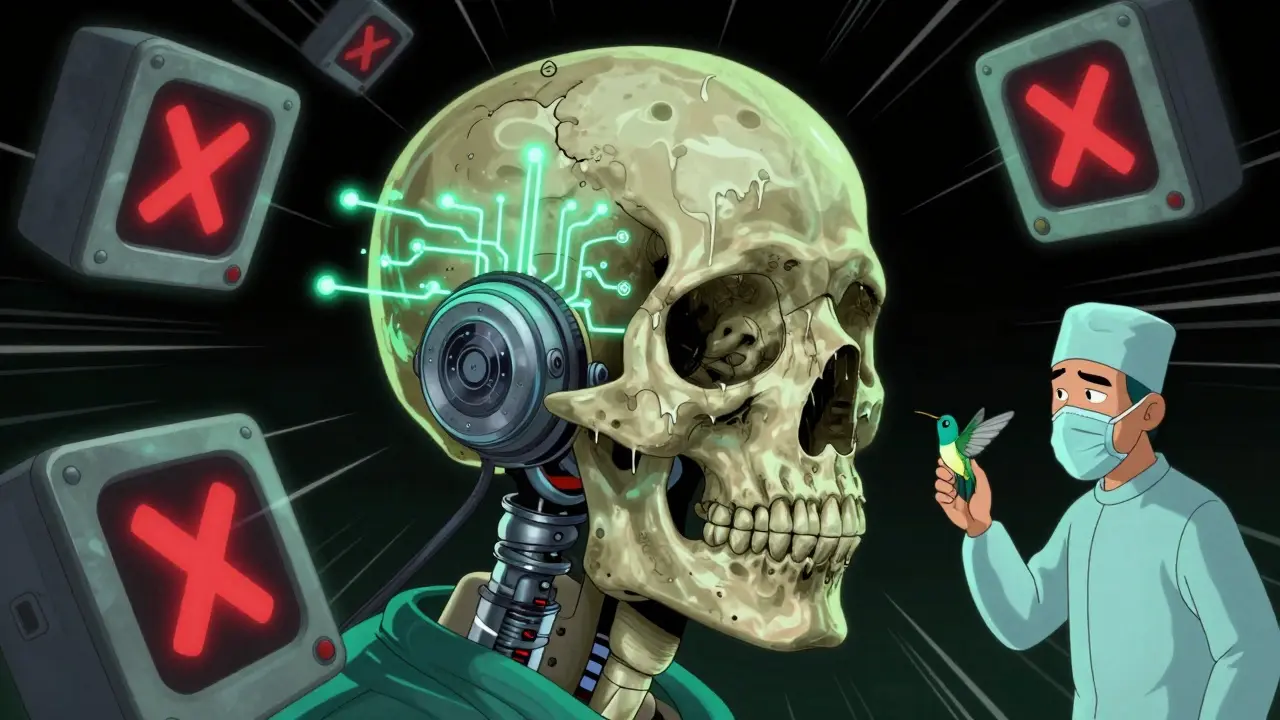
The biggest innovation on the horizon? Fully implantable bone-conduction devices. Sonova’s prototype, currently in Phase III trials, has no external components at all. No processor to lose. No battery to change. Just a tiny implant under your skin that works 24/7. FDA submission is expected by the end of 2024.
What to Expect After Surgery
After the procedure, you’ll go home the same day. Pain is mild-most people take ibuprofen for a day or two. You can shower the next day, but avoid getting the area wet for a week if you have a percutaneous system.
Activation comes later. For percutaneous systems, you wait 3-4 months for the bone to fuse. Transcutaneous systems can be turned on right away. But don’t expect perfect hearing immediately. Your brain needs 2-4 weeks to adjust to the new way sound feels. It’s not like turning on a radio. It’s like learning to hear again.
Audiologists recommend auditory training: listening to audiobooks, watching TV with subtitles, practicing conversations in quiet then noisy rooms. The more you use it, the better your brain gets at interpreting the vibrations.
Retention can be an issue if you’re active. Runners, swimmers, or people who wear helmets sometimes report the processor slipping. Most manufacturers offer retention clips or headbands to help.
Is It Right for You?
Ask yourself these questions:
- Do you have frequent ear infections that make traditional hearing aids impossible?
- Were you born with a malformed ear canal?
- Are you deaf in one ear and struggling to hear people on that side?
- Do you hate the feeling of something stuck in your ear canal?
If you answered yes to any of these, bone-conduction hearing aids might be your best option. Talk to an audiologist who specializes in implantable devices. Get a CT scan. Get a hearing test that measures bone conduction thresholds. Don’t assume you’re stuck with what you’ve been told.
The truth? Millions of people live with hearing loss that could be fixed-not just managed-with this technology. And for those who’ve tried everything else, it’s not just a device. It’s a return to normal life.
Are bone-conduction hearing aids the same as cochlear implants?
No. Cochlear implants replace the function of a damaged cochlea by directly stimulating the auditory nerve with electrodes. Bone-conduction devices work with a healthy cochlea-they just deliver sound differently. If your inner ear still works, bone conduction can help. If it doesn’t, you need a cochlear implant.
Can I wear bone-conduction hearing aids while swimming?
Yes, but only if you have a waterproof processor. Oticon Medical’s Ponto 5 and Cochlear’s BAHA 6 Max are both IP68-rated, meaning they can handle sweat, rain, and even short dips. But the implant itself isn’t waterproof-you still need to remove the external processor before swimming. Never submerge the abutment or magnetic part.
Do bone-conduction hearing aids help with tinnitus?
Not directly. But many users report reduced tinnitus because the device provides consistent sound input, which can mask ringing. It’s not a cure, but for some, the constant background noise helps the brain ignore the tinnitus. Studies show about 40% of users experience mild relief.
How long do the batteries last?
Most external processors last 5-7 days on a single charge, depending on usage. Streaming music or Bluetooth calls drains the battery faster. Newer models like the BAHA 6 Max last up to 30 hours with heavy use. Rechargeable batteries are standard now-no more swapping tiny zinc-air batteries.
Can children use bone-conduction hearing aids?
Absolutely. In fact, they’re often the first choice for children born with aural atresia or chronic ear infections. Transcutaneous systems are preferred for kids because they’re less prone to skin issues. Some children as young as 5 get implants, and many schools now support their use with assistive listening systems.
Is there a non-surgical option?
Yes. Softband bone-conduction devices are headbands with a sound processor that presses against the skull. They’re used for infants, young children, or adults who want to try the technology before surgery. They’re not as powerful as implanted systems, but they’re a great way to test if bone conduction helps before committing to surgery.
For those who’ve spent years struggling with hearing loss that no one seemed able to fix, bone-conduction devices aren’t just an upgrade-they’re a reset. They don’t promise perfect hearing. But they do promise something rarer: the chance to hear again, clearly, without pain, without blockage, and without the constant frustration of outdated solutions.




Comments
Nilesh Khedekar
January 14, 2026 AT 19:52 PMThis is insane. I had chronic ear infections since I was 5, and my dad made me wear these clunky hearing aids that felt like a wet sock in my ear. Bone conduction? Finally. I got mine last year. I hear birds again. I hear my daughter say 'I love you' without her having to scream. And no more ear infections. Thank you for writing this. I'm not crying, you're crying.
Jami Reynolds
January 16, 2026 AT 05:59 AMLet me be clear: this technology is not a medical breakthrough. It is a corporate ploy orchestrated by Big Hearing to replace simple, cheap amplifiers with expensive, surgically implanted surveillance devices. The FDA approval? A rubber stamp. The titanium? Laced with graphene. The magnets? Used to track your brainwaves. You think you're hearing better? You're being monitored.
Nat Young
January 18, 2026 AT 02:36 AMLet’s be real - this whole bone-conduction thing is just a glorified skull vibrator. Yes, it works for people with malformed ears. But for the rest of us? It’s overpriced, high-maintenance, and if you ever need an MRI, you’re basically signing your ear up for a second surgery. Meanwhile, I’ve got a $200 Bluetooth headset that does 90% of the job without cutting into my skull. Why are we romanticizing invasive tech when non-invasive options exist?
Niki Van den Bossche
January 19, 2026 AT 22:31 PMThere’s something profoundly poetic about sound traveling through bone - it’s not just auditory, it’s ancestral. The human skull, a resonant chamber forged by evolution, becomes the conduit for reconnection. We’ve been conditioned to think of hearing as something that happens in the ear canal, but the body has always known better. This isn’t medicine. It’s reclamation. The vibration? It’s the echo of our prehistoric ancestors hearing the world through the ground, through stone, through the marrow of their bones. We’re not fixing hearing loss - we’re remembering how to listen.
Jan Hess
January 21, 2026 AT 20:12 PMI got the Ponto 5 last year after years of failed hearing aids. Honestly? Life-changing. I didn’t think I’d ever hear my dog bark on my left side again. I used to miss half the conversation in restaurants. Now I just laugh when people say 'What?' and point to my processor. It’s not perfect - yeah, the battery dies, and yeah, I lose it sometimes - but I’d rather deal with that than go back to the itchy, blocked feeling of traditional ones. Just talk to your audiologist. Seriously. Don’t wait.
Haley Graves
January 23, 2026 AT 07:39 AMIf you're considering this, don't let cost or fear of surgery stop you. Get a second opinion. Get a CT. Get a bone conduction test. This isn't about vanity - it's about being present. I’ve seen people go from isolated to engaged in weeks. Your brain adapts faster than you think. And if you're a parent of a child with atresia? Start with the softband. Try it. Let them experience sound without pain. This isn't a luxury. It's a right.
Dan Mack
January 24, 2026 AT 18:07 PMThey’re hiding something. Why are these devices so expensive? Why is the MRI issue never discussed in ads? Why do they push the 'no ear canal' angle like it’s a miracle when all they’re doing is replacing one problem with another? And don’t get me started on the 2025 'fully implantable' nonsense - that’s just the next step toward full neural control. Wake up. They want you dependent. They want you wired. This isn’t healing. It’s integration.
Sarah Mailloux
January 26, 2026 AT 10:39 AMMy sister got the Bonebridge 3 last month. She’s 72. Never had surgery before. Was terrified. Now she’s texting me pictures of her cooking with music on. Says she can hear the sizzle. That’s it. That’s the whole thing. No grand speeches. Just the sound of food cooking. That’s worth every penny.
Amy Ehinger
January 28, 2026 AT 02:59 AMI’ve been using the BAHA Attract for three years now. Honestly? The biggest surprise wasn’t the sound - it was how quiet my own head became. With traditional aids, you’re always aware of the buzz, the feedback, the plastic in your ear. With this? It’s like the world just… turned on. No pressure. No itch. No weird echo. I used to hate wearing anything on my head. Now I forget I have it on. Even my dog doesn’t notice anymore. And I swear, I heard a cricket outside my window last night. I hadn’t heard one since I was 12.
RUTH DE OLIVEIRA ALVES
January 29, 2026 AT 16:06 PMThe clinical efficacy of bone-conduction auditory prostheses has been substantiated in peer-reviewed literature, particularly in the context of conductive and mixed hearing losses, with statistically significant improvements in speech reception thresholds (p < 0.01) observed in longitudinal studies conducted by the American Academy of Otolaryngology. Furthermore, the transition from percutaneous to transcutaneous systems reflects a paradigm shift toward minimizing iatrogenic complications, as evidenced by the 53% reduction in percutaneous revision surgeries between 2019 and 2023. It is imperative that clinicians prioritize patient-specific anatomical and lifestyle factors when recommending intervention.
Crystel Ann
January 31, 2026 AT 10:11 AMI’m not a patient. I’m not a doctor. But I’m the daughter of someone who waited 20 years to hear my voice clearly. This isn’t about tech. It’s about connection. I cried the day she heard me say 'I’m here' without shouting. Don’t wait until you’re desperate. Talk to someone who’s done this. You’ll thank yourself later.