
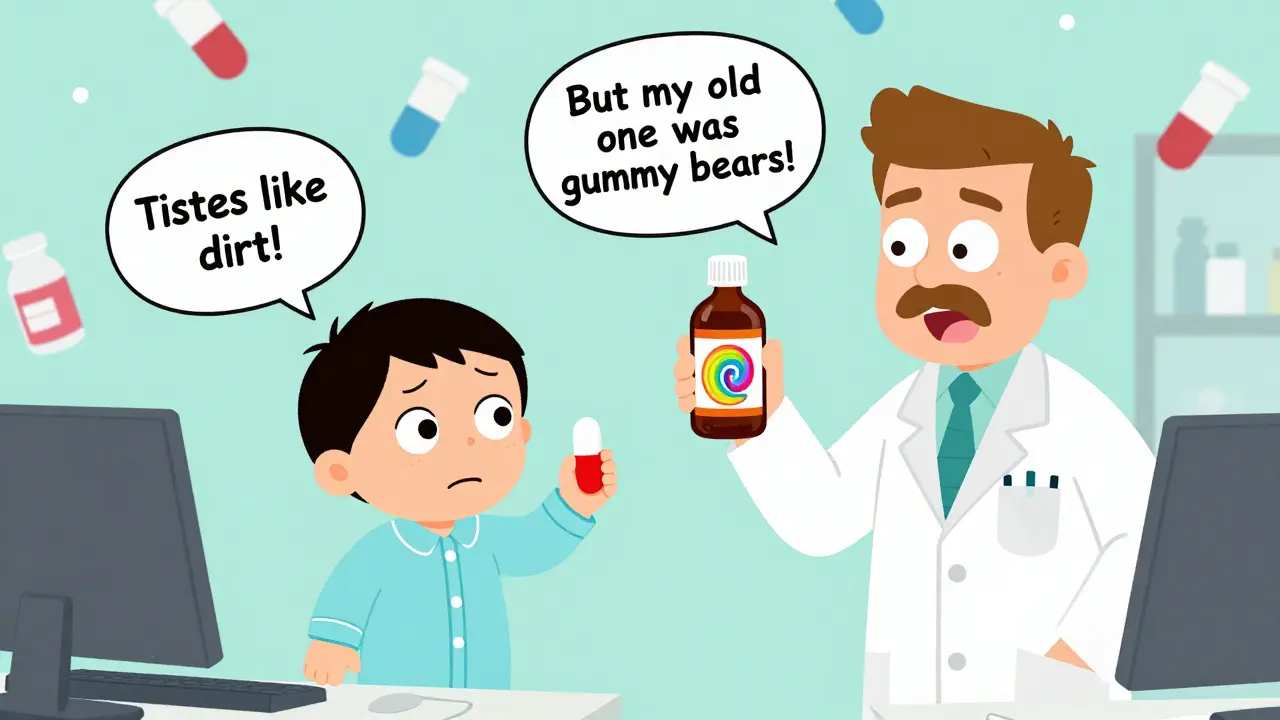
When a pharmacist hands you a pill that looks different from what you’ve been taking for years, it’s natural to feel uneasy. For parents of young children or seniors managing multiple prescriptions, this moment can trigger anxiety, confusion, or even refusal to take the medicine. The truth is, generic substitution is not just a cost-saving move-it’s a clinical decision that requires thoughtful communication. And when it’s done poorly, it can break trust, hurt adherence, and even put patients at risk.
Why Generic Substitution Feels Different Even When It’s the Same
Generic drugs are required by the FDA to contain the same active ingredient, strength, and dosage form as their brand-name versions. They must also prove they’re absorbed into the body at a rate within 80-125% of the original-what’s called bioequivalence. That sounds scientific, but what matters to patients is this: the pill looks different, tastes different, and sometimes even comes in a different shape or size. For kids, this isn’t just about appearance. Many brand-name pediatric medications are specially made as sweet-tasting liquids, chewable tablets, or easy-to-swallow capsules. Generics? Often, they’re not. According to FDA data, only 32% of generic pediatric formulations come in child-friendly forms, compared to 68% of brand-name versions. One parent on Reddit shared that their 2-year-old refused the generic amoxicillin because it tasted bitter-something the brand version didn’t. The child stopped taking it. The infection came back. For seniors, the problem is layered. Many take four or more medications daily. When their blood pressure pill changes color, shape, or size three times in six months, they start thinking: Is this a different drug? Did I make a mistake? A 78-year-old man in an AARP forum said he stopped taking his pill altogether because he couldn’t keep track of the changes. His doctor had to explain each new version individually.What’s Really at Stake: More Than Just Cost
The biggest myth is that generics are just cheaper versions of the same thing. They’re not. They’re legally required to be therapeutically equivalent-but that doesn’t mean they’re identical in every way that matters to the patient. For narrow therapeutic index drugs-like seizure medications, thyroid hormones, or blood thinners-small changes in absorption can lead to real clinical consequences. A 2017 Danish study followed nine epilepsy patients who switched from brand to generic. Four had seizure relapses after the switch, even though the generic met FDA bioequivalence standards. The difference? Just enough to tip the balance in someone whose body is finely tuned. And then there’s the nocebo effect-the flip side of the placebo effect. If you’re told a cheaper pill might not work as well, your brain starts looking for signs it’s true. A 2021 study found that 58% of seniors reported new side effects after switching to a generic, even when no actual pharmacological change occurred. Their minds were primed to expect trouble.How to Talk to Parents About Generic Medications for Kids
Parents aren’t resistant because they don’t care about cost. They’re worried because their child’s health is on the line. In a 2020 Pediatrics study, 62% of parents expressed hesitation about switching their child to a generic. That’s not stubbornness-it’s responsibility. Here’s what works:- Don’t say, “It’s the same thing.” Instead, say: “This medicine has the same active ingredient as the brand, but it’s made by a different company. That’s why it looks different.”
- Check the formulation. Ask: “Is there a liquid version? Does it taste better?” If the generic is bitter and the brand wasn’t, say: “We can ask the pharmacy to check if they have a flavored version, or we can talk about switching back if your child can’t keep it down.”
- Use the teach-back method. After explaining, ask: “Can you tell me how you’ll give this to your child?” If they say, “I’ll mix it with juice,” but the label says “take on empty stomach,” you’ve caught a mistake before it happens.
- Offer alternatives. If the generic causes refusal, suggest asking the prescriber for a prior authorization for the brand-or explore patient assistance programs that cover the cost difference.
How to Talk to Seniors About Generic Medications
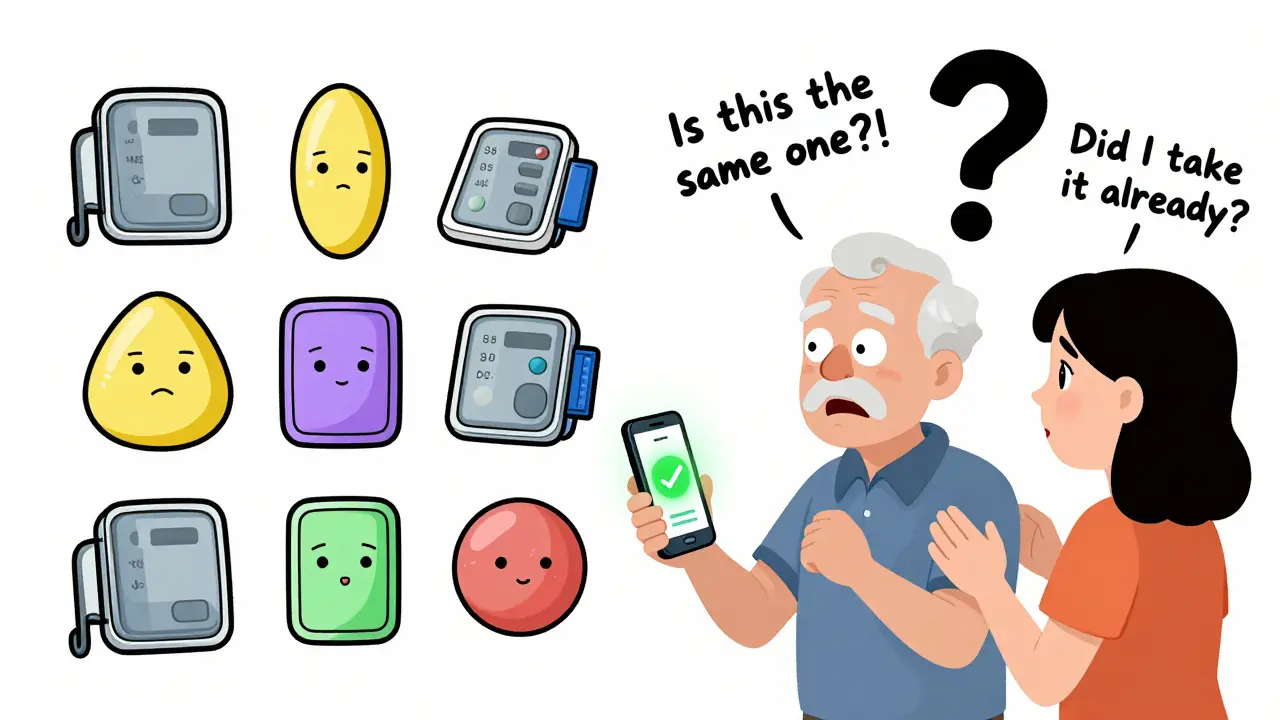
Seniors aren’t confused because they’re old. They’re confused because the system changes things without warning. A 2022 study showed that 52% of seniors experienced confusion when their medication changed appearance multiple times in a short period. Here’s how to help:- Start early. Don’t wait until the pill looks different. Talk to them before the switch happens. Say: “Your blood pressure medicine might change next month. I’ll call you if it does so you’re not surprised.”
- Use large print and pictures. Give them a simple handout with the old and new pill images, color, shape, and name. Many seniors don’t read small labels. A photo helps them recognize it.
- Involve family. Ask: “Would you like your daughter to come with you next time so she can help remember what to look for?”
- Address cost fears directly. Many seniors think generics are “weaker.” Say: “This pill has to prove it works just as well as the brand before it can be sold. It’s not cheaper because it’s worse-it’s cheaper because the company didn’t spend money on ads.”
- Use the teach-back method. Ask: “What will you do if you see a new pill and you’re not sure it’s the same one?” Their answer will tell you if they truly understand.
What Pharmacists and Providers Must Do Differently
The system isn’t broken-it’s poorly designed for people, not paperwork. In 19 states, pharmacists are required to substitute generics automatically. In 7 states, they need your consent. In 31, they just have to tell you after the fact. That’s not care. That’s chaos. Best practices are clear:- Communicate before the switch. The Drug Patent Watch 2020 framework found that proactive counseling reduces complaints by 47%.
- Don’t assume understanding. A 2021 CMS survey found 68% of seniors believe generics are less effective. That’s not ignorance-it’s misinformation that’s never been corrected.
- Use digital tools. A 2023 University of Florida study found that 67% of seniors felt more confident using a medication image app to compare pills. These apps let them snap a photo of their new pill and get instant confirmation it’s the same drug.
- Document the conversation. If a patient refuses a generic, note why. If they’re concerned about taste, formulation, or appearance-write it down. That info helps the prescriber make better choices next time.
When to Avoid Generic Substitution Altogether
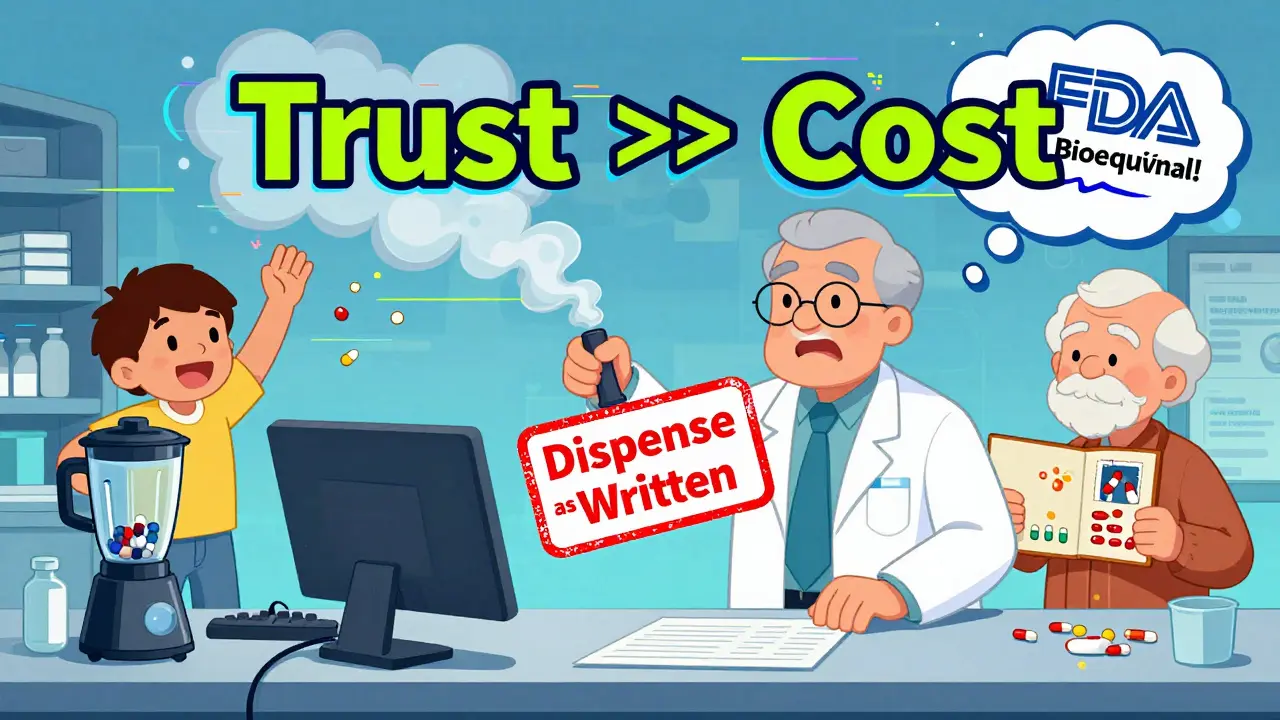
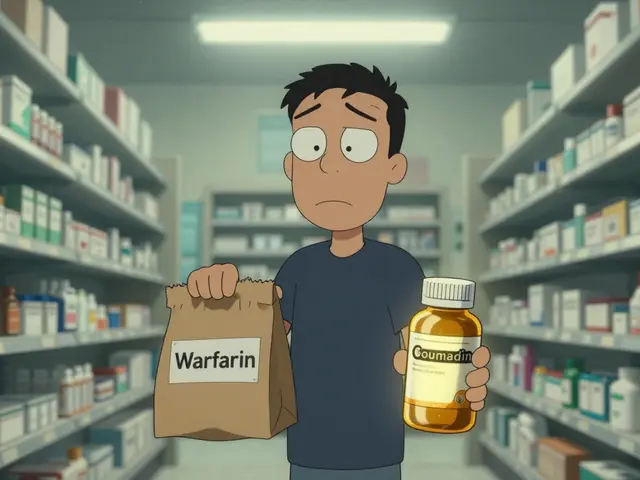
Not every drug should be swapped. The FDA and medical societies agree: avoid automatic substitution for:- Drugs with a narrow therapeutic index (epilepsy, thyroid, warfarin, digoxin)
- Pediatric formulations without a child-friendly generic version
- Patients with a history of adverse reactions after a switch
- Seniors with cognitive impairment or those taking five or more medications
What Patients Can Do Right Now
You don’t have to wait for the system to fix itself. Here’s what you can do:- Ask your pharmacist: “Is this a generic? Can I see the brand name it’s replacing?”
- Keep a list of your pills with photos and names. Use your phone’s camera.
- If your child refuses a new medicine, don’t force it. Call the doctor. Taste matters.
- If your pill changes again and again, say: “I need consistency. Can we stick with one version?”
- Ask about patient assistance programs. Some brands offer coupons or free samples if cost is the issue.
The goal isn’t to eliminate generics. It’s to make sure they work for people-not just balance sheets. When communication is clear, consistent, and patient-centered, generics save money without sacrificing safety. But when we treat them like interchangeable parts, we risk losing more than just dollars-we lose trust, adherence, and sometimes, health.
Are generic medications really as effective as brand-name drugs?
Yes, for most people and most drugs, generics are just as effective. The FDA requires them to have the same active ingredient, strength, and dosage form as the brand, and they must prove they’re absorbed into the body at the same rate-within 80-125%. But effectiveness isn’t just about chemistry. For children, taste and form matter. For seniors, consistency matters. If a child refuses a bitter generic liquid or a senior stops taking a pill because it changed shape three times, then even a scientifically equivalent drug isn’t working.
Why do generic pills look different from brand-name ones?
By law, generic manufacturers can’t copy the exact look of the brand-name pill-color, shape, or logo-because those are trademarked. So they change the appearance to avoid legal issues. That’s why the same drug can look completely different depending on which company makes it. It doesn’t mean it’s different in how it works-but it can feel different to the person taking it.
Can switching to a generic cause side effects?
Sometimes, but not because the drug is weaker. Side effects can happen if the generic has different inactive ingredients-like dyes, fillers, or flavorings-that trigger allergies or intolerance. In rare cases, especially with narrow therapeutic index drugs like seizure medications, small differences in how the body absorbs the drug can lead to loss of control. And sometimes, side effects are real only in the mind. If you’re told a cheaper pill might not work, your brain can convince you it’s causing problems-even when it’s not.
Should I always ask for the brand-name drug for my child?
Not always-but you should ask questions. If your child is on a liquid or chewable form, check if the generic has the same formulation. Many don’t. If your child refuses the generic because of taste, texture, or smell, talk to your doctor. There may be another generic option, or the brand might be covered by a patient assistance program. The goal isn’t to avoid generics-it’s to find the version your child will actually take.
What should seniors do if their medication keeps changing?
Keep a simple list or photo log of each pill-name, color, shape, imprint. Ask your pharmacist to show you the difference before the switch. If you’re confused or worried, say: “I need to stay on the same version.” Some pharmacies can order a specific generic brand if you ask. If your doctor knows you’ve had trouble before, they can write “Dispense as written” on the prescription to prevent automatic substitution.
Is it legal for a pharmacist to switch my medication without telling me?
In most states, yes-but only if the prescription doesn’t say “Dispense as written.” In 19 states, pharmacists are required to substitute generics automatically. In 7 states and Washington, D.C., they must get your consent. In 31 states, they just have to notify you after the fact. That’s why it’s important to ask: “Will this be switched to a generic?” before you leave the pharmacy. If you’re uncomfortable with the change, you can always ask for the brand or request a different generic.



Comments
Bradford Beardall
January 10, 2026 AT 15:42 PMMan, I never thought about how much the color and shape of a pill can mess with someone’s head-especially for seniors who juggle ten meds a day. My grandma stopped taking hers for two weeks because the new generic was blue instead of white. She swore it was a different drug. Turned out she was right about one thing: the system doesn’t care if you understand it, just that you take it.
And kids? My nephew refused his generic amoxicillin like it was poison. Tasted like chalk. The brand was sweet, fruity. No wonder he gagged. We had to call the pharmacy and beg for the brand. They finally gave us a sample. Saved the whole situation.
Why can’t we just have generic versions that match the kid-friendly forms? It’s not like it’s rocket science. Just copy the flavor, the texture. The FDA cares about absorption, not whether a 3-year-old will spit it out.
Also, why do pharmacists wait until you’re at the counter to say, ‘Oh, this is generic now’? That’s not service, that’s a trap.
And the nocebo effect? Real. My uncle started getting dizzy after switching to a generic blood pressure pill. No change in dosage. No new ingredients. Just the fear that it ‘wasn’t as good.’ He felt worse because he believed he would. Mind is wild.
Someone needs to make a pill app that scans and says, ‘This is the same as your last one, just made by a different company.’ That’d cut the panic in half.
Also, why are 19 states forcing swaps without consent? That’s not healthcare, that’s corporate logistics dressed up as policy.
Love that the article mentioned patient assistance programs. Too many people don’t know those exist. Brand-name drugs aren’t always unaffordable if you ask. Seriously, just call the manufacturer. They’ll send you free samples. I’ve done it twice.
Bottom line: it’s not about generics being bad. It’s about treating people like humans, not inventory.
McCarthy Halverson
January 11, 2026 AT 15:26 PMCheck the formulation. Use teach-back. Involve family. Simple stuff. But nobody does it.
Done.
Michael Marchio
January 12, 2026 AT 09:35 AMLet’s be real here-this whole ‘generic substitution’ debate is just a thinly veiled excuse for lazy prescribing and pharmacy cost-cutting. You want to know why people are confused? Because the system is designed to confuse them. Pharmacists aren’t counselors, they’re order-takers. Doctors don’t follow up because they’re paid by volume, not outcomes. And patients? They’re collateral damage in a profit-driven machine.
The FDA’s ‘bioequivalence’ standard is a joke. 80-125%? That’s a 45% swing in absorption. That’s not ‘equivalent,’ that’s a gamble. And don’t even get me started on the inactive ingredients-dyes, fillers, binders-that can trigger real allergic reactions, especially in kids with sensitivities. But hey, the generic cost $3 instead of $12, so who cares if the child vomits for three days?
And now we’re supposed to believe that seniors are just ‘confused because they’re old’? No. They’re confused because they’re being lied to. Every time their pill changes, it’s a new puzzle. No warning. No explanation. Just a different-looking tablet shoved into their hand. And when they ask, they’re told, ‘It’s the same thing.’ That’s not communication. That’s gaslighting.
And don’t get me started on the ‘teach-back method’ as if it’s some revolutionary idea. It’s been standard in nursing for decades. Why are we only talking about it now? Because the system finally got caught.
Meanwhile, the pharmaceutical companies that make generics? They’re the same ones that made the brand names. They just stopped spending money on marketing. The pill’s still the same company. The difference is the label. And we’re pretending that doesn’t matter?
This isn’t about cost. It’s about control. And until we treat patients like people, not line items, this will keep happening. And people will keep dying because their seizure meds didn’t ‘work’ anymore. Because the system didn’t care enough to ask if they could swallow it.
lisa Bajram
January 13, 2026 AT 10:42 AMOH MY GOSH, YES!! I’ve been screaming this from the rooftops for years!!
My mom switched to a generic thyroid med and started feeling like she was dragging through molasses-tired, foggy, weird heart palpitations. We thought it was aging. Turns out? The generic had a different filler that messed with her absorption. She went back to the brand after three months of misery. Her doctor was shocked. Said, ‘Oh, that’s rare.’
It’s not rare. It’s just ignored.
And the kids?! My niece refused her generic albuterol inhaler because the plastic casing felt ‘wrong’-like, the texture was rougher. She said it ‘didn’t feel like medicine.’ She was five. FIVE. And she was right. The brand had a smoother grip. The generic? Looked like a cheap toy.
Why are we not designing generics with the user in mind?!
Also, I use the Pill Identifier app from WebMD. I snap a pic of the pill, it tells me what it is, what it replaced, and even shows me a side-by-side. My dad uses it now. He says it’s the only thing that keeps him from panicking every time the pill changes color.
And yes, pharmacists, PLEASE stop just handing over pills and saying ‘here you go.’ Say something. Ask. Explain. We’re not dumb. We just need to be spoken to like humans.
Also, if you’re a senior or a parent reading this-ASK FOR A SAMPLE. ASK FOR THE BRAND. ASK FOR A DIFFERENT GENERIC. YOU HAVE RIGHTS. THIS IS YOUR BODY.
And if your pharmacist rolls their eyes? Find a new one. Seriously. Your life is worth more than a $2 savings.
Dwayne Dickson
January 15, 2026 AT 06:41 AMIt is, regrettably, an incontrovertible fact that the current paradigm of pharmaceutical substitution in the United States constitutes a systemic failure of patient-centered care. The reductionist paradigm that equates bioequivalence with therapeutic equivalence is not merely scientifically incomplete-it is ethically indefensible when applied to vulnerable populations such as pediatric and geriatric patients. The assumption that a pill’s chemical composition is the sole determinant of clinical efficacy ignores the phenomenological reality of medication adherence, which is inextricably bound to perceptual consistency, cognitive load, and psychosocial trust.
Moreover, the institutionalized practice of post-facto notification, particularly in thirty-one jurisdictions, constitutes a violation of the principle of informed consent, as codified in the Belmont Report and reiterated in the Hippocratic Oath’s modern iterations. To inform a patient after the fact is not counseling-it is notification of fait accompli.
Furthermore, the assertion that ‘generics are cheaper because they don’t spend on advertising’ is a rhetorical trope that obscures the more profound truth: that the entire system is structured to externalize risk onto the patient while internalizing profit for manufacturers and insurers.
It is not unreasonable to demand, as a baseline standard of care, that all substitutions be preceded by a documented, patient-specific risk-benefit discussion-particularly when therapeutic index is narrow, when cognitive impairment is present, or when pediatric formulations lack bioequivalent palatability.
The solution is not more apps. The solution is accountability. The solution is policy. The solution is not treating patients as passive recipients of cost-saving algorithms.
Until then, we are not practicing medicine. We are administering logistics.
Ted Conerly
January 16, 2026 AT 12:30 PMBiggest win? Just ask your pharmacist: ‘Is this the same as last time?’
They’ll show you. They’ll explain. Most of them actually care.
And if they don’t? Go to a different pharmacy.
Simple.
Also-take a pic of your pills. Seriously. I started doing it for my mom. Now we have a folder on her phone. No more panic when the color changes.
And if your kid won’t take it? Don’t force it. Call the doctor. Taste matters more than you think.
You got this.
Faith Edwards
January 18, 2026 AT 08:14 AMHow quaint. We now have entire treatises on how to ‘communicate’ the fact that generics are cheaper-and therefore, presumably, inferior. The real issue isn’t the pill’s appearance-it’s the cultural decay of a society that has forgotten that medicine is a privilege, not a right. Why should a child’s amoxicillin taste like candy? Why should a senior’s blood pressure medication remain unchanged when market forces dictate otherwise?
Perhaps we should stop infantilizing patients and instead teach them to accept the reality of economics. If you want consistency, pay for it. If you want the brand, pay the price. There is no moral obligation to preserve your comfort when the market has moved on.
And let’s not pretend that the ‘nocebo effect’ is some sinister conspiracy-it’s simply the natural consequence of indulging irrational fears. If you believe a cheaper pill won’t work, then yes, it won’t. That’s not the system’s fault. That’s yours.
Let the free market decide. Stop demanding emotional hand-holding for every pill change.
It’s not a crisis. It’s capitalism.
Jay Amparo
January 18, 2026 AT 15:33 PMWow. This hit me hard. I’m from India, and here, generics are the only option most people have. But we don’t have the luxury of brand-name drugs. So we’ve learned to adapt. My aunt takes five meds every day. She keeps a notebook-color, shape, size, even the imprint number. She shows it to the pharmacist every time.
And here’s the thing: the pharmacist remembers her. He knows her pills. He tells her when it’s changing. He even calls her when the new batch comes in.
It’s not about the system. It’s about the person behind the counter.
Maybe we don’t need new laws. Maybe we just need pharmacists who care enough to say, ‘Hey, your pill changed today. Here’s what’s different.’
That’s what saved my uncle’s life. Not an app. Not a study. Just someone who remembered his name.
Let’s make that the standard.
Not the cheapest pill.
The most cared-for patient.
Lisa Cozad
January 20, 2026 AT 10:47 AMI’m a nurse, and I see this every day. Parents are terrified they’re ‘doing it wrong’ if they switch meds. Seniors feel like they’re losing their minds because the pill changed again.
Here’s what I tell everyone: You are not crazy. The system is broken.
But you’re not powerless.
Ask for a picture of your pill before you leave the pharmacy. Write the name on the bottle with a Sharpie. Tell your pharmacist: ‘I need to know before it changes.’
And if they say ‘it’s the same’-ask them to show you the label. Show them the difference.
It’s not about being difficult. It’s about being smart.
And if your kid won’t take it? You’re not a bad parent. You’re a good one.
Keep asking. Keep advocating.
You’re not alone.