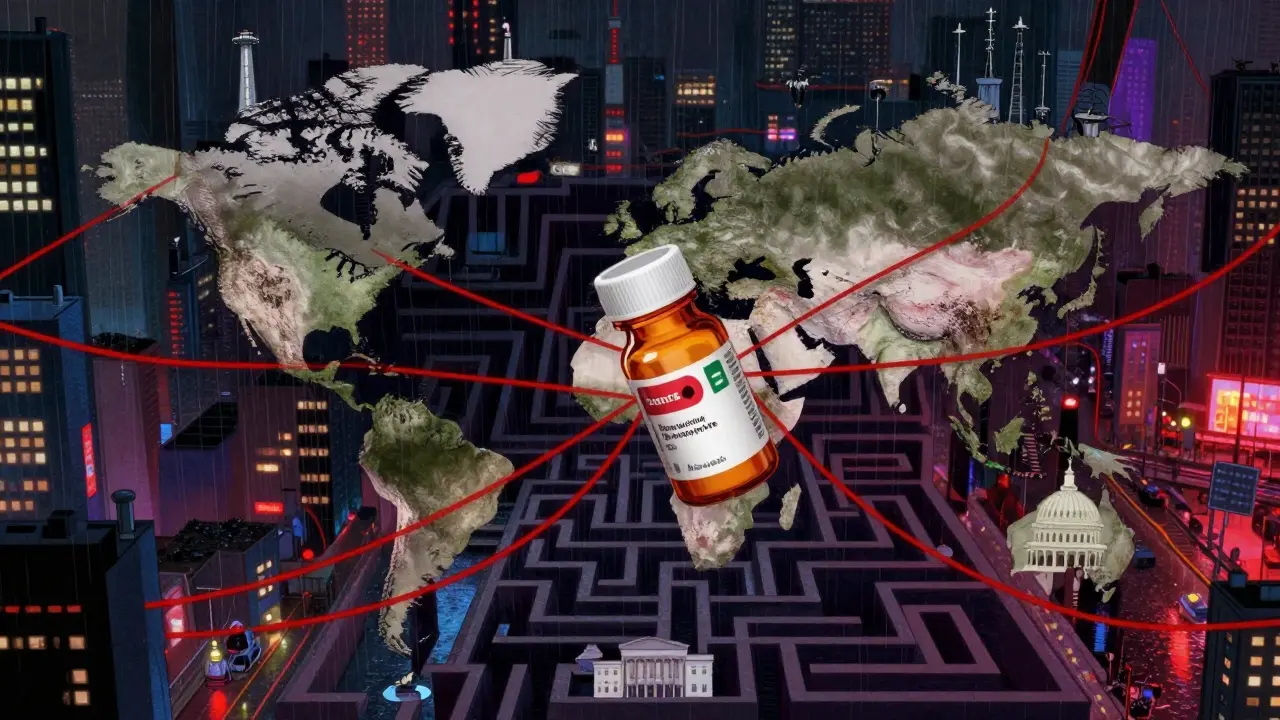
That bottle of generic ibuprofen sitting on your shelf didn't just appear out of thin air. It traveled through a labyrinthine global network involving factories in Asia, regulatory agencies in Washington, massive wholesalers, and complex financial negotiations that most people never see. While we often think of generic drugs as simple copies of brand-name medications, the journey they take to reach your local pharmacy is arguably more complex than the original.
The generic drug supply chain is the backbone of modern healthcare affordability. It handles roughly 90% of all prescriptions filled in the United States, yet it operates on razor-thin margins compared to its brand-name counterparts. Understanding this process isn't just an academic exercise; it explains why certain medicines go missing from shelves, why prices fluctuate wildly, and who actually profits when you pick up a prescription.
Where It Starts: The Global Hunt for Raw Materials
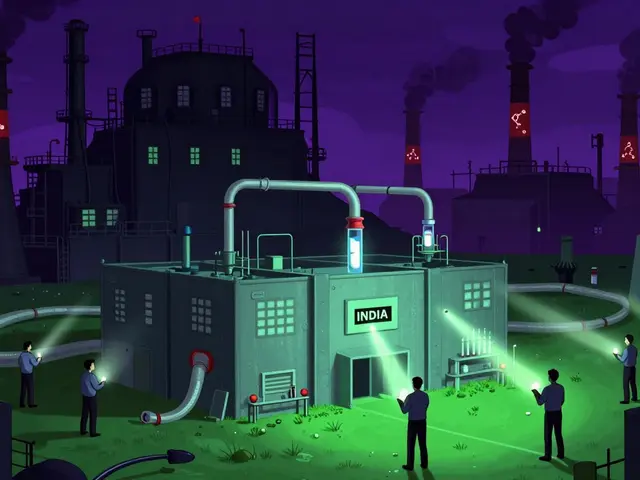
Every medicine begins with an Active Pharmaceutical Ingredient (API), which is the biologically active component responsible for the therapeutic effect of a drug. If you assume these ingredients are made locally, you'd be wrong. A staggering 88% of API manufacturing now occurs outside the United States, primarily in China and India, according to a 2021 study published in PMC. Only 12% of this critical production happens on U.S. soil.
This globalization creates efficiency but also vulnerability. When a factory in India faces a power outage or a port in Shanghai gets congested, pharmacies in Bristol or Boston feel the impact weeks later. Dr. David Ridley, a former FDA official, has pointed out that this reliance on overseas facilities creates significant quality control challenges. Regulators simply cannot monitor every foreign facility with the same intensity as domestic ones. This geographic distance is the first link in a chain that has been lengthening for decades, making the system susceptible to geopolitical shifts and pandemic-related disruptions.
Manufacturing and Regulatory Hurdles
Once the raw materials arrive at a manufacturing plant, the real work begins. Generic manufacturers must prove their product is therapeutically equivalent to the brand-name reference drug. They do this by submitting an Abbreviated New Drug Application (ANDA) to the U.S. Food and Drug Administration (FDA), demonstrating safety and efficacy without repeating costly clinical trials. This process, established by the Hatch-Waxman Act of 1984, allows generics to bypass some of the expensive testing required for new drugs, keeping costs down.
However, approval is only half the battle. Production requires strict adherence to Good Manufacturing Practices (GMP). Quality control tests happen at multiple stages to ensure purity and potency. Despite these rules, shortages still occur. During the COVID-19 pandemic, API shortages affected 170 different generic medications. The issue isn't usually a lack of demand; it's often a lack of competition. For many common generics, there might be only one or two manufacturers globally. If one stumbles, the whole supply line halts.
The Middlemen: Wholesalers and Distribution
After manufacturing, the drugs don't go straight to pharmacies. They enter the hands of wholesale distributors. These companies buy drugs in bulk from manufacturers, often negotiating "prompt payment discounts" to lower their acquisition costs. Major players like AmerisourceBergen, McKesson, and Cardinal Health dominate this space.
Wholesalers then sell these medications to pharmacies at a discount off the Wholesale Acquisition Cost (WAC). The size of this discount depends heavily on the pharmacy's purchasing power. Large retail chains negotiate better rates than independent community pharmacies. This tiered system means that while the drug moves efficiently, the profit margins shrink at each step. According to Avalere Health's 2023 analysis, these contracts are complex, often including provisions for bulk-purchasing discounts that vary case-by-case.
The Financial Maze: PBMs and Reimbursement
If distribution is complex, the financial side is a maze. Enter the Pharmacy Benefit Managers (PBMs). Three major PBMs-CVS Caremark, OptumRx, and Express Scripts-control approximately 80% of the market. Their job is to manage prescription drug benefits for insurers and employers. They decide which drugs are covered, set copays, and negotiate rebates with manufacturers.
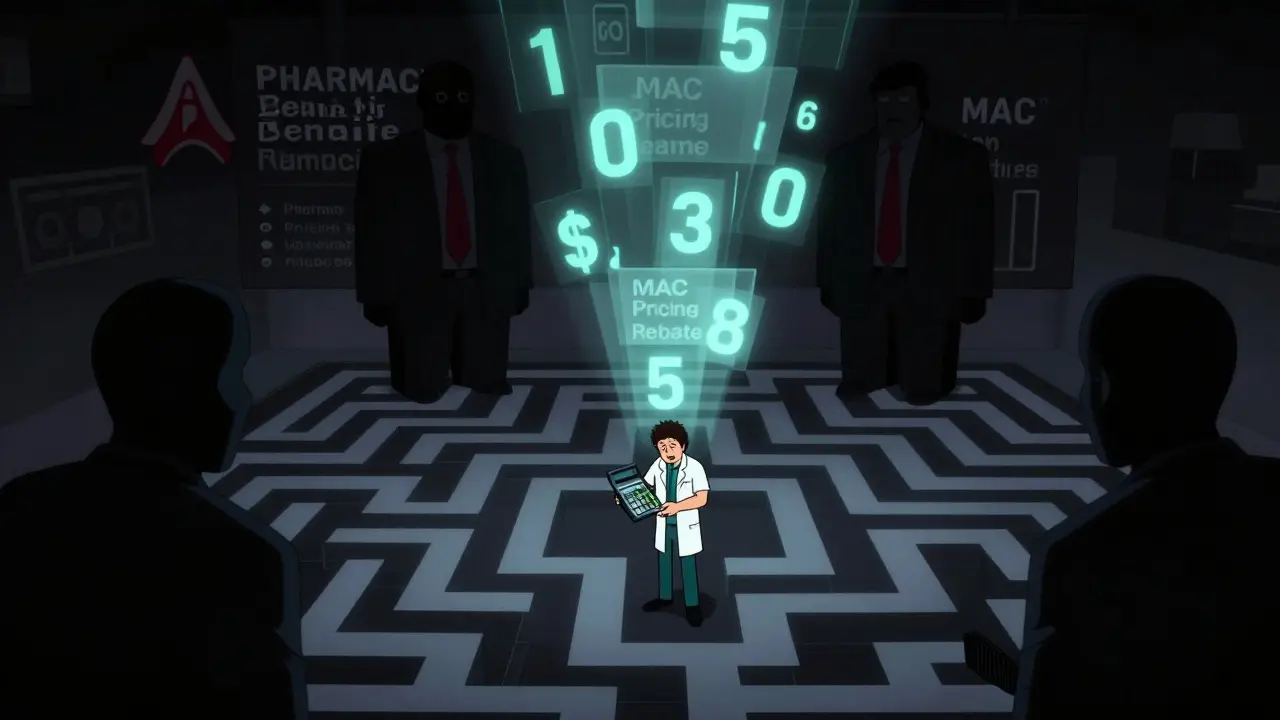
Here is where the generic model diverges sharply from the brand-name model. Brand manufacturers often pay hefty rebates to PBMs to get their drugs placed on preferred formulary tiers. Generic manufacturers rarely engage in these rebate negotiations. Instead, payers use a methodology called Maximum Allowable Cost (MAC) for generics. MAC sets a ceiling for reimbursement for specific strengths and dosage forms, such as a 10 mg tablet of atorvastatin.
This system creates a unique pressure point. As noted by the Association for Accessible Medicines in their 2024 brief, reimbursement for generics is tied to a blended cost of products from all manufacturers. This gives pharmacies an incentive to find the cheapest possible source for their inventory. However, if the MAC price set by the PBM falls below what the pharmacy paid the wholesaler, the pharmacy loses money on every fill. In a 2023 survey, 68% of independent pharmacy owners cited MAC pricing below acquisition cost as a major financial threat.
| Feature | Generic Drugs | Brand-Name Drugs |
|---|---|---|
| Manufacturer Revenue Share | 36% of expenditure | 76% of expenditure |
| Reimbursement Method | Maximum Allowable Cost (MAC) | Percentage of List Price + Rebates |
| PBM Rebate Negotiations | Rarely engaged | Critical for formulary placement |
| Production Cost Impact | ~50% of revenue goes to production | Lower percentage relative to final price |
| Market Competition | High volume, low margin, intense price war | Patent-protected exclusivity periods |
Who Actually Makes Money?
You might wonder why generic drugs are so cheap if the supply chain is so complicated. The answer lies in the disparity of profit capture. A comparative analysis by the University of Southern California's Schaeffer Center revealed that generic manufacturers capture only 36% of the total expenditure on generic drugs. In contrast, brand manufacturers recoup 76% of spending on their products.
Where does the rest of the generic money go? Half of the generic drug revenue is consumed by production costs alone. The remaining portion is distributed among wholesalers, pharmacies, and administrative overhead. Because generics are commodities, manufacturers have little leverage to raise prices. They compete purely on cost efficiency. This "race to the bottom" pricing dynamic means that if a manufacturer cannot produce a pill cheaper than their competitor, they exit the market. This consolidation reduces choice and increases the risk of future shortages.
Current Challenges and Future Outlook
The generic drug supply chain is under strain. The global market was valued at $438.9 billion in 2022 and is projected to grow to $709.9 billion by 2030, but the structure remains fragile. The top 10 generic manufacturers now control 65% of the U.S. market, according to Evaluate Pharma's 2023 analysis. This concentration is dangerous. When fewer companies make essential medicines, the entire system becomes vulnerable to single points of failure.
New technologies are emerging to help. Industry consultants suggest using AI for demand forecasting and blockchain for supply chain transparency. Real-world data (RWD) allows companies to pinpoint bottlenecks and respond to delays faster than before. Additionally, the FDA has increased its focus on foreign facility inspections, rising from 248 in 2010 to 641 in 2022, aiming to tighten quality controls.
Policy changes also loom large. The Inflation Reduction Act of 2022 introduced new Medicare drug pricing provisions that could indirectly affect generic reimbursement through changes to the 340B program. As payers continue to squeeze margins via MAC pricing, experts warn that current margins may become unsustainable for smaller manufacturers, potentially leading to further consolidation and reduced availability of certain niche generic therapies.
Why are generic drugs so much cheaper than brand names?
Generic drugs are cheaper because manufacturers do not need to repeat the expensive clinical trials required for brand-name drugs. They submit an Abbreviated New Drug Application (ANDA) proving equivalence instead. Additionally, intense competition among generic makers drives prices down, as they compete on cost rather than marketing or patent exclusivity.
What is the role of a PBM in the generic drug supply chain?
Pharmacy Benefit Managers (PBMs) act as intermediaries between drug manufacturers, insurers, and pharmacies. For generics, PBMs typically set the Maximum Allowable Cost (MAC) for reimbursement. They process claims, develop formularies, and determine which pharmacies participate in their networks, significantly influencing how much a pharmacy gets paid for dispensing a generic medication.
Why do generic drug shortages happen?
Shortages often occur due to the high concentration of manufacturing. Many generic APIs are produced in only one or two countries, primarily China and India. Disruptions in these regions, combined with low profit margins that discourage backup production capacity, can lead to sudden supply gaps. Quality control issues at a single facility can also halt production for widely used medications.
How does MAC pricing affect pharmacies?
Maximum Allowable Cost (MAC) pricing sets a cap on what insurers will reimburse pharmacies for generic drugs. If the MAC price is lower than the pharmacy's actual acquisition cost from the wholesaler, the pharmacy loses money on every prescription filled. This forces pharmacies to constantly negotiate lower prices with distributors or drop certain generic drugs from their inventory.
Is the generic drug supply chain safe?
Yes, the supply chain is rigorously regulated. The FDA requires Good Manufacturing Practices (GMP) and has increased inspections of foreign facilities. While the globalized nature of API sourcing presents logistical challenges, the therapeutic equivalence of generics is strictly enforced through the ANDA approval process, ensuring that generic medications are safe and effective alternatives to brand-name drugs.