
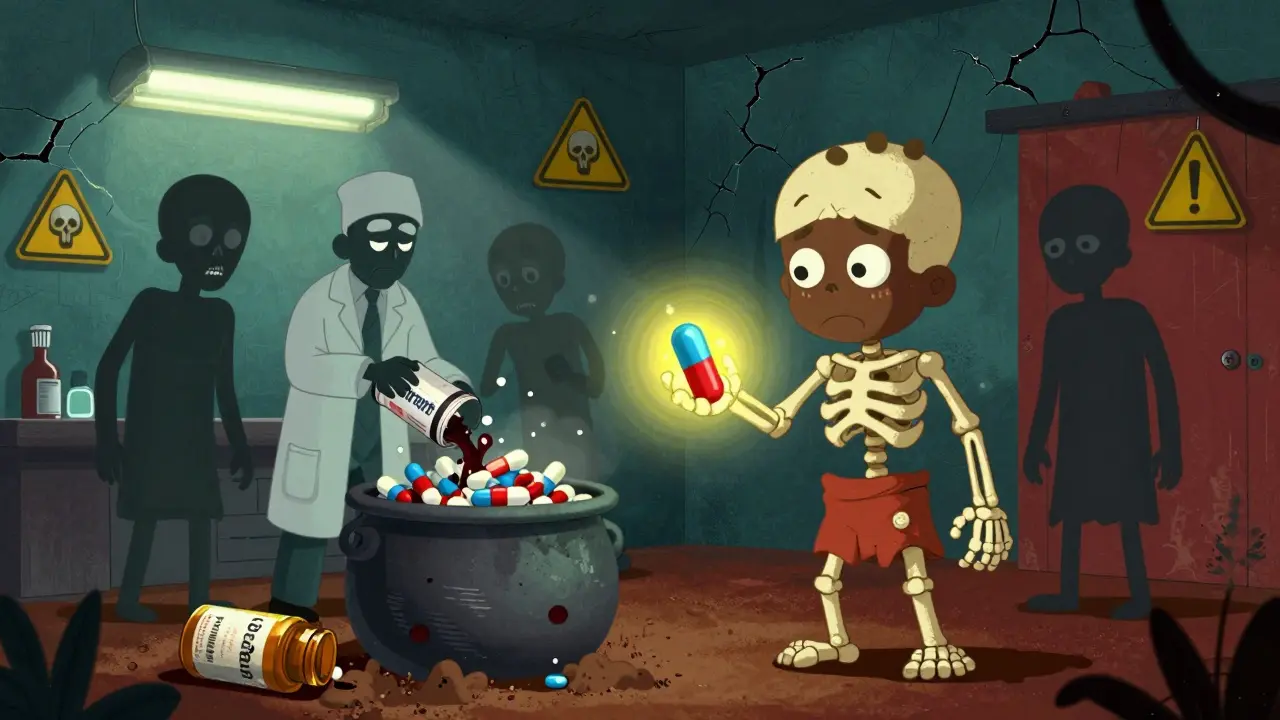
Every year, counterfeit drugs kill more children than malaria alone. In rural clinics across Africa, Asia, and Latin America, people are dying not because they lack access to medicine-but because the medicine they’re given is fake. A pill that looks identical to the real thing might contain no active ingredient at all. Or worse, it might be laced with toxic chemicals. This isn’t science fiction. It’s happening right now, and the numbers are terrifying.
What Exactly Are Counterfeit Drugs?
The World Health Organization draws a clear line between two types of dangerous medicines: substandard and falsified. Substandard drugs are real products that were made poorly-maybe stored wrong, expired, or diluted. Falsified drugs are outright frauds. They’re made in secret labs, often in China or Bangladesh, and designed to look exactly like the real thing. Packaging, logos, even holograms are copied with 90% accuracy. Some are now printed using 3D printers that replicate labels so precisely, even pharmacists can’t tell the difference without lab equipment.
These fake drugs fall into three dangerous categories: about 30% have no active ingredient at all. Another 45% have the wrong dose-too little to work, too much to be safe. And 25% contain toxic substances like rat poison, antifreeze, or industrial dyes. In 2022, counterfeit cancer drugs in Nigeria and Kenya caused treatment failures in dozens of patients. In Pakistan in 2012, over 200 people died after being given heart medication contaminated with a deadly chemical. These aren’t rare outliers. They’re symptoms of a broken system.
Why Is This Worse in Developing Nations?
It’s not just about corruption or crime-it’s about poverty and lack of infrastructure. In high-income countries like the U.S., fewer than 1% of medicines are counterfeit. In some parts of sub-Saharan Africa, that number jumps to over 30%. Why? Because legitimate drugs cost 300% to 500% more than the fake versions. A genuine antimalarial like Coartem might cost $10 in a Nairobi pharmacy. A fake version? $1.50. For families living on $2 a day, the choice isn’t between safe and unsafe-it’s between life and death, and the fake drug feels like the only option.
Supply chains in these regions are long and fragmented. A pill might pass through five or seven middlemen before reaching a village clinic. At each stop, someone can swap the real medicine for a fake one. There’s no temperature control. No tracking. No accountability. By the time it gets to the patient, there’s no way to know what’s inside.
The Human Cost: Deaths, Resistance, and Suffering
The death toll is not abstract. According to the OECD, counterfeit anti-malarial drugs alone caused more than 116,000 deaths in sub-Saharan Africa in 2018. Other studies estimate 72,000 to 169,000 child deaths from pneumonia each year because fake antibiotics didn’t work. These aren’t just numbers-they’re children who never got better because their medicine was empty.
But the damage doesn’t stop there. When a fake antibiotic doesn’t kill all the bacteria, it leaves behind the strongest strains. That’s how drug-resistant infections spread. The WHO warns that counterfeit medicines are fueling a global crisis of antimicrobial resistance. Tuberculosis, malaria, and even common infections like urinary tract infections are becoming untreatable because we’ve trained bacteria to survive through failed treatments.
One mother in Nigeria shared on Reddit in March 2025: “My brother died of malaria last year after taking counterfeit Coartem. The pharmacy had no way to verify authenticity.” She wasn’t alone. A 2024 survey in 10 African countries found that 63% of people had bought fake medicine-31% of them suffered serious side effects.
How Do You Spot a Fake Drug?
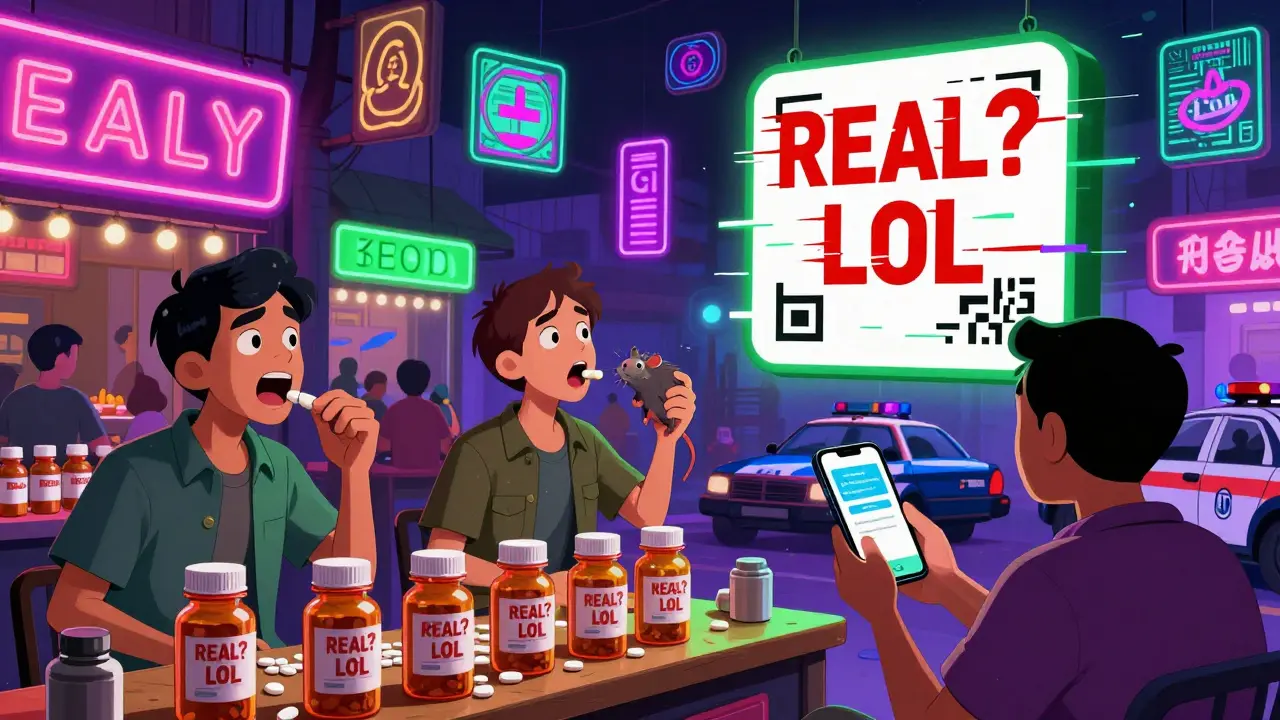
Most people can’t. The packaging looks real. The pills look real. Even the taste can be copied. But there are signs-if you know what to look for.
- Pills that dissolve too quickly in water (a common complaint in Southeast Asia)
- Color differences-slightly lighter or darker than usual
- Smell-fake antibiotics often have a chemical or plastic odor
- Batch numbers that don’t match official records
- Pharmacies that don’t have a license or visible regulatory seal
But here’s the problem: even trained health workers miss 70% of fakes without testing tools. In rural clinics, there’s no spectrometer. No chemical kit. No internet to check batch codes. Many clinics don’t even have electricity to run basic devices.
What’s Being Done? The Tools That Actually Work
There are solutions-but they’re not being scaled fast enough.
mPedigree is a simple SMS system. You text a code from the pill pack to a number, and you get back a yes or no: real or fake. It’s free, works on basic phones, and has saved lives in Ghana and Nigeria. One user wrote: “The SMS verification system saved my child’s life when we discovered the antimalarial was fake.” But only 28% of people in low-literacy areas can use it without help.
Blockchain verification is now being rolled out by the WHO’s Global Digital Health Verification Platform, already active in 27 countries. It tracks every pill from factory to patient. If a batch is flagged as fake, it’s blocked before it leaves the warehouse. Pfizer has used similar tech since 2004 to stop over 302 million counterfeit doses.
Some countries are using solar-powered testing kits that cost under $50 and can check a pill in minutes. Others are training community health workers to recognize fake packaging and report suspicious pharmacies. In pilot programs, these efforts reduced counterfeit use by 37%.
But here’s the catch: only 22% of pharmacies in low-income countries use any kind of verification system. In the U.S. and Europe, it’s 98%.
Who’s Behind This?
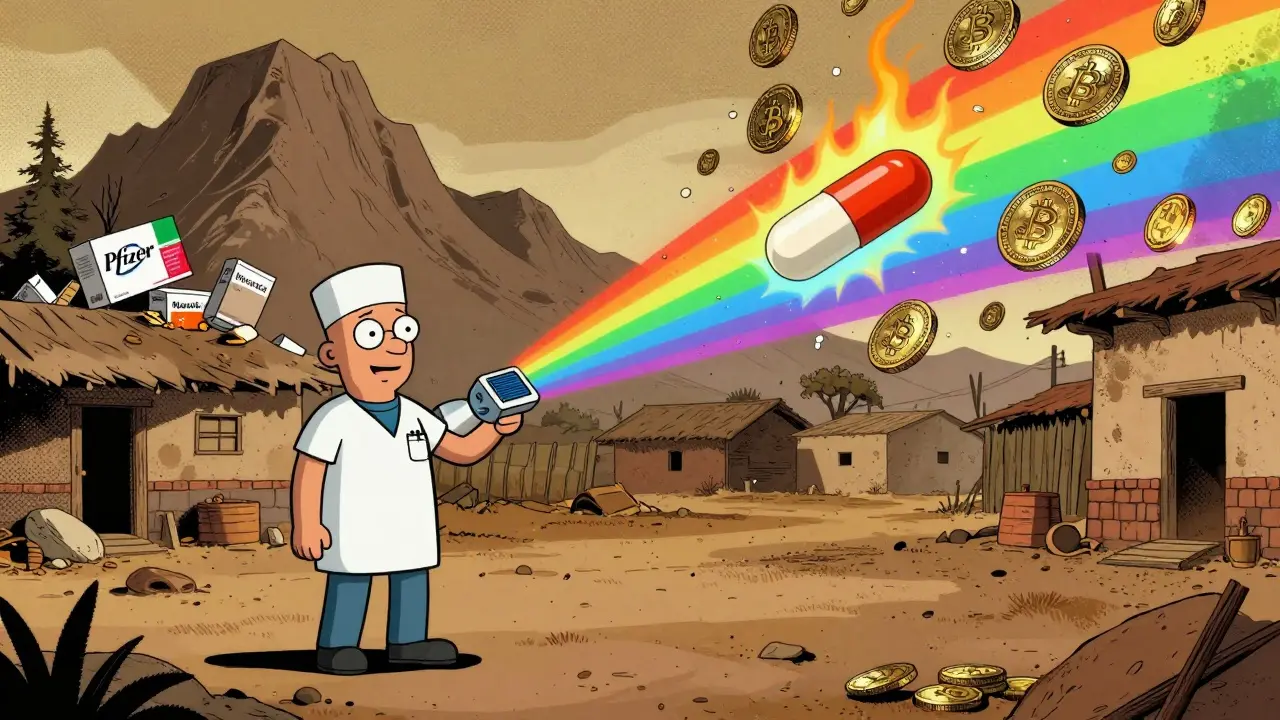
It’s not small-time criminals. It’s organized crime. Interpol says Chinese labs produce 78% of the high-quality fakes. Bangladesh, Lebanon, Syria, and Turkey are key distribution hubs. These networks use cryptocurrency to move money and operate across borders with little fear of prosecution. In 2024, Interpol’s Operation Pangea XVI arrested 769 people, shut down 13,000 websites, and seized 50 million fake doses. That’s a big win-but it’s like trying to empty the ocean with a teaspoon.
The profit margins? Up to 9,000%. A pill that costs 10 cents to make sells for $10. Compare that to cocaine, which has a 1,000% markup. Pharmaceuticals are now the most profitable illegal trade on earth.
What Needs to Change?
Three things are urgent:
- Stronger regulation. Only 45 of the 76 countries that signed the Medicrime Convention have turned it into national law. Without legal teeth, fines are meaningless.
- Invest in local testing. Solar-powered, low-cost verification tools need to be in every clinic. Not just in cities-in villages too.
- Make real medicine affordable. If genuine antimalarials cost $1 instead of $5, people won’t risk buying fakes. Generic manufacturers in India and South Africa need support to produce low-cost, high-quality drugs for global markets.
The EU’s 2026 Anti-Counterfeiting Pharmaceutical Initiative plans to spend €250 million to strengthen supply chains in 30 developing nations. That’s a start. But the WHO’s goal-to cut counterfeit drug prevalence to under 5% by 2027-is only possible if money, tech, and political will align.
The Future: AI, Scams, and Survival
Counterfeiters are getting smarter. In 2024, 15% of fake drugs used AI-generated packaging-designed to fool even automated scanners. Some now include QR codes that link to fake verification sites. Others use fake digital certificates that look real until you dig deeper.
Without action, the World Bank predicts 5.7 million deaths from counterfeit drugs in developing nations by 2030. But if AI-powered verification systems are deployed at scale, that number could drop by 65%.
This isn’t just a health issue. It’s a justice issue. People in poor countries deserve medicine that works. They deserve the same protection as someone in London or New York. The technology exists. The knowledge exists. What’s missing is the will to act-and the urgency to treat this like the emergency it is.
Every fake pill is a promise broken. Every death from a counterfeit drug is preventable. The question isn’t whether we can fix this. It’s whether we’ll choose to.
Comments
Celia McTighe
December 28, 2025 AT 05:54 AMWow. This hit me in the chest. I had no idea fake meds were killing more kids than malaria. 😔 We need to treat this like the global emergency it is. My heart goes out to every family who lost someone to a pill that looked real.
Sydney Lee
December 28, 2025 AT 17:46 PMLet’s be brutally honest: this is what happens when you outsource healthcare infrastructure to nations with zero regulatory oversight. The WHO’s ‘verification platform’ is a band-aid on a hemorrhage. Real solution? Ban all pharmaceutical exports from jurisdictions without FDA-equivalent oversight. End of story. And stop pretending ‘affordability’ excuses systemic criminal negligence.
oluwarotimi w alaka
December 30, 2025 AT 13:10 PMUSA and Europe made this worse. They shipped all the cheap meds here, then left us with the trash. Now they wanna come in with blockchain and ‘solutions’? Nah. We know who’s really behind this-foreign labs and corrupt officials funded by Western pharma who don’t want us making our own generics. Fake pills? Yeah. But the real fake is their ‘aid’.
ANA MARIE VALENZUELA
January 1, 2026 AT 11:29 AMLet’s not romanticize the victims here. People are buying fake drugs because they’re lazy, ignorant, and refuse to travel to licensed pharmacies-even when they’re 2km away. This isn’t a conspiracy, it’s a behavioral failure. Teach people to check for seals. Teach them to ask for receipts. Stop blaming the system for their apathy.
Debra Cagwin
January 1, 2026 AT 11:55 AMThere’s hope. I work with a nonprofit that trains community health workers in Ghana to use those $50 solar testers. Last month, they caught a batch of fake antibiotics in a village clinic-and saved 14 kids. It’s slow, it’s messy, but it works. We don’t need billionaires. We need boots on the ground. And we need to listen to the people who live this every day.
Ryan Touhill
January 3, 2026 AT 08:27 AMInteresting how the article conveniently omits that 92% of counterfeit drugs are sold via unregulated online pharmacies-many of which are hosted on servers in the U.S. and EU. The real villain isn’t Nigeria or Bangladesh-it’s Silicon Valley’s lax enforcement and Wall Street’s profit-driven indifference. We built the digital infrastructure for this crisis. Now we’re pretending we’re the victims.
Teresa Marzo Lostalé
January 4, 2026 AT 03:31 AMIt’s funny how we call it a ‘crisis’ only when it kills children. What about the millions who survive but are left with chronic kidney damage from counterfeit painkillers? Or the women who took fake birth control and got pregnant in villages with no prenatal care? We fixate on death because it’s dramatic. But the quiet suffering? That’s the real epidemic.
Gran Badshah
January 5, 2026 AT 11:05 AMin india we have this problem too. fake insulin, fake tb drugs. people buy from street vendors because hospitals make you wait 3 days. and the real ones? too expensive even with govt subsidies. no one talks about how the system itself pushes people to the dark market. its not about being dumb. its about being desperate.
Bradly Draper
January 6, 2026 AT 04:21 AMMy cousin in Kenya took a fake malaria pill. She got better anyway. But she still got sick three more times. I just wish people knew how dangerous it really is. It’s not just ‘it won’t work’-it’s ‘it’ll make you worse’.
Hakim Bachiri
January 7, 2026 AT 22:31 PMAnd yet-despite all this-there’s still a bunch of ‘woke’ activists who think the answer is ‘decolonize pharmaceuticals’ and ‘let Africa make its own drugs’… while ignoring that 90% of the active ingredients in those drugs come from China and India. You can’t just ‘make your own’ when you don’t have the chemistry labs, the patent rights, or the regulatory capacity. It’s not a moral issue-it’s a logistical nightmare. Stop the performative outrage and fund the damn testing kits.