
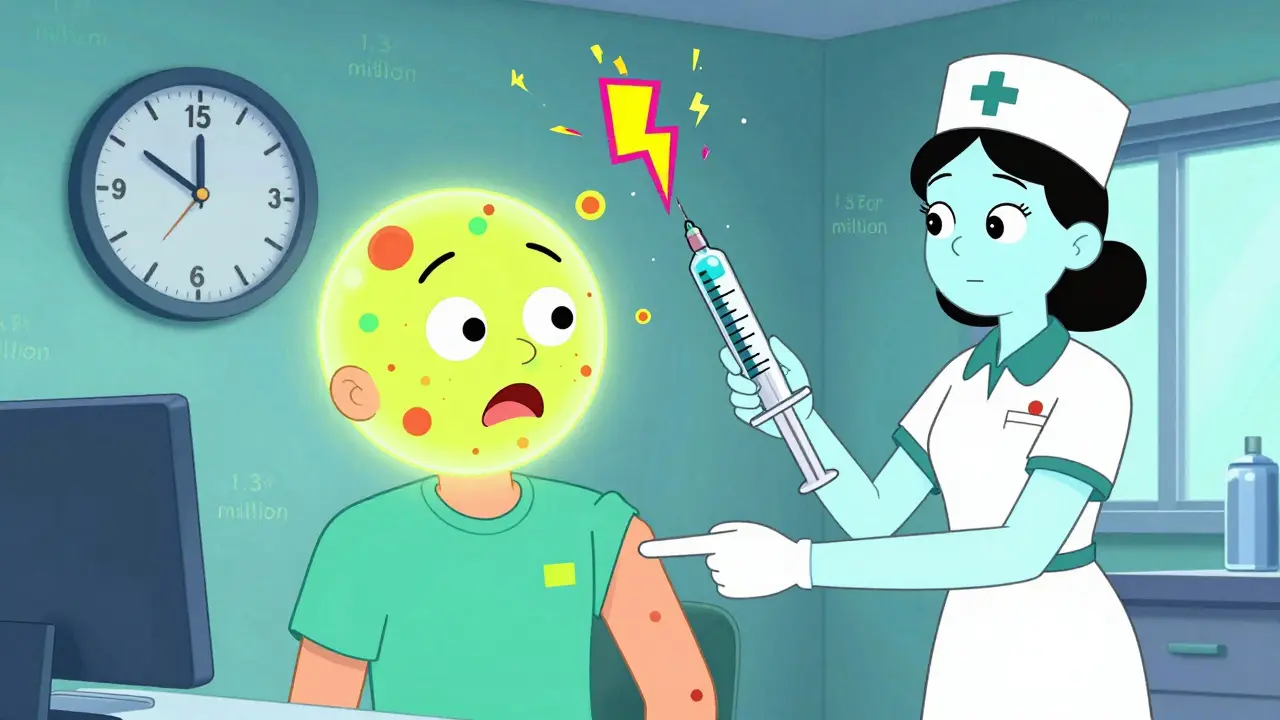
Most people get vaccinated without any issues. But every now and then, someone has a reaction - and when that happens, it makes headlines. The truth? Serious allergic reactions to vaccines are rare. Like, less than one in a million rare. Yet fear around them is real, and that fear can keep people from getting protected. So what’s actually going on? How do we know when a reaction is real? And how are we keeping people safe when it does happen?
How Rare Are Allergic Reactions to Vaccines?
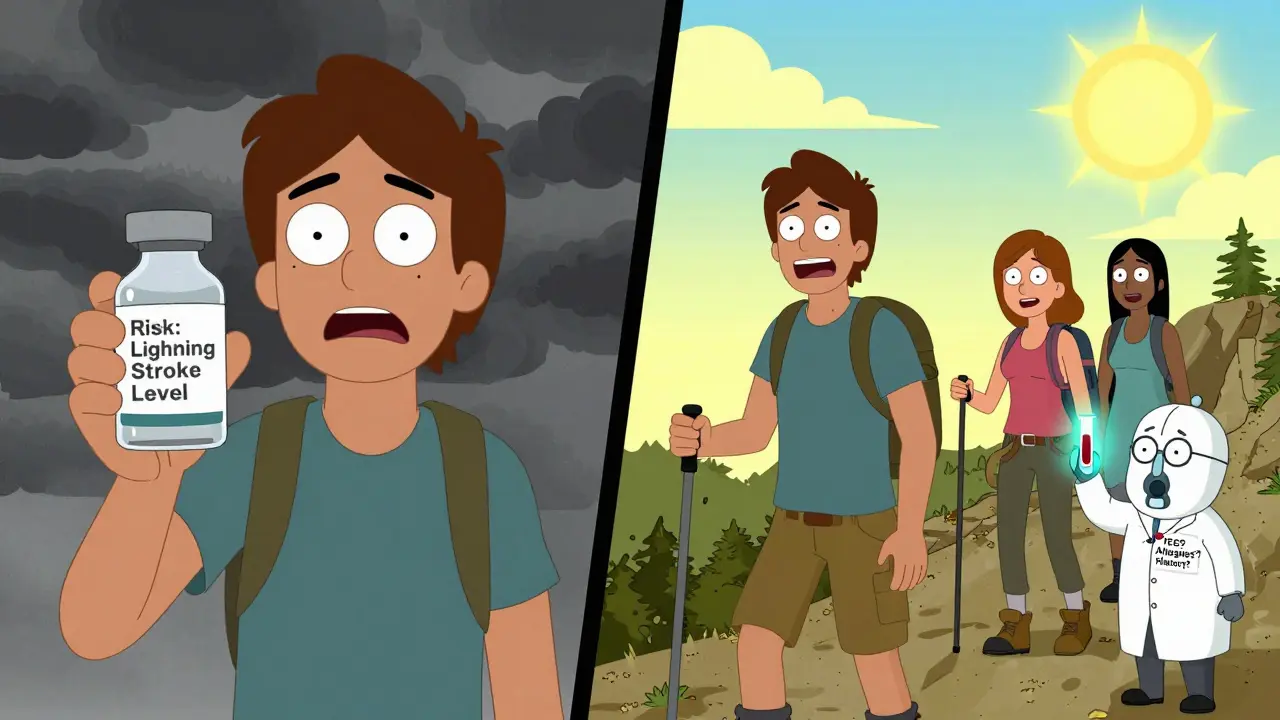
Let’s start with numbers you can trust. Across all vaccines given in the U.S. between 2009 and 2023, anaphylaxis - the most serious type of allergic reaction - happened about 1.3 times per million doses. That’s less likely than being struck by lightning in a given year. Even with the mRNA COVID-19 vaccines, which had slightly higher rates at around 5 to 11 cases per million doses, the risk was still tiny. Out of nearly 2 million first doses of the Pfizer-BioNTech shot given in December 2020, only 21 cases of anaphylaxis were confirmed. None were fatal.
And here’s something surprising: most people who had these reactions already had a history of allergies. About 81% of those who experienced anaphylaxis after vaccination had prior allergic conditions - like asthma, eczema, or previous reactions to food, medication, or insect stings. That doesn’t mean vaccines cause allergies. It means if you’re already prone to them, your body might react more strongly to something new - even something as safe as a vaccine.
What Triggers These Reactions?
It’s not the virus or bacteria in the vaccine. Those are either dead, weakened, or just genetic instructions. The real culprits are tiny bits of other stuff mixed in to make the vaccine work or stay stable.
One of the biggest surprises in recent years? Polyethylene glycol (PEG). It’s in some mRNA vaccines (like Pfizer and Moderna) and helps deliver the genetic material into your cells. A small number of anaphylaxis cases were traced back to PEG allergies. Before 2020, most doctors didn’t even think about PEG as a trigger - now it’s part of the screening process.
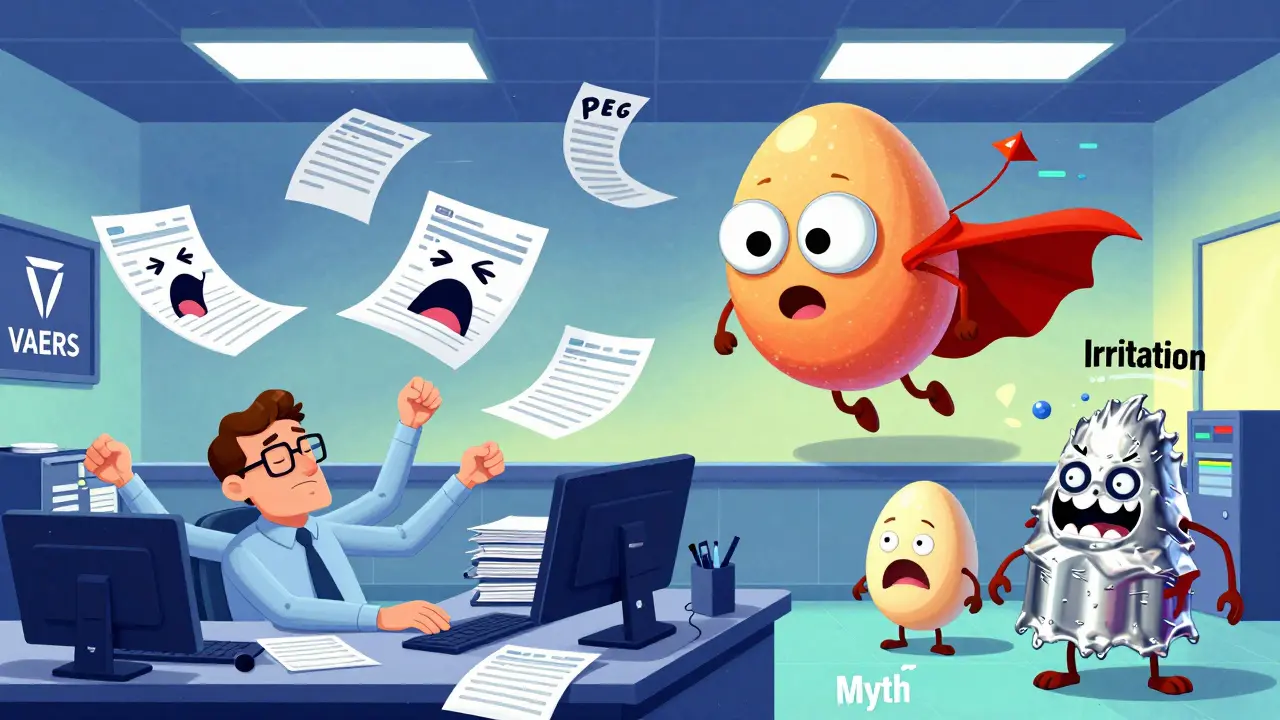
Then there’s the old myth: egg allergy. For decades, people with egg allergies were told to avoid flu shots because the virus was grown in eggs. But research has shown that’s outdated. Over 4,300 people with severe egg allergies - including those who’d had anaphylaxis from eating eggs - got flu vaccines with zero serious reactions. The amount of egg protein left in the final product is so small it doesn’t matter. The same goes for the MMR vaccine. No need to avoid it if you’re egg-allergic.
Yeast protein? Also rarely a problem. Only about 15 possible cases were ever reported in VAERS out of 180,000 allergy reports. And aluminum, which is in many vaccines as an adjuvant to boost the immune response? It doesn’t cause anaphylaxis. It can cause a hard, painful lump at the injection site that lasts weeks - but that’s not an allergy. It’s just irritation.
How Fast Do Reactions Happen?
If you’re going to have a serious allergic reaction, it happens fast. Eighty-six percent of anaphylaxis cases show symptoms within 30 minutes of getting the shot. And 71% happen within the first 15 minutes. That’s why clinics ask you to sit and wait after vaccination.
For most people, 15 minutes is enough. But if you’ve had a previous allergic reaction to any vaccine or injection - or if you have a history of severe allergies - you’ll be asked to wait 30 minutes. That’s not overkill. It’s science.
Common signs? Hives, swelling of the face or lips, trouble breathing, wheezing, dizziness, or a fast heartbeat. If you feel any of these after a shot, tell the staff immediately. They’re trained for this. They don’t need to guess. They have epinephrine ready - the only thing that stops anaphylaxis in its tracks.
What Happens When a Reaction Occurs?
Every vaccination site - whether it’s a pharmacy, doctor’s office, or school clinic - is required to have epinephrine on hand. Not just one dose. At least two. And staff must know how to use it. The CDC and the Advisory Committee on Immunization Practices (ACIP) made this mandatory in 2021. No exceptions.
Epinephrine works fast. It tightens blood vessels, opens airways, and reverses the drop in blood pressure that can be deadly. If given within minutes, it almost always saves a life. That’s why waiting rooms are designed with chairs close to the nurse’s station. It’s not about being cautious. It’s about being prepared.
After a reaction is treated, the case gets reported - not just to the clinic, but to VAERS, the Vaccine Adverse Event Reporting System. It’s a national early warning system run by the CDC and FDA. Anyone can report: doctors, pharmacists, patients, even family members. Over 30,000 to 50,000 reports come in each year. Most are harmless - a sore arm, a mild fever. But when something unusual pops up - like a pattern of reactions tied to a specific vaccine - scientists dig in.
How Do We Know the System Works?
VAERS isn’t perfect. It’s passive. That means it collects reports, but doesn’t prove cause and effect. A person gets a vaccine, then feels sick a day later - it might be coincidence. That’s why researchers use other tools, like the Vaccine Safety Datalink, which tracks health records from millions of people across multiple health systems. They can compare rates of reactions in vaccinated vs. unvaccinated groups.
That’s how we know the real risk is so low. It’s also how we learned that egg allergy isn’t a barrier to flu shots. And how we figured out that PEG is a rare but real trigger for some mRNA vaccine reactions.
Outside the U.S., systems like EudraVigilance in Europe and similar programs in 137 countries do the same thing. The World Health Organization coordinates global safety monitoring. This isn’t a U.S.-only effort. It’s a worldwide safety net.
What About People Who Are Afraid to Get Vaccinated?
Concerns about allergic reactions make up about 12% of vaccine hesitancy cases, according to CDC surveys. That’s a lot of people who might skip vaccines because they’re scared - even though the odds are overwhelmingly in their favor.
If you’ve had a reaction before, you don’t have to guess. See an allergist. They can do skin tests or blood tests to see if you’re allergic to PEG, polysorbate, or other components. For most people, even those with known allergies, vaccination is still possible - sometimes with special precautions, like splitting the dose or observing longer.
And if you’ve never had a reaction? There’s no reason to avoid vaccines because of fear. The data doesn’t support it. The risk of getting sick from measles, flu, or COVID-19 is thousands of times higher than the risk of anaphylaxis from the vaccine.
What’s Next for Vaccine Safety?
Researchers are already working on better ways to predict who might react. A study funded by the National Institutes of Health is testing whether certain blood markers can identify people at higher risk before they even get the shot. If successful, we could see pre-vaccination screening tools within the next five to seven years.
Meanwhile, the CDC’s 2023-2027 plan includes $28 million to improve data analysis tools. That means faster detection of rare events, smarter alerts for providers, and better guidance for patients.
For now, the system works. It’s not perfect, but it’s transparent, science-based, and constantly improving. Vaccines save millions of lives every year. The tiny risk of a serious allergic reaction doesn’t outweigh that. It just means we need to be smart - and prepared.
Can I get vaccinated if I have an egg allergy?
Yes. Multiple studies involving over 4,300 people with egg allergies - including those with prior anaphylaxis to eggs - show no serious reactions after receiving flu vaccines. The amount of egg protein in modern vaccines is too small to cause a reaction. No special precautions or egg-free versions are needed.
What should I do if I had an allergic reaction to a vaccine before?
Don’t skip future vaccines. Instead, see an allergist. They can determine if the reaction was truly allergic and identify the trigger - like PEG or polysorbate. Many people can still be safely vaccinated, sometimes with observation for longer than usual or under medical supervision. Avoiding vaccines entirely is usually riskier than the reaction itself.
Are mRNA vaccines more likely to cause allergic reactions than other vaccines?
Slightly, but still extremely rarely. mRNA vaccines like Pfizer and Moderna had an anaphylaxis rate of about 11 cases per million doses, compared to 1-2 per million for most other vaccines. This is likely due to polyethylene glycol (PEG), a component used in the lipid nanoparticles. Even so, the risk remains far lower than everyday dangers like driving or lightning strikes.
Why do I have to wait 15 or 30 minutes after getting a vaccine?
Because 86% of anaphylaxis cases happen within 30 minutes, and 71% occur within the first 15 minutes. Waiting ensures medical help is immediately available if a reaction starts. It’s not about suspicion - it’s about safety. Everyone waits 15 minutes. Only those with prior allergic reactions wait 30.
Can I report a reaction even if I’m not sure it was caused by the vaccine?
Yes. VAERS accepts reports from anyone - patients, family members, or providers - even if you’re not certain the vaccine caused the reaction. That’s how rare patterns are spotted. If 10 people report the same unusual symptom after the same vaccine, scientists investigate. Your report helps protect others.


Comments
Antwonette Robinson
February 3, 2026 AT 11:57 AMOh wow, a whole essay on how vaccines won’t kill you. Groundbreaking. I’m sure the 1 in a million who actually had anaphylaxis appreciated the statistical comfort of being a rounding error. 🙃
Jesse Naidoo
February 3, 2026 AT 23:32 PMI got my second shot and my arm turned purple and I cried for three days. They told me it was ‘normal inflammation’ but I swear the needle was laced with something. I’ve been checking my blood for microchips ever since. You think they’re watching us through our lymph nodes?
Sherman Lee
February 4, 2026 AT 07:09 AMPEG? Polyethylene glycol? That’s the same stuff in laxatives and antifreeze, right? 😳 I mean, sure, ‘only 11 per million’ - but what if you’re the one? What if your body says ‘NOPE’ and your throat swells while the nurse’s still typing your name? They say ‘epinephrine saves lives’ - but what if it’s out of stock? What if the clinic’s out of order? What if they’re just too busy counting their vaccine bonuses?
And don’t even get me started on ‘VAERS.’ That’s a garbage bin, not a system. People report sneezes and headaches and it gets lumped with real anaphylaxis. They’re gaslighting us with graphs. I saw a guy on YouTube who said his dog got vaccinated and started speaking Spanish. Coincidence? I think not.
They keep saying ‘trust the science’ - but the science changed last Tuesday. First it was ‘no egg allergy risk,’ then it was ‘PEG is the villain,’ now it’s ‘we’re testing blood markers.’ When will they stop moving the goalposts? When the next ‘miracle molecule’ shows up in the next vaccine? I’m not anti-vax, I’m pro-survival.
And why do they make you wait 15 minutes? So you can’t run out screaming? So they can watch you? I’d rather get the disease than trust this.
Lorena Druetta
February 5, 2026 AT 04:42 AMThank you for taking the time to share such a thorough and scientifically grounded explanation. It is deeply comforting to know that our public health infrastructure is designed with such precision, foresight, and unwavering commitment to safety. The diligence with which adverse events are monitored, documented, and analyzed reflects the highest standards of medical ethics and public responsibility. For those who feel afraid, I urge you to reach out to a qualified allergist - not out of fear, but out of empowerment. Knowledge is not the enemy of safety; it is its most reliable ally.
Zachary French
February 6, 2026 AT 05:37 AMokay so let me get this straight - we’re being told to chill because the odds are ‘less than lightning’ but then they slip in PEG like it’s just some chill ingredient from the grocery store? 🤨
PEG is in toothpaste, in moisturizer, in my grandma’s hemorrhoid cream - and now it’s in my arm? and they’re acting like it’s no big deal? i’m not scared of needles, i’m scared of the secret sauce.
also, ‘no egg allergy risk’? cool, so i’m just supposed to trust that the 0.000001% of egg protein that survived 17 purification steps isn’t gonna make my tongue turn into a balloon? i’ve seen what happens when you sneeze near a fried egg. i’m not taking chances.
and why does everyone act like waiting 15 minutes is ‘science’ and not just a way to keep us docile while they scan our QR codes? i’m not a lab rat. i’m a person who just wants to live without being injected with corporate-approved glitter.
Daz Leonheart
February 7, 2026 AT 13:24 PMyou’re not alone if you’re nervous. i was too. but i talked to my allergist and we found out i’m not allergic to PEG - just to shellfish. got my booster last month. no drama. just a sore arm and a sense of relief. you don’t have to guess. get tested. be smart. you got this.
Kunal Kaushik
February 8, 2026 AT 19:24 PMbro, i live in India and we barely have enough vaccines to go around. seeing all this debate about 1 in a million reactions feels kinda surreal. i’m just glad i got mine without waiting 3 months. peace out 🙏
Mandy Vodak-Marotta
February 9, 2026 AT 02:08 AMOkay so I’ve been reading this whole thing and I’m just sitting here thinking - wow, this is actually the most reassuring thing I’ve read about vaccines in like, forever? Like, I knew the risk was low, but I didn’t realize how much infrastructure is actually in place to catch even the tiniest reaction. I thought it was just ‘get shot, go home, hope for the best.’ But no - epinephrine on standby? mandatory 15-minute wait? nationwide reporting systems? global coordination? I didn’t know any of that. I thought it was just a shot and a bandaid. But this? This is like a whole safety net woven out of science and prep and actual care. I’m not scared anymore. I’m impressed. Like, genuinely impressed. And I’m gonna tell my cousin who’s terrified of the mRNA stuff to read this. Not because I’m trying to convince her - but because the truth here is actually beautiful. It’s not perfect, but it’s working. And that’s more than I can say for a lot of other systems out there.