
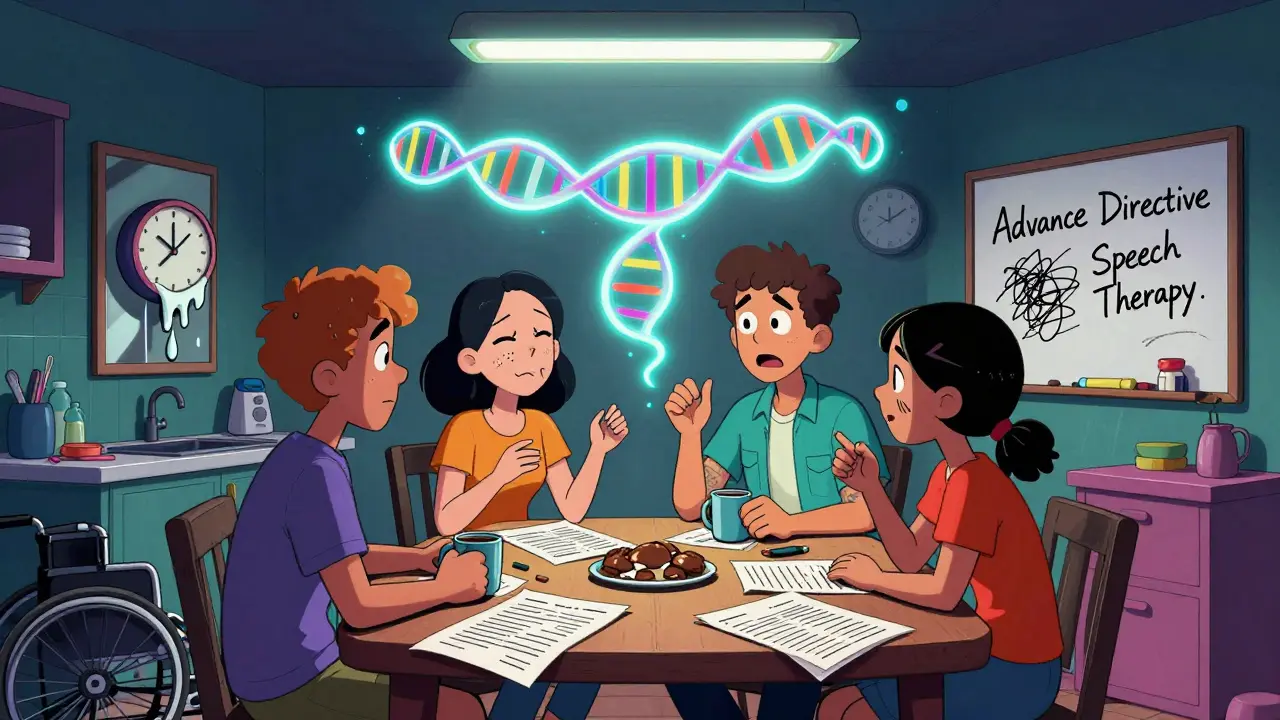
When someone is diagnosed with Huntington’s disease, it’s not just a medical label-it’s a life-altering moment for the whole family. There’s no cure. No magic pill. But there is something powerful: care planning. And it starts with understanding the science behind the disease, recognizing what chorea really looks like, and preparing for what’s ahead-not just medically, but emotionally and practically.
How Huntington’s Disease Is Passed Down
Huntington’s disease doesn’t skip generations. If one parent has it, each child has exactly a 50% chance of getting the faulty gene. It doesn’t matter if you’re male or female. It doesn’t matter which side of the family it came from. The gene is on chromosome 4, and it’s called HTT. What makes it dangerous is a tiny glitch: too many repeats of the letters C-A-G in that gene.Normal? 10 to 26 repeats. Anything over 40? You will develop Huntington’s. Between 36 and 39? You might, or you might not-this is called reduced penetrance. And here’s the twist: if the gene comes from your dad, those repeats tend to grow bigger. That’s why most cases of juvenile Huntington’s-where symptoms start before age 20-come from the father. A dad with 45 repeats might pass on 55. That means his child could be diagnosed at 12 instead of 40.
This isn’t just biology. It’s a family legacy. And that’s why genetic counseling isn’t optional. It’s essential. People who know they’re at risk often delay testing for years, afraid of what the result might mean. But knowing early gives you time. Time to talk about finances, time to make legal plans, time to decide who will speak for you if you can’t speak for yourself.
What Chorea Really Feels Like
Chorea is the signature symptom of Huntington’s. It’s not just twitching. It’s not just fidgeting. It’s involuntary movements that flow from one part of the body to another-like a dance you didn’t sign up for. A hand might jerk while you’re holding a cup. Your foot might tap when you’re sitting still. Your face might scrunch without you meaning to.At first, it’s subtle. People think you’re nervous. Or tired. Maybe you’re just clumsy. But over time, it gets worse. Movements become bigger, more unpredictable. You might drop things. Trip over nothing. Struggle to walk in a straight line. And here’s the cruel part: chorea fades when you sleep. So you wake up feeling normal-only to face it again when you open your eyes.
Doctors measure chorea using the Unified Huntington’s Disease Rating Scale, or UHDRS. A score of 1 means mild, occasional movements. A score of 4? Constant, wild motion that interferes with everything. Most people start around 1 or 2. By the time they’re 10 years into the disease, many are at 3 or 4.
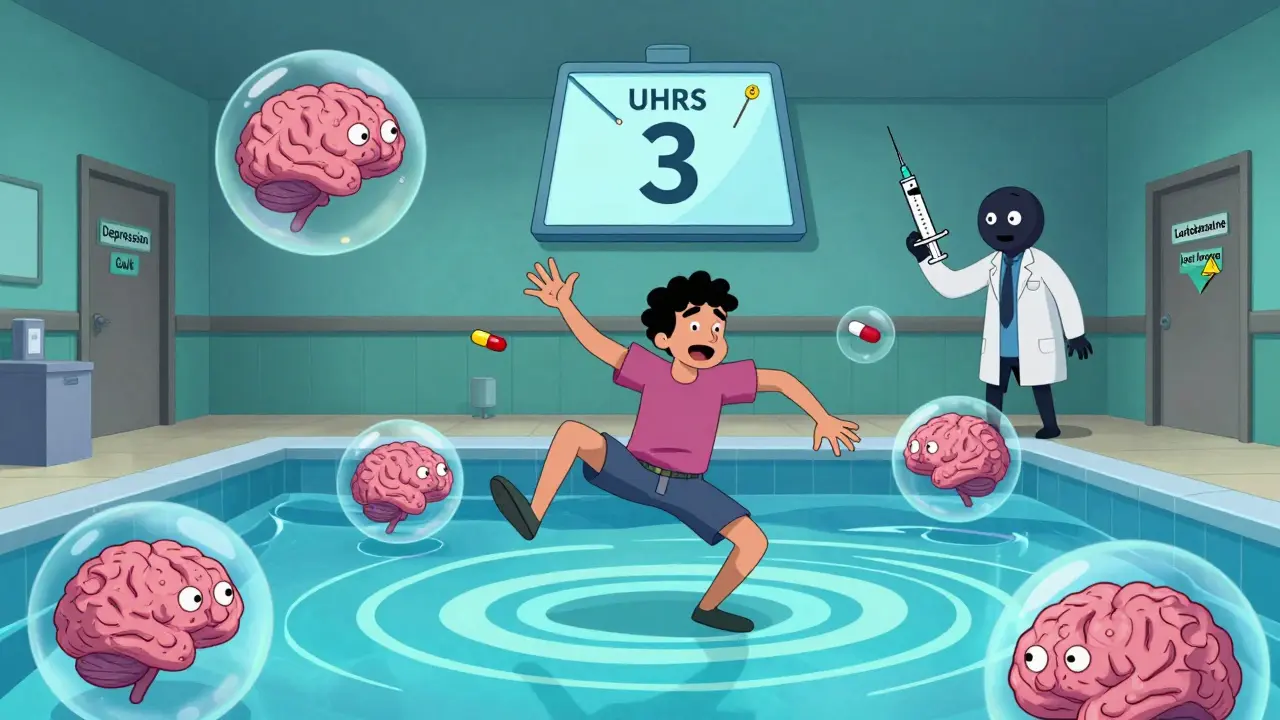
There are two drugs approved specifically for chorea: tetrabenazine and deutetrabenazine. They can reduce the movements by about 25-30%. But they come with a cost-depression, fatigue, even suicidal thoughts in some cases. That’s why many people avoid them. Instead, they turn to physical therapy. Aquatic therapy, in particular, helps. Water supports the body. It lets people move without fear of falling. One study showed it’s 35% more effective than land-based exercises for balance.
When the Mind Starts to Change
Huntington’s doesn’t just affect movement. It eats away at thinking and emotions. Memory fades. Planning becomes impossible. You forget appointments. You lose track of conversations. You can’t follow a recipe or manage bills.Psychiatric symptoms are just as common. Depression hits 40-50% of people with HD. Irritability. Anxiety. Obsessive thoughts. Some become aggressive. Others withdraw completely. And yes-suicide risk is higher than in the general population. That’s why mental health care isn’t an add-on. It’s part of the core treatment plan.
Many families don’t realize how early these changes start. Cognitive decline can begin years before chorea becomes obvious. That’s why doctors recommend regular testing-even if you’re not showing motor symptoms yet. The PREDICT-HD study found that people with the gene but no visible signs still showed brain changes and subtle thinking problems. Catching it early means you can adapt. Use reminders. Simplify routines. Get help before things spiral.
Care Planning: Not Optional, But Essential
The biggest mistake families make? Waiting. Waiting until someone can’t walk. Until they can’t swallow. Until they need 24-hour care. By then, it’s too late to make thoughtful decisions.Real care planning starts at diagnosis. That’s when you sit down with a team: neurologist, psychiatrist, physical therapist, occupational therapist, speech therapist, social worker, and genetic counselor. Together, you build a roadmap. Not a rigid one. A flexible one that changes as the disease moves.
Early stage (0-5 years): Focus on legal documents. Advance directives. Healthcare proxies. Living wills. Only 37% of people in general care do this. At specialized HD centers? 82%. That’s the difference between chaos and control.
Middle stage (5-15 years): This is when independence fades. You might need help dressing, bathing, eating. Speech gets slurred. Swallowing becomes risky. That’s when speech therapy kicks in. Occupational therapy helps modify the home-grab bars, non-slip floors, adaptive utensils. About 65% of people need occupational therapy by 10 years. And 45% need speech therapy.
Late stage (15+ years): Full-time care becomes necessary. Most people end up in a residential facility. By 20 years after diagnosis, 89% need round-the-clock support. Care costs hit $125,000 a year in the U.S. And that’s before factoring in lost income from caregivers who quit jobs to help.
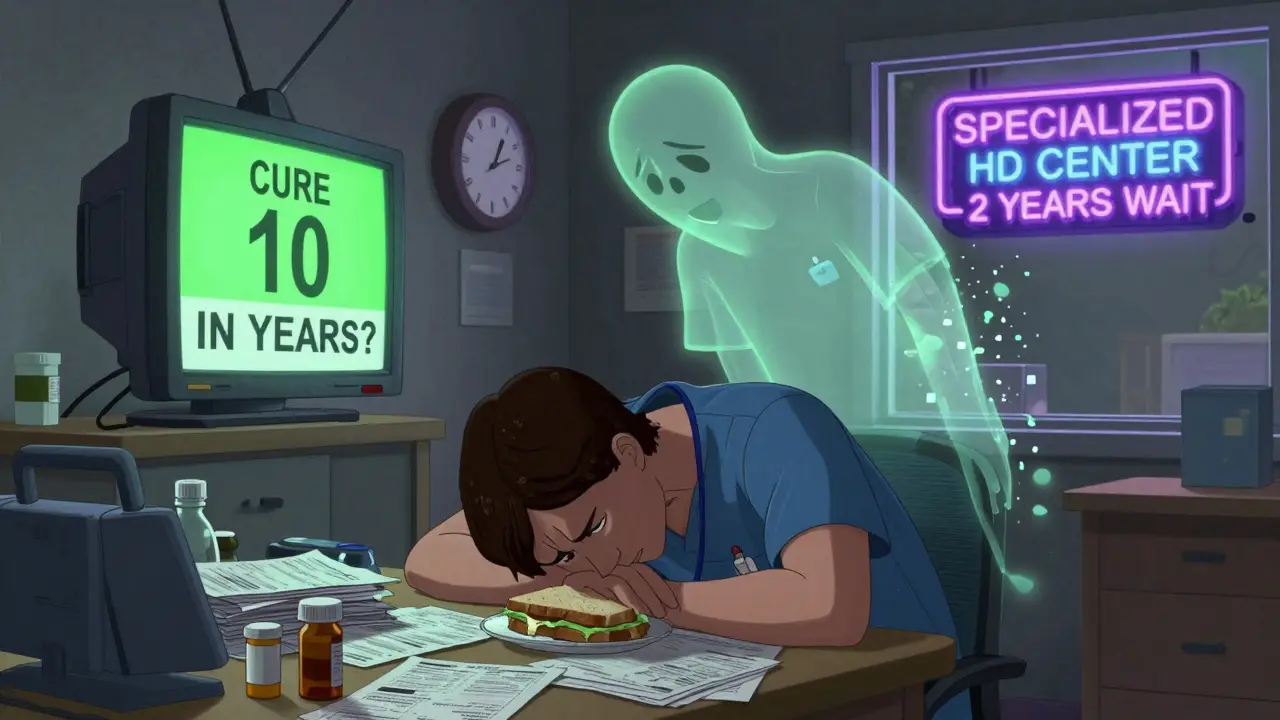
Here’s the hard truth: only 38% of U.S. neurologists follow the official care guidelines. Most patients get scattered care-seen by different doctors in different places, with no one tying it all together. That’s why specialized HD centers matter. They coordinate everything. And they save lives. People who get coordinated care live 2.3 years longer on average. They’re 32% less likely to end up in the hospital with pneumonia. And 58% less likely to die by suicide.
The Hidden Costs: Time, Money, and Emotion
Behind every care plan is a caregiver. Usually a spouse, a child, a sibling. And they’re drowning.A survey from the HDSA found that 87% of caregivers say coordinating care is the hardest part. They spend 15 or more hours a week just scheduling appointments, filling prescriptions, arguing with insurance. Many are working full-time while doing this. Some quit their jobs. The emotional toll? Unmeasurable.
Financially, it’s brutal. Even with insurance, families pay out-of-pocket for therapies, home modifications, transportation, special diets. 42% of U.S. patients spend over $5,000 a year on uncovered services. And that’s not counting lost wages. One mother on a patient forum wrote: “I used to be a teacher. Now I’m a nurse, a driver, a accountant, and a grief counselor. No one tells you how much you’ll lose.”
And then there’s the guilt. The people with HD feel it. They see their family giving up everything. They hear the sighs. They feel the weight of being a burden. One man on Reddit said: “The hardest part isn’t the chorea or even knowing I’ll decline-it’s watching my family try to plan for my deterioration while I’m still here.”
What’s on the Horizon
There’s hope. Not today. But maybe soon.Drugs like tominersen and Wave Life Sciences’ SELECT-HD are trying to stop the disease at its source-by lowering the bad huntingtin protein. Early results are promising. One trial showed a 38% drop in the toxic protein after 135 weeks. But these are still experimental. They’re not available to the public. And even if they work, they won’t reverse damage already done.
That’s why care planning remains critical. Even if a cure comes tomorrow, there are 40,000 Americans living with HD right now. They need help now. Not in 10 years.
Organizations like the Huntington’s Disease Society of America are pushing to expand access to specialized care centers. Their goal? To cover 85% of U.S. patients by 2025. Right now, only 62% have access. That gap means people in rural areas wait over two years just to get a proper diagnosis.
And while researchers race toward a cure, families are learning to live with the disease. They’re joining support groups. They’re sharing stories. They’re teaching each other how to eat safely, how to move without falling, how to talk about death without breaking down.
There’s no perfect answer. But there is one truth: the most important thing you can do for someone with Huntington’s isn’t a drug. It’s a plan. A real, written, updated, talked-about plan. Because when the body fails, the mind still remembers love. And care planning is how you keep that love alive-even as the disease takes everything else.

Comments
Meenakshi Jaiswal
December 17, 2025 AT 15:25 PMMy mom had HD, and I can tell you the biggest game-changer was getting her into aquatic therapy. She could actually move without fear for the first time in years. Water doesn’t judge, and it doesn’t make you feel broken. We did it twice a week, and her mood lifted even before the movements got better. Don’t underestimate the power of just feeling safe in your own body.
Also, if you’re in India, reach out to the HD Society’s outreach partners in Bangalore-they’ve started a caregiver support network. You’re not alone.
bhushan telavane
December 18, 2025 AT 14:49 PMBro in India we don’t even have neurologists who know what chorea is half the time. My uncle got misdiagnosed as Parkinson’s for 3 years. By the time they figured it out, he couldn’t walk anymore. This post is fire but honestly? Most of us are just trying to survive the system.
Also why is everyone talking about US stats? We don’t have insurance. We don’t have therapists. We have love and desperation.
Mahammad Muradov
December 20, 2025 AT 14:15 PMPeople who delay genetic testing are just being selfish. If you know you carry the gene and you have kids, you’re playing Russian roulette with their lives. No one’s asking you to be a hero-but you owe it to your family to know. And if you’re too scared to face it, that’s not courage, that’s cowardice wrapped in denial.
Also, the 50% inheritance thing isn’t some mystical probability-it’s Mendelian genetics. Learn it. Stop pretending it’s a lottery.
Connie Zehner
December 20, 2025 AT 22:58 PMOMG I just cried reading this 😭 I have a cousin with HD and I’ve been her caregiver for 6 years and no one gets it. I’m literally up at 4am feeding her pureed food and wiping her drool and I just want someone to say ‘you’re doing amazing’ but no one does 😭
Also have you tried CBD oil? My friend’s mom swears by it for the anxiety. I’m trying to get her on a clinical trial but the paperwork is a nightmare 😩
Jedidiah Massey
December 22, 2025 AT 13:33 PMIt’s statistically significant that only 38% of U.S. neurologists adhere to the AAN guidelines-this speaks to a systemic failure in translational neurology. The heterogeneity of care delivery is a direct function of fragmented reimbursement models and lack of integrated care pathways.
Moreover, the UHDRS, while validated, lacks ecological validity in low-resource settings. We need a culturally adaptive biomarker suite-perhaps incorporating wearable kinematic sensors with AI-driven anomaly detection.
And frankly, the emotional labor burden on caregivers is under-quantified in the literature. We need a validated psychosocial burden index.
Alex Curran
December 23, 2025 AT 09:42 AMHad a friend in Perth go through this. The aquatic therapy thing is legit. She did hydrotherapy three times a week and it bought her two extra years of independence. Also the part about chorea fading at night? Yeah that’s the cruelest part. Waking up feeling normal then watching your body betray you again.
What’s the uptake like for those gene-silencing drugs in Australia? Last I heard they were still Phase 3. Any idea if we’ll get access before 2027?
Also anyone know if the HD Society has a mobile unit? Rural folks here get zero support.
Allison Pannabekcer
December 24, 2025 AT 01:40 AMI want to say thank you to everyone who’s shared their stories here. This is heavy stuff and it takes guts to talk about it.
For those feeling alone-I get it. But there are people out there who’ve walked this path and made it to the other side. Not cured, not fixed-but alive and still loving.
Start small. One conversation. One legal document. One day where you let yourself cry and then make tea anyway. That’s the plan. Not perfection. Just presence.
And if you’re a caregiver-you’re not a burden. You’re the anchor. Even on the days you feel like you’re failing, you’re holding the line. That matters more than any statistic.
Nicole Rutherford
December 24, 2025 AT 17:41 PMOf course people avoid the drugs. They’re weak. If you can’t handle a little depression to reduce involuntary movements, maybe you shouldn’t be making decisions for your family.
And why are we romanticizing ‘care planning’? It’s just delaying the inevitable. You can’t plan your way out of neurodegeneration. The real solution is genetic screening before marriage. No one talks about that.
Also, anyone else notice how this post ignores the fact that HD is more common in Western populations? It’s not a universal tragedy-it’s a genetic accident of ancestry. Stop acting like it’s everyone’s burden.
Mark Able
December 26, 2025 AT 04:04 AMBro I just found out my dad has the gene. He’s 52. No symptoms yet. I’m 28. I’m getting tested next week. I’m terrified. But I’m doing it because I refuse to live in the dark. If I have it, I want to know so I can plan. If I don’t, I want to know so I can help my family without guilt.
Also if anyone’s got a link to the PREDICT-HD study or the UHDRS scoring sheet-drop it. I need to read everything.