

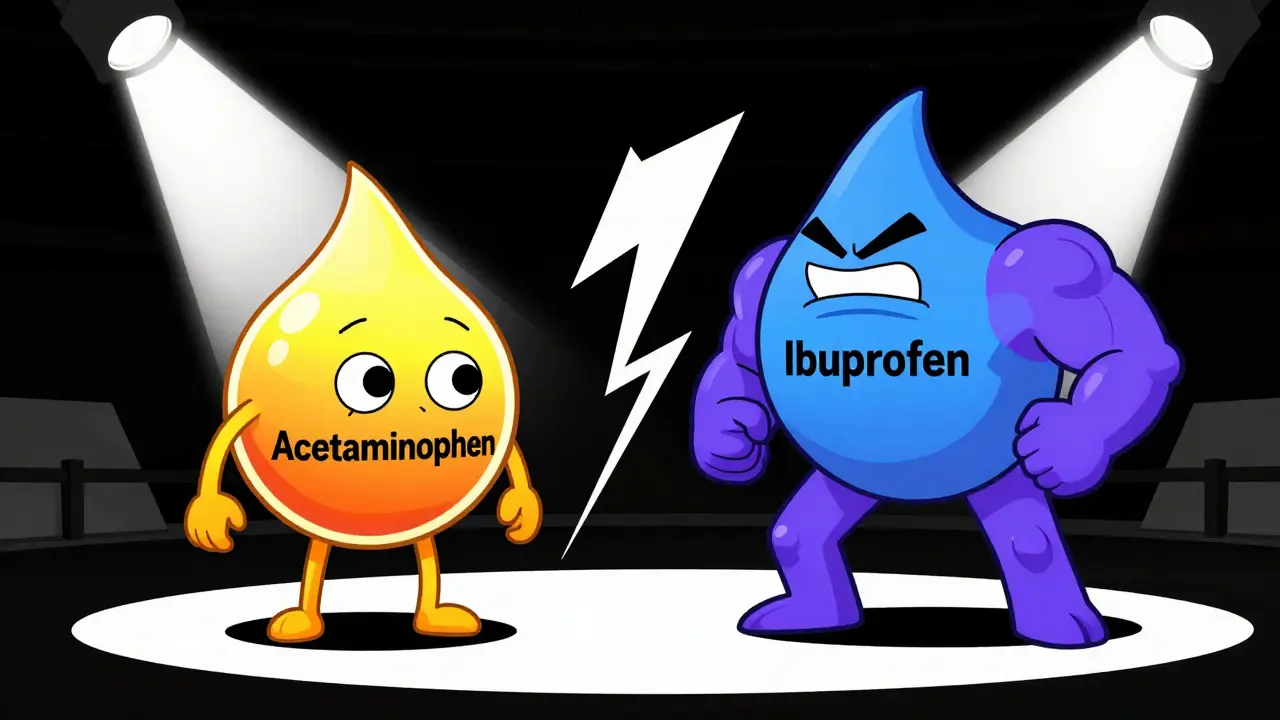
Watching your child struggle with a high fever is one of the most stressful experiences you can face as a parent. You rush to the medicine cabinet, grab whatever looks familiar, and hope it works. But here is the reality: giving the wrong dose or the wrong medication to a toddler isn't just ineffective-it can be dangerous. The debate between acetaminophen (often known by the brand name Tylenol) and ibuprofen (commonly sold as Motrin or Advil) has been raging for decades. Which one is safer? Which one actually brings the temperature down faster? And when should you absolutely avoid one over the other?
The short answer is that both medications are safe and effective when used correctly. However, they work differently in your child's body, have different age restrictions, and carry distinct risks if misused. Understanding these differences isn't about finding a 'magic bullet'; it's about making an informed choice that keeps your little one comfortable without causing harm.
Key Takeaways
- Ibuprofen is generally more effective at lowering fever quickly and lasts longer, but it should not be given to infants under six months old.
- Acetaminophen is safer for younger infants (over three months) and those with stomach issues, but it requires more frequent dosing.
- Dosing must always be based on your child's weight, not their age. Using household spoons instead of the provided measuring device is a leading cause of overdose.
- Avoid alternating medications unless specifically instructed by a doctor, as this increases the risk of dosing errors.
- Never use adult formulations or combination cold medicines to treat simple fevers in young children.
How These Medications Work in Children
To understand which drug is right for your situation, you need to know what they are doing inside your child's system. Acetaminophen and ibuprofen belong to different drug classes, which dictates how fast they work and how long they last.
Acetaminophen is a pain reliever and fever reducer that works primarily in the brain to block pain signals and reduce heat production. It was first synthesized in 1878 and became widely available in the 1950s. Because it acts centrally, it doesn't irritate the stomach lining, making it gentler on the gut. However, its effects wear off relatively quickly. In most children, peak plasma concentrations are reached within 30 to 60 minutes, and the half-life-the time it takes for half the drug to leave the body-is about 1.25 to 3 hours. This means you often need to give it every four to six hours to keep the fever at bay.
Ibuprofen is a nonsteroidal anti-inflammatory drug (NSAID) that reduces inflammation, pain, and fever throughout the entire body. Synthesized in 1961 and approved for medical use in 1969, ibuprofen works by blocking prostaglandins, the chemicals that cause inflammation and fever. Because it acts systemically, it tends to lower fevers more aggressively. A comprehensive meta-analysis published in American Family Physician in May 2021 examined 85 studies and found that ibuprofen demonstrated superior efficacy for fever reduction compared to acetaminophen in children under two years old. Specifically, children given ibuprofen were significantly more likely to be fever-free at four hours post-dose (odds ratio = 1.86). Furthermore, ibuprofen has a longer duration of action, allowing for dosing every six to eight hours.
Safety Profiles and Age Restrictions
Safety is the primary concern for any parent administering medication. While both drugs are considered safe when used appropriately, the American Academy of Pediatrics (AAP) has specific guidelines based on age and health status.
You should never give acetaminophen to an infant younger than three months without consulting a doctor. Similarly, ibuprofen is strictly prohibited for infants younger than six months. These restrictions exist because very young infants have immature liver and kidney functions. Their bodies cannot process these drugs efficiently, increasing the risk of toxicity. If your baby is under these age thresholds and has a fever, seek immediate medical evaluation rather than self-medicating.
For older children, the safety profiles differ slightly. Historically, there were concerns that ibuprofen might increase the risk of acute kidney injury or mask symptoms of serious bacterial infections like meningitis. However, recent evidence, including the 2021 AAP-aligned meta-analysis, suggests that when used correctly, ibuprofen has a comparable safety profile to acetaminophen. There were no significant differences in adverse events between the two groups in large-scale reviews.
Conversely, newer research has raised questions about acetaminophen. A 2022 meta-analysis in the European Respiratory Journal found a 1.6-fold increased risk of childhood asthma associated with acetaminophen use in the first year of life. While this does not mean you should ban acetaminophen, it highlights why using the lowest effective dose for the shortest duration is crucial. Dr. Theresa Fiorito, Chief of Pharmacy at Children's Hospital of Orange County, emphasizes that "both medications are safe when used correctly, but too high a dose can make children very sick."
Dosing Mistakes That Put Kids at Risk
The biggest danger in pediatric fever management isn't the drug itself-it's human error. According to data from the American Association of Poison Control Centers, improper dosing accounts for a vast majority of medication-related emergencies in children.
Weight vs. Age: Many parents rely on age-based charts printed on bottles. This is risky. Children vary wildly in size at the same age. Always dose based on your child's current weight. For acetaminophen, the standard dose is 7-15 mg/kg per dose, up to a maximum of 75 mg/kg per day. For ibuprofen, it is 4-10 mg/kg per dose, with a maximum daily limit of 40 mg/kg. Using a digital scale at your next pediatric visit ensures you have the correct number.
Measuring Devices: Never use a kitchen spoon. Household teaspoons vary in volume by up to 20%. Always use the calibrated syringe, dropper, or cup that comes with the medication. The FDA mandated concentration standardization in 2011 (changing infant acetaminophen from 80 mg/0.8 mL to 160 mg/5 mL) to reduce confusion, but mixing up old and new bottles remains a hazard. Check the label carefully every single time.
Combination Products: This is a silent killer. Many cold and flu medicines contain acetaminophen as an ingredient. If you give your child a multi-symptom cold remedy and then also give them plain acetaminophen for fever, you may accidentally double-dose them. This can lead to severe liver damage. Always read the "Drug Facts" panel on every bottle to check for hidden ingredients.
Comparison: Acetaminophen vs. Ibuprofen
| Feature | Acetaminophen (Tylenol) | Ibuprofen (Motrin/Advil) |
|---|---|---|
| Minimum Age | 3 months (with doctor guidance) | 6 months |
| Dosing Interval | Every 4-6 hours | Every 6-8 hours |
| Max Daily Doses | Up to 5 doses in 24 hours | Up to 4 doses in 24 hours |
| Fever Reduction Speed | Moderate | Faster and more potent |
| Stomach Irritation | Low risk | Moderate risk (give with food) |
| Primary Risk | Liver damage if overdosed | Kidney stress or stomach upset |

Should You Alternate Medications?
This is one of the most common questions parents ask. Some doctors used to recommend alternating acetaminophen and ibuprofen every three hours to keep the fever down continuously. However, current clinical guidance strongly advises against this practice unless explicitly directed by a healthcare provider.
Why? Because it is incredibly easy to make a mistake. Tracking two different medications with different schedules and doses increases the cognitive load on exhausted parents. A study published in Pediatrics in 2023 noted that while alternating therapy might get a child fever-free faster, the complexity leads to higher rates of dosing errors. Most parents find themselves confused about which drug was given last, leading to accidental overdoses.
If one medication isn't working well enough, do not immediately switch to the other. Instead, ensure you are using the correct weight-based dose. If the fever persists despite proper dosing, contact your pediatrician. They may want to evaluate your child for underlying infection rather than just masking the symptom.
Practical Tips for Administration
Getting a crying, feverish toddler to take medicine is a battle in itself. Here are some practical strategies to make it smoother:
- Use the Right Flavor: Both medications come in various flavors. Grape and cherry are popular, but some children hate them. Experiment during non-fever times to see which flavor your child accepts best.
- Position Matters: Always administer liquid medication with your child sitting upright. Lying down increases the risk of choking or aspiration. Boston Children's Hospital notes that improper administration technique accounts for 22% of reported adverse events in young children.
- Don't Force It: If your child spits out the medicine, don't re-dose immediately. Wait at least 30 minutes to see if they swallow any residue before considering another dose. Forcing it can create negative associations with medicine that last into adulthood.
- Hydration is Key: Medicine lowers the fever, but hydration helps the body cool down naturally. Offer small sips of water, breast milk, or electrolyte solutions frequently.
When to Call the Doctor
Fever is a symptom, not a disease. It is your child's immune system fighting back. However, certain signs indicate that home care is no longer sufficient. Seek immediate medical attention if:
- Your child is under three months old and has a rectal temperature of 100.4°F (38°C) or higher.
- The fever lasts more than 48 hours (for children under 2) or 72 hours (for older children).
- Your child shows signs of dehydration: dry mouth, no tears when crying, or fewer than three wet diapers in 24 hours.
- You notice a stiff neck, severe headache, sensitivity to light, or difficulty breathing.
- Your child is unusually lethargic, difficult to wake, or inconsolable.
- A rash appears along with the fever.
Can I give ibuprofen to my 4-month-old baby?
No, you should not give ibuprofen to a baby under six months old. Their kidneys are not mature enough to handle the medication safely. For infants between 3 and 6 months, acetaminophen is the preferred option, but only after consulting with your pediatrician to determine the correct dose.
Which medicine is better for teething pain?
Both acetaminophen and ibuprofen can help with teething pain. Ibuprofen may provide slightly better relief due to its anti-inflammatory properties, which target the swollen gums. However, acetaminophen is gentler on the stomach. Ensure you use the correct weight-based dose and avoid topical numbing gels, which can be unsafe for infants.
What happens if I accidentally give too much acetaminophen?
An overdose of acetaminophen can cause severe liver damage. Symptoms may not appear immediately, so do not wait for signs of illness. Contact your local poison control center or emergency services immediately. Bring the medication bottle with you to provide details on the concentration and amount ingested.
Is it safe to use generic brands instead of Tylenol or Motrin?
Yes, generic brands are completely safe and effective. They contain the exact same active ingredients as the branded versions. In fact, generics represent 76% of sales volume in the pediatric OTC market. Just ensure you check the concentration (mg/mL) on the label, as different brands may have different strengths.
How do I know if my child's fever is high enough to worry?
Focus on how your child behaves rather than just the number on the thermometer. A child with a 102°F fever who is drinking fluids and playing is usually fine. A child with a 100°F fever who is lethargic and irritable needs closer attention. Rectal temperatures are the most accurate for infants under 3 months. For older children, oral or temporal artery thermometers are reliable.



Comments
Jeremiah Cassandra
May 17, 2026 AT 12:10 PMOh look, another article telling us what we already know but somehow still get wrong 😅. The bit about using weight instead of age is the golden nugget here because let's be honest, half the parents out there are just eyeballing it with a kitchen spoon and praying to the medicine gods 🙏. I've seen too many people panic over a temp of 102 when the kid is actually fine, or ignore a lethargic 99 because 'it's not high enough'. Stop treating the thermometer like a scoreboard and start looking at your actual human child 👀.
charles robert
May 19, 2026 AT 09:29 AMThe modern parent is trapped in a labyrinth of pharmaceutical anxiety, isn't they? We dose our offspring with precision that would make a surgeon blush, yet we ignore the fundamental truth that fever is merely the body's ancient cry for help being drowned out by chemical silence 🌑. It’s tragic really, how we’ve outsourced our intuition to bottle labels. The soul of the child screams while we count milligrams. Truly a commentary on our loss of connection to nature itself 🍂.
Warren Brewer
May 21, 2026 AT 05:01 AMI think this is really helpful info for everyone. A lot of folks forget that ibuprofen can hurt tummies so always give it with food if you can. Also please never use a regular spoon from the drawer because they are all different sizes and you might give too much by accident. Just stick to the little syringe thing that comes with the meds. It keeps everyone safe and happy 😊.
Mark Ronson
May 21, 2026 AT 22:13 PMIt is imperative that one adheres strictly to the weight based dosing charts provided by medical professionals. Many individuals mistakenly believe that age is a sufficient proxy for dosage requirements which is a dangerous misconception leading to potential toxicity. Furthermore the practice of alternating medications without explicit instruction from a physician introduces unnecessary variables into the treatment regimen thereby increasing the likelihood of error. One must exercise extreme caution when handling pediatric medications as the margin for error is exceedingly small and the consequences can be severe. Please ensure you have a calibrated measuring device available at all times to mitigate these risks effectively.
Mikey Mann
May 22, 2026 AT 16:37 PMThere is something profound about the way we try to control the uncontrollable forces of biology in our little ones. Fever is just heat, yes, but it represents the fire of life fighting back against the cold encroachment of illness. When we choose between acetaminophen and ibuprofen, we are really choosing between two different philosophies of comfort: the gentle nudge versus the strong hand. Both have their place in the grand tapestry of care, but only if applied with wisdom and love rather than fear. Let us trust our instincts more and the numbers less 🌟.
Mollie Louise
May 23, 2026 AT 02:28 AMI completely agree with everything said here regarding the importance of hydration alongside medication! 💧 While the drugs do help lower the temperature physically, it is the fluids that truly support the body's natural cooling mechanisms and prevent dehydration which can be quite serious especially in younger children who may not communicate their thirst effectively. I always find that offering small frequent sips of water or electrolyte solutions works wonders in keeping my kids comfortable and stable during those long feverish nights when sleep seems impossible to achieve. It is amazing how much better they feel once they are properly hydrated even if the fever has not completely broken yet! 🌈
Christina Moran
May 24, 2026 AT 11:14 AMdoes anyone else just hate the grape flavor tho?? my kid spits it out every time. i tried the cherry one but he doesnt like that either. its such a struggle trying to get them to take anything when they are sick. also im confused about the part where u say dont alternate unless doctor says so cause my grandma always did it and said it worked best. am i doing it wrong? sorry if this is a dumb question but parenting is hard lol 😩
mardy duffy
May 24, 2026 AT 15:22 PMboring.
Desirea Gaona
May 25, 2026 AT 11:47 AMIt is of utmost importance that caregivers refrain from utilizing household utensils for the measurement of pediatric medications due to the significant variance in volume capacity among standard teaspoons. The utilization of calibrated devices such as oral syringes or dosing cups is essential to ensure accurate administration and to prevent accidental overdose which can result in severe hepatic or renal complications. Furthermore, it is advisable to consult with a healthcare provider prior to administering any antipyretic agent to an infant under the age of three months to rule out serious underlying infections. Adherence to these protocols ensures the safety and well-being of the child.