
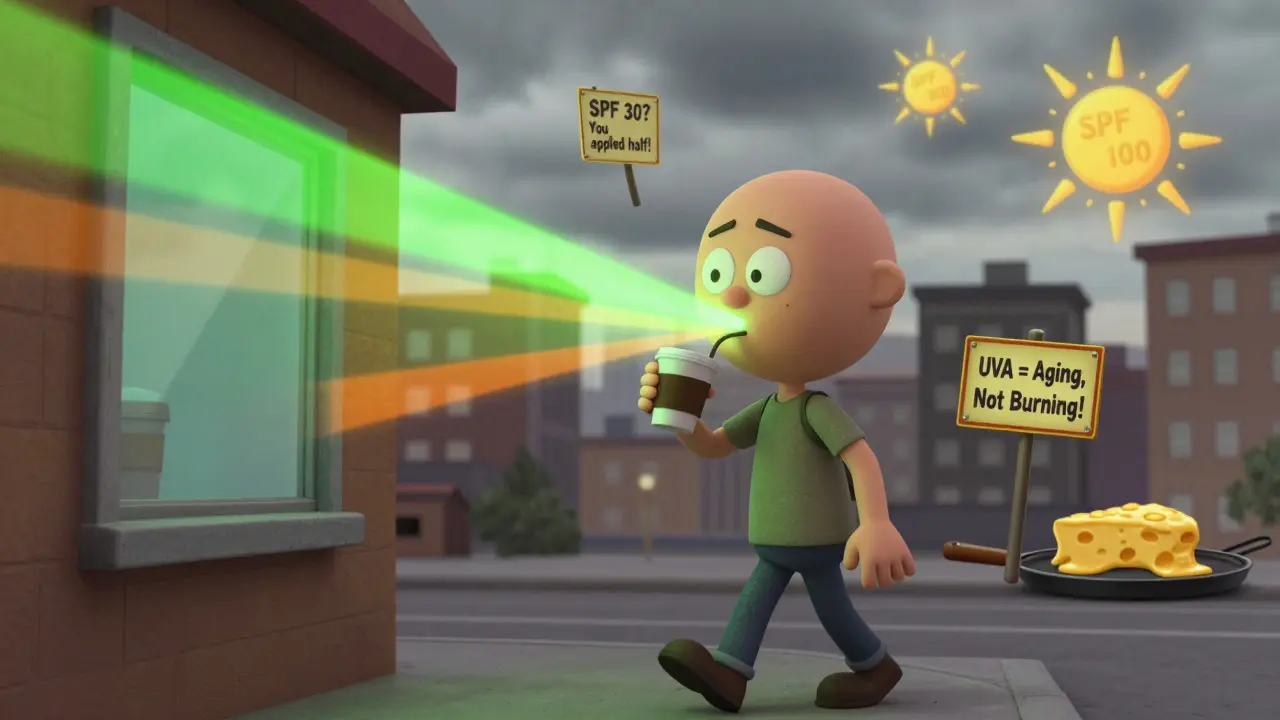
Every day, you walk outside. Maybe you grab coffee, walk the dog, or sit by a window. You don’t think about it - but your skin does. Ultraviolet radiation is there, even on cloudy days, even in winter, even through glass. And if you’re not using sunscreen properly, you’re letting it damage your skin without even knowing.
What SPF Really Means - And What It Doesn’t
SPF stands for Sun Protection Factor. It’s not a measure of how long you can stay in the sun. It’s a ratio. SPF 30 means it takes 30 times longer for your skin to burn compared to wearing no sunscreen at all. That sounds great - until you realize most people apply less than half the amount needed.The FDA and dermatologists agree: SPF 30 blocks about 97% of UVB rays. SPF 50 blocks 98%. That’s it. The jump from SPF 30 to SPF 50 isn’t doubling your protection - it’s adding 1%. Higher numbers like SPF 70 or 100? They’re mostly marketing. The difference between SPF 50 and SPF 100 is less than 1% more UVB blocking. Yet, people think SPF 100 means they’re invincible. They’re not.
Here’s the real problem: if you use SPF 50 but only apply half the amount you should, your protection drops to SPF 7.5. That’s worse than SPF 15. That’s why dermatologists say: SPF 30 applied correctly beats SPF 100 applied poorly.
UVA vs. UVB: The Hidden Battle
Most people think sunscreen is just for sunburns. That’s UVB - the burning rays. But UVA is the silent killer.UVA rays are longer wavelengths. They sneak past the top layer of skin and dig into the dermis. That’s where collagen and elastin live. That’s where wrinkles, sagging, and dark spots come from. UVA doesn’t burn you. It ages you. And it’s present all day, every day. Even indoors. Even in the car.
UVB is the shorter, sharper ray. It’s the one that causes sunburns and direct DNA damage - the kind that leads to skin cancer. It’s strongest between 10 a.m. and 4 p.m., but UVA? It’s constant. That’s why “broad spectrum” isn’t just a buzzword. It’s non-negotiable.
The FDA requires sunscreens labeled “broad spectrum” to pass a critical wavelength test - at least 370 nanometers. That means they protect against UVA rays deep enough to matter. But here’s the catch: not all broad spectrum sunscreens are equal. A product with SPF 50 and low UVA protection is still a gamble. That’s why the Skin Cancer Foundation now requires UVA protection to be at least one-third of the SPF number. For SPF 50, that means UVA-PF of at least 16.6. Many don’t hit that.
Mineral vs. Chemical: Which One Should You Use?
There are two main types of sunscreen: mineral and chemical.Mineral sunscreens use zinc oxide and titanium dioxide. They sit on top of your skin like a shield and reflect UV rays. They start working immediately. They’re less likely to irritate sensitive skin. And they’re the go-to for people with rosacea, eczema, or acne.
But they have a downside: white cast. Especially on deeper skin tones. That’s why many people avoid them. But newer formulas - like those from La Roche-Posay, CeraVe, and Suntribe - use micronized particles that blend better. Still, it takes practice. Most users need 2-3 weeks to learn how to rub it in without leaving a ghostly glow.
Chemical sunscreens use ingredients like avobenzone, octinoxate, and oxybenzone. They absorb UV rays like a sponge. They’re often lighter, easier to spread, and don’t leave a white cast. But they need 15-20 minutes to activate. And they can irritate sensitive skin. Oxybenzone? It’s been linked to breakouts and allergic reactions. Reddit users in r/SkincareAddiction report that 78% of those who switched from chemical to mineral saw fewer breakouts.
Here’s the trade-off: chemical sunscreens usually offer better UVA coverage. Mineral ones? Zinc oxide is great for UVB and some UVA, but titanium dioxide alone? It’s weak against long UVA rays. That’s why the best mineral sunscreens combine both.
How to Apply Sunscreen - The 1/4 Teaspoon Rule
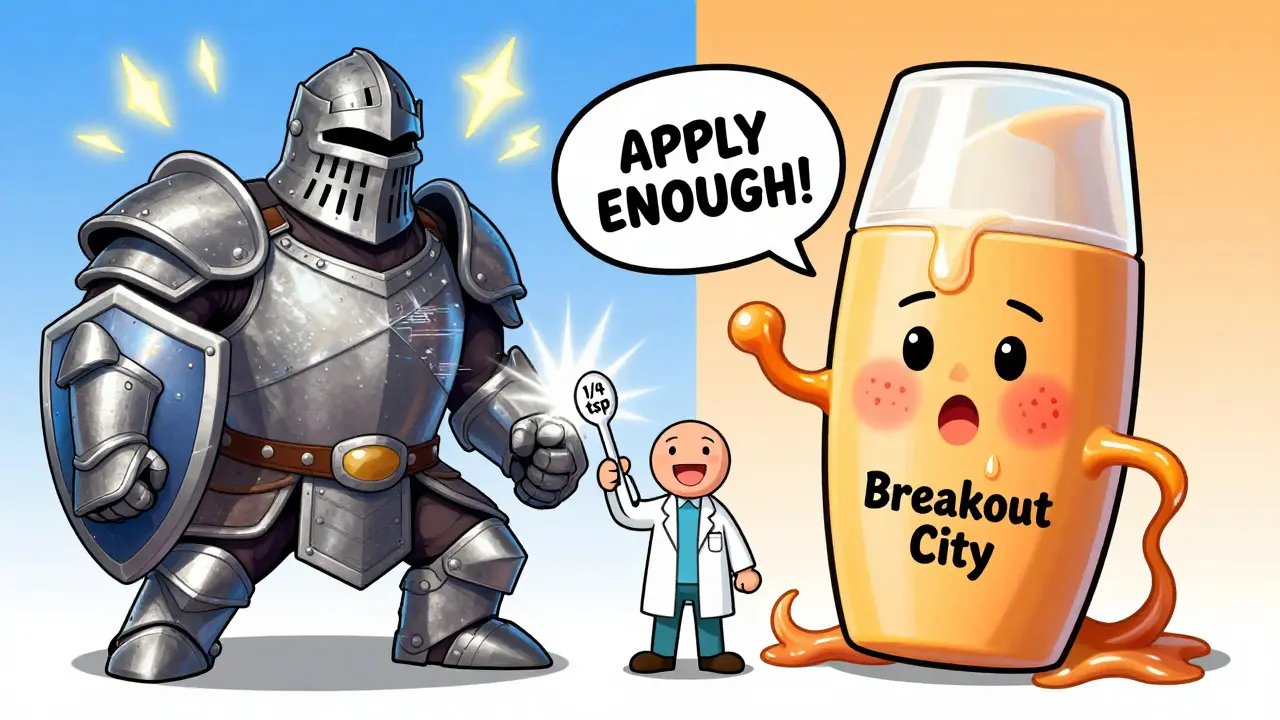
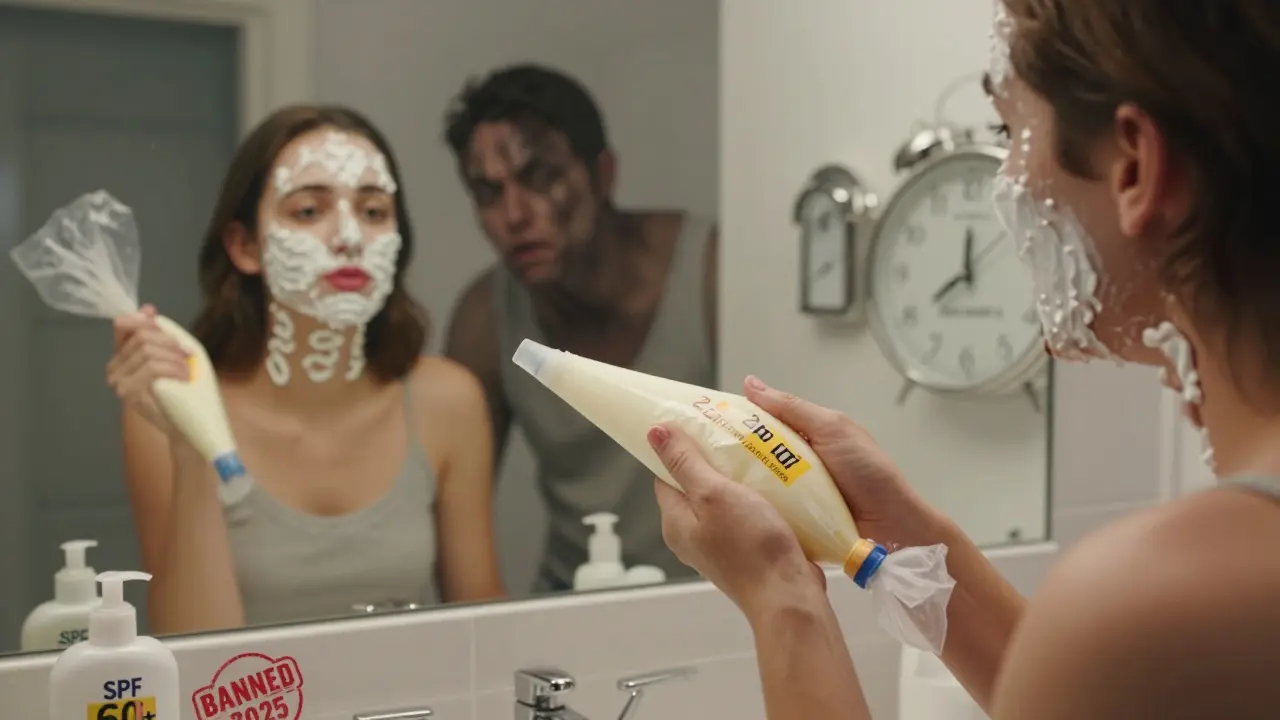
You’re not using enough.The American Academy of Dermatology says you need 2 milligrams of sunscreen per square centimeter of skin. That’s about 1/4 teaspoon for your face and neck. For your whole body? A shot glass full.
Most people use 25-50% of that. And that’s why SPF 30 becomes SPF 15. Or worse. If you’re only applying a thin layer, you’re not getting the protection you paid for.
Apply it like you’re frosting a cake. Evenly. Don’t skip your ears, neck, hands, or lips. Reapply every two hours. If you’re sweating, swimming, or wiping your face? Reapply right away. No exceptions.
And here’s a pro tip: apply sunscreen as the last step in your skincare routine - after moisturizer, before makeup. Let it sit for 15 minutes. That prevents pilling and helps it absorb properly.
Daily Use Isn’t Optional - Even in Winter
You don’t need to be at the beach to need sunscreen. UVA rays penetrate clouds. They pass through windows. They’re in your office, your car, your kitchen window.Dr. Leslie Baumann, a board-certified dermatologist, says: “UVA rays are equally intense during all daylight hours throughout the year.” That means January 15 in Bristol? You still need protection. Snow reflects up to 80% of UV rays. That’s more than sand.
The Skin Cancer Foundation updated its recommendations in 2023. Daily use? SPF 30+. Active days? SPF 50+. That’s not a suggestion. It’s based on years of research showing that cumulative sun damage adds up - even if you never burn.
Think of sunscreen like brushing your teeth. You don’t skip it because you didn’t eat candy. You do it because it prevents long-term damage.
What to Look for - And What to Avoid
Look for these on the label:- Broad spectrum - non-negotiable
- SPF 30 or higher - SPF 50 is fine, but don’t chase 100
- Water resistant (40 or 80 minutes) - if you sweat or swim
- Zinc oxide or titanium dioxide - if you have sensitive skin
- Avobenzone - one of the best UVA filters in chemical sunscreens
Avoid these if you’re prone to breakouts or irritation:
- Oxybenzone - common irritant, linked to hormonal disruption
- Octinoxate - can cause allergic reactions
- Fragrances and alcohol - drying, irritating
And if you care about reefs? Skip oxybenzone and octinoxate. They’re banned in Hawaii and the U.S. Virgin Islands. Brands like Suntribe and Badger make reef-safe formulas that still work.
What’s Changing in 2025 - And Why It Matters
The FDA just announced new rules. By December 2025, all sunscreens sold in the U.S. must clearly label “broad spectrum” and can’t claim SPF higher than 60+. Why? Because SPF 60+ gives almost no extra protection - but tricks people into thinking they’re safer.Also, UVA protection will be tested more strictly. Sunscreens labeled SPF 50+ must now prove they block UVA rays at a level that matches their SPF. No more “SPF 50 with weak UVA” products.
And the future? Dermatologists are already testing protection against blue light from screens and infrared radiation. By 2030, sunscreen might protect against more than just the sun.
Final Take: Sunscreen Is a Habit - Not a Chore
You don’t need the fanciest bottle. You don’t need to spend $50. You just need to use it - every day - correctly.Find a formula you like. If mineral leaves a cast, try a tinted one. If chemical stings, switch to zinc oxide. Test it on your jawline first. Reapply like clockwork. Don’t wait for a beach day. Don’t wait for a burn.
Every day you skip sunscreen, you’re adding to the damage. Every day you use it, you’re buying time - time for your skin to stay healthy, clear, and cancer-free.



Comments
Jack Havard
February 14, 2026 AT 08:48 AMSPF 30 is all you need. The rest is corporate greed. I've been using a $5 Walmart sunscreen for 12 years. No skin cancer. No wrinkles. Just a guy who doesn't fall for marketing.
Luke Trouten
February 15, 2026 AT 21:36 PMThere's a deeper philosophical question here: if we are constantly exposed to invisible environmental stressors, are we not already living in a state of chronic vulnerability? Sunscreen is merely one small ritual in a society that demands constant protection from everything - the sun, the air, the water, even our own thoughts.
Gabriella Adams
February 16, 2026 AT 16:37 PMI want to emphasize something important: the 1/4 teaspoon rule is non-negotiable. I used to skimp, then I started tracking my application with a measuring spoon. My skin tone evened out in 3 weeks. No exaggeration. Also - reapplying after sweating? Yes. Even if you're just walking to your car. It's not a chore. It's preventative medicine.
Brad Ralph
February 17, 2026 AT 11:42 AMSPF 100? More like SPF 'I'm too lazy to reapply'. 🤡
Suzette Smith
February 18, 2026 AT 10:25 AMI used to hate mineral sunscreens until I tried the CeraVe tinted one. Now I look like I have a filter on. And I don't care. My dermatologist said I've cut my risk of melasma in half. Worth the white-ish glow.
Autumn Frankart
February 19, 2026 AT 15:58 PMThey're lying about UVA. It's not just aging - it's a government tool. The FDA knows full well that UVA penetrates deeper. Why do you think they don't regulate it like UVB? It's because they want you to believe you're safe with SPF 50. But your DNA? It's still being fried. And the 'broad spectrum' label? A distraction. They don't test for long-wave UVA properly. I've seen the lab reports.
Skilken Awe
February 19, 2026 AT 21:47 PMLet's be clear: if you're using chemical sunscreen and not reapplying every 90 minutes, you're doing more harm than good. Avobenzone degrades in sunlight. That's not a feature - it's a flaw. And you're literally coating yourself in a photo-unstable compound that breaks down into free radicals. Congratulations, you've turned your face into a chemistry experiment.
Ernie Simsek
February 20, 2026 AT 07:02 AMI switched to zinc oxide after my face broke out for 6 months. Total game-changer. Also, I apply it after moisturizer but before my serum. Let it sit 20 mins. No pilling. No ghost face. Just clean, protected skin. And yes - I do it in December. Even in my apartment. UVs don't care about your heating bill.