
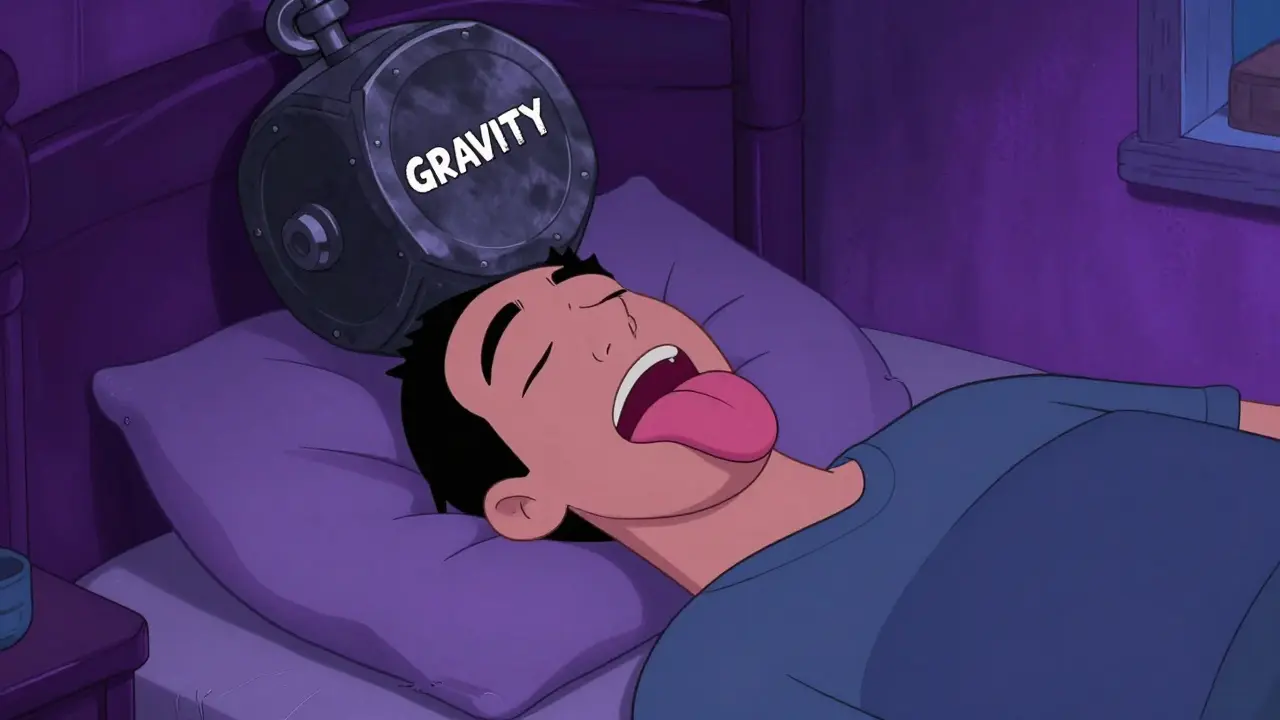
Waking up feeling like you haven't slept a wink, even after eight hours in bed, is a frustrating cycle. For many, the culprit isn't just the disorder itself, but the way they lay their head at night. If you've been told you have obstructive sleep apnea is a common disorder where the upper airway becomes blocked during sleep, leading to repeated stops and starts in breathing, you might have noticed that your snoring gets significantly worse when you're flat on your back. This isn't a coincidence; it's physics. Gravity pulls your tongue and soft tissues backward, narrowing your airway and turning a light snore into a full-blown breathing interruption.
The Gravity Problem: Why Back Sleeping is Risky
When you sleep in the supine position (on your back), your anatomy works against you. Research shows that the base of your tongue shifts backward, which can shrink your upper airway space by as much as 30% to 40%. For someone with a normal airway, this is no big deal. But for those with Positional Obstructive Sleep Apnea (or POSA), this slight shift is the difference between breathing freely and choking. In clinical terms, POSA is diagnosed when your apnea-hypopnea index (AHI)-the number of times you stop breathing per hour-is at least double when you're on your back compared to when you're on your side.
Imagine the difference: one person might have 30 breathing interruptions per hour while supine, but that number drops to fewer than 5 the moment they roll onto their side. That is a massive shift in sleep quality and cardiovascular stress. When you stop breathing, your oxygen levels drop, and your heart rate fluctuates wildly, which is why side sleeping is often touted as the single best position for those struggling with airway collapse.
Positional Therapy: Training Your Body to Stay Sideways
If your sleep apnea is position-dependent, you don't always have to jump straight to a heavy-duty machine. Positional Therapy is a non-invasive treatment designed to prevent patients from sleeping on their backs and promote lateral positioning. The goal is simple: keep you off your back so your airway stays open.
There are a few ways to tackle this, ranging from "old school" DIY tricks to high-tech wearables. The most famous-and most dreaded-is the tennis ball technique. This involves sewing a tennis ball into the back of a pajama shirt. The idea is that when you try to roll onto your back, the ball makes it uncomfortable enough that you subconsciously roll back to your side without fully waking up. While it sounds primitive, it works for some, though nearly half of the people who try it give up within three months because it's just too uncomfortable.
For those who can't stand the "ball in the shirt" method, the Sleep Position Trainer (or SPT) is a modern alternative. These are wearable devices that use sensors to detect when you're on your back and give you a gentle vibration to nudge you over. Because the feedback is subtle, it's much easier to stick with than a physical obstacle in your clothes.
| Method | Mechanism | Estimated Cost | Compliance Rate | Comfort Level |
|---|---|---|---|---|
| Tennis Ball Technique | Physical Discomfort | $5 - $10 | Moderate to Low | Low |
| Sleep Position Trainer (SPT) | Vibrational Feedback | $300 - $500 | High | Moderate to High |
| Specialized Pillows | Structural Support | $20 - $50 | Variable | High |
Comparing Positional Therapy to CPAP
You've probably heard of CPAP (Continuous Positive Airway Pressure). It's the gold standard for a reason: it uses a machine to pump air into your throat, physically holding the airway open regardless of your position. If you're looking for the absolute lowest AHI, CPAP is the winner.
However, there's a huge catch: people hate wearing them. Masks can leak, the air can feel too strong, and many find the whole setup claustrophobic. This is where positional therapy shines. Because it's less invasive, adherence rates are often 35% to 40% higher than with CPAP. A treatment that you actually use every night is infinitely more effective than a "perfect" machine that sits on your nightstand gathering dust. For patients with mild to moderate POSA, shifting to side sleeping can be a viable first-line treatment that avoids the noise and bulk of a machine.
How to Know if This Works for You
You can't just guess if you have positional apnea; you need a professional sleep study, known as Polysomnography. During this study, technicians track your respiratory events based on your sleep stage and your physical position. If they find that your breathing only collapses when you're supine, you're a prime candidate for positional therapy.
If you're trying this at home, a few pro tips can make it easier. Combine side sleeping with a slight head elevation. Using a wedge pillow or adjusting your bed frame to keep your head elevated helps maintain a better neck and spine alignment, which reduces the likelihood of your airway closing. It's also helpful to give yourself a two-week adaptation period. Your brain has spent years associating your back with sleep; it takes a little time to rewire that habit.
Beyond Breathing: Heart Health and Side Sleeping
The benefits of getting off your back go beyond just stopping the snoring. When you experience an apnea event, your heart has to work overtime. The sudden drop in oxygen and the surge of adrenaline as your brain screams "wake up and breathe!" puts a massive strain on your cardiovascular system. There is evidence suggesting that sleeping supine increases the risk of exacerbating heart failure and even acute stroke events in vulnerable people.
By maintaining a lateral position, you're not just improving your sleep quality-you're potentially protecting your heart. While we're still waiting for more long-term clinical trials to prove the exact cardiovascular impact, the logic is sound: less oxygen deprivation equals less stress on the heart.
Will side sleeping completely cure my sleep apnea?
Not necessarily. If you have non-positional OSA, your airway might collapse regardless of how you sleep. Positional therapy is specifically for those whose apnea is significantly worse on their back. If you still stop breathing while on your side, you may need other treatments like an oral appliance or CPAP.
Is the tennis ball method actually effective?
Yes, it can be very effective at reducing the time spent in the supine position. However, it has a high dropout rate because many users find it too uncomfortable or disruptive to their overall sleep quality compared to electronic trainers.
How do I know if I have Positional OSA (POSA)?
The only way to confirm POSA is through a sleep study (polysomnography). A doctor looks for a "positional dependence," meaning your Apnea-Hypopnea Index (AHI) is at least double when you are on your back versus when you are on your side.
Which side is better to sleep on, left or right?
For sleep apnea, either side is generally better than the back. While some people prefer the left side to help with acid reflux (GERD), the primary goal for apnea is simply to avoid the supine position to keep the airway open.
Are there any risks to using a Sleep Position Trainer?
Most devices are safe and non-invasive. The main "risk" is potential sleep fragmentation if the vibration is too strong and wakes you up completely. However, most modern devices are designed to nudge you without fully alerting you from sleep.


Comments
Edwin Perez
April 26, 2026 AT 01:35 AMTypical medical industrial complex pushing these fancy vibration devices. They just want you to spend 500 bucks on a gadget that probably tracks your every move for some database. Just use a pillow and stop falling for the high-tech scam.
Anand Mehra
April 27, 2026 AT 08:21 AMphysics of sleep is simple gravity wins always. people think machines save them but habits do. just roll over
Eric Mwiti
April 28, 2026 AT 15:22 PMRight, because sewing a tennis ball into your shirt is a totally normal way to spend a Sunday afternoon. I'm sure the fashion world is just dying for this trend.
Kristen O'Neal
April 29, 2026 AT 12:10 PMActually, those vibrational trainers are way more sustainable for the long term. I've seen a few people switch back to the ball method and they just end up ripping their clothes or waking up grumpy. It's about finding a balance that doesn't make you hate your bedtime routine.
Hayley Redemption
April 30, 2026 AT 23:08 PMIt's honestly quaint that people still consider the tennis ball method a viable 'technique' in the modern era. The disparity in compliance rates alone should tell you that physical discomfort is a primitive motivator compared to neurological feedback. Only those with an utter lack of resources or an odd fetish for discomfort would actually stick with such a crude method. If you can't afford a proper SPT, perhaps you should focus on your budget before your breathing. It's simply a matter of efficiency and class. Why settle for a DIY nightmare when the science of vibrational nudging is readily available for those who actually value their sleep hygiene? The level of cognitive dissonance required to prefer a ball in a shirt over a calibrated sensor is staggering. I find it amusing that this is even listed as a comparison point in a medical context. One is a clinical tool, the other is essentially a prank. Let's be real about the standards of care here. Precision matters, and a sewing kit is not a precision medical instrument.
Gauri Parab
May 1, 2026 AT 02:59 AMThe whole obsession with side sleeping is just a band-aid for a deeper systemic failure of airway anatomy. Why are we pretending that vibrating your chest is a 'solution' when the underlying issue is often obesity or genetic predisposition? This whole approach is just a way to avoid the hard work of lifestyle changes. I'll be the one to say it: most people just want a magic pill or a vibrating belt so they can keep living poorly. It's an exercise in futility to suggest that 'positional therapy' is a primary fix when it's really just a secondary mitigation strategy. I've seen the data, and the reliance on these gadgets is just another form of consumerist dependency.
William Zhigaylo
May 2, 2026 AT 23:39 PMThe sheer incompetence of suggesting a 'tennis ball' as a medical intervention is absolutely appalling. One must wonder how such a ridiculous suggestion ever made it into a discourse on cardiovascular health. It is an affront to professional medicine and a waste of the reader's time to present such trivialities alongside CPAP therapy. The lack of rigor in this discussion is frankly insulting to anyone who actually understands the gravity of sleep apnea.
Elle Torres Sanz
May 4, 2026 AT 21:06 PMLet's try to keep things helpful and kind, everyone. We all have different budgets and different ways of coping with health issues, and whatever works for the individual is what matters most in the end.