

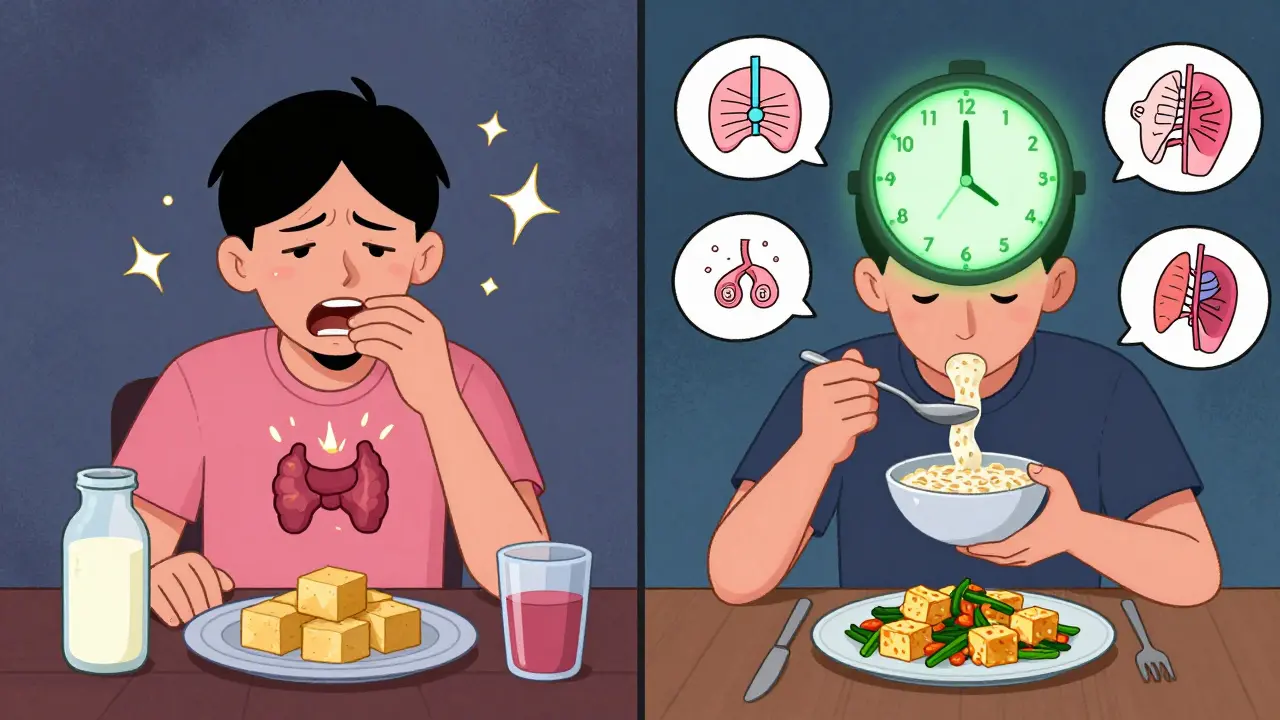
When you take levothyroxine for hypothyroidism, what you eat can make a real difference - especially if you love soy. Tofu, soy milk, edamame, and soy protein powders are popular, healthy foods. But if you take them too close to your thyroid medication, they can seriously cut down how well your body absorbs it. This isn’t a myth. It’s backed by decades of research and real patient outcomes. The good news? You don’t have to give up soy. You just need to know when to eat it.
How Soy Interferes with Thyroid Medication
Soy doesn’t make your thyroid worse. It doesn’t cause hypothyroidism. But it does block your body from absorbing levothyroxine the way it should. The main culprits are isoflavones - compounds like genistein and daidzein - found naturally in soybeans. These bind to the medication in your gut, sticking to the drug molecules like glue. That means less of it gets into your bloodstream, and your thyroid hormone levels drop.
Studies show this interference isn’t minor. When soy is taken at the same time as levothyroxine, absorption can drop by 9% to 30%. One 2006 case report followed a woman who needed her dose bumped from 100 mcg to 200 mcg after drinking soy protein shakes with her pill. Her TSH - the hormone that tells your brain how much thyroid hormone you need - shot up because her body wasn’t getting enough of the drug.
It’s not just supplements. Whole soy foods like tofu and edamame cause the same problem. In fact, they’re often worse than isolated soy isoflavone pills because the whole food has more protein and fiber that help trap the medication. A 2004 study found soy reduced absorption more than fiber supplements like psyllium. Calcium and iron supplements are worse still - they can block up to 36% of absorption. But soy is right up there on the list.
Timing Is Everything
The biggest mistake people make? Eating soy at the same time they take their pill. That’s when interference is strongest. But if you separate them by even a few hours, the problem fades.
Here’s what the latest guidelines say:
- Take levothyroxine on an empty stomach with water - ideally first thing in the morning.
- Wait at least 60 minutes before eating or drinking anything else.
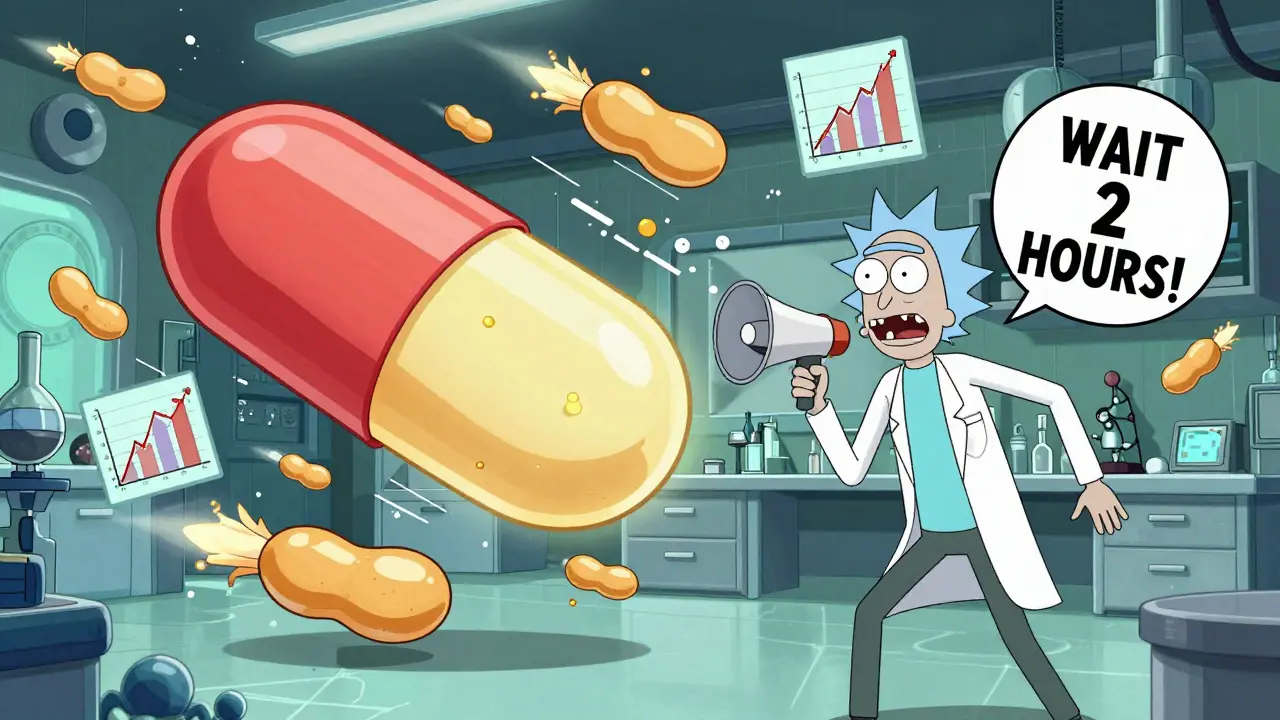
- Wait 2 to 4 hours before consuming soy products.
Mayo Clinic updated its advice in March 2023. For most adults, 2 hours is enough. But for children, infants, or people with unstable thyroid levels, stick to 3-4 hours. Why the difference? Research from Dr. Elena Rodriguez in early 2023 showed that a 2-hour gap reduced absorption interference to less than 0.1 mIU/L in TSH levels - basically no effect. That’s why many endocrinologists now say 2 hours works fine for most people.
Still, if you’ve had trouble before - like your TSH jumped after starting soy milk - go with 3 hours. Better safe than sorry.
What About Bedtime Dosing?
Many patients find it easier to take levothyroxine at night. That’s fine - as long as you follow the same rules. If you eat soy for dinner, wait 2-4 hours before taking your pill. Or, if you take it at night, make sure your last soy-containing meal was at least 2-4 hours earlier.
A 2022 survey of endocrinologists found that 78% recommend either morning dosing with 3-hour soy avoidance or nighttime dosing with no soy in the 2-4 hours before. Both work. The key is consistency. Switching between morning and night can mess with your hormone levels. Pick one and stick with it.
Not All Soy Is the Same
Some forms of soy interfere more than others:
- High risk: Soy milk, tofu, tempeh, edamame, soy-based meat alternatives. These contain full soy protein and isoflavones.
- Moderate risk: Soy sauce, miso, soy oil. These have much lower isoflavone levels. You can usually eat these without timing issues.
- Low risk: Isolated soy isoflavone supplements. Studies show they cause less interference than whole soy foods - but still avoid taking them within 2 hours of your pill.
One 2019 meta-analysis of 3,600 people found soy supplements only raised TSH by 0.35 mIU/L on average - a tiny change. But for someone already struggling to keep their levels stable, even that much can matter.
Real Patient Stories
People report wildly different experiences.
One Reddit user, HypoWarrior42, saw their TSH jump from 1.8 to 5.2 after switching to daily soy milk with breakfast. Their doctor increased their dose from 75 mcg to 100 mcg. Another user, SoyLoverHypo, has taken Synthroid with soy milk for five years with stable TSH at 1.5. Their endocrinologist says timing matters more than avoidance.
That’s the truth: some people are sensitive. Others aren’t. But you won’t know until you test it. If you’ve been eating soy with your pill and your TSH is creeping up, try separating them. Retest in 6-8 weeks. You might be surprised how much it helps.
Who’s at Highest Risk?
You’re more likely to have problems if:
- You’re on a plant-based diet (74% of vegetarians/vegans with hypothyroidism report being counseled on this)
- You’re an infant or child (soy formula can require 15-30% higher levothyroxine doses)
- Your TSH is already above 4.5 mIU/L (subclinical hypothyroidism)
- You’ve been on levothyroxine for more than 3 months (the effect builds over time)
Even if you’re healthy, if you’ve been taking soy daily and your dose hasn’t changed in a year, it’s worth asking your doctor: “Could soy be affecting my absorption?”
What About Other Foods?
Soy isn’t the only food that interferes. Calcium supplements, iron pills, and high-fiber foods like bran or psyllium also block absorption. Coffee can reduce it by 20%. The general rule: take levothyroxine alone with water, wait an hour, then eat. Then wait 2-4 hours before taking calcium, iron, or soy.
Some patients keep a simple chart: morning pill → wait 60 min → breakfast → wait 3 hours → lunch → soy at dinner. It’s not hard. Just plan ahead.
What Should You Do?
Here’s your action plan:
- Take levothyroxine first thing in the morning with a full glass of water.
- Wait at least 60 minutes before eating or drinking anything else.
- Wait 2-4 hours before eating soy products - 3 hours if you’re unsure or have had issues before.
- Don’t take soy supplements unless approved by your doctor.
- Keep a food and TSH log for 2-3 months if you’ve recently changed your soy intake.
- Ask your doctor to check your TSH if you’ve been eating soy regularly and your levels are unstable.
There’s no need to eliminate soy. You just need to move it. Swap that soy milk with breakfast for a glass of water and oatmeal. Save the tofu stir-fry for dinner. It’s a small change that makes a big difference.
What’s Changing in 2026?
Research is getting more precise. A clinical trial at Cleveland Clinic, launched in June 2023, is testing whether genetic differences affect how people absorb levothyroxine around soy. They’re building a personalized timing algorithm - someday, your doctor might tell you, “Because of your genes, you only need a 90-minute gap.”
For now, stick with the 2-4 hour rule. It’s simple, safe, and backed by science.
Can I take levothyroxine at night instead of in the morning to avoid soy interference?
Yes, taking levothyroxine at night is a common and effective alternative - as long as you wait at least 2-4 hours after your last soy-containing meal. Many patients find nighttime dosing easier because it avoids morning rush and soy-heavy breakfasts. The key is consistency: don’t switch back and forth. Pick one time and stick with it.
Does all soy interfere with thyroid medication the same way?
No. Whole soy foods like tofu, soy milk, and edamame have the strongest effect because they contain full soy protein and isoflavones. Soy sauce, miso, and soy oil have much lower levels and rarely cause issues. Isolated soy isoflavone supplements interfere less than whole foods but still require a 2-hour gap. Stick to whole foods and avoid soy protein powders unless approved by your doctor.
I’ve been eating soy with my pill for years. Should I be worried?
Not necessarily - but you should check. Some people metabolize soy differently and never have issues. Others see their TSH climb over time. If your thyroid levels have been stable for years, you’re probably fine. But if your dose has been unchanged while your soy intake increased, ask your doctor to test your TSH. A simple blood test can tell you if soy is affecting you.
Can I take soy protein shakes if I take my medication 4 hours apart?
Yes. A 4-hour gap between levothyroxine and soy protein shakes is more than enough to prevent interference. This is the safest approach if you rely on protein supplements. Many patients on plant-based diets use this strategy: take pill in the morning, wait 4 hours, then have their shake. It works reliably.
Is there a difference between generic levothyroxine and brand-name Synthroid when it comes to soy interference?
No. Soy interferes with the active ingredient - levothyroxine - regardless of the brand. Whether it’s Synthroid, Levoxyl, or a generic, the chemical is the same. The problem isn’t the pill, it’s the soy. But stick to one brand if possible. Switching between formulations can cause small changes in absorption that make it harder to track whether soy is the issue.
If you’re managing hypothyroidism and love soy, you don’t have to choose. With smart timing, you can enjoy your tofu stir-fry and still keep your thyroid levels where they need to be. The science is clear. The solution is simple. Just wait a few hours.


Comments
tatiana verdesoto
March 1, 2026 AT 22:50 PMJust wanted to say this post saved my thyroid game. I was eating soy milk with my pill for years and never knew why my TSH kept creeping up. Switched to taking it at night and waiting 4 hours after dinner - my levels are stable now. No more guesswork. Thank you for the clarity.
Justin Rodriguez
March 2, 2026 AT 12:50 PMFor anyone worried about soy and meds - the key isn’t avoidance, it’s separation. Studies show even 2 hours is enough for most adults. I’ve been doing this for 7 years: pill at 7 AM, soy smoothie at 10 AM. TSH stable. No drama. Your body isn’t broken. You just need rhythm.
Shivam Pawa
March 4, 2026 AT 12:26 PMAs someone from India where soy is everywhere - tofu, soymilk, even some atta - this is gold. I used to think it was my diet or stress. Turns out it was timing. Now I take meds before breakfast and have soy at lunch. Simple. No side effects. No panic.
Siri Elena
March 5, 2026 AT 08:32 AMOh wow. So we’re now treating thyroid patients like they’re lab rats with a soy schedule? Next you’ll tell me to wear gloves when I touch my phone before my pill. At least the FDA doesn’t have a ‘Soy Advisory Panel’ yet. But give it time.
Divya Mallick
March 5, 2026 AT 19:46 PMThis is why Western medicine is so obsessed with control. In India, we eat soy with everything - and our thyroid rates are lower than yours. You’re overmedicalizing food. Your body knows what to do. Stop micromanaging your breakfast. Just breathe.
Callum Duffy
March 5, 2026 AT 20:45 PMThank you for the thorough and evidence-based summary. The 2-4 hour separation window is consistently supported across multiple clinical trials, and the distinction between whole soy and processed derivatives is particularly valuable. I’ve shared this with several patients who were previously confused by conflicting online advice. Clarity is rare - this is exemplary.
Jeff Card
March 6, 2026 AT 01:06 AMMy TSH jumped from 2.1 to 6.3 after I started drinking soy milk every morning. I thought I was being healthy. Turns out I was sabotaging my meds. Took the advice - waited 3 hours - retested. Back to 2.0. It’s not about giving up soy. It’s about timing. Just… time it right.
Matt Alexander
March 6, 2026 AT 09:53 AMTake pill. Wait an hour. Eat breakfast. Wait 3 hours. Then eat soy. That’s it. No need to overthink. Your body doesn’t care if it’s organic or non-GMO. It cares about spacing. Do the spacing. You’ll be fine.
Mike Dubes
March 8, 2026 AT 09:22 AMbro i took my pill at 7am and had soy tofu at 11am for 2 years and never had an issue. my doc said im one of those lucky ones. dont stress if your levels are good. if it aint broke dont fix it. but if ur tsh is up? try waiting. its easy. no biggie.
Gretchen Rivas
March 8, 2026 AT 19:44 PMFor those of us on plant-based diets - this isn’t a restriction. It’s a reordering. Swap soy for breakfast with avocado toast. Save the stir-fry for dinner. You don’t lose anything. You gain control. And that’s worth a few extra minutes of planning.
Helen Brown
March 10, 2026 AT 02:04 AMAre you sure this isn’t a Big Pharma tactic to sell more blood tests? What if soy is actually helping your body detox the synthetic hormone? What if the real issue is the pill itself? I’ve heard of people going off levothyroxine and feeling better. Maybe we should question the whole system.