
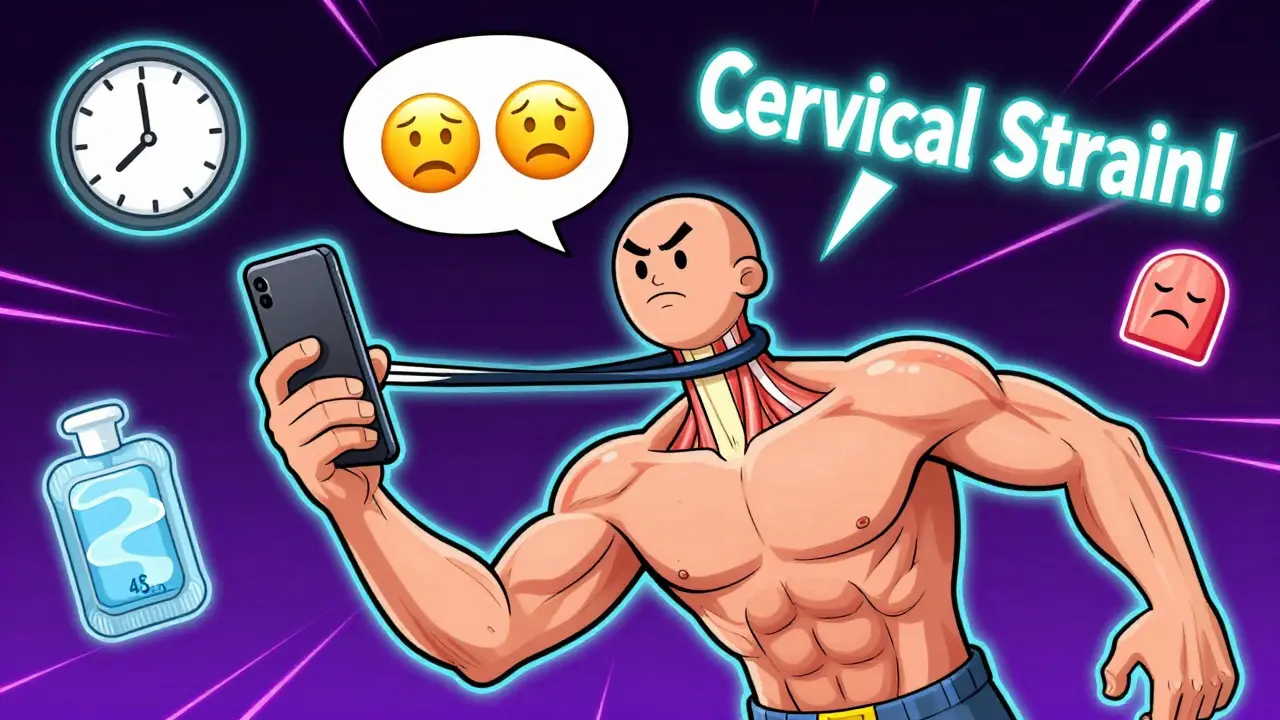
Neck pain is one of the most common reasons people visit a doctor. But not all neck pain is the same. When you hear "neck pain," many think of a stiff neck after sleeping wrong. But the real culprit behind most cases-about 65% of all neck pain visits-is something called cervical strain. This isn’t just a minor ache. It’s a tear or overstretching of the muscles, tendons, or ligaments in your neck. And if you ignore it, it can turn into a chronic problem that lasts for months.
What Exactly Is Cervical Strain?
Cervical strain happens when the soft tissues in your neck get pushed beyond their limits. Think of it like pulling a rubber band too far. It snaps back, but not without damage. This commonly occurs from sudden movements-like a car crash (whiplash), lifting something heavy the wrong way, or even holding your phone too long with your head tilted forward. The most affected muscles? The trapezius (back of your neck and shoulders), levator scapulae (between shoulder blade and neck), and sternocleidomastoid (running from behind your ear to your collarbone).Symptoms are hard to miss. Over 90% of people with cervical strain feel sharp or dull pain right in the neck. Around 87% report stiffness-like your neck is locked. About 78% can’t touch their chin to their chest without discomfort. And nearly three-quarters can’t turn their head fully without pain. The pain usually gets worse when you move your neck, especially when looking up or twisting. It rarely radiates down your arm-that’s a sign of a pinched nerve, not a strain.
How Is It Different From Other Neck Problems?
It’s easy to confuse cervical strain with other neck issues. But the differences matter.Cervical radiculopathy (pinched nerve) causes pain, numbness, or tingling that shoots down your arm, sometimes into your fingers. You might even feel weakness in your hand. That’s not cervical strain. Strain stays in the neck and upper shoulders.
Cervical stenosis is a narrowing of the spinal canal. It mostly affects people over 40 and can cause balance issues, leg weakness, or even trouble controlling your bladder. Strain doesn’t do that.
Osteoarthritis in the neck is gradual. You’ll notice a grinding feeling when you move your head, and the pain builds over months or years. Cervical strain hits fast-often after a single event.
Rheumatoid arthritis causes morning stiffness that lasts over 30 minutes and affects both sides of the neck symmetrically. Strain pain is usually one-sided and improves with rest.
Here’s the key: if your pain gets worse with movement and better with rest, it’s likely a strain. If it’s constant, burning, or radiating, see a doctor. You might have something else.
How Long Does It Take to Heal?
Recovery time depends on how bad the strain is.- Mild strain: Tiny tears in muscle fibers. Pain fades in 48 to 72 hours.
- Moderate strain: Partial tearing. Lasts 1 to 2 weeks. You’ll feel stiff and sore with most movements.
- Severe strain: Complete tear of muscle or tendon. Takes 6 to 12 weeks to heal. May need imaging like an MRI.
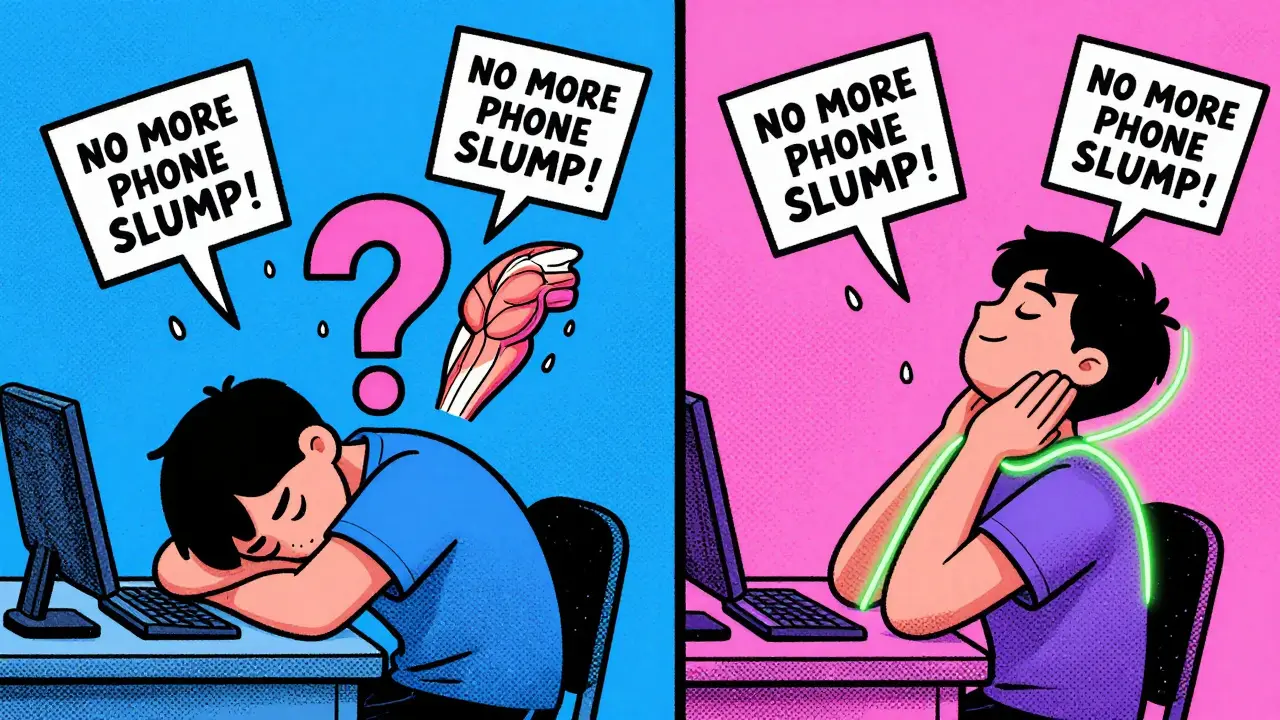
Most people (85%) recover fully within 4 weeks with the right care. But if you keep slouching at your desk, cradling your phone, or sleeping with your neck twisted? You’re setting yourself up for chronic pain. Studies show that people with forward head posture (common in office workers) are 22% more likely to turn an acute strain into a long-term issue.
What Actually Works for Treatment?
Forget bed rest. That’s outdated advice. The latest guidelines from the American College of Physicians and Mayo Clinic say: move, but wisely.Days 1-3: Protect and Reduce Swelling
Use ice for 15-20 minutes every 2-3 hours. Don’t wrap ice directly on skin-use a towel. Ice cuts inflammation and numbs pain better than heat in the first few days. Avoid heavy lifting, long drives, or anything that strains your neck. Over-the-counter painkillers like acetaminophen are fine. NSAIDs (like ibuprofen) don’t help much after day 7 and can irritate your stomach.
Days 4-14: Start Gentle Movement
This is where most people fail. They stay too still. But staying still for more than 72 hours makes recovery 37% slower. Begin with simple exercises:
- Chin tucks: Sit or stand tall. Gently pull your chin straight back, like you’re making a double chin. Hold for 3 seconds. Repeat 10 times, 3 times a day.
- Scapular retractions: Squeeze your shoulder blades together like you’re trying to hold a pencil between them. Hold 5 seconds. Do 10 reps, 3 times daily.
These moves help realign your neck and reduce tension. Studies show people who do this daily improve their neck rotation by nearly 19 degrees in just two weeks.
Weeks 3-6: Build Strength
Now it’s time to get stronger. Use a resistance band (TheraBand®) for light exercises:
- Resistance band rows (pull band toward your ribs)
- Isometric neck presses (press hand against forehead while resisting with neck muscles)
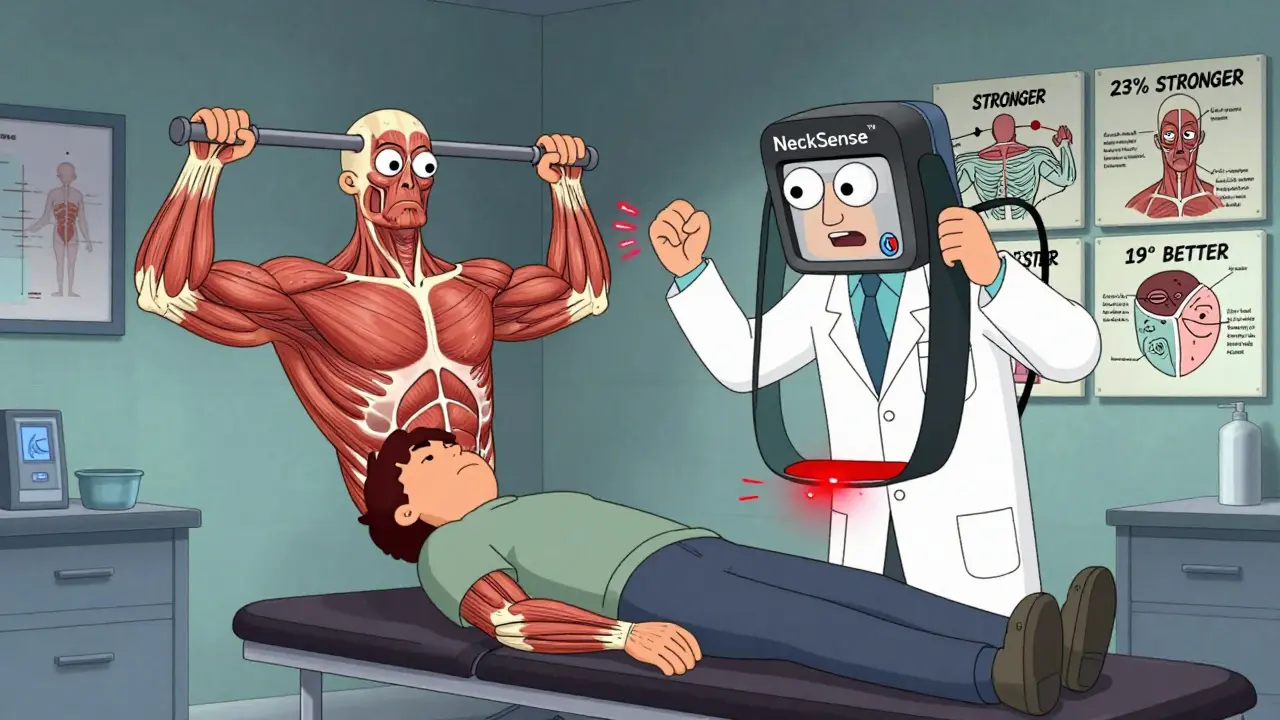
Do 2 sets of 15 reps, 3 times a week. This isn’t about lifting heavy. It’s about training your neck muscles to handle daily stress again. People who do this gain 23% more strength than those who just do bodyweight moves.
What About Physical Therapy, Chiropractic, or Massage?
Physical therapy gets the highest patient ratings-4.3 out of 5 stars. Why? Because it’s not just about hands-on work. A good physical therapist teaches you how to move correctly, corrects posture, and gives you a home plan. One Reddit user shared how focusing on lower trapezius and serratus anterior exercises fixed their forward head posture, eliminating daily headaches.Chiropractic care gets 3.9 stars. Many people feel instant relief after an adjustment. But 32% say the relief is temporary and they need to keep going back. It helps, but it’s not a fix unless you change how you sit or sleep.
Massage can relax tight muscles, but if your posture hasn’t changed, the pain will come back. It’s a band-aid, not a cure.
What Should You Avoid?
- Staying inactive: Rest for 2-3 days max. After that, movement is medicine.
- Using painkillers too long: NSAIDs beyond 7-10 days offer no extra benefit and raise your risk of stomach problems.
- Slouching: Forward head posture is the #1 hidden cause of recurring strain. If your head sticks out past your shoulders, you’re asking for trouble.
- Waiting too long: People who delay seeing a specialist take an average of 8 weeks to get diagnosed. By then, the strain has turned into myofascial pain syndrome-harder and longer to treat.
New Tools and Tech Helping Recovery
In January 2023, the FDA approved a wearable device called NeckSense™. It uses sensors to monitor your neck posture and buzzes when you slouch. In tests, it was 92.7% accurate compared to X-rays. It’s not a cure, but for office workers or drivers, it’s a game-changer.Researchers are also testing whether combining manual therapy (like massage or joint mobilization) with sensorimotor training (balance and coordination drills) can cut recurrence rates in half. Early results show it drops the chance of the pain coming back from 39% to just 18% after a year.
Why This Matters Beyond Pain
Neck pain costs the U.S. healthcare system $8.9 billion every year. Most of that comes from cases that turn chronic. But the real cost? Lost productivity, missed work, and reduced quality of life. Office workers are 2.3 times more likely to get cervical strain than manual laborers-not because they lift heavy things, but because they sit still for hours.Employers are catching on. Over 90% of workplace wellness programs now include neck and posture education. It’s not just about comfort-it’s about keeping people working.
What If It Doesn’t Get Better?
If after 6 weeks you’re still in pain, it’s time for a deeper look. Your doctor may order imaging (X-ray, MRI) to rule out other causes. You might also be screened for pain catastrophizing-a mindset where pain feels overwhelming and out of control. People with high scores on this scale are 3.2 times more likely to develop chronic pain. Cognitive-behavioral techniques can help reframe how you think about pain, and they’re now part of official treatment guidelines.Bottom Line: You Can Fix This
Cervical strain is common, treatable, and usually goes away fast-if you do the right things. Don’t wait. Don’t just pop pills. Start moving. Fix your posture. Do the exercises. Get help early. Most people recover fully in 2-4 weeks. The ones who don’t? They waited too long.How long does cervical strain usually last?
Most mild to moderate cervical strains resolve within 1 to 4 weeks. Mild cases improve in 2-3 days with rest and ice. Moderate strains take 1-2 weeks, especially with gentle movement and exercises. Severe strains with full muscle tears may take 6-12 weeks. Recovery time depends heavily on whether you follow a structured plan-delaying movement or ignoring posture can turn a short injury into a long-term problem.
Is heat or ice better for neck strain?
Use ice for the first 48-72 hours to reduce swelling and numb pain. Apply for 15-20 minutes every 2-3 hours. After that, switch to heat to relax tight muscles. Heat improves blood flow and helps with stiffness, but using it too early can increase swelling. Never apply ice or heat directly to skin-always use a cloth barrier.
Should I see a chiropractor for neck strain?
Chiropractic adjustments can provide short-term relief for some people, especially if joint stiffness is part of the problem. But it’s not a standalone solution. If you don’t also correct your posture, strengthen your neck muscles, and change habits like phone use or desk setup, the pain will likely return. Physical therapy is more effective long-term because it teaches you how to prevent recurrence.
Can neck strain cause headaches?
Yes, especially tension headaches that start at the base of the skull and spread to the forehead. This happens because the upper neck muscles (like the trapezius and levator scapulae) connect to the scalp and head. When these muscles are tight or injured, they pull on nerves that trigger headaches. Correcting neck posture and doing chin tucks often eliminate these headaches within a few weeks.
When should I worry about neck pain?
See a doctor if your pain lasts more than 6 weeks, radiates down your arm, causes numbness or weakness in your hands, or is accompanied by dizziness, trouble walking, or loss of bladder control. These aren’t signs of simple strain-they may point to nerve compression, spinal stenosis, or other serious conditions. Also seek help if pain wakes you up at night or doesn’t improve with rest and basic exercises.




Comments
trudale hampton
March 19, 2026 AT 17:01 PMHonestly, this post saved me. I was ignoring my neck pain for weeks thinking it was just stress. Started doing chin tucks and scapular retractions like they said, and within 10 days I could turn my head without wincing. No more ice packs, no more pills. Just movement.
Also, that NeckSense™ device? I got one. It buzzes when I slouch at my desk. Sounds dumb, but it works. My posture’s actually improving. Weird, right?
Shaun Wakashige
March 20, 2026 AT 08:53 AMlol i just took ibuprofen and called it a day 😴
Paul Cuccurullo
March 22, 2026 AT 06:44 AMThe science here is profoundly aligned with modern rehabilitative principles. Movement as medicine is not merely a trend-it is a paradigm shift in musculoskeletal care. To remain passive is to invite chronicity. The data presented-particularly the 37% slower recovery with prolonged inactivity-is not anecdotal; it is empirically validated. We must move beyond the myth of bed rest.
Moreover, the integration of sensorimotor training with manual therapy represents a frontier in preventive neurology. This is not just treatment. It is neuroplastic re-education.
Solomon Kindie
March 23, 2026 AT 14:18 PMpeople dont even know what strain means anymore like its not a tear its just tight muscles and you stretch it and done
why are we overcomplicating this with bands and sensors and all this tech nonsense
my grandpa fixed his neck by sleeping on the floor and never saw a doctor
Natali Shevchenko
March 23, 2026 AT 14:33 PMI’ve been living with this for three years now. At first I thought it was just from hunching over my laptop, but then I realized it was the way I held my phone-chin tucked forward for hours, staring at screens. The moment I started doing chin tucks and became aware of my posture, things changed. Not overnight, but slowly. Like my body was relearning how to exist in space.
It’s funny how something so small-a tilt of the head-can unravel an entire nervous system. We’re not just broken muscles. We’re wired. And when we misalign, the whole system sings off-key. I didn’t fix my neck. I re-tuned it.
Johny Prayogi
March 23, 2026 AT 23:49 PMYES YES YES this is everything 😍 I started doing the resistance band rows last week and my shoulders don’t feel like they’re glued to my ears anymore. Also, I threw out my pillow and got one that actually supports my neck. Game. Changer.
Stop waiting for it to go away. Move. Now. You’ll thank yourself in 2 weeks.
Nicole James
March 25, 2026 AT 21:25 PMThey never tell you the real reason neck pain is so common… it’s because the government and big pharma want you dependent on painkillers and chiropractors.
They don’t want you to know that posture correction and simple exercises can eliminate it permanently. That’s why they push expensive devices like NeckSense™-to keep you paying monthly.
Wake up. Your neck pain is a distraction. The real issue? Surveillance capitalism. Your slouch is being tracked. Your data is being sold.
Stop using phones. Stop sitting. Go outside. Breathe. Your body knows how to heal. They just don’t want you to remember.
Nishan Basnet
March 27, 2026 AT 03:01 AMAs someone from India where desk jobs are exploding and neck pain is becoming epidemic, I can confirm every word here.
I used to sit with my laptop on my lap, neck bent at 45 degrees. After 6 months, I couldn’t look up without pain. Started chin tucks, did them religiously for 10 minutes a day. Within 3 weeks, the stiffness vanished. No meds. No visits. Just awareness.
It’s not about strength. It’s about alignment. And yes, the NeckSense™ device? I’d buy ten if it meant saving one person from chronic pain. This isn’t tech-it’s prevention.
Allison Priole
March 28, 2026 AT 23:19 PMI didn’t believe the exercises at first. I thought, ‘it’s just neck pain, how hard can it be?’ But then I started doing the scapular retractions every morning before coffee. And guess what? My headaches disappeared. Like, completely.
I used to think my tension headaches were from stress or caffeine, but nope-it was my neck. I didn’t even know my shoulders were hunched up to my ears.
Also, I started sleeping on my back with a tiny rolled towel under my neck. Changed everything. I feel like a new person. Not cured. Reborn.
Casey Tenney
March 30, 2026 AT 09:50 AMIf you’re still using heat in the first 72 hours, you’re doing it wrong.
Ice first. Always.
Stop listening to influencers. This isn’t a spa day. It’s tissue repair.
Sandy Wells
March 31, 2026 AT 08:56 AMPhysical therapy is overrated. I went twice and they just massaged me. Didn’t fix anything.
Real solution? Stop slouching. That’s it. No devices. No bands. Just sit up.
People need to take responsibility. Not blame their chairs. Not blame their jobs. Blame their own spine.
Bryan Woody
March 31, 2026 AT 20:43 PMOh wow. Another post telling us to ‘move wisely.’ Thanks for the life advice, doctor.
Let me guess-next you’ll tell us to drink water and stop staring at screens?
Here’s the truth: most people don’t have time for chin tucks. They have kids, jobs, and rent. You want them to ‘rebuild their posture’? Cool. Do it while you’re on your third coffee and your boss is yelling about the quarterly report.
Real solution? Ergonomic chairs. Standing desks. And employers who care enough to pay for it. Not ‘do 10 reps a day’ while you’re drowning in debt.
It’s not a medical problem. It’s a capitalist one.
Chris Dwyer
April 2, 2026 AT 00:34 AMI was skeptical. Then I tried the resistance band rows. I did them while watching Netflix. Two weeks later, I could lift my arms over my head without groaning.
It’s not about being fit. It’s about being functional.
Don’t wait until you can’t tie your shoes. Start today. 5 minutes. That’s all. Just 5 minutes. You’ve got this.
matthew runcie
April 2, 2026 AT 02:24 AMSolid info. I’ve been doing the chin tucks for a month now. Noticed my shoulders don’t ache as much during Zoom calls. Small wins.
shannon kozee
April 2, 2026 AT 15:44 PMThe part about pain catastrophizing was eye-opening. I didn’t realize I was catastrophizing. I thought I was just in pain. Turns out, I was also terrified of being in pain. Therapy helped. So did the exercises.
trudale hampton
April 3, 2026 AT 07:45 AMI saw your comment about the NeckSense™ and got one too. It’s weird at first-buzzing like a mosquito when you slouch-but now I don’t even notice it. It’s just… there. Like a quiet reminder.
Also, I started sleeping with a rolled towel under my neck like Allison said. Best sleep I’ve had in years.