

When you pick up a generic version of a prescription medication, you trust it will work exactly like the brand-name original. But how do regulators prove that? They don’t run massive clinical trials for every single generic pill. Instead, they rely on two specific numbers derived from blood tests: Cmax and AUC. These metrics tell us everything we need to know about how your body absorbs and processes a drug.
If these two values match between the generic and the reference product within a strict statistical range, the drugs are considered bioequivalent. This means they deliver the same therapeutic effect with the same safety profile. Understanding what Cmax and AUC actually measure helps clarify why this system works so well for most medications, and where its limits lie.
The Core Metrics: What Are Cmax and AUC?
To determine if two drug products behave the same way in the body, scientists look at the concentration of the drug in the bloodstream over time. This creates a curve. Two points on that curve matter most.
Cmax is the maximum plasma drug concentration reached after taking a dose. It tells us how high the drug levels get. If a drug has a narrow therapeutic index-meaning the difference between a helpful dose and a toxic one is small-Cmax is critical. For example, if a painkiller peaks too high, it might cause dizziness or nausea. If an antibiotic peaks too low, it might not kill the bacteria effectively. Cmax is measured in units like milligrams per liter (mg/L).
AUC is the area under the plasma drug concentration-time curve. Think of it as the total amount of drug exposure your body receives over time. It represents the extent of absorption. If you take a pill but your stomach doesn't break it down properly, your AUC will be low because less drug entered your system. AUC is typically expressed in mg·h/L (milligram-hours per liter). It answers the question: "Did I get enough of the drug overall?"
Together, Cmax and AUC cover both the rate and the extent of absorption. The FDA’s 2013 guidance on bioequivalence studies explicitly states that these pharmacokinetic measurements must reflect systemic exposure to ensure therapeutic equivalence. Without both, you’d have an incomplete picture. You could have a drug that delivers the right total amount (good AUC) but dumps it all into your system at once (bad Cmax), causing side effects.
The 80-125% Rule: How Regulators Decide Equivalence
You might wonder why two drugs aren’t required to be identical in their blood levels. Human bodies vary. Even if you take the same brand-name drug twice, your Cmax might differ slightly due to food, metabolism, or hydration. Because of this natural variability, regulators allow a margin of error.
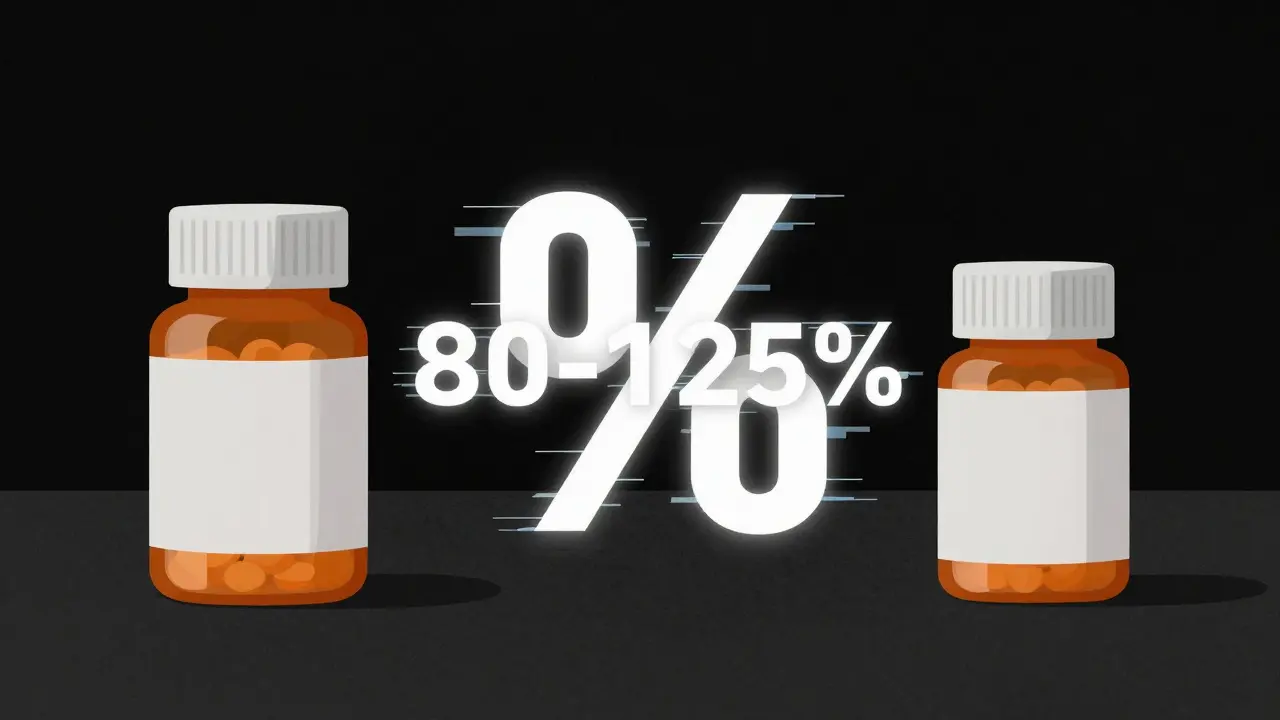
The globally accepted standard requires that the 90% confidence interval for the ratio of geometric means (generic vs. reference) for both AUC and Cmax falls within 80% to 125%. This means the generic can deliver anywhere from 20% less to 25% more exposure than the brand name, statistically speaking, and still be considered equivalent.
This specific range isn’t arbitrary. It stems from statistical principles established in the early 1990s. On a logarithmic scale-which is necessary because drug concentrations follow a log-normal distribution-the bounds of 0.8 and 1.25 are symmetrical. ln(0.8) equals -0.2231, and ln(1.25) equals +0.2231. This symmetry ensures that the acceptable deviation is proportional rather than absolute. The assumption here is that a difference of less than 20% in systemic exposure is not clinically significant for most drugs.
| Drug Type | Acceptable Ratio Range |
|---|---|
| Standard Drugs (e.g., Ibuprofen) | 80% - 125% |
| Narrow Therapeutic Index (NTI) Drugs (e.g., Warfarin) | 90% - 111% |
However, exceptions exist. For drugs with a narrow therapeutic index, such as warfarin or levothyroxine, small changes in exposure can lead to serious health issues. Regulatory agencies like the EMA recommend tighter limits of 90%-111% for these specific cases. This stricter criterion reflects the higher risk associated with minor deviations in drug levels.
How Bioequivalence Studies Are Conducted
Getting those Cmax and AUC numbers requires rigorous testing. Most bioequivalence studies use a crossover design. Typically, 24 to 36 healthy volunteers participate. Each person takes the reference drug during one period and the test drug during another, with a washout period in between to ensure the first drug clears their system completely.
Blood samples are collected at frequent intervals-often 12 to 18 time points-over several hours or days. The timing is crucial. If you miss the peak absorption phase, you’ll underestimate Cmax. Industry data suggests that inadequate sampling during the first 1-2 hours is the leading cause of unreliable Cmax estimates, accounting for about 15% of study failures.
Modern labs use highly sensitive techniques like LC-MS/MS (Liquid Chromatography-Mass Spectrometry) to detect drug concentrations. These methods can measure levels as low as 0.1 to 1 ng/mL, ensuring precision even for potent drugs given in microgram doses. Once the data is collected, statisticians apply logarithmic transformations to the AUC and Cmax values before calculating ratios. This step is mandatory because raw pharmacokinetic data is skewed; transforming it normalizes the distribution, making the statistical comparison valid.

Challenges and Controversies in the System
While the 80-125% rule works for the vast majority of medications, it faces criticism in specific scenarios. One major issue is high intra-subject variability. Some drugs show huge fluctuations in absorption from day to day in the same person. If a drug varies by more than 30% naturally, the standard bioequivalence limits might reject a generic that is clinically just as effective as the brand name simply because the statistical noise is too high.
To address this, regulators have introduced scaled average bioequivalence. This approach widens the acceptance limits proportionally to the variability of the reference drug. However, this remains controversial among some regulatory scientists who worry it could allow inferior generics onto the market.
Another challenge involves complex formulations. Modified-release tablets, which release drug slowly over 24 hours, don’t always fit neatly into standard Cmax and AUC analysis. A single peak might not capture multiple release windows. The FDA’s 2023 draft guidance proposes using partial AUC analysis for these complex products to better assess performance at different stages of absorption.
Why This Matters for Patients
You might ask: does any of this affect me when I fill my prescription? Yes, indirectly. The bioequivalence framework allows generic manufacturers to skip expensive clinical endpoint studies. Clinical trials cost hundreds of millions of dollars and take years. Bioequivalence studies cost a fraction of that and take months. This efficiency drives down prices, making healthcare accessible to millions.
A 2019 meta-analysis in JAMA Internal Medicine reviewed 42 studies comparing generic and innovator products. It found no clinically meaningful differences in efficacy or safety for drugs that met standard bioequivalence criteria. This evidence supports the reliability of the current system. When you see a generic approved by the FDA or EMA, you can trust that its Cmax and AUC profiles are statistically indistinguishable from the brand name in a way that matters for treatment outcomes.
That said, individual responses can vary. If you feel a generic isn’t working as well as the brand, it’s worth discussing with your doctor. Sometimes, inactive ingredients (excipients) in the generic can cause allergies or digestive issues, even if the active ingredient’s pharmacokinetics are perfect. But purely from a drug absorption standpoint, the science holds up.
What is the difference between Cmax and AUC?
Cmax measures the highest concentration of drug in your blood (peak level), indicating how fast the drug is absorbed. AUC measures the total amount of drug exposure over time, indicating how much of the drug was absorbed overall. Both are needed to ensure a generic drug behaves like the brand name.
Why is the bioequivalence range 80-125%?
The 80-125% range accounts for natural human variability in drug absorption. Statistically, it represents a symmetrical ±20% deviation on a logarithmic scale. Regulators assume that differences within this window do not significantly impact therapeutic effectiveness or safety for most drugs.
Are generic drugs really as effective as brand names?
Yes, for the vast majority of medications. Extensive research, including large meta-analyses, shows no clinically meaningful differences in efficacy or safety between generics and brand names that meet bioequivalence standards. The active ingredient performs identically in terms of absorption and exposure.
What happens if a drug fails bioequivalence testing?
If a generic drug fails to meet the 80-125% criteria for Cmax or AUC, it cannot be approved. Manufacturers must reformulate the product-changing binders, coatings, or manufacturing processes-to improve absorption consistency before resubmitting for review.
Do all drugs use the same bioequivalence limits?
No. While most drugs use the 80-125% standard, narrow therapeutic index (NTI) drugs like warfarin require tighter limits (90-111%). Highly variable drugs may also qualify for scaled bioequivalence approaches, which adjust the limits based on the reference drug's variability.