

Azithromycin Liver Injury Risk Calculator
Personal Risk Factors
Risk Assessment
When you’re prescribed azithromycin - whether for a sinus infection, bronchitis, or chlamydia - you’re likely told it’s safe, well-tolerated, and easy to take. Just one pill a day for five days. No need to worry about food, no frequent dosing, and minimal side effects. But behind that reputation for safety lies a hidden risk: azithromycin can cause serious liver injury, even in people who seem perfectly healthy.
It’s not rare. According to the National Institute of Diabetes and Digestive and Kidney Diseases, azithromycin is now one of the top ten causes of drug-induced liver injury (DILI) in the U.S., not because it’s extremely toxic, but because it’s used so often. Over 23 million prescriptions were filled in 2022 alone. For most people, it’s harmless. But for a small percentage, it triggers a silent, sometimes irreversible, attack on the liver.
How Azithromycin Damages the Liver
Azithromycin doesn’t work like a blunt instrument. It doesn’t poison the liver directly in most cases. Instead, it triggers an idiosyncratic reaction - meaning it affects only certain people, for reasons we still don’t fully understand. The injury typically shows up 1 to 3 weeks after starting the drug, and in nearly 9 out of 10 cases, symptoms don’t appear until after you’ve finished the course.
The most common pattern is cholestatic liver injury. That means bile flow from the liver gets blocked. You’ll see high levels of alkaline phosphatase (ALP) and gamma-glutamyl transferase (GGT), along with rising bilirubin. This leads to jaundice - yellow skin and eyes - along with intense itching, dark urine, and fatigue. In about 1 in 5 cases, the injury is hepatocellular: liver cells themselves are damaged, with ALT levels spiking above five times the upper limit of normal.
One study tracking 18 patients found that 78% had cholestatic patterns. Another, more recent study of 120 cases showed that 63% of patients had bile duct loss on liver biopsy. In extreme cases, this progresses to vanishing bile duct syndrome - a condition where the tiny tubes that carry bile out of the liver disappear. That’s not reversible. It can lead to liver failure.
Who’s at Risk?
Not everyone is equally vulnerable. The risk isn’t random. Certain groups are far more likely to suffer liver injury from azithromycin:
- People over 65 - they make up nearly 40% of severe cases, according to FDA data.
- Those with pre-existing liver disease - even mild fatty liver or past hepatitis increases vulnerability.
- Patients on long-term therapy - while a 5-day course carries low risk, courses longer than 7 days raise the chance of liver enzyme elevation to 5-7%.
- People taking other liver-metabolized drugs - combining azithromycin with statins, antifungals, or even some supplements can amplify the risk.
There’s also a troubling pattern: many cases are missed. A 2023 Medscape poll found that 78% of primary care doctors rarely consider liver damage when prescribing azithromycin, even though they know it’s possible. Patients often go to their doctor with jaundice and fatigue - and are told they have viral hepatitis. It takes weeks to realize the real culprit is the antibiotic they took three weeks ago.
How Bad Can It Get?
Most cases resolve on their own. Once azithromycin is stopped, liver enzymes usually return to normal within 4 to 8 weeks. But not always.
Approximately 0.7% of patients develop chronic liver injury. In rare cases - about 1 in every 65,000 prescriptions - the damage is so severe that a liver transplant is needed. One documented case involved a 62-year-old man who took azithromycin for pneumonia. He finished the course. Two weeks later, he turned yellow. By week six, his bilirubin hit 28.7 mg/dL (normal is under 1.2). His liver failed. He received a transplant.
The FDA’s Adverse Event Reporting System has documented over 1,200 cases of azithromycin-related liver injury since 2010. Of those, 21% required hospitalization. 8% led to acute liver failure. And 12 patients - yes, 12 - needed transplants.

How It Compares to Other Antibiotics
Not all antibiotics are equal when it comes to liver risk. Here’s how azithromycin stacks up:
| Antibiotic | Typical DILI Incidence | Pattern of Injury | Recovery Time | Transplant Risk |
|---|---|---|---|---|
| Azithromycin | 1 in 2,500-65,000 prescriptions | Cholestatic (78%) or mixed | 4-8 weeks (most) | 0.7% |
| Erythromycin | 1 in 1,000 prescriptions | Cholestatic | 6-10 weeks | 1.2% |
| Clarithromycin | 1 in 10,000 prescriptions | Cholestatic | 5-9 weeks | 0.4% |
| Isoniazid | 1 in 10-20 users | Hepatocellular | 3-6 months | 2.5% |
| Doxycycline | 1 in 100,000+ prescriptions | Minimal to none | N/A | Negligible |
| Tedizolid | No significant risk in trials | None observed | N/A | None |
Azithromycin isn’t the most toxic antibiotic - isoniazid is far worse. But because it’s prescribed so frequently, it ends up causing more total cases of liver injury than many stronger offenders. And unlike isoniazid, which mostly affects people on long-term TB treatment, azithromycin hits healthy people on short courses.
What Doctors Should Do
The American Association for the Study of Liver Diseases (AASLD) recommends stopping azithromycin immediately if:
- ALT is more than 3 times the upper limit of normal
- Bilirubin is more than 2 times the upper limit of normal
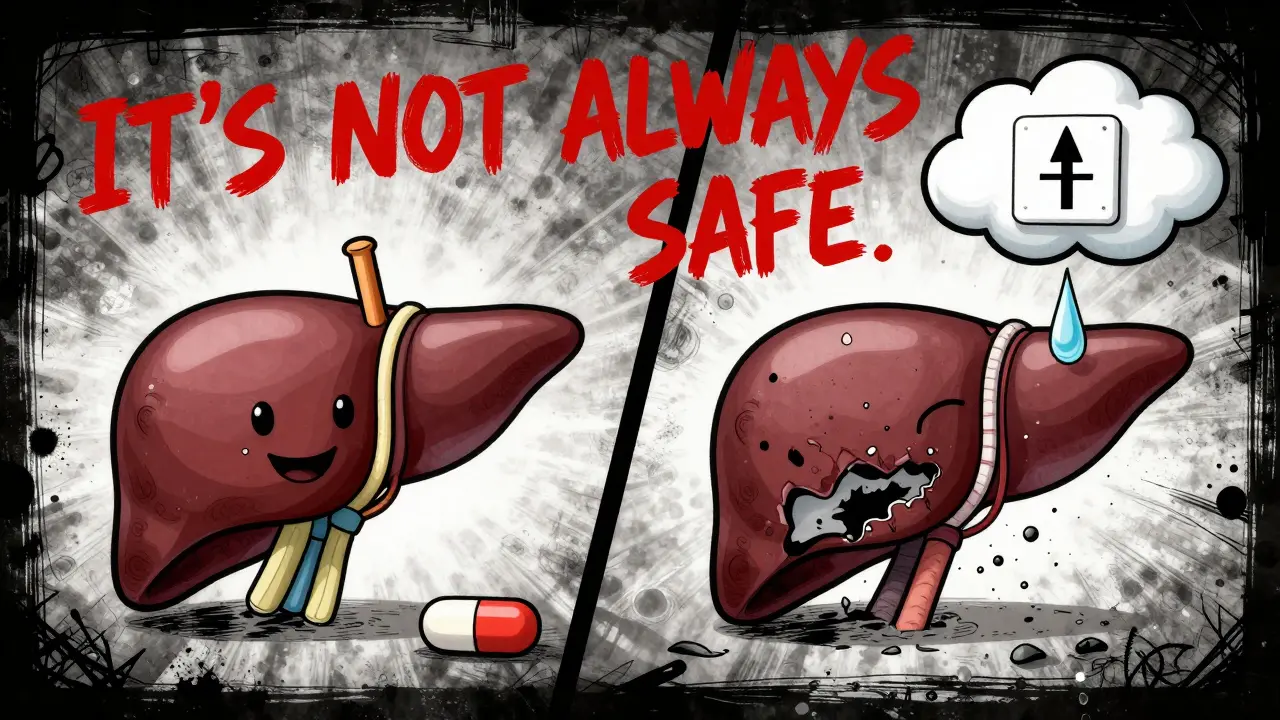
This combination - known as Hy’s Law - means there’s a 10-14% chance of acute liver failure. If you see jaundice, dark urine, or unexplained fatigue after taking azithromycin, get liver tests done. Don’t wait. Delayed diagnosis means longer recovery - and higher risk of permanent damage.
For patients over 65, with existing liver disease, or on longer courses (over 7 days), checking liver enzymes before and after treatment is a reasonable precaution. Kaiser Permanente now requires this for patients on prolonged azithromycin therapy. Mayo Clinic recommends it for those with prior liver issues.
What You Should Do
If you’ve been prescribed azithromycin:
- Know the signs: yellow eyes/skin, dark urine, severe fatigue, itching, abdominal pain.
- Don’t assume it’s safe just because it’s common. Many patients are surprised when their doctor says, "This might be the antibiotic."
- Wait for symptoms to appear - they usually come 1-3 weeks after finishing the course.
- If you notice symptoms, stop taking the drug and contact your doctor immediately.
- Ask if a safer alternative exists - especially if you’re over 65 or have liver concerns.
For common infections like sinusitis or bronchitis, doxycycline is often just as effective and carries far less liver risk. For chlamydia, azithromycin remains the gold standard - but even there, alternatives like doxycycline are being studied for resistant strains.
What’s Changing Now
The FDA updated azithromycin’s label in 2018 to include stronger warnings about liver injury. The European Medicines Agency now advises against its use in patients with severe liver impairment. And new research is emerging:
- A 2024 mouse study suggests azithromycin may directly suppress Nrf2 - a protein that protects liver cells from damage. This could mean it’s not just an immune reaction, but a direct toxic effect.
- Early trials are testing sulforaphane (found in broccoli sprouts) as a possible protective agent. Human trials are planned for 2025.
- The NIH’s DILIN study, tracking 500 cases of antibiotic-induced liver injury, expects to confirm azithromycin as the third most common cause after amoxicillin-clavulanate and isoniazid.
Prescription rates are already starting to decline. Evaluate Pharma predicts a 4.2% annual drop in azithromycin use through 2028 - not because it’s ineffective, but because doctors are starting to think twice.
Final Takeaway
Azithromycin is not dangerous for most people. But it’s not harmless either. Its reputation as a "safe" antibiotic has created blind spots in clinical practice. The liver injury it causes is often delayed, subtle, and easily mistaken for something else. And when it’s missed, the consequences can be life-changing.
If you’re taking azithromycin, don’t panic. But do pay attention. If you feel unusually tired, notice your skin or eyes turning yellow, or have persistent itching - don’t wait. Get tested. Your liver doesn’t always scream before it fails.



Comments
Srividhya Srinivasan
March 16, 2026 AT 14:40 PMLet me get this straight-Big Pharma is silently poisoning millions with azithromycin because it’s ‘convenient’?!
They’ve been doing this for DECADES. You think the FDA actually cares? HA. They’re paid off. The ‘1 in 65,000’ statistic? That’s the tip of the iceberg. They don’t report the real numbers. They bury the data under ‘idiosyncratic reactions.’ That’s just corporate-speak for ‘we knew and didn’t tell you.’
And don’t even get me started on broccoli sprouts as a ‘protective agent.’ That’s the same nonsense they pushed with vitamin C for COVID. ‘Nature knows best!’-while they patent synthetic drugs that make them billions.
I’ve been taking azithromycin since 2018 for recurrent sinus infections. My ALT was 89 last month. My doctor said ‘it’s probably stress.’ STRESS?! I’m 41, vegan, yoga every day. The only thing I’ve changed is this damn antibiotic. They’re gaslighting us.
Why isn’t this on the nightly news? Why isn’t Congress holding hearings? Why are we still allowed to buy this poison over the counter in 37 states?!
It’s not about liver injury-it’s about control. They want you dependent on their drugs. They want you scared of ‘viral hepatitis’ so you’ll keep coming back for more prescriptions. This isn’t medicine. It’s a slow-motion massacre.
I’ve started a petition. 12,000 signatures so far. Join me. Share this. Don’t let them erase us.
They’ll call me crazy. Fine. But when your liver fails, and you’re begging for a transplant while they’re busy counting profits-you’ll remember this comment.
PS: I’m not a doctor. I’m a survivor. And I’m not done fighting.
PPS: Broccoli sprouts. Every. Single. Day. And no, I don’t take statins. I told my doctor to F off.
Prathamesh Ghodke
March 17, 2026 AT 11:34 AMHey, I’m a pharmacist in Mumbai, and I’ve seen this firsthand.
Azithromycin? Yeah, it’s a lifesaver for so many-especially in places where access to healthcare is patchy. But you’re absolutely right: we don’t check liver enzymes enough. Not because we’re negligent, but because we’re overwhelmed.
I’ve had 3 patients in the last year with jaundice after azithromycin. All over 60. All had fatty liver. All were told ‘it’s just the flu.’ One almost died. We caught it because his daughter is a nurse. She asked about meds.
Here’s the thing: in India, azithromycin is sold over the counter like candy. No prescription. No counseling. No follow-up. It’s cheaper than a bus ticket.
I’ve started putting up simple posters in pharmacies: ‘Yellow eyes? Dark pee? Waited 2 weeks after meds? Get tested.’ Simple. No jargon. 1000+ printed. People actually read them.
And yes, doxycycline is a great alternative for sinusitis. But in monsoon season? Azithromycin works faster. So we use it. But we should be smarter.
Not all drug companies are evil. Some are trying. But the system? Broken. We need better training. Not fear. Not outrage. Just better habits.
TL;DR: Awareness > Alarmism. Education > Conspiracy.
Stephen Habegger
March 18, 2026 AT 14:30 PMThis is such an important post. Thank you.
I work in urgent care. We see so many people come in with fatigue and jaundice after a ‘simple’ antibiotic course. It’s terrifying how often we miss it.
I now ask every patient: ‘Did you take any antibiotics in the last 4 weeks?’ It’s changed my practice.
And yes-azithromycin is great for chlamydia. But for bronchitis? Most cases are viral. We shouldn’t be prescribing it at all.
Small change: I now say ‘Let’s try this first’ instead of ‘Here’s your prescription.’ It opens the door for conversation.
It’s not about fear. It’s about awareness. And you just gave us all a better way to talk about it.
Justin Archuletta
March 19, 2026 AT 04:05 AMBro. I took azithromycin last year for a sinus infection. Two weeks later? I turned into a human lemon. Yellow skin. Itched like crazy. Thought I had hepatitis. Went to the ER. Turned out it was the antibiotic.
My doctor was like, ‘Ohhh, yeah, that happens.’
NO. IT DOESN’T HAPPEN. IT’S NOT NORMAL.
Why isn’t this on the box? Why isn’t it in the ads? Why do we still think ‘common’ = ‘safe’?
My liver’s fine now. But I’ll never trust a ‘simple’ antibiotic again.
PS: I told my mom. She’s 68. She’s not taking it anymore. Neither am I.
Sanjana Rajan
March 19, 2026 AT 22:40 PMOh my god. Another ‘wake-up call’ article.
Can we just admit that doctors are lazy? They prescribe azithromycin because it’s easy. One pill. Five days. Done.
Meanwhile, patients are dying quietly. No one’s checking liver enzymes. No one’s asking about supplements. No one’s listening.
And now we’re supposed to eat broccoli sprouts like it’s a magic fix?!
It’s not a ‘hidden risk.’ It’s a systemic failure.
Stop pretending this is about science. It’s about profit. And convenience. And ignoring the elderly.
I’m done with this. I’m switching to tea. And yoga. And never trusting a doctor again.
Kyle Young
March 20, 2026 AT 06:14 AMThere’s a philosophical tension here that’s rarely discussed.
We live in a society that equates convenience with safety. We assume that if a drug is widely prescribed, it must be benign. But medicine isn’t governed by popularity-it’s governed by biology.
Azithromycin’s danger lies not in its molecular structure, but in our collective denial: the belief that because something is ‘common,’ it is ‘harmless.’
This is the same logic that led us to believe cigarettes were safe, or that lead paint was acceptable.
The real question isn’t ‘How many people get liver injury?’
It’s: ‘Why do we refuse to see harm until it’s too late?’
Perhaps the deeper toxicity isn’t in the drug-but in our cultural trust of pharmaceutical convenience.
Aileen Nasywa Shabira
March 22, 2026 AT 01:34 AMOh wow. So now we’re blaming antibiotics for liver damage?
What’s next? ‘Vitamin D causes cancer’? ‘Water causes drowning’?
Let me guess-you’re one of those people who thinks every drug is a poison, and every doctor is a shill.
Here’s a radical idea: maybe your liver is just… weak. Maybe you’re 65. Maybe you’re on 12 supplements. Maybe you’re a ‘natural health’ influencer who thinks ‘detox’ is a real thing.
Stop turning every medical fact into a horror story.
Azithromycin saved my life in 2019. I have no liver issues. I’m 52. I’m fine.
Maybe the real risk is panic-driven misinformation?
Just saying.
Kendrick Heyward
March 23, 2026 AT 07:46 AMI’m so angry. I’m so hurt. I’m so betrayed.
I took azithromycin for bronchitis. My mom had liver disease. I didn’t know. I didn’t think. I trusted.
Two weeks later, I turned yellow. I cried. I screamed. I Googled. I found this article.
I’m not mad at the drug. I’m mad at the system. I’m mad at the silence. I’m mad at the doctors who didn’t warn me.
My liver is healing. But I’ll never trust another prescription again.
😭💔
If you’re reading this… please. Please ask your doctor. Please get tested. Please don’t wait until you’re a statistic.
I love you. I’m here. I’m not alone.
lawanna major
March 24, 2026 AT 11:07 AMOne of the most thorough and well-researched summaries I’ve seen on this topic.
The distinction between cholestatic and hepatocellular injury is critical, and the data on delayed onset-especially post-course-is underappreciated in clinical practice.
I’m a nurse practitioner in rural Maine. We see a lot of elderly patients on polypharmacy. Azithromycin is often chosen because it’s ‘easy.’ But ease shouldn’t override vigilance.
I now routinely check LFTs before prescribing azithromycin to anyone over 60 or with a history of elevated transaminases-even if ‘mild.’
It takes five minutes. It prevents months of suffering.
Also: the comparison table is excellent. I’ve printed it and posted it in our clinic.
Thank you for writing this with precision, not panic.
Ryan Voeltner
March 26, 2026 AT 05:59 AMThis is a valuable contribution to the discourse on antibiotic safety. The data presented is both statistically significant and clinically relevant. The emphasis on delayed presentation and the importance of monitoring in high-risk populations is particularly commendable. While the emotional tone of some comments may reflect understandable anxiety, the factual foundation of this post provides a necessary counterbalance to alarmist narratives. I commend the author for presenting a nuanced, evidence-based perspective that prioritizes patient safety without sacrificing clinical pragmatism.
Linda Olsson
March 28, 2026 AT 01:13 AMOh honey. Let me guess-you’re one of those people who thinks ‘1 in 65,000’ means ‘safe’?
That’s the same math they used for Vioxx. For thalidomide. For cigarettes.
And now you want us to believe that a drug that causes bile duct loss in 63% of cases is ‘just fine’?
Did you even read the part about vanishing bile duct syndrome?
It’s not a ‘risk.’ It’s a catastrophe. And they’re still prescribing it like it’s Advil.
Meanwhile, the FDA’s label update? A PR stunt. The NIH study? Still pending. The broccoli sprout ‘trial’? A joke.
You’re not protecting patients. You’re protecting the system.
And that’s the real disease.