
You spot a safety violation at work. You see money being mismanaged. Or maybe you just know something is fundamentally wrong with how your company operates. The instinct to speak up is natural, but the fear of losing your job is real. This is where whistleblower laws come in. These legal frameworks are designed to protect individuals who report illegal, unethical, or dangerous practices within organizations from retaliation by employers.
For decades, these protections have evolved from scattered regulations into a more structured system aimed at safeguarding public health, safety, and financial integrity. But do they actually work? And more importantly, do you know if you’re covered? Understanding your rights isn’t just about knowing the law; it’s about knowing how to survive the process without losing your livelihood.
What Exactly Does Whistleblower Protection Cover?
Not every complaint you make to HR counts as protected activity. To be shielded by the law, your actions usually need to meet specific criteria regarding what you reported, to whom you reported it, and whether you had a reasonable belief that a violation occurred.
In many jurisdictions, including under California’s Labor Code Section 1102.5, protected activity includes disclosing information to supervisors or government agencies when employees have reason to believe their employer is violating state or federal statutes or regulations. This doesn’t mean you have to be right about the violation-just that you genuinely believed it was happening based on the evidence available to you.
Who gets protected? It’s broader than you might think. Current employees are obviously covered, but so are job applicants. In some cases, even people who are merely perceived as potential whistleblowers can claim protection if they are targeted because an employer suspects they might speak up.
However, the definition of "protected" varies significantly depending on which law applies. Federal protections often target specific industries. For instance, the Sarbanes-Oxley Act protects employees of publicly traded companies who report federal mail, wire, bank, or securities fraud. The False Claims Act covers those reporting fraud against government programs. If you work in a small private business outside these sectors, your primary shield might be state law rather than federal statute.
The Reality of Retaliation: What Employers Do When You Speak Up
Legal definitions of retaliation are clear, but workplace reality is messier. Prohibited retaliation encompasses obvious actions like termination, demotion, or reduced hours and pay. It also includes denied promotions and the creation of hostile work environments.
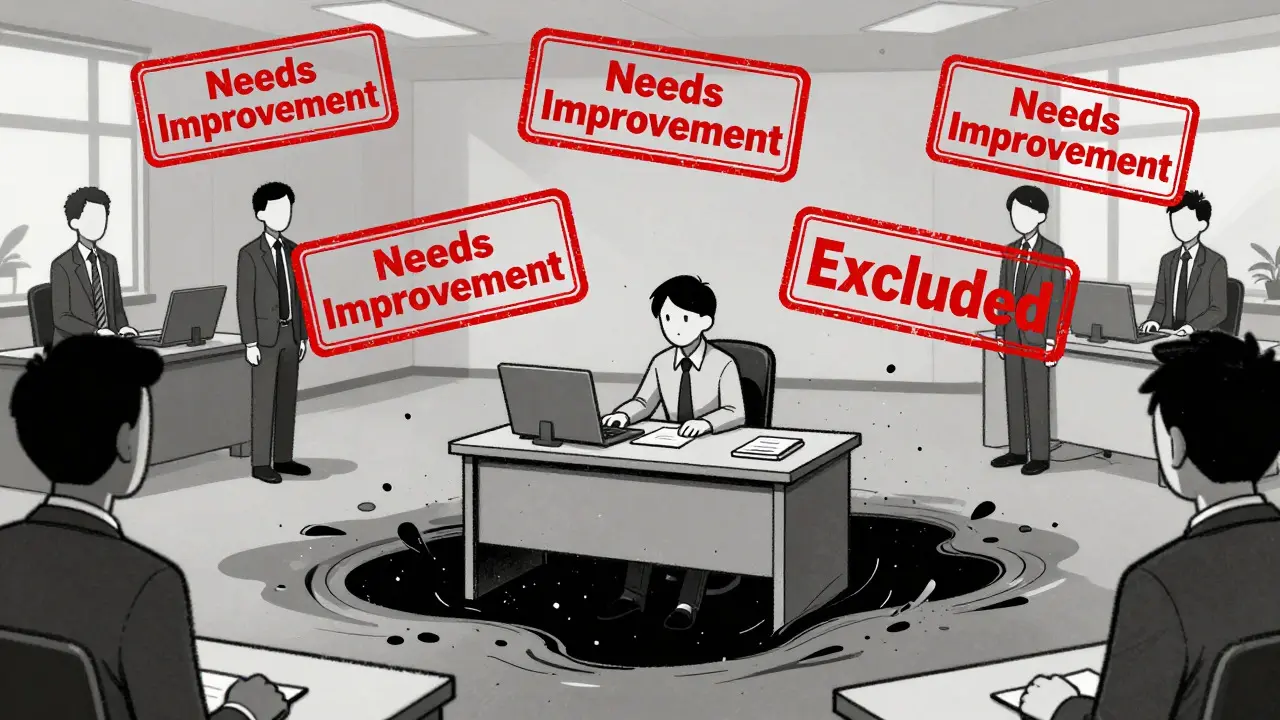
But savvy employers often use subtler tactics. Retaliatory performance management is a common tool. Suddenly, your annual review goes from "exceeds expectations" to "needs improvement." You’re excluded from key meetings. Your workload increases while your resources decrease. These tactics are designed to force you to quit voluntarily, a strategy known as constructive dismissal.
Data supports the prevalence of this issue. A 2024 survey by the National Whistleblower Center found that 68% of whistleblowers experienced some form of retaliation despite existing legal protections. Of those, 42% reported that Human Resources dismissed their concerns as not meeting the legal threshold for protected activity. On platforms like Reddit, users frequently share stories of being assigned undesirable shifts or isolated after reporting safety violations, highlighting the gap between statutory protection and daily experience.
Federal vs. State Protections: Where Do You Stand?
Navigating whistleblower rights requires understanding the difference between federal and state laws. They don’t always align, and one may offer stronger protection than the other depending on your situation.
| Feature | Federal Law (General) | California (Labor Code 1102.5) |
|---|---|---|
| Scope of Coverage | Often limited to specific industries (e.g., finance, aviation) or types of violations. | Broad coverage: reports of potential violations of any state or federal law. |
| Financial Incentives | Yes, under acts like Dodd-Frank (10-30% of sanctions over $1M). | No direct bounty system, but allows for civil penalties and back pay. |
| Penalties for Retaliation | Varies by statute; often focuses on reinstatement and back pay. | Civil penalties up to $10,000 per violation (effective Jan 1, 2025). |
| Filing Deadline | Strict limits: 30 to 180 days depending on the specific act. | No strict statutory deadline for filing with DLS, but sooner is better for evidence. |
| Notice Requirements | No universal requirement to post rights notices in workplaces. | Employers must post official whistleblower rights notices prominently (AB 2299). |
California’s approach has become a benchmark. As of January 1, 2025, new rules implemented through Assembly Bill 2299 require all employers to post whistleblower rights notices with the Attorney General's Whistleblower Hotline number (1-800-952-5225). These notices must be in at least 14-point font. Failure to comply can result in significant fines. This transparency helps employees know their rights before they even think about reporting.
Federal law, enforced largely by the Department of Labor's Occupational Safety and Health Administration (OSHA), covers 25 different whistleblower protection statutes. While federal law provides access to federal courts for certain claims-which California employees currently lack under some interpretations-it often suffers from enforcement delays. OSHA missed legally mandated investigation timelines for AIR21 complaints in a majority of cases, according to recent watchdog reports.
New Developments: AI and Emerging Sectors
As technology evolves, so do the risks-and the laws. One of the most significant gaps in current legislation involves artificial intelligence. In May 2025, Senator Grassley introduced the AI Whistleblower Protection Act. This proposed legislation aims to provide anti-retaliation protections specifically for AI industry employees who report abuse of power and opaque business practices.
Why does this matter? Because the tech sector moves fast, and traditional whistleblower frameworks were built for factories and banks, not algorithmic bias or data privacy breaches. The National Whistleblower Center has identified this as a critical area for reform in 2025, arguing that without specific protections, engineers and ethicists risk career suicide for exposing dangerous technologies.
This trend reflects a broader shift. The global whistleblower management software market, valued at $1.27 billion in 2023, is projected to reach $3.45 billion by 2028. Companies are investing heavily in compliance tools, partly due to pressure from regulators and partly to manage internal risks. However, high-tech solutions don’t replace human judgment. A Deloitte survey of Fortune 500 companies in 2024 showed that while financial services led with 92% compliance with whistleblower program requirements, the technology sector lagged at 68%.
How to Protect Yourself Before You Report
If you decide to blow the whistle, preparation is your best defense. Legal experts emphasize that documentation is everything. Under California’s Division of Labor Standards Enforcement (DLSE) standards, you need "clear and convincing evidence" of retaliatory intent. That means keeping records of every interaction.
- Document Everything: Save emails, write down dates and times of verbal conversations, and keep copies of performance reviews. If your manager suddenly changes your schedule after you report a violation, note it immediately.
- Know the Timeline: Federal deadlines are strict. For example, the Clean Air Act requires filing within 30 days, while the Consumer Financial Protection Act allows 180 days. Missing these windows can kill your case before it starts.
- Consult an Attorney Early: The National Whistleblower Center reports that 78% of successful cases involved legal representation. Don’t wait until you’re fired. Talk to a specialist before making your first move.
- Use Official Channels: Reporting to a supervisor might be required by policy, but reporting to a government agency (like OSHA or the SEC) often triggers stronger legal protections. Know which agency handles your specific industry.
Remote workers face unique challenges. With fewer physical witnesses and digital communication trails that can be deleted, proving retaliation is harder. California’s Labor Code Section 1207 permits email distribution of required notices, but it doesn’t fully address the nuances of remote reporting mechanisms. If you work from home, ensure your reporting method creates a permanent, timestamped record.
Resources and Hotlines
You don’t have to navigate this alone. Several organizations provide support, ranging from free legal assistance to anonymous reporting channels.
- California Attorney General's Whistleblower Hotline: 1-800-952-5225. Use this for general inquiries and to report violations in California.
- OSHA Whistleblower Protection Program: 800-321-6742. Contact this for federal workplace safety and health violations.
- National Whistleblower Center: Provides free legal assistance and advocacy. In 2024, they assisted over 1,200 whistleblowers.
- SEC Whistleblower Program: For securities law violations. In fiscal year 2023, the SEC paid $637 million to 131 individuals, showing that financial rewards are possible for high-impact cases.
Remember, the average whistleblower case takes 22 months to resolve, according to a 2024 DLSE report. That’s nearly two years of uncertainty. Financial planning and emotional support are just as important as legal strategy during this period.
Looking Ahead: Strengthening the System
The landscape of whistleblower protection is changing. Lawmakers recognize that the current patchwork of statutes creates confusion. Professor David P. Weber, a former FDIC Special Agent, criticized the fragmented nature of U.S. laws in a 2023 Harvard Law Review article, noting it leads to inconsistent enforcement.
In response, there is momentum toward standardization. The Congressional Budget Office estimated in 2022 that strengthening federal whistleblower protections could save taxpayers $12.7 billion annually by preventing fraud. This economic argument is driving legislative efforts, including the proposed Congressional Whistleblower Protection Act, which seeks to enable federal whistleblowers to pursue claims directly in federal court rather than relying solely on administrative processes.
Business groups warn of increased litigation risks, estimating potential costs of $4.3 billion yearly for employers. But for employees, the trade-off is worth it. By 2030, legal scholars predict whistleblower protections will become standardized across most industries, driven by high-profile cases in emerging sectors like AI and climate reporting. Until then, staying informed and documenting your journey is the only way to ensure your voice is heard-and protected.
What happens if my employer fires me for whistleblowing?
If you can prove retaliation, remedies typically include reinstatement to your previous position, back pay for lost wages, compensation for emotional distress, and sometimes civil penalties paid by the employer. In California, penalties can reach $10,000 per violation. You must file a complaint with the appropriate agency (like OSHA or the DLSE) within strict deadlines, often ranging from 30 to 180 days depending on the law violated.
Do I get paid for reporting fraud?
In some cases, yes. Under federal laws like the Dodd-Frank Act and the False Claims Act, whistleblowers can receive 10% to 30% of the sanctions collected by the government, provided the total recovery exceeds $1 million. This applies primarily to securities fraud and government contract fraud. Most state laws, including California’s, do not offer bounties but do allow for damages and penalties against the retaliating employer.
Is my identity kept secret?
Confidentiality varies by agency and statute. Many programs, such as the SEC’s Whistleblower Program, strive to keep identities confidential from the employer during investigations. However, if your case goes to court, your name may become part of the public record. Anonymous reporting is often possible through third-party hotlines, but pursuing legal remedies usually requires revealing your identity to investigators.
What is the new California whistleblower law effective in 2025?
Assembly Bill 2299, effective January 1, 2025, requires all California employers to post official whistleblower rights notices prominently in the workplace. These notices must include the Attorney General's Whistleblower Hotline number (1-800-952-5225) in at least 14-point font. Employers who fail to post these notices face civil penalties, and the law strengthens overall protections by ensuring employees are aware of their rights upfront.
Can I report a violation anonymously?
Yes, many agencies accept anonymous tips. However, anonymous reporting makes it harder to prove that you were retaliated against later, since the employer may not know who reported the issue. If you anticipate retaliation, it is often safer to report through an attorney who can maintain some level of confidentiality while establishing your standing as a protected whistleblower.