Tamoxifen-Antidepressant Compatibility Checker
Select an antidepressant to see its compatibility with Tamoxifen based on current medical evidence and guidelines.
Paroxetine
(Paxil)
Strong Inhibitor
Fluoxetine
(Prozac)
Moderate-Strong
Sertraline
(Zoloft)
Moderate
Citalopram
(Celexa)
Weak
Escitalopram
(Lexapro)
Weak
Venlafaxine
(Effexor)
Negligible
Clinical Recommendation:
Key Points:
If you are taking Tamoxifen to treat or prevent estrogen receptor-positive (ER+) breast cancer, you might have heard a scary story. For years, doctors warned that combining Tamoxifen with certain antidepressants could make the cancer treatment less effective. This warning created a difficult choice for many patients: manage your mental health or protect your physical health?
The truth is more nuanced than the old warnings suggested. While there is a biological interaction between Tamoxifen and some Selective Serotonin Reuptake Inhibitors (SSRIs), recent large-scale studies show this rarely leads to worse cancer outcomes. Understanding how these drugs work together can help you make confident decisions about your care without unnecessary fear.
How Tamoxifen Works in Your Body
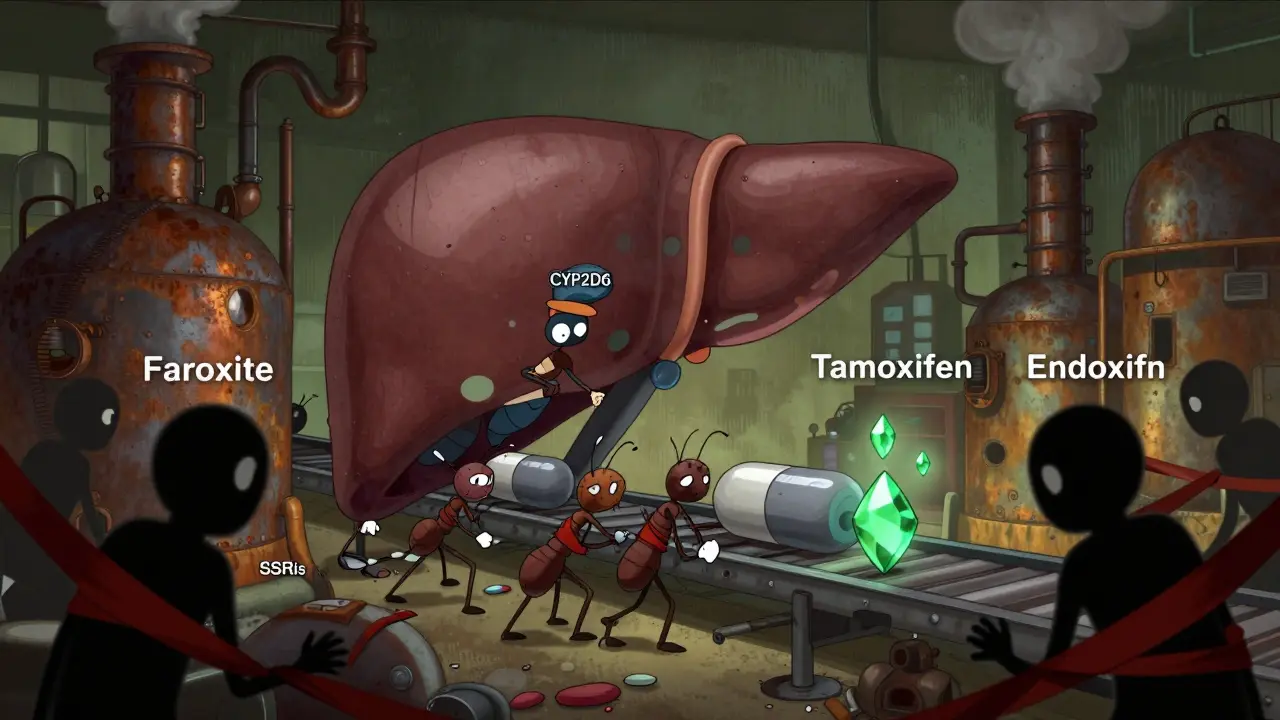
To understand the interaction, we first need to look at how Tamoxifen functions. It is not active when you swallow the pill. Your body must convert it into its active form, called endoxifenthe metabolite responsible for blocking estrogen receptors in breast tissue. Endoxifen is significantly more powerful than Tamoxifen itself, offering 30 to 100 times greater anti-estrogenic activity.
This conversion happens primarily through an enzyme in your liver called CYP2D6a cytochrome P450 enzyme involved in drug metabolism. Think of CYP2D6 as a factory worker that turns raw materials (Tamoxifen) into finished products (endoxifen). If something blocks this worker, the production of endoxifen slows down. This is where the concern about antidepressants comes in.
Why SSRIs Were a Concern
Many people diagnosed with breast cancer experience depression or anxiety. It is a normal reaction to a life-altering diagnosis. SSRIs are commonly prescribed to help manage these symptoms. However, some SSRIs are potent inhibitors of the CYP2D6 enzyme. They essentially tie up the "factory worker," preventing it from converting Tamoxifen into endoxifen.
Not all antidepressants affect CYP2D6 equally. Here is how they break down based on their inhibition strength:
- Strong Inhibitors: Paroxetine (Paxil) and Fluoxetine (Prozac). These block CYP2D6 significantly.
- Moderate Inhibitors: Sertraline (Zoloft). This has a medium effect on the enzyme.
- Weak Inhibitors: Citalopram (Celexa) and Escitalopram (Lexapro). These have minimal impact on CYP2D6.
- No Significant Inhibition: Venlafaxine (Effexor). Although technically an SNRI, it is often grouped here because it does not inhibit CYP2D6.
In the early 2000s, small studies showed that women taking strong inhibitors like paroxetine had lower levels of endoxifen in their blood. Logically, if you have less active drug, you might expect higher cancer recurrence rates. This logic drove clinical guidelines for over a decade.
What Large Studies Actually Show
Logic suggests lower endoxifen means worse outcomes, but real-world data tells a different story. When researchers looked at thousands of patients rather than dozens, the link between low endoxifen and poor cancer outcomes disappeared.
A pivotal 2016 study by Kaiser Permanente analyzed nearly 17,000 breast cancer survivors over 14 years. They found no statistically significant increase in breast cancer risk for women who took antidepressants alongside Tamoxifen. Even those taking paroxetine did not show a meaningful increase in recurrence or mortality compared to those who did not take antidepressants.
Similarly, a 2023 Bayesian modeling study of 4,493 premenopausal women found only a slight, non-clinical increase in recurrence hazard with CYP2D6 inhibitors. The difference was so small that it did not change the overall survival benefit of Tamoxifen. These large datasets suggest that while the chemical interaction exists, the body may compensate through other metabolic pathways, or the threshold for effectiveness is lower than previously thought.
| Medication | CYP2D6 Inhibition Strength | Clinical Recommendation with Tamoxifen |
|---|---|---|
| Paroxetine | Strong | Generally avoided due to high inhibition |
| Fluoxetine | Moderate to Strong | Often avoided; long half-life complicates switching |
| Sertraline | Moderate | Acceptable alternative; monitor if possible |
| Citalopram | Weak | Preferred option; minimal interaction |
| Escitalopram | Weak | Preferred option; minimal interaction |
| Venlafaxine | Negligible | Safe alternative; widely used in oncology |
Current Medical Guidelines
Medical advice has shifted dramatically in recent years. The American Society of Clinical Oncology (ASCO) updated its guidelines in 2022 to reflect the latest evidence. They now state that clinicians should not avoid antidepressants solely due to concerns about CYP2D6 inhibition. Instead, the choice of antidepressant should be based on efficacy, side effects, and patient preference.
The National Comprehensive Cancer Network (NCCN) also advises against automatically avoiding all SSRIs. Their guidelines specifically recommend citalopram, escitalopram, or venlafaxine as safer alternatives if a doctor wants to minimize any theoretical risk. However, they acknowledge that even strong inhibitors have not been proven to harm outcomes in large population studies.
This shift is crucial for patient well-being. Untreated depression can lead to poor adherence to cancer treatments, meaning patients might skip doses of Tamoxifen altogether. A stable mental health status supports better overall compliance with the cancer regimen.
Do You Need Genetic Testing?
You might have heard about pharmacogenetic testing for CYP2D6. This test determines if you are a "poor metabolizer" naturally, meaning your body produces very little CYP2D6 enzyme regardless of what drugs you take. About 7-10% of European populations fall into this category.
While it sounds logical to test everyone before starting Tamoxifen, major guidelines do not currently recommend routine genetic testing. The reason? Even poor metabolizers often respond well to Tamoxifen. The drug has multiple metabolic pathways, and other enzymes like CYP3A4 can help produce endoxifen if CYP2D6 is slow. Testing adds cost and complexity without a clear guarantee of better outcomes.
Practical Steps for Patients
If you are considering starting an antidepressant while on Tamoxifen, here is a practical approach to discuss with your healthcare team:
- Screen for Depression: Use validated tools like the PHQ-9 to assess your mental health needs accurately.
- Review Current Medications: Bring a complete list of all prescriptions and supplements to your oncologist.
- Prioritize Mental Health: Do not suffer in silence. Treating depression is vital for quality of life and treatment adherence.
- Choose Wisely: If possible, start with weak inhibitors like escitalopram or non-inhibitors like venlafaxine. These provide peace of mind while maintaining safety.
- Monitor Symptoms: If you are already on a strong inhibitor like paroxetine and doing well, do not panic. Switching medications can cause withdrawal symptoms and destabilize mood. Discuss the risks and benefits of switching with your doctor.
Conclusion on the Interaction
The fear that SSRIs will ruin your Tamoxifen therapy is largely outdated. While the chemical interaction is real, the clinical consequence is minimal for most patients. Modern oncology prioritizes holistic care, recognizing that mental health is just as important as tumor biology. By choosing antidepressants with minimal CYP2D6 inhibition, you can protect both your mind and your body with confidence.
Can I take Lexapro with Tamoxifen?
Yes. Escitalopram (Lexapro) is a weak inhibitor of CYP2D6 and is considered a safe and preferred option for patients taking Tamoxifen. It has minimal impact on endoxifen levels.
Does Zoloft interfere with Tamoxifen?
Sertraline (Zoloft) is a moderate inhibitor of CYP2D6. While it may slightly reduce endoxifen levels, large studies have not shown a significant negative impact on cancer outcomes. It is generally considered an acceptable alternative if stronger inhibitors are avoided.
Should I stop taking Paxil if I am on Tamoxifen?
Paroxetine (Paxil) is a strong CYP2D6 inhibitor. While current evidence suggests it does not drastically worsen survival rates, many doctors prefer to switch patients to weaker inhibitors like Lexapro or Effexor to eliminate any theoretical risk. Do not stop Paxil abruptly without medical supervision due to withdrawal risks.
Is Effexor safe with Tamoxifen?
Yes. Venlafaxine (Effexor) does not inhibit CYP2D6 and is widely recommended as a first-line antidepressant for breast cancer patients on Tamoxifen. It effectively treats depression and anxiety without affecting Tamoxifen metabolism.
Do I need a CYP2D6 genetic test before starting Tamoxifen?
No. Major guidelines from ASCO and NCCN do not recommend routine genetic testing for CYP2D6 status. Evidence shows that even poor metabolizers benefit from Tamoxifen, and the test does not reliably predict clinical outcomes.