
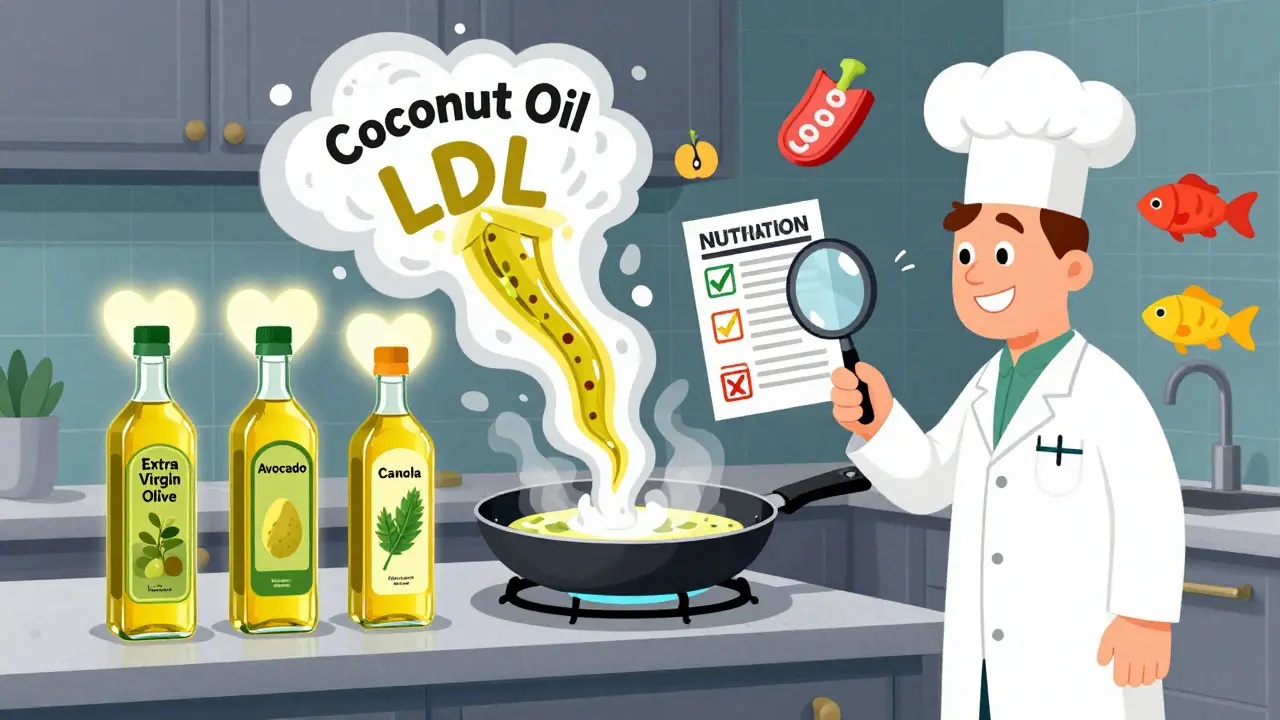
When you're cooking dinner, what you pour into the pan matters more than you think. It’s not just about flavor-it’s about your heart. Every time you cook with oil or fat, you’re making a choice that can either protect your cardiovascular system or slowly damage it. The good news? You don’t need to give up taste or convenience. You just need to know which oils to reach for-and which ones to leave on the shelf.
What Makes an Oil Heart-Healthy?
Not all fats are created equal. The key is in the type of fat: unsaturated fats are your friends, while saturated and trans fats are the ones to limit. Research from the American Heart Association and Harvard Medical School shows that replacing saturated fats with unsaturated ones can lower your LDL ("bad") cholesterol by 5% to 15%. That’s not a small change-it’s the difference between a moderate risk and a much lower one for heart attack or stroke.
Heart-healthy oils have three clear traits:
- High in monounsaturated fats (at least 55%)
- Low in saturated fat (under 15%)
- Free of trans fats and minimally processed
Extra virgin olive oil, for example, has 73% monounsaturated fat and just 14% saturated fat. It’s also packed with polyphenols-natural antioxidants that reduce inflammation, similar to how ibuprofen works at a fraction of the dose. These compounds are why the Mediterranean diet, built around olive oil, nuts, and vegetables, has been linked to a 30% lower risk of heart disease in large studies like PREDIMED.
The Top 5 Heart-Healthy Oils (and What to Use Them For)
Here’s what actually works in your kitchen, backed by science and real-world use:
1. Extra Virgin Olive Oil
This is the gold standard for low-heat cooking and dressings. It’s rich in antioxidants, has a deep flavor, and is the backbone of the Mediterranean diet. But don’t use it to sear steak. Extra virgin olive oil has a smoke point of 375°F. Once it starts smoking, it breaks down and loses its benefits-sometimes even creating harmful compounds.
Best for: Salad dressings, drizzling over soups, sautéing vegetables, light stir-fries.
2. Avocado Oil
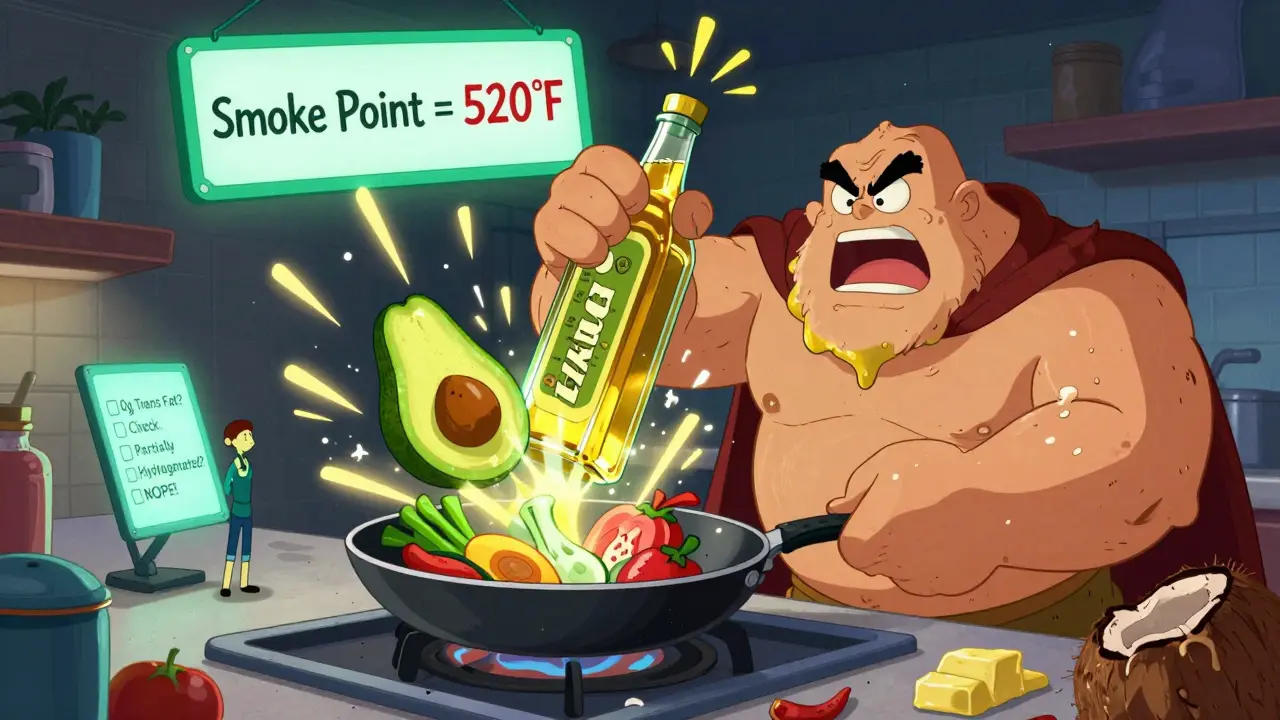
If you need to cook at high heat, avocado oil is your go-to. With a smoke point of 520°F, it’s perfect for roasting, grilling, or searing meats. It has 67% monounsaturated fat and 12% saturated fat-almost as clean as olive oil but far more heat-resistant. The flavor is mild, so it won’t overpower your food.
Price-wise, it costs about 30-50% more than olive oil, but if you’re frying or baking often, it’s worth the switch.
3. Canola Oil
Don’t let the stigma fool you. Canola oil is one of the most researched and heart-friendly oils out there. It has 62% monounsaturated fat, just 7% saturated fat, and a good dose of ALA (alpha-linolenic acid)-a plant-based omega-3. It’s also affordable and has a neutral taste, making it great for baking and everyday cooking.
Just check the label. Some brands use chemical solvents in processing. Look for "cold-pressed" or "expeller-pressed" to avoid those.
4. Algae Oil
This is the new kid on the block-and it’s impressive. Algae oil contains 86% monounsaturated fat, higher than olive oil. Its smoke point hits 535°F, and it has no flavor at all. It’s also more sustainable: it uses 90% less land than olive oil production.
Right now, it’s harder to find and costs around $25 per bottle. But if you’re serious about heart health and cooking versatility, it’s worth trying. Brands like Thrive Algae Oil are now in over 25,000 U.S. stores and expanding in the UK.
5. Nut Oils (Almond, Hazelnut)
These are great for flavor and have only 7% saturated fat. But they’re not for high heat. Their smoke points hover around 400°F, so stick to drizzling, baking, or low-heat sautéing. They’re also expensive, so use them like a seasoning-not your main cooking oil.
What to Avoid: The Hidden Heart Risks
Some oils look healthy but aren’t. Here’s what to skip:
- Coconut oil: 82% saturated fat. The American Heart Association says it raises LDL cholesterol just like butter. Don’t be fooled by claims about "medium-chain fats"-they don’t cancel out the damage.
- Corn, sunflower, and safflower oils: These are high in omega-6 fatty acids. Too much omega-6 without enough omega-3 can trigger inflammation, which is linked to heart disease. If you use them, keep them rare.
- Partially hydrogenated oils: These are trans fats. Even if the label says "0g trans fat," if it lists "partially hydrogenated," it’s still there. The FDA banned them in 2020, but loopholes let some sneak into packaged foods.
How to Read a Label Like a Pro
You can’t trust the front of the bottle. The real info is on the nutrition facts panel and ingredient list.
Here’s your quick checklist:
- Check saturated fat: Aim for less than 2g per serving. If a tablespoon has more than 2g, think twice.
- Look for "trans fat": Even if it says "0g," scan the ingredient list. If you see "partially hydrogenated," put it back.
- Find the processing method: "Cold-pressed," "expeller-pressed," or "unrefined" are best. "Refined" or "blended" often means chemicals were used.
- Watch for "vegetable oil": That’s a vague term. It could be soybean, corn, or palm oil-all high in omega-6 or saturated fat.
- Look for certifications: The Heart Foundation’s Tick label (Australia) or similar EU seals mean the product met strict heart-health standards.
And here’s a trick: If the oil is in a clear bottle and sits on a sunny shelf, it’s probably already going bad. Light and heat destroy healthy fats. Buy dark glass bottles and store them in your pantry-not by the stove.
Storage Tips That Matter
Omega-3 oils like flaxseed, walnut, and even some algae oils go rancid fast. Once they do, they turn into harmful compounds that cause inflammation.
- Refrigerate flaxseed and walnut oil after opening.
- Use them within 30-60 days.
- Keep olive, avocado, and canola oils in a cool, dark cupboard.
- Buy in smaller bottles if you don’t cook with them daily.
Don’t assume your oil lasts forever. If it smells stale, like crayons or old nuts, toss it. Your heart will thank you.
Common Mistakes (And How to Fix Them)
- Mistake: Using the same oil for everything.
- Fix: Keep three oils on hand: extra virgin olive for dressings, avocado for high heat, canola for baking.
- Mistake: Believing "natural" or "cold-pressed" means it’s healthy.
- Fix: Always check the saturated fat content. Some "natural" oils like coconut or palm are still high in saturated fat.
- Mistake: Overheating oil until it smokes.
- Fix: If it smokes, turn off the heat. That oil is ruined. Clean the pan and start over.
- Mistake: Using "light" olive oil thinking it’s healthier.
- Fix: "Light" means processed, not low-calorie. It’s stripped of antioxidants. Stick with extra virgin.
Why This Matters Right Now
Heart disease is still the number one killer worldwide, causing nearly 18 million deaths each year. But diet is one of the most powerful tools we have to change that. You don’t need to be perfect. Just make smarter swaps.
Switching from butter to olive oil. Choosing avocado oil for roasting instead of vegetable oil. Reading labels before you buy. These small steps add up.
The science is clear: unsaturated fats protect your arteries. Saturated and trans fats clog them. Your kitchen is where you can start healing your heart-today, not tomorrow.
Is coconut oil heart-healthy?
No. Coconut oil is 82% saturated fat-higher than butter. The American Heart Association advises against using it for heart health, despite claims about "medium-chain triglycerides." It raises LDL cholesterol, which increases heart disease risk. Stick with oils that have less than 15% saturated fat.
What’s the best oil for frying?
Avocado oil is the best for frying because it has a smoke point of 520°F and is high in monounsaturated fat. Algae oil is even better (535°F), but it’s harder to find and more expensive. Avoid canola or sunflower oil for deep frying-they break down faster and can create harmful compounds at high heat.
Can I use olive oil for baking?
Yes, but use regular olive oil (not extra virgin) for baking. Extra virgin has a strong flavor that can overpower desserts. Regular olive oil has a milder taste and a smoke point of 390-465°F, which is fine for most baking. Canola oil is a better neutral option if you want no flavor at all.
How do I know if my oil has gone bad?
Rancid oil smells stale, like crayons, old nuts, or plastic. It may taste bitter or sour. If you’re unsure, pour a little into a spoon and smell it. Healthy oils should smell mild and fresh-like olives, nuts, or nothing at all. If it smells off, throw it out. Rancid oils cause inflammation and damage your cells.
Are "blended" oils safe for heart health?
Usually not. Blended oils often contain cheap, high-omega-6 oils like soybean or corn oil. They may also include palm oil, which is high in saturated fat. Always check the ingredient list. If it says "vegetable oil blend," avoid it. Choose single-ingredient oils instead.





Comments
Stephanie Paluch
March 13, 2026 AT 16:27 PMJust switched to avocado oil for everything and my fried eggs have never tasted better 😍 Also stopped using coconut oil after reading this-no more weird aftertaste. My cardiologist would high-five me right now. 🙌
tynece roberts
March 13, 2026 AT 22:29 PMi never thought about how light ruins oil like fr fr like why is it in clear bottles on the shelf like who designed this system 😭 i just bought a big jug of olive oil and now im scared to open it lmao
Hugh Breen
March 14, 2026 AT 00:07 AMTHIS. IS. A. GAME-CHANGER. 🎉 I used to think "olive oil = good" and call it a day. But now I’ve got THREE bottles on my counter: EVOO for drizzling, avocado for searing, and canola for baking. And I check labels like a hawk now. No more "vegetable oil" sneaking in! If you’re not reading ingredients, you’re playing Russian roulette with your arteries. Let’s get smart, people. 💪❤️
Byron Boror
March 15, 2026 AT 03:59 AMAlgae oil? Really? We’re importing some fancy green juice from algae farms while our own farmers grow perfectly good soy and canola? This is why America’s food system is getting ruined by overpriced hipster nonsense. Stick to what works.
Lorna Brown
March 16, 2026 AT 02:56 AMIt’s fascinating how much we’ve internalized the idea that "natural" equals healthy. Coconut oil is literally 82% saturated fat-it’s basically butter with a tropical vibe. But we’re told it’s "anti-inflammatory" because of MCTs? That’s like saying a brick is healthy because it contains oxygen. We need more science literacy, not more marketing fluff.
Rex Regum
March 16, 2026 AT 19:23 PMSo now we’re supposed to believe the American Heart Association? The same group that told us to eat low-fat cereal for 40 years while sugar was killing us? This is just another dietary dogma wrapped in science-speak. Who really benefits from this? The olive oil industry? The algae startups? Wake up.
Kandace Bennett
March 17, 2026 AT 15:23 PMOMG I’m so glad you mentioned the dark glass bottles 🙌 I’ve been storing my almond oil in the fridge since January and it’s still perfect! Also, I only buy oils with the Heart Foundation Tick label-no exceptions. If it doesn’t have it, it’s not worthy of my pantry. 💅✨ Also, never use "light" olive oil. It’s just a scam. Extra virgin or bust.
douglas martinez
March 18, 2026 AT 12:30 PMThank you for this comprehensive and well-researched overview. The distinction between processing methods-cold-pressed versus refined-is often overlooked. Many consumers assume all olive oils are equal, but the antioxidant content can vary by over 50% depending on extraction. Your emphasis on storage and label reading is critical. I’ve shared this with my nutrition students as a model of evidence-based dietary guidance.