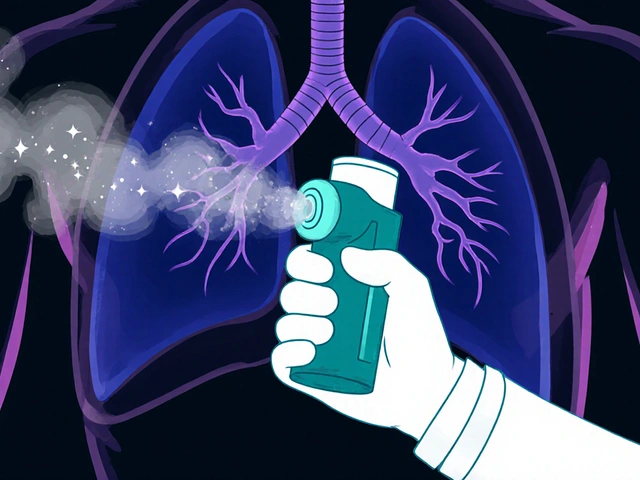

If you wake up every morning sneezing, with itchy eyes or a stuffy nose, it might not be the season-it could be dust mites. These tiny bugs live in your bed, your couch, even your stuffed animals, feeding on dead skin cells you shed every night. And while you can’t see them, their waste triggers allergies in 20 million Americans. The good news? You don’t need expensive treatments or miracle sprays. You just need to change how you handle your bedding, humidity, and cleaning routine.
Why Dust Mites Are Worse Than You Think
Dust mites aren’t the bugs you picture crawling around. They’re microscopic, eight-legged arachnids-related to spiders-that thrive where humans sleep. They don’t bite. They don’t spread disease. But their feces and body fragments are powerful allergens. When you inhale them, your immune system overreacts, causing runny noses, coughing, and even asthma flare-ups. The Mayo Clinic calls them the most common year-round indoor allergen. And here’s the kicker: you spend 6 to 8 hours a night right in the middle of their habitat-your mattress, pillows, and sheets. That’s why symptoms often get worse in the morning. Studies show that allergen levels in bedding can hit over 10 micrograms of Der p 1 (the main dust mite protein) per gram of dust. Clinical benefit? You need to drop that below 2 micrograms. That’s not guesswork. That’s science.Bedding: The First Line of Defense
Your bed is ground zero. Washing sheets weekly isn’t enough if you’re using cold water. Cold water kills almost nothing. You need 130°F (54.4°C). At that temperature, 100% of dust mites die. It’s not a suggestion-it’s the minimum standard backed by the Mayo Clinic and the National Institutes of Health. Use hot water for sheets, pillowcases, blankets, and even stuffed toys. If something can’t go in the washer-like a feather pillow or a childhood teddy-freeze it for 24 hours. Freezing kills mites, but it doesn’t remove their allergens. You still need to wash or vacuum afterward. Mattress and pillow encasements are critical. Not just any cover. You need ones with pores smaller than 10 micrometers. That’s fine enough to block mites and their waste. Cheaper ones tear after a few months. Look for products tested to withstand 10,000 abrasion cycles. Amazon reviews show 78% satisfaction with certified encasements, but 42% of users who bought cheap ones reported tears within six months. Replace old pillows every 1-2 years. They can hold up to 1/3 of their weight in dead mites and waste. If your pillow looks lumpy or smells musty, it’s time.Humidity: The Silent Killer (and Savior)
Dust mites need moisture. They can’t survive in dry air. That’s why they’re everywhere in Florida and nowhere in Arizona. The magic number? Below 50% relative humidity. The best results? 45% or lower. A study in the Journal of Allergy and Clinical Immunology found that dropping humidity to 45% cuts mite populations by 90% in just two weeks. No chemicals. No vacuuming. Just dry air. Buy a digital hygrometer-$20-$50-and place it at bed level. Don’t trust the one on your thermostat. It’s probably in the living room, where humidity is different. If your bedroom hits 60% or higher, you need a dehumidifier. Run it nightly. In humid climates, you might need to run it year-round. HVAC systems can help too. If you have central air, make sure your ducts are sealed and your filter is changed every 3 months. A poorly maintained system can pump humid air into your bedroom. One Reddit user, "DustMiteWarrior," spent $300 on a dehumidifier and certified encasements. Within a month, their morning sneezing dropped by 80%. They said, "The dehumidifier was the game-changer. Everything else just helped a little."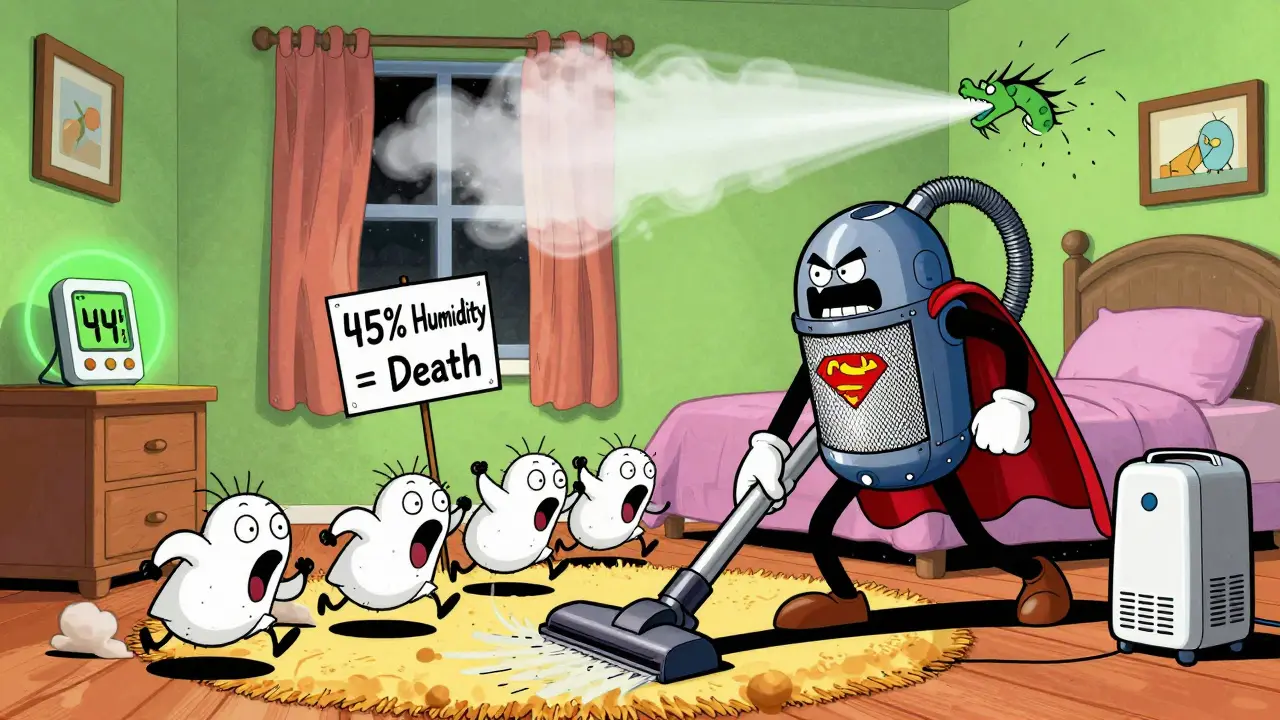
Cleaning: What Actually Works
Vacuuming sounds like a no-brainer. But most vacuums just blow allergens back into the air. You need a HEPA vacuum. Not a "HEPA-style" one. A real HEPA filter that traps 99.97% of particles 0.3 microns or larger. Dust mite allergens are 10-40 microns-easily caught by real HEPA. Vacuum slowly. One foot per second. Rushing through means you miss 70% of the allergens. Focus on the mattress seams, upholstered furniture, and carpets. If you have carpet, consider replacing it with hardwood, tile, or vinyl. Studies show carpet removal reduces allergens by 90%. HEPA vacuuming alone? Only 60-70%. Damp mop hard floors weekly. Dry dusting spreads allergens. Wet cloths trap them. Wash curtains and blinds every month. They collect dust like a sponge. Avoid clutter. Stuffed animals, piles of clothes, and decorative throw pillows are dust mite hotels. Keep surfaces clear. Store toys in sealed bins. Don’t waste money on sprays. Tannic acid sprays reduce allergens by 50-60%-but only temporarily. Plant-based powders like Dr. Killigan’s Dust to Dust last longer, but they still require vacuuming to remove the dead mites. They’re not a replacement. They’re a supplement.The 4-Step Weekly Routine That Works
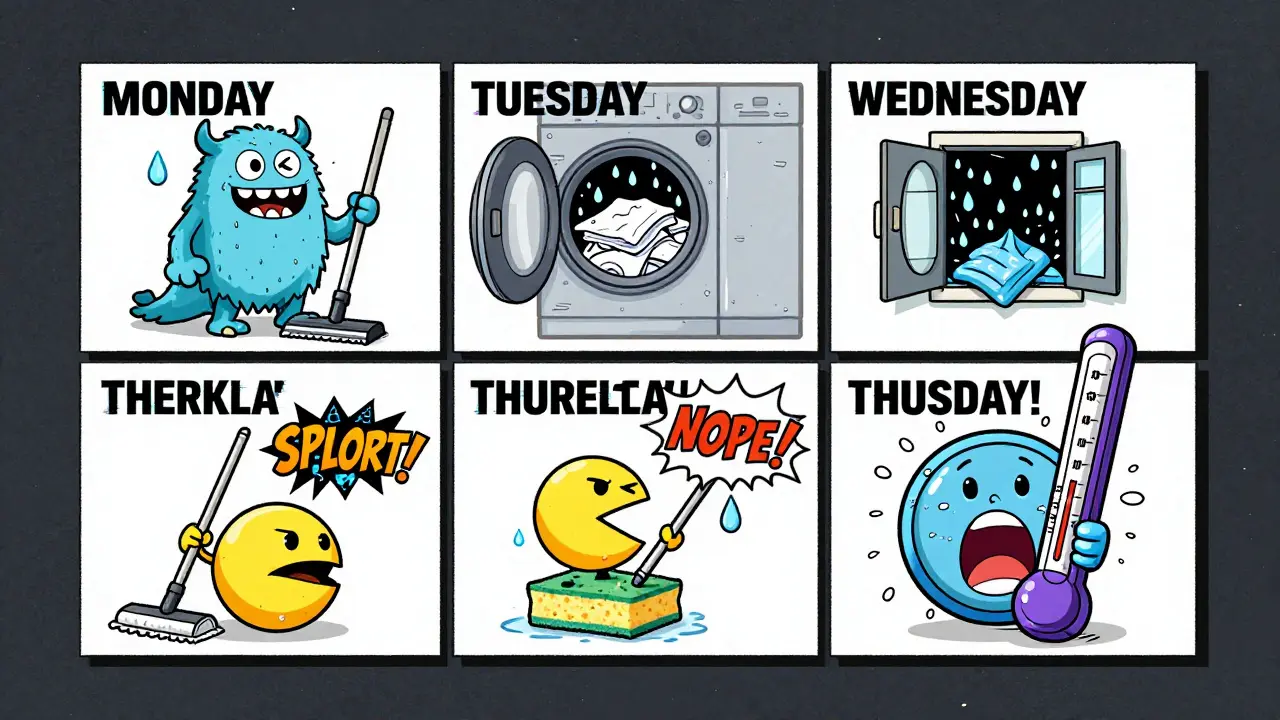
Here’s a simple, proven schedule that takes about 90 minutes a week:- Monday: Vacuum - Use your HEPA vacuum on mattress, pillows, and carpet. Don’t skip the seams.
- Tuesday: Wash Bedding - Sheets, pillowcases, blankets at 130°F. Dry on high heat for at least 15 minutes.
- Wednesday: Damp Mop - Hard floors in the bedroom. Use a microfiber cloth. No chemicals needed.
- Thursday: Check Humidity - Look at your hygrometer. If it’s above 50%, turn on the dehumidifier. If it’s below 45%, you’re good.
What Doesn’t Work (And Why)
Lots of products promise quick fixes. They don’t deliver.- Essential oil sprays - No scientific proof they kill mites. Some may irritate your lungs.
- Ultrasonic devices - They claim to repel mites. They don’t. The FDA has warned against them.
- Washing in warm water (90-100°F) - Kills 75-85% of mites. Not good enough. You need 130°F.
- Buying "allergy-proof" bedding without certification - Many are marketing gimmicks. Look for pore size ≤10 micrometers and abrasion testing.
Cost and Commitment: Is It Worth It?
Initial setup costs $350-$500:- Two certified mattress and pillow encasements: $150-$250
- HEPA vacuum: $180-$300
- Digital hygrometer: $20-$50
- Dehumidifier: $100-$200 (if you don’t already have one)
What’s Next? The Future of Dust Mite Control
New research is promising. A 2023 NIH study found a new tannic acid derivative that kills 98% of mites on carpets-but it’s not on shelves yet. CRISPR gene editing could one day target mite populations, but that’s 10-15 years away. For now, the best solution is simple: control humidity, wash bedding hot, vacuum with HEPA, and seal your mattress. It’s not glamorous. But it’s proven. And it works. The World Allergy Organization warns that rising global humidity levels mean dust mites will spread further. If you’re dealing with allergies now, acting today isn’t optional. It’s your best defense against a future where allergens are even harder to escape.Can dust mites live in memory foam mattresses?
Yes, they can. Memory foam isn’t immune. Dust mites live in the fabric covers and any padding around the foam. Even if the foam itself doesn’t hold skin flakes, the surrounding materials do. Always use a certified encasement, regardless of mattress type.
Is it okay to use a humidifier in the bedroom?
No, if you’re trying to control dust mites. Humidifiers increase moisture in the air, which helps mites thrive. If you have dry skin or respiratory issues, use a humidifier in another room, not your bedroom. Keep your bedroom dry-below 50% humidity-to starve the mites.
How often should I wash my bedding?
Weekly. Biweekly washing leaves too many allergens behind. Dust mites reproduce quickly. A single female can lay 20-30 eggs per day. If you wash every two weeks, you’re letting their waste build up. Hot water weekly is the only proven way to keep levels low.
Do air purifiers help with dust mites?
Not really. Dust mite allergens are heavy-they fall onto surfaces, not float in the air. Air purifiers capture airborne particles, but most mite allergens are already on your bed, carpet, and furniture. Focus on cleaning those surfaces instead. HEPA vacuums are far more effective.
Can I just use a dryer to kill dust mites?
Yes, but only if you’ve already washed the items. Drying at 130°F for 15 minutes kills mites, but it doesn’t remove their allergens. Washing removes the waste and dead bodies. Drying alone won’t reduce allergen levels enough to help your symptoms. Always wash first, then dry hot.